
 Worksheets
Biology 1406-02P CH 3
Total questions: 96
Worksheet time: 48mins
Which of the following is NOT a class of biological macromolecules?
A) Carbohydrates
B) Lipids
C) Proteins
D) Vitamins
Modern biochemistry studies biological molecules ________ of cells.
outside
inside
on the surface
in the nucleus
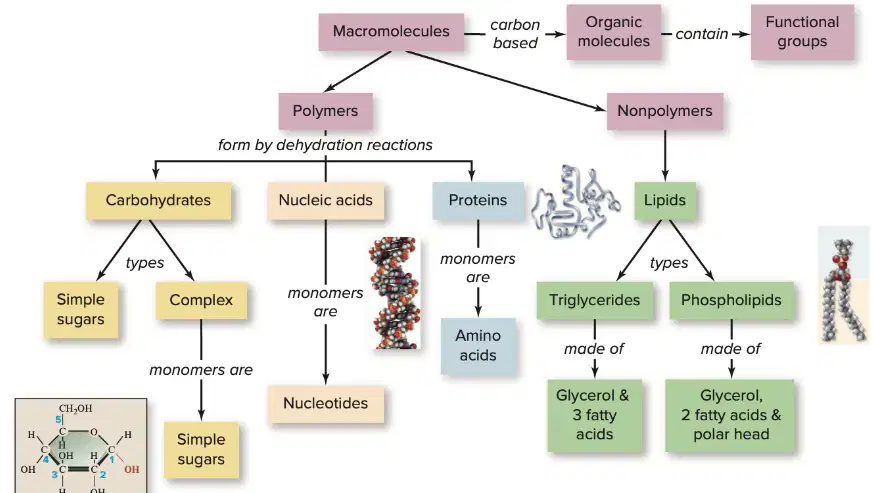
Which of the following is made of glycerol and three fatty acids?
Triglycerides
Phospholipids
Proteins
Nucleic acids
Lipids are a class of biological macromolecules.
True
False
Fill in the blank: The monomers of nucleic acids are ________.
nucleotides
amino acids
monosaccharides
fatty acids
The framework of biological molecules consists primarily of carbon bonded to which of the following?
Only Carbon
O, N, S, P or H
Both A and B
Only Hydrogen
How many covalent bonds can carbon form?
Up to four covalent bonds
Only one covalent bond
Up to two covalent bonds
Up to six covalent bonds
Hydrocarbons are molecules consisting only of ______ and ______.
carbon and hydrogen
carbon and oxygen
hydrogen and nitrogen
carbon and nitrogen
Are hydrocarbons generally polar or nonpolar?
Polar
Nonpolar
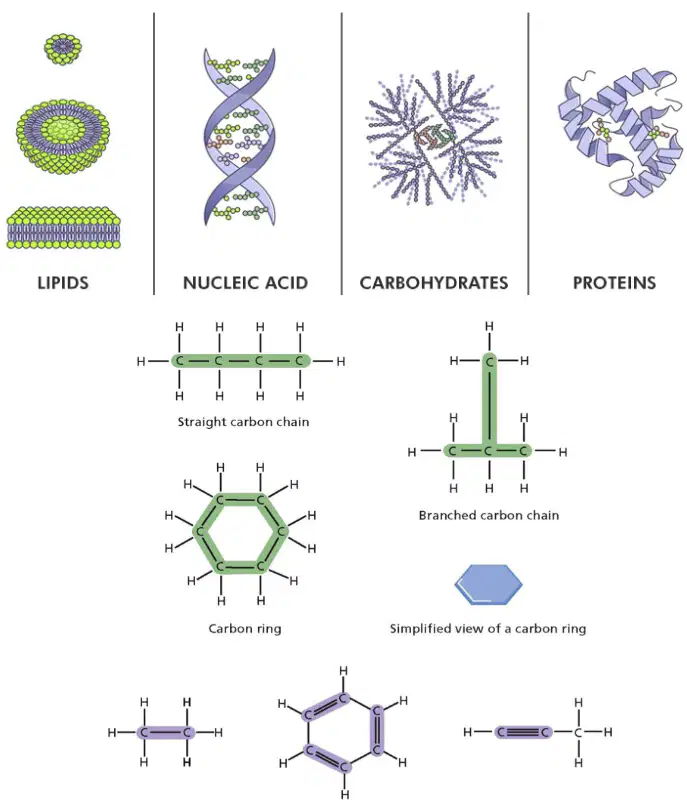
Which of the following is NOT a type of biomolecule shown in the diagram?
Lipids
Nucleic Acid
Carbohydrates
Vitamins
Proteins
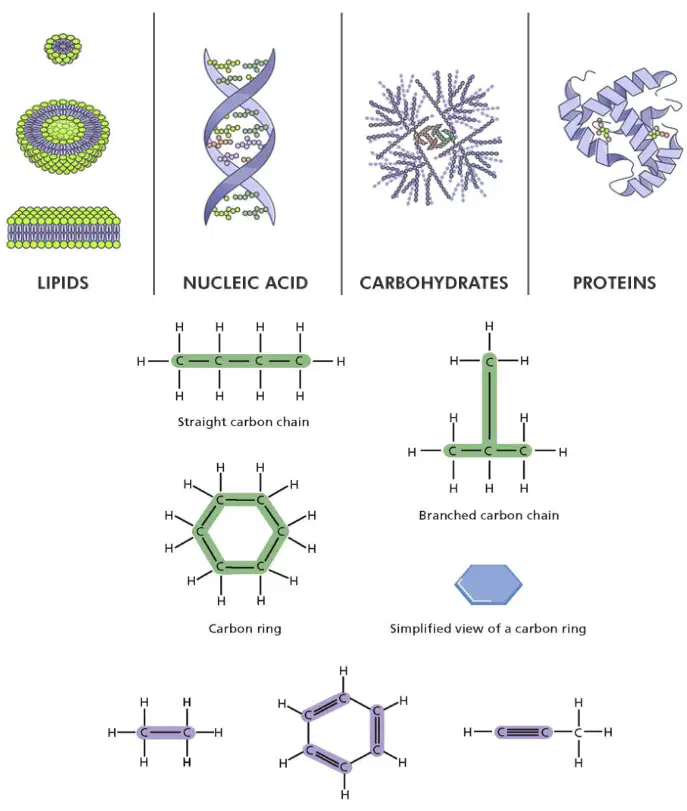
Which type of bond is represented by three lines between two carbon atoms in the diagram?
Single bond
Double bond
Triple bond
Fill in the blank: The subunit of starch and glycogen is ________.
Glucose
Fructose
Sucrose
Cellulose
Fill in the blank: The function of cellulose is ________.
Structural support in plant cell walls
Energy storage in animals
Transport of oxygen in blood
Catalyzing metabolic reactions
Fill in the blank: Chitin provides ________ support.
Structural
Chemical
Thermal
Electrical
Fill in the blank: DNA is made up of ________.
Nucleotides
Amino acids
Fatty acids
Monosaccharides
Fill in the blank: The function of RNA is ________.
Needed for gene expression
Providing structural support to bones
Storing genetic information in the nucleus
Regulating blood sugar levels
Fill in the blank: Functional proteins are made of ________.
Amino acids
Fatty acids
Nucleotides
Monosaccharides
Fill in the blank: Structural proteins provide ________.
Support
Energy
Hormones
Enzymes
Fill in the blank: Triglycerides are composed of glycerol and ________.
three fatty acids
two amino acids
four nucleotides
one monosaccharide
Fill in the blank: Phospholipids are important for ________.
Cell membranes
Hormone production
DNA replication
Muscle contraction
Fill in the blank: Prostaglandins act as ________ messengers.
Chemical
Electrical
Thermal
Optical
Fill in the blank: Steroids have ________ fused carbon rings.
Four
Three
Five
Six
Fill in the blank: Terpenes are made of ________ carbon chains.
Long
Short
Branched
Aromatic
What are functional groups in biomolecules?
Specific groups of atoms within molecules
Types of proteins
DNA sequences
Water molecules
Functional groups determine whether a molecule is _____, basic, polar, or nonpolar, which is important for how it works in your body.
acidic
neutral
radioactive
metallic
Functional groups provide unique properties and determine how molecules behave in chemical reactions.
True
False
Functional groups can help molecules dissolve in water.
True
False
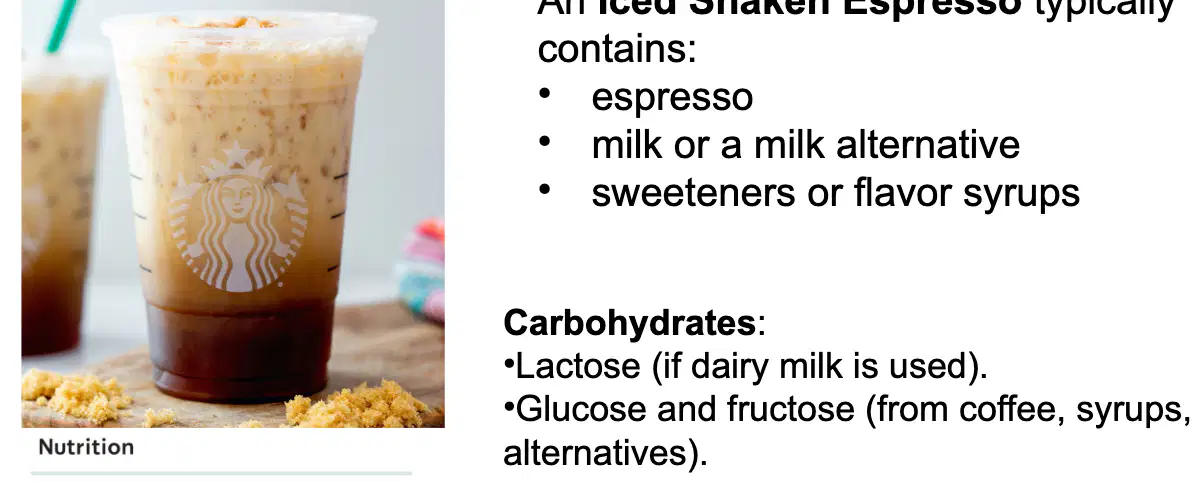
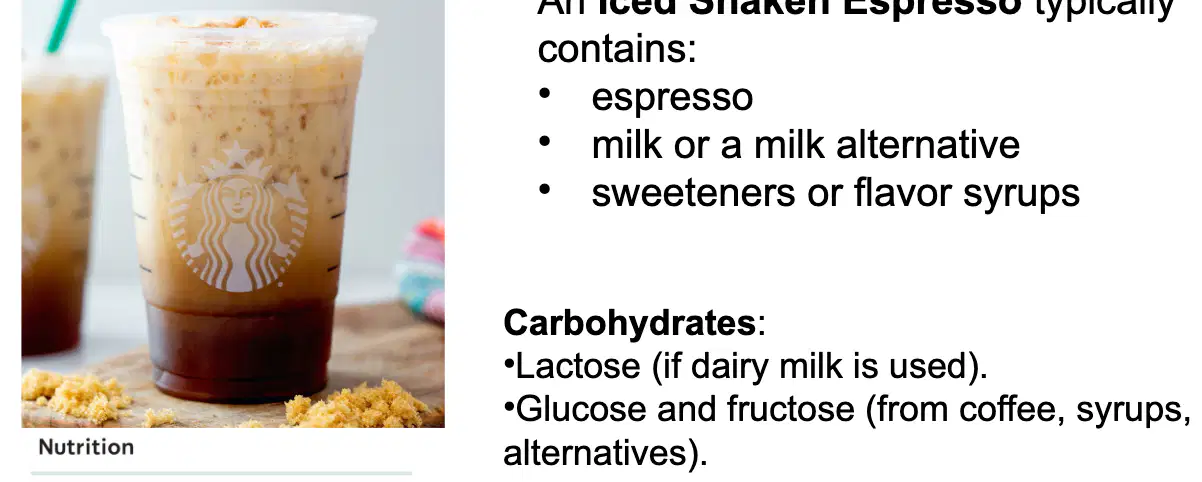
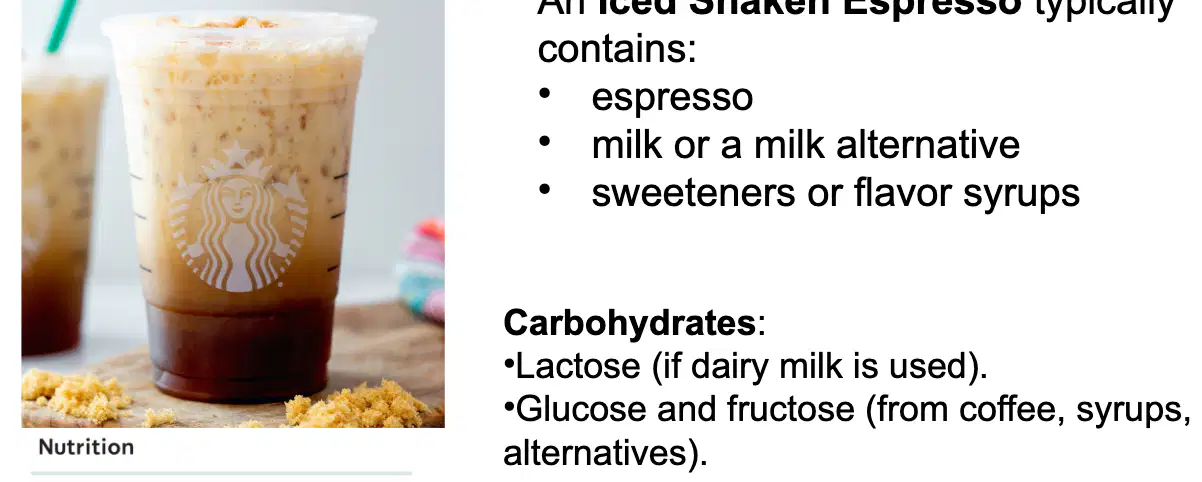
What are the typical ingredients in an Iced Shaken Espresso?
Espresso, milk or a milk alternative, sweeteners or flavor syrups
Tea, honey, lemon
Water, sugar, lemon
Coffee, ice, chocolate
Fill in the blank: An Iced Shaken Espresso contains ________ as a source of caffeine.
espresso
green tea
cola
matcha
Which of the following carbohydrates can be found in an Iced Shaken Espresso if dairy milk is used?
Lactose
Sucrose
Maltose
Cellulose
How many calories are in an Iced Shaken Espresso according to the nutrition facts table?
100
50
200
150
The total fat content in an Iced Shaken Espresso is 2 grams.
True
False
Which of the following is NOT a lipid found in an Iced Shaken Espresso?
Saturated fats
Unsaturated fats
Cellulose
Coffee oils (cafestol, kahweol)
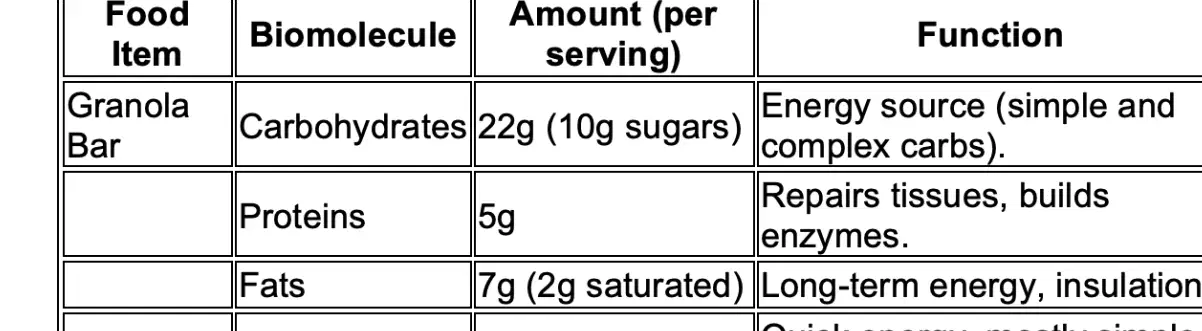
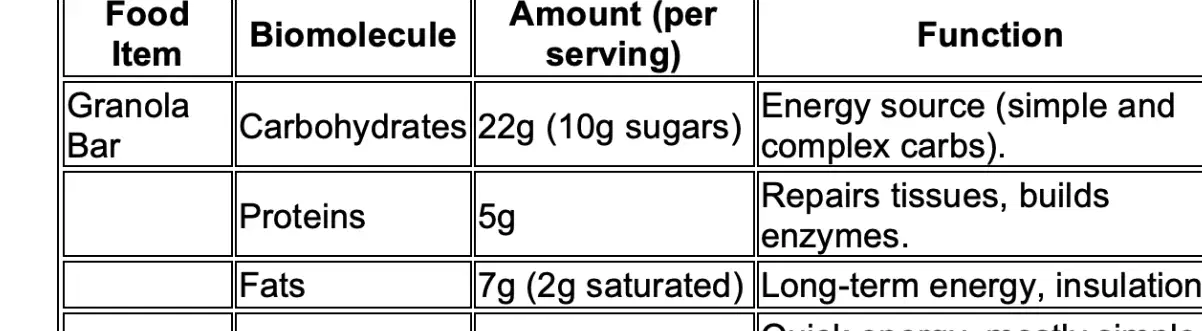
What is the function of carbohydrates found in a granola bar?
Energy source (simple and complex carbs).
Structural support for bones.
Production of genetic material.
Regulation of body temperature.
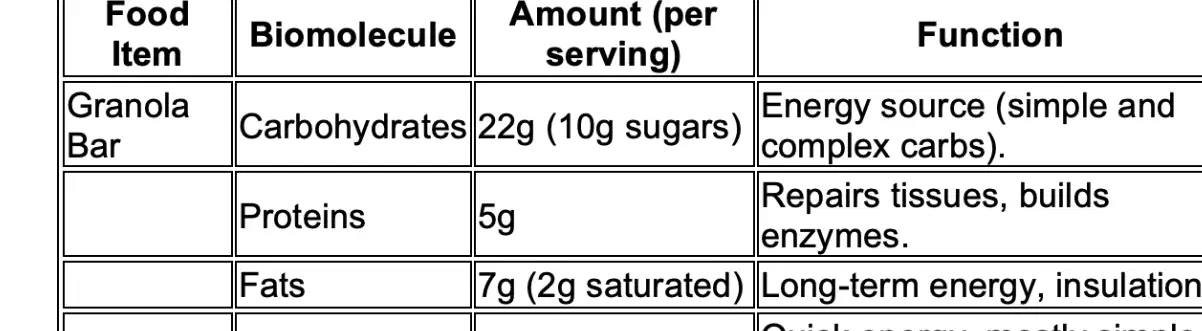
How much protein is present in a granola bar per serving?
5g
2g
8g
12g

What is the function of fats found in a granola bar?
Long-term energy, insulation.
Immediate energy, muscle growth.
DNA replication, oxygen transport.
Bone strengthening, vision improvement.

How many grams of carbohydrates (all sugars) are present in a serving of soda?
39g
15g
25g
60g
What is the function of sodium found in soda?
Regulates fluid balance.
Provides energy for muscles.
Aids in digestion of proteins.
Acts as a vitamin supplement.
What are the four major types of biomolecules?
DNA, RNA, ATP, and Water
Proteins, Lipids, Carbohydrates, and Nucleic Acids
Vitamins, Minerals, Hormones, and Enzymes
Monomers, Polymers, Atoms, and Molecules
What are the four major types of biomolecules?
DNA, RNA, ATP, and Water
Proteins, Lipids, Carbohydrates, and Nucleic Acids
Vitamins, Minerals, Hormones, and Enzymes
Monomers, Polymers, Atoms, and Molecules

What are the two main categories of organic molecules shown in the diagram?
Polymers and Nonpolymers
Acids and Bases
Metals and Nonmetals
Ions and Isotopes

Which of the following is a polymer?
Carbohydrates
Lipids
Triglycerides
Phospholipids

The monomers of proteins are ________.
Amino acids
Fatty acids
Nucleotides
Monosaccharides
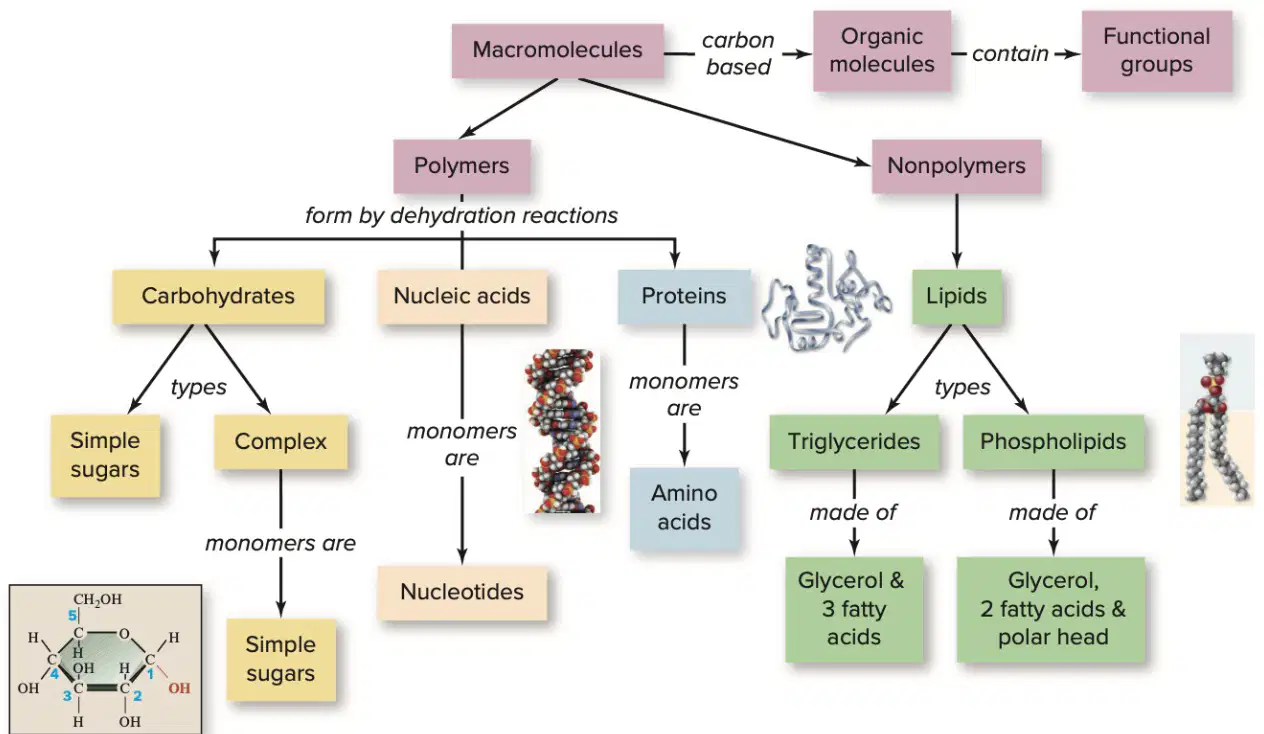
Which type of macromolecule is made of nucleotides?
Carbohydrates
Nucleic acids
Proteins
Lipids

Simple sugars are the monomers of which macromolecule?
Carbohydrates
Proteins
Nucleic acids
Lipids

Triglycerides are made of ________ and ________.
Glycerol and 3 fatty acids
Glucose and 2 fatty acids
Amino acids and phosphate
Glycerol and 2 amino acids

Phospholipids are made of glycerol, 2 fatty acids, and a ________.
polar head
sugar group
hydrophobic tail
protein chain

Lipids are classified as nonpolymers in the diagram.
True
False

What functional group do all organic molecules contain according to the diagram?
Functional groups
Amino group
Carboxyl group
Hydroxyl group
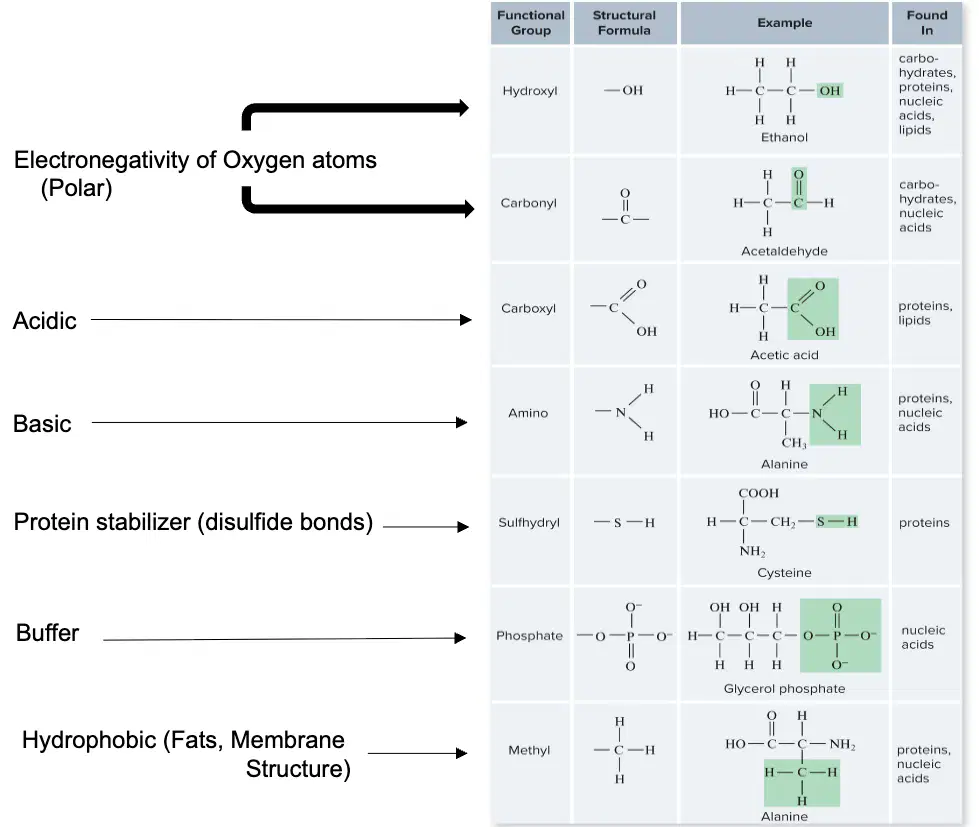
Which functional group has the structural formula —OH and is found in carbohydrates, proteins, nucleic acids, and lipids?
Hydroxyl
Carboxyl
Amino
Phosphate
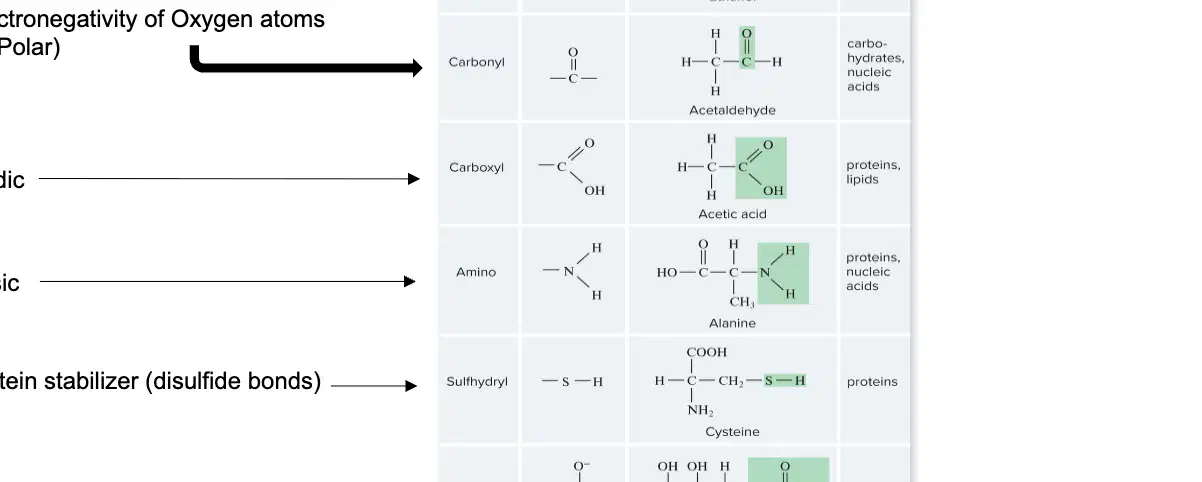
Which functional group is characterized by the structural formula —C=O and is found in carbohydrates and nucleic acids?
Carbonyl
Hydroxyl
Amino
Phosphate
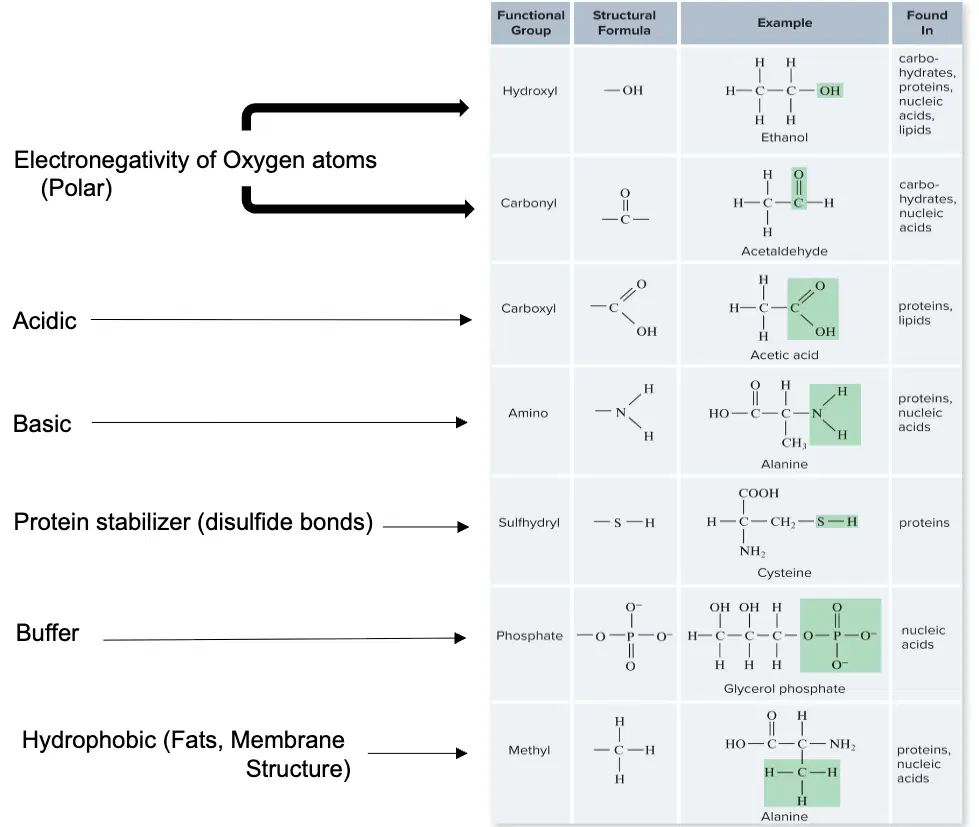
Which functional group is acidic, has the structural formula —COOH, and is found in proteins and lipids?
Carboxyl
Amino
Hydroxyl
Phosphate
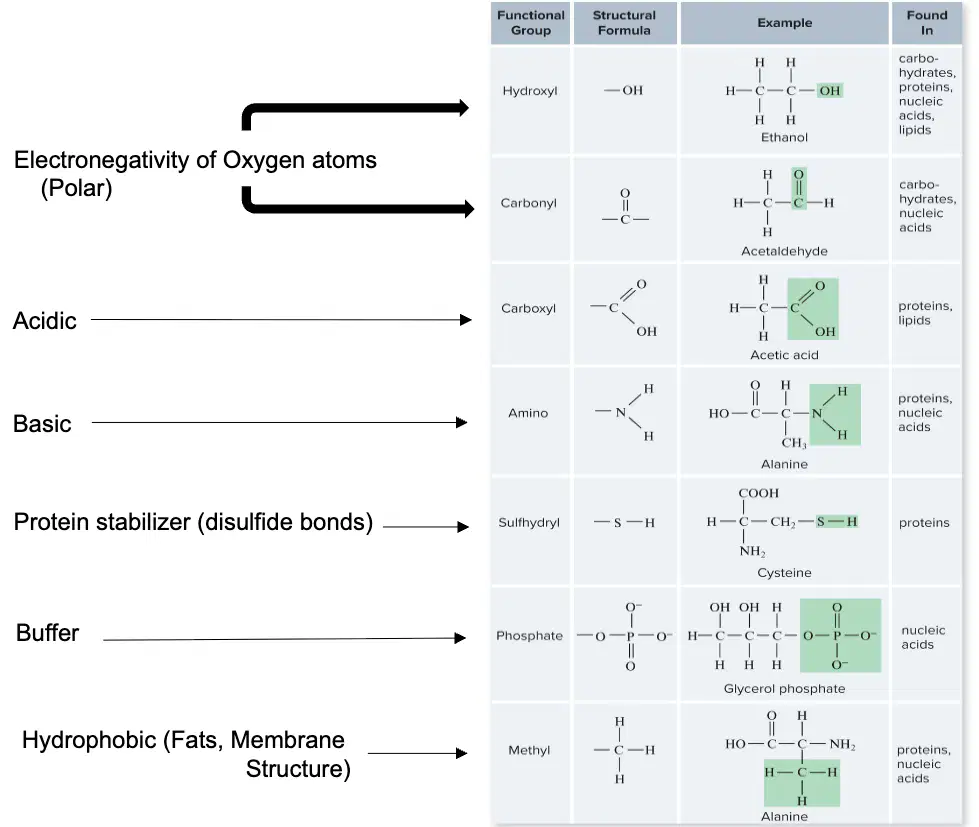
Which functional group is basic, has the structural formula —NH2, and is found in proteins and nucleic acids?
Amino
Carboxyl
Hydroxyl
Phosphate

Which functional group acts as a protein stabilizer (disulfide bonds), has the structural formula —SH, and is found in proteins?
Sulfhydryl
Carboxyl
Amino
Phosphate
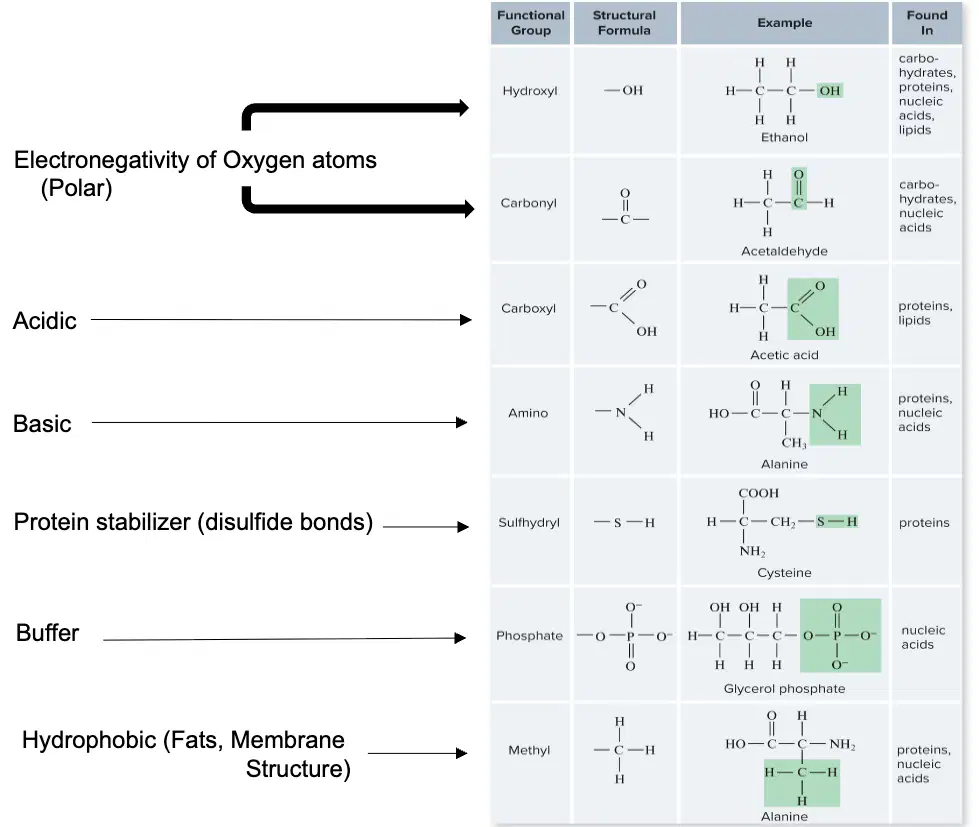
Which functional group acts as a buffer, has the structural formula —PO4, and is found in nucleic acids?
Phosphate
Carboxyl
Amino
Hydroxyl
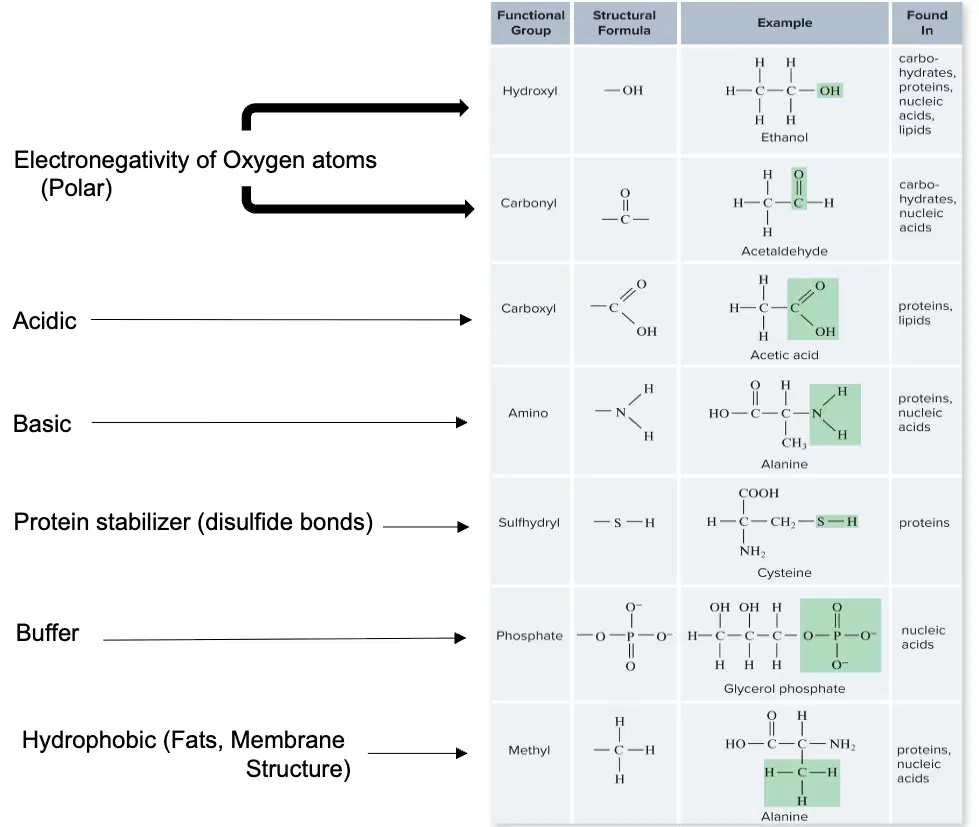
Which functional group is hydrophobic, important in fats and membrane structure, has the structural formula —CH3, and is found in proteins and nucleic acids?
Methyl
Hydroxyl
Carboxyl
Amino
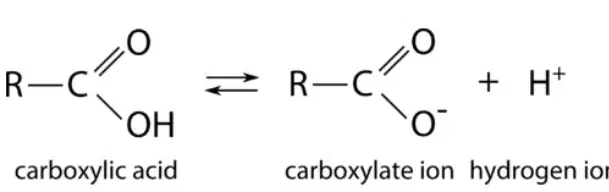
Which functional group makes a molecule acidic?
Carboxyl (-COOH)
Methyl (-CH₃)
Amino (-NH₂)
Hydroxyl (-OH)
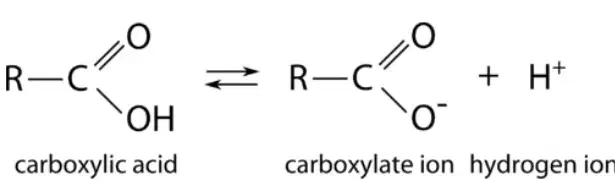
Which functional group makes a molecule acidic?
Carboxyl (-COOH)
Methyl (-CH3)
Amino (-NH2)
Hydroxyl (-OH)
What are isomers?
Molecules with different molecular formulas
Molecules with the same molecular formula but different structures, arrangements, or spatial orientations
Molecules with the same structure but different atoms
Molecules with different numbers of atoms
Isomers have the same molecular formula but different chemical and physical properties.
True
False
Fill in the blank: Structural isomers differ in the _______ of the carbon skeleton.
structure
length
mass
color
What is the main difference between stereoisomers and other types of isomers?
Stereoisomers have different molecular formulas
Stereoisomers differ in how groups are attached or arranged in space
Stereoisomers have different elements
Stereoisomers are always mirror images
Enantiomers are a subcategory of stereoisomers. What is unique about enantiomers?
They are not mirror images
They are mirror image molecules
They have different molecular formulas
They have the same arrangement
Fill in the blank: Enantiomers are referred to as ______ because they have four unique groups attached.
Chiral
Achiral
Isotopic
Planar
Diastereomers are mirror images of each other.
True
False

What are the two main categories of macromolecules shown in the diagram?
Polymers and Nonpolymers
Lipids and Nucleic acids
Carbohydrates and Proteins
Monomers and Dimers

Which of the following is NOT a type of polymer?
Carbohydrates
Nucleic acids
Proteins
Lipids

What are the monomers of proteins?
Amino acids
Fatty acids
Nucleotides
Monosaccharides
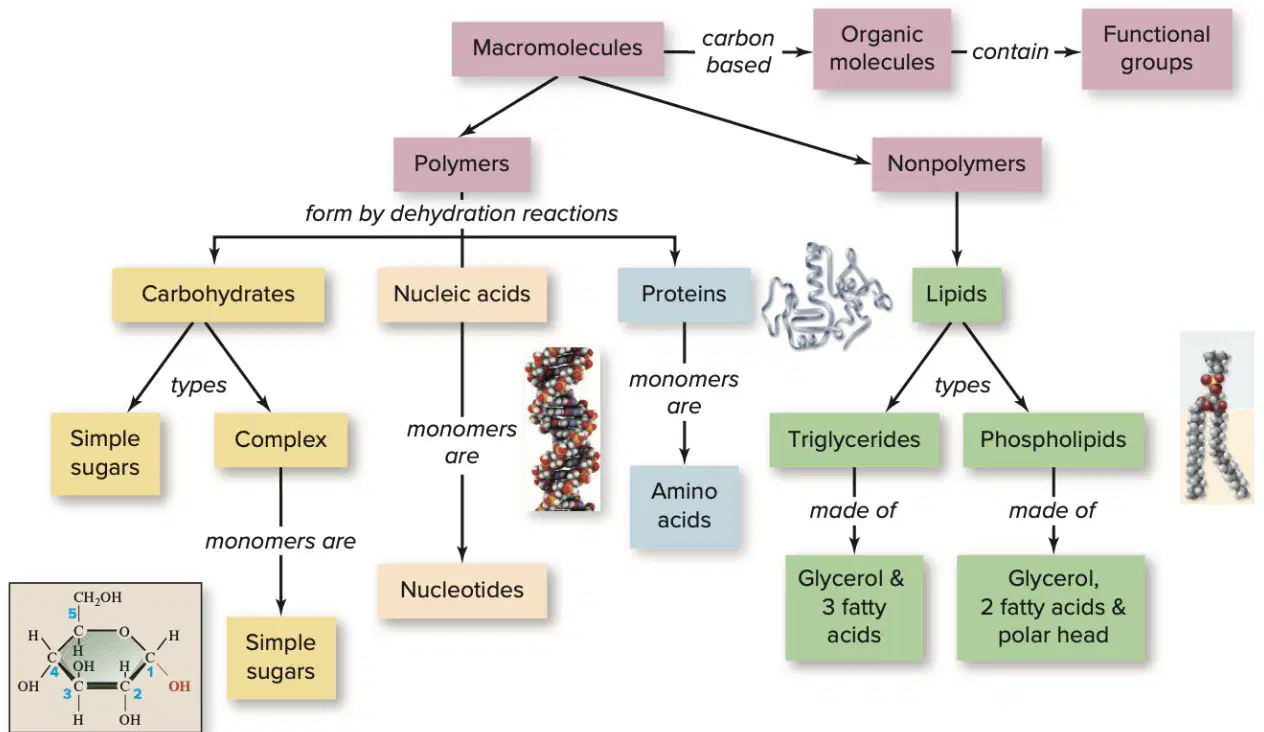
Carbohydrates can be classified into which two types?
Simple sugars and Complex
Proteins and Fats
Vitamins and Minerals
Lipids and Nucleic acids

What are the monomers of nucleic acids?
Nucleotides
Amino acids
Fatty acids
Monosaccharides
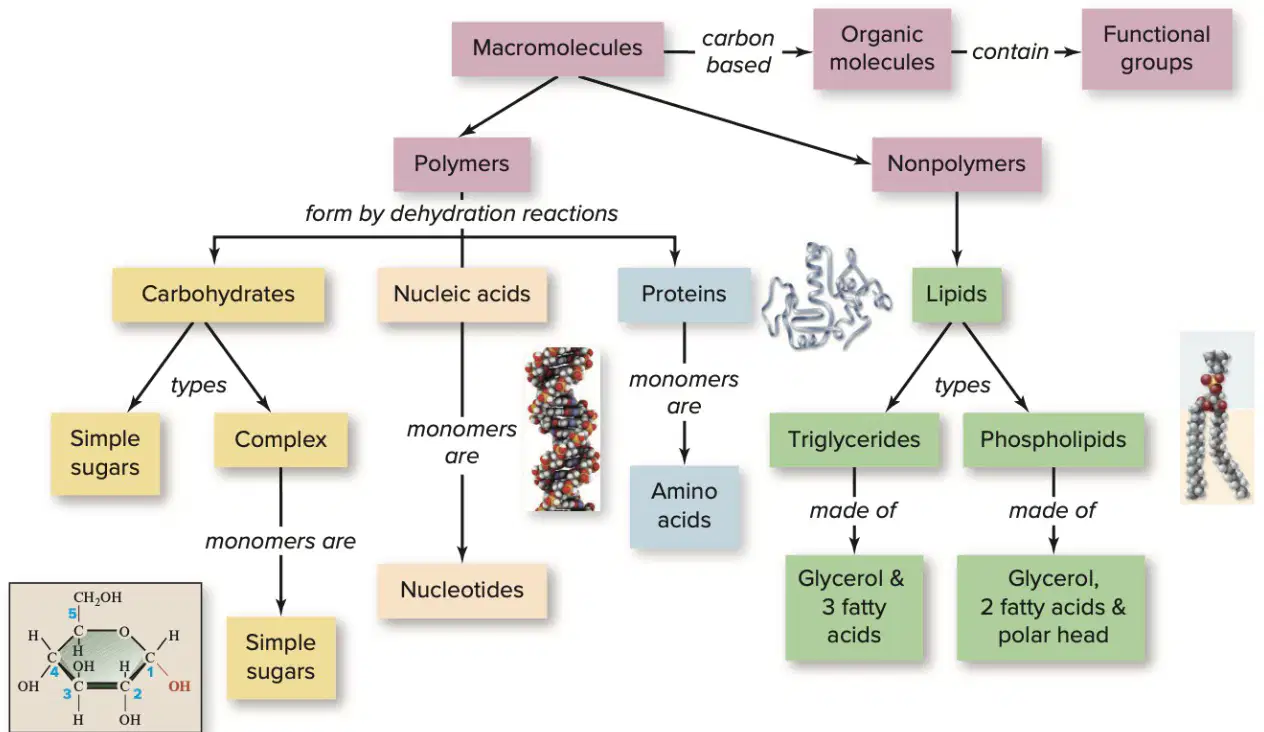
Triglycerides are made of which components?
Glycerol and 3 fatty acids
Glycerol and 2 fatty acids
Glycerol and 3 amino acids
Glycerol and 3 monosaccharides
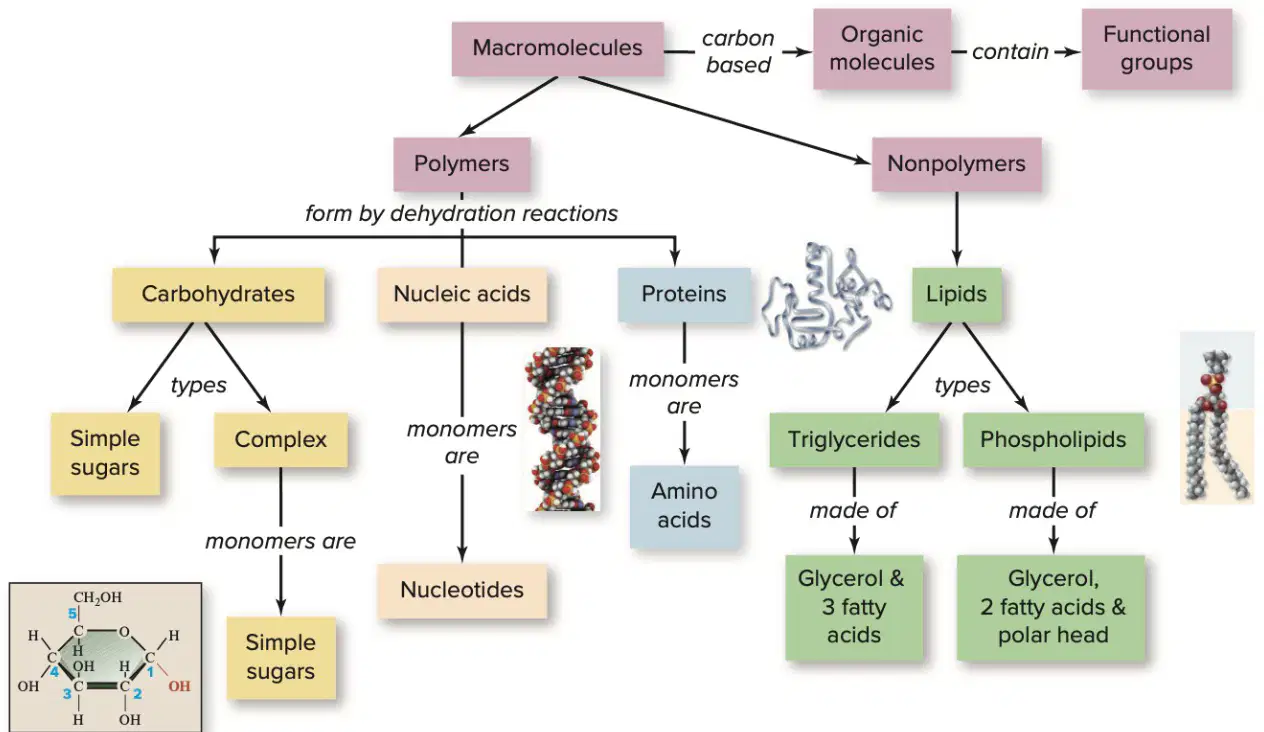
Phospholipids are made of which components?
Glycerol, 2 fatty acids, and a polar head
Glycerol, 3 fatty acids, and a nonpolar tail
2 glycerol molecules and 2 fatty acids
Glycerol, 1 fatty acid, and a sugar group
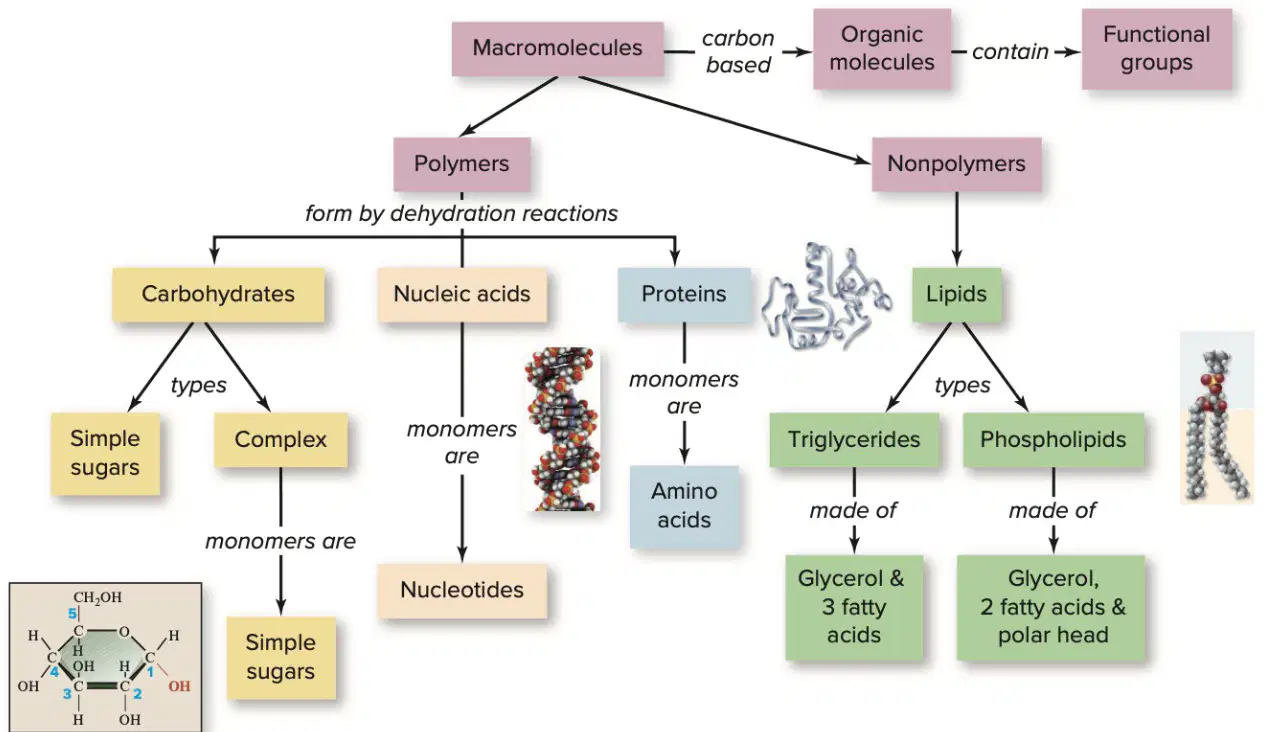
Organic molecules are carbon based.
True
False

Which functional group is common to all organic molecules?
Functional groups
Amino group
Carboxyl group
Hydroxyl group
What is the subunit of starch and glycogen?
Glucose
Fructose
Sucrose
Galactose
Which macromolecule has the function of energy storage and is found in potatoes?
Starch, glycogen
Cellulose
Protein
DNA
What is the function of cellulose?
Structural support in plant cell walls
Energy storage in animals
Transport of oxygen in blood
Catalyzing metabolic reactions
Which example is associated with chitin?
Crab shells
Potato tubers
Wool fibers
Cotton bolls
DNA is made up of which subunit?
Nucleotides
Amino acids
Fatty acids
Monosaccharides
What is the function of RNA?
Needed for gene expression
Provides structural support to bones
Stores genetic information in the nucleus
Regulates blood sugar levels
Which protein type is responsible for catalysis and transport?
Functional
Structural
Storage
Regulatory
What is an example of a structural protein?
Hair; silk
Insulin
Hemoglobin
Amylase
Which lipid is composed of glycerol and three fatty acids and is used for energy storage?
Triglycerides (animal fat, oils)
Phospholipids
Steroids
Waxes
Phospholipids are important for which cell structure?
Cell membranes
Mitochondria
Ribosomes
Nucleus
What is the function of prostaglandins?
Chemical messengers
Structural proteins
Energy storage molecules
Genetic material
Which macromolecule has four fused carbon rings and functions in membranes and hormones?
Steroids
Proteins
Nucleic acids
Polysaccharides
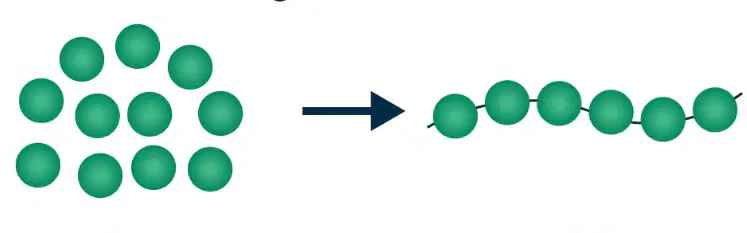
What is a polymer?
A small, similar chemical subunit
Built by linking monomers (like railroad cars coupled to form a train)
A type of enzyme
A single molecule
What is a monomer?
Built by linking monomers
Small, similar chemical subunit
A type of protein
A chain of polymers
Chains are built via ________ reactions, broken via ________ reactions.
dehydration reactions, hydrolysis reactions.
hydrolysis reactions, dehydration reactions.
oxidation reactions, reduction reactions.
condensation reactions, combustion reactions.
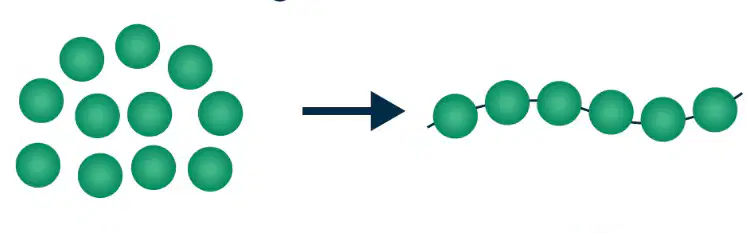
What process is illustrated when monomers are linked together to form a polymer?
Hydrolysis
Dehydration
Photosynthesis
Respiration
What process is responsible for building polymers?
Hydrolysis
Dehydration synthesis
Photosynthesis
Respiration
What process is responsible for breaking down polymers?
Hydrolysis
Dehydration synthesis
Photosynthesis
Respiration
Fill in the blank: Polymers are built by ________ synthesis.
Dehydration
Hydrolysis
Oxidation
Reduction
Fill in the blank: Polymers are broken down by ________.
Hydrolysis
Condensation
Polymerization
Oxidation
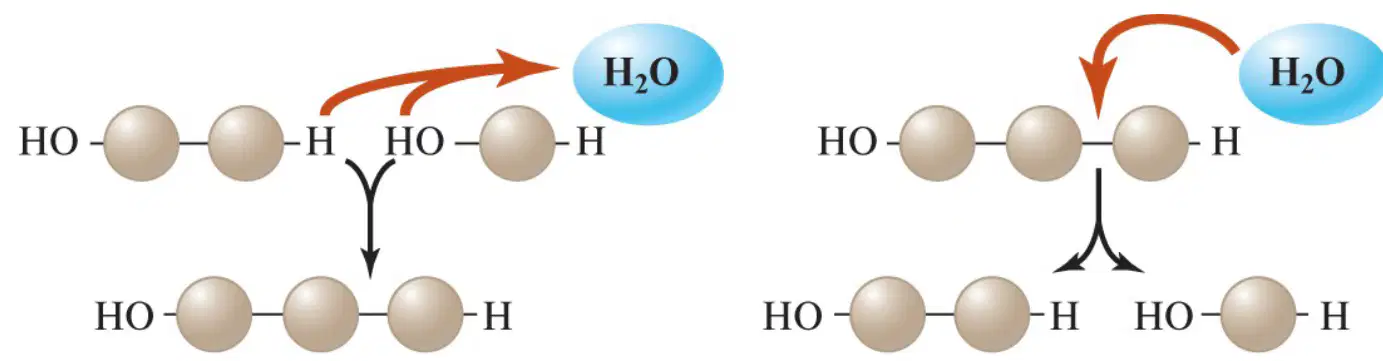
Refer to the diagram showing the assembly and disassembly of polymers. Which reaction results in the formation of water as a byproduct?
Dehydration reaction
Hydrolysis reaction
What process is responsible for building polymers by joining monomers together through the removal of water?
Hydrolysis
Dehydration synthesis
Photosynthesis
Respiration

