
 Worksheets
Scientific Principles 3
Total questions: 48
Worksheet time: 24mins
What is the SI unit of Velocity?
Metres per second (m/s)
Kilogram (kg)
Newton (N)
Joule (J)
What is the SI unit of Acceleration?
Meters per second squared (m/s²)
Meters per second (m/s)
Newton (N)
Joule (J)
What is the SI unit of Flow rate?
Litres per second/minute (l/s or l/m)
Cubic meter per second (m³/s)
Joules per second (J/s)
Newton per meter (N/m)
What is the SI unit of Force?
Newtons (N)
Joules (J)
Watts (W)
Pascals (Pa)
What is the SI unit of Pressure?
Pascal (N/m²) (Pa)
Newton (N)
Joule (J)
Watt (W)
Fill in the blank: ______ is the rate at which an object changes its position, taking into account speed and direction (m/s).
Velocity
Acceleration
Distance
Force
Fill in the blank: ______ is the rate at which an object increases its velocity.
Acceleration
Distance
Force
Mass
What is the gravitational pull due to acceleration due to gravity?
9.81m/s
9.81KN/m²
10m/s
1KN/m²
Fill in the blank: ______ is the amount of fluid that flows through a pipe at a given time.
Flow rate
Pressure
Temperature
Density
Fill in the blank: ______ is an influence on an object that may cause it to move (N)+.
Force
Energy
Mass
Velocity

The object exerting the greatest pressure on the floor is:
The object with the smallest contact area and highest weight.
The object with the largest contact area and lowest weight.
The object with the smallest contact area and lowest weight.
The object with the largest contact area and highest weight.

Which is exerting the least pressure on the floor?
The object with the largest surface area in contact with the floor is exerting the least pressure.
The object with the smallest surface area in contact with the floor is exerting the least pressure.
The heaviest object is exerting the least pressure on the floor.
The object with the highest density is exerting the least pressure on the floor.

The resultant force on the sharp pin head is _____ pressure.
high
low
zero
negative

According to the information provided, in which direction does a solid object exert pressure?
Downward only
Upward only
Outwards only
Downwards and outwards
According to the information provided, the pressure exerted by a liquid is: Choose the correct option.
Only downwards
Only outwards
Both downwards and outwards
Only upwards

What would the IoP be if the head height was 6m?
58.86 N/m²
45.00 N/m²
62.50 N/m²
70.00 N/m²
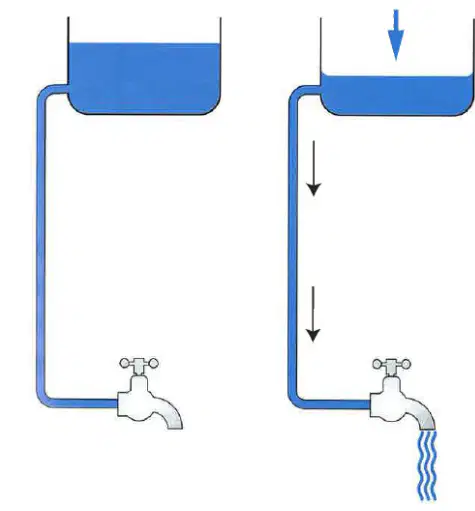
If the IoP was 78.48 N/m² what is the head height?
8 m
2 m
12 m
20 m
Atmospheric pressure is exerted by the atmosphere onto every _______.
object
liquid
sound
color
At sea level, atmospheric pressure is _______.
50 kPa
101.3 kPa
200 kPa
10 kPa
Below sea level, atmospheric pressure _______ and above sea level it _______.
increases; decreases
decreases; increases
remains constant; increases
decreases; remains constant
Siphonic action happens due to _______; this is how many WCs flush.
atmospheric pressure
gravity only
centrifugal force
electrical pressure

When suction is applied at point C, water will flow from beaker B to beaker A.
True
False
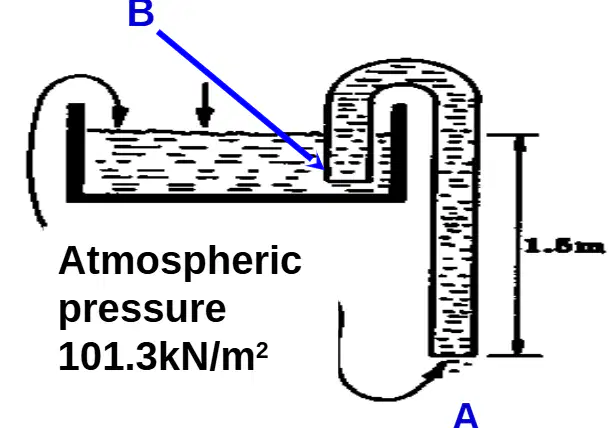
The pressure at point B is below atmospheric pressure. The pressure at point A is above atmospheric pressure. Is the pressure at point B below atmospheric pressure?
Yes
No
What is the definition of force? Fill in the blank: Force is an influence on an object that may cause it to _______.
move
change color
shrink
emit light
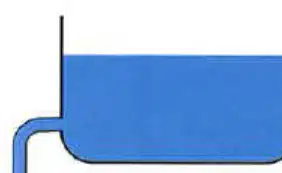
What happens when the tap is closed according to the diagram?
The water flows out of the tap
The body of water is at rest
The water evaporates
The water boils
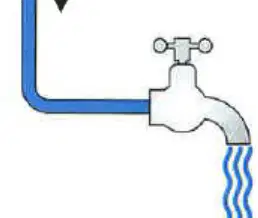
What causes the water to flow out of the tap when it is open according to the diagram?
The force of gravity
The force of wind
The force of heat
The force of light
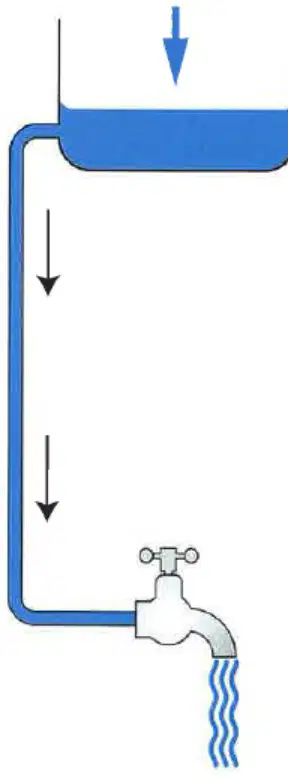
According to the information provided, how much does 1 litre of water weigh?
0.5 kg
1 kg
2 kg
10 kg

If the cistern holds 40 litres of water, what is the total mass of water in the cistern?
40 kg
20 kg
80 kg
400 kg
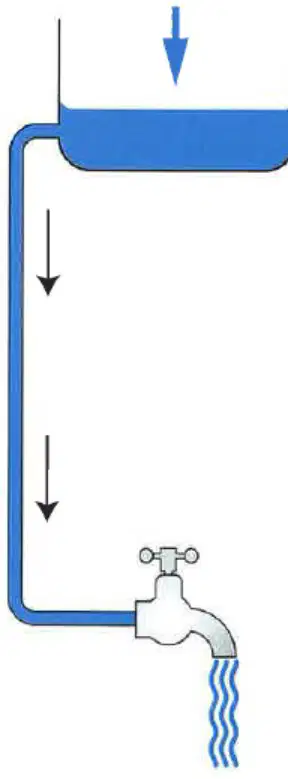
Using the formula Force = mass x gravity, what is the force of water leaving the tap if the mass is 40 kg and gravity is 9.81 m/s²?
392 N
40 N
9.81 N
400 N
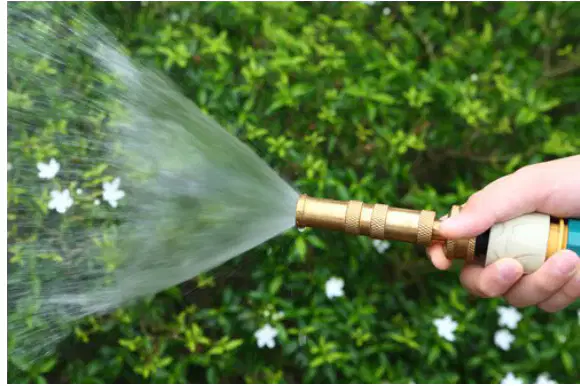
According to the passage, what happens if you reduce the pipe diameter, like on the garden hose shown in the images?
The speed decreases and the water shoots out less far
The speed increases and the water shoots out further, but the pressure and flow rate have reduced
The pressure and flow rate increase
Nothing changes
Fill in the blank: Flow rate is the amount of fluid that flows through a pipe at a given _____
time
temperature
pressure
distance
Fill in the blank: Flow rate can be affected by changes in _____
direction
color
taste
temperature
Fill in the blank: Flow rate can be affected by frictional _____
resistance
temperature
velocity
pressure
What is the equivalent length of pipe for 1 elbow in a water flow system?
0.37m
0.15m
0.75m
1.2m
Changes in direction: A machine bend is only equivalent to ____ of pipe (because it sweeps).
0.26m
0.5m
1.0m
0.75m
Pipe size: The larger the pipe, the more water can flow.
True
False
Frictional resistance: Polybutylene is smooth; galvanised LCS is rough.
True
False
What do valves and taps offer in a water flow system?
A lot of resistance
Increased water temperature
Additional water pressure
Purification of water
Why should elbows be removed and replaced by machined bends if an appliance requires an increase in the flow rate?
To increase restriction
To ease the restriction
To decrease the velocity
To reduce water pressure
Increasing the pipe diameter is commonly done for a bath feed compared to a basin feed.
True
False
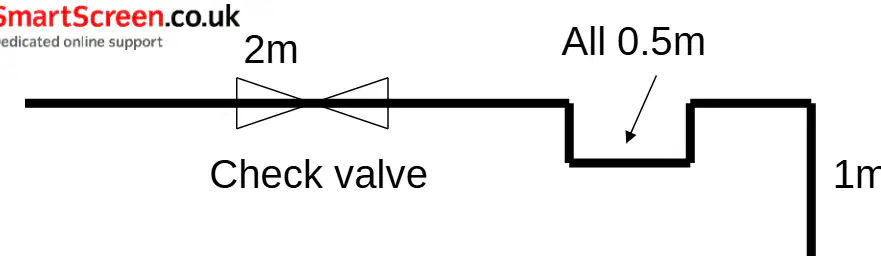
Calculate the resistance for the number of corners if elbows are used: 5 x 0.5 = ____
2.5
1.5
0.25
5
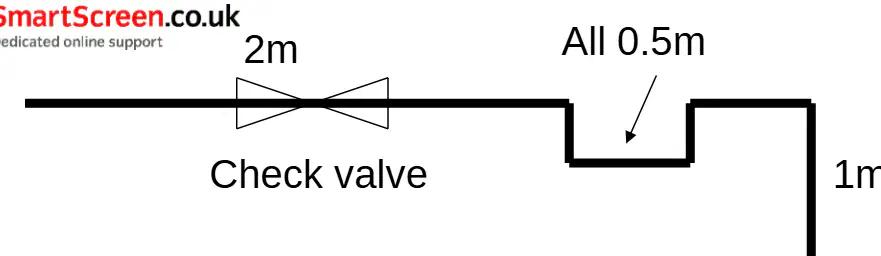
Calculate the resistance for the number of valves if elbows are used: 1 x 2.5 = ____
2.5
1.5
3.5
5
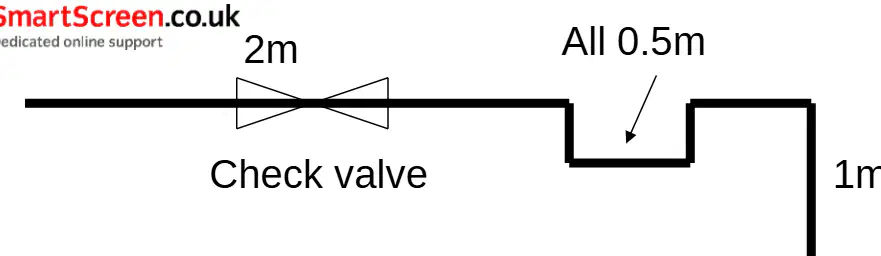
Calculate the resistance for the length of pipe if elbows are used: 2 + (0.5 x 4) + 1 = ____
5.0
4.0
6.0
3.5
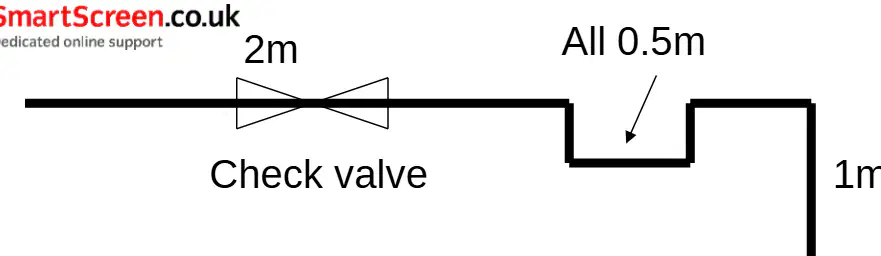
Refer to the diagram. What is the total resistance if elbows are used? Total = ____
10m
5m
15m
20m
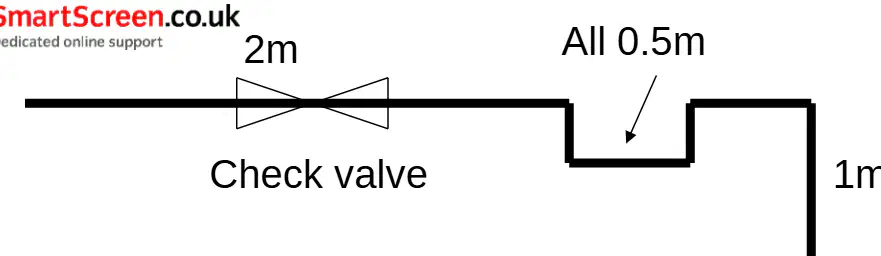
Calculate the resistance for the number of corners if pulled bends are used: 5 x 0.3 = ____
1.5
0.8
2.0
1.2
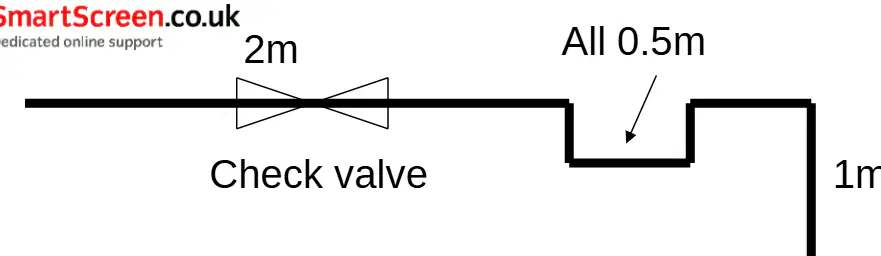
Calculate the resistance for the number of valves if pulled bends are used: 1 x 2.5 = ____
2.5
1.5
3.5
5
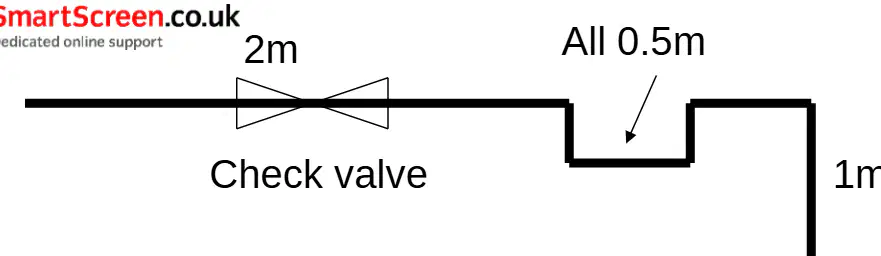
Calculate the resistance for the length of pipe if pulled bends are used: 2 + (0.5 x 4) + 1 = ____
5.0
4.0
6.0
3.5
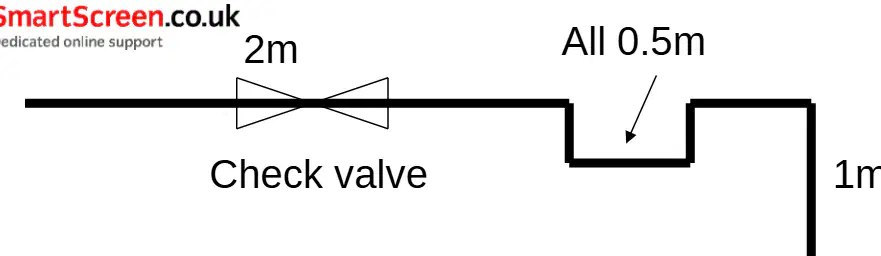
What is the total resistance if pulled bends are used? Total = ____
9m
6m
12m
15m

