wayground logo

Free Printable Worksheets

Font size

S
M
L
XL
Worksheets

Anatomy Test #1

Total questions: 55

Worksheet time: 28mins

Name
Class
Date
1.
A dermatologist is studying the ways that skin heals itself. Which category does this fit into?
a)
anatomy
b)
physiology
2.
If a doctor is comparing the size of one person’s brain to another, this would be part of
a)
anatomy
b)
physiology
3.
A group of similar cells working together is called a(n)
a)
organ
b)
tissue
c)
organ system
d)
organism
4.
Which system of the body contains glands and hormones?
a)
Nervous system
b)
Endocrine system
c)
Lymphatic system
d)
Excretory System
5.
Which system of the body is responsible for transporting nutrients and gases around the body?
a)
skeletal
b)
circulatory
c)
endocrine
d)
respiratory
6.
Which of the following is NOT one of the 5 survival needs?
a)
Oxygen
b)
Water
c)
Shelter
d)
Normal Body Temperature
7.
Your little sister fell and scraped her knee. What necessary function of life has been affected?
a)
movement
b)
responsiveness
c)
metabolism
d)
maintaining boundaries
8.
If the body has been divided in half to produce front and back sections, what type of plane is this?
a)
frontal
b)
midsagittal
c)
transverse
9.
What is A on the diagram?
a)
pericardial cavity
b)
abdominal cavity
c)
cranial cavity
d)
pelvic cavity
10.
What is H on the diagram?
a)
cranial cavity
b)
thoracic cavity
c)
abdominal cavity
d)
pelvic cavity
11.
Which of the following body parts is lateral to the heart?
a)
teeth
b)
stomach
c)
lungs
12.
Which of the following body parts is proximal to the elbow?
a)
wrist
b)
toes
c)
fingers
d)
shoulder
13.
Histology is the study of
a)
tissues
b)
muscles
c)
epithelium
d)
physiology
14.
Which of the following is NOT one of the 4 major categories of tissues found in the human body?
a)
Nervous
b)
Vascular
c)
Epithelial
d)
Muscular
15.
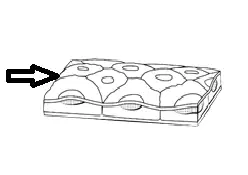
What is the arrow pointing to on the tissue?
a)
basement membrane
b)
basal surface
c)
free surface
d)
nuclei
16.
Epithelial tissues are classified by the number is layers and _________ of the cells
a)
color
b)
shape
c)
number of nuclei
d)
position
17.
The membrane underneath the basal surface is called?
a)
free surfaces
b)
mucous membrane
c)
basement membrane
d)
epithelium
18.
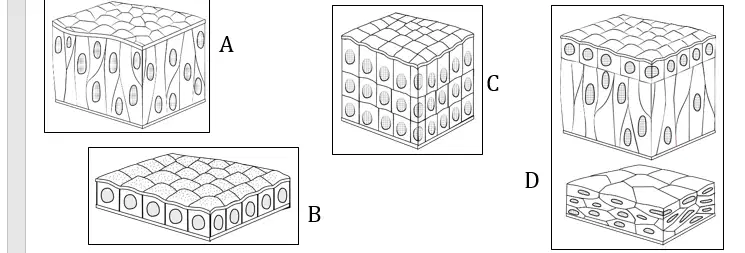
Which of the pictures above shows a pseudostratified tissue?
a)
A
b)
B
c)
C
d)
D
19.
Which type of cells become bone tissue?
a)
chondrocytes
b)
erythrocytes
c)
osteocytes
d)
fibrocytes
20.
The space surrounding the cell body in a connective tissue that is often gel-like or watery is known as the
a)
elastic fibers
b)
collagen fibers
c)
ground substance
d)
epithieal tissue
21.
Which statement correctly describes the term "Blood"?
a)
found in your ear lobe and tip of your nose
b)
the type of tissue that causes movement of the body
c)
the type of epithelial tissue that changes shape when stretched
d)
connective tissue that contains macrophages and mast cells
22.
Which statement correctly describes the term "Transitional "?
a)
the category of epithelial tissues with more than one layer of cells
b)
the type of epithelial tissue that changes shape when stretched
c)
the type of tissue that passes impulses around the body
d)
the type of connective tissue that has a calcified ground substance
23.
Which statement correctly describes the term " Elastic cartilage"?
a)
the type of tissue that passes impulses around the body
b)
found in your ear lobe and tip of your nose
c)
the type of tissue that causes movement of the body
d)
connective tissue that contains macrophages and mast cells
24.
Which statement correctly describes the term "Simple"?
a)
the category of epithelial tissues with more than one layer of cells
b)
found in your ear lobe and tip of your nose
c)
the category of epithelial tissues with only one layer of cells
d)
the type of epithelial tissue that changes shape when stretched
25.
Which type of muscle contracts voluntarily?
a)
Skeletal muscle
b)
Cardiac muscle
c)
Smooth Muscle
26.
Smooth muscle cells are found in which of the following?
a)
surrounding the skeleton
b)
heart muscle
c)
walls of the stomach
27.
Which of the following is NOT a function of skin?
a)
secretion of hormones
b)
sensation
c)
excretion of waste
d)
production of vitamins
28.
Which layer of the skin is the outermost layer?
a)
Dermis
b)
Hypodermis
c)
Epidermis
d)
Subcutis
29.
Which layer of the skin is primarily composed of fat and connective tissues?
a)
Epidermis
b)
Dermis
c)
Hypodermis
d)
Subdermis
30.
What is the layer of skin located beneath the epidermis?
a)
Subcutis
b)
Hypodermis
c)
Dermis
d)
Cuticle
31.
What is the dermis primarily composed of?
a)
Loose connective tissue
b)
Dense irregular connective tissue
c)
Muscle tissue
d)
Adipose tissue
32.
Which of the following epidermal layers is made of cells that are constantly dividing?
a)
stratum lucidum
b)
stratum granulosum
c)
stratum corneum
d)
stratum basale
33.
Which of the following epidermal layers is constantly being shed during your daily activities?
a)
stratum lucidum
b)
stratum granulosum
c)
stratum corneum
d)
stratum basale
34.
The Stratum lucidum is a layer found only in certain parts of the body. Where is it located?
a)
In the thick skin of the palms and soles of feet
b)
Throughout the entire epidermis
c)
In the thin skin covering most of the body
d)
In the lowermost layer of the epidermis
35.
Which of the following is NOT found in the dermis?
a)
Nerves
b)
Blood vessels
c)
Sweat glands
d)
Melanocytes
36.
The pigment produced by your skin that protects you from UV radiation is
a)
melanin
b)
keratin
c)
vitamin d
d)
collagen
37.
The arrangement of _________ in the dermis forms lines of cleavage.
a)
melanin
b)
keratin
c)
vitamin d
d)
collagen
38.
What is the uncontrolled division of melanocytes known as?
a)
Basal cell carcinoma
b)
Squamous cell carcinoma
c)
Melanoma
d)
Dermatitis
39.
The sudoriferous glands found primarily in the armpits and groin responsible for body odor are known as
a)
apocrine glands.
b)
eccrine glands
c)
sebaceous glands
d)
subcutaneous glands
40.
What happens to the blood vessels in the dermis during exercise?
a)
They constrict, causing skin to appear pale.
b)
They swell, causing skin to appear red.
c)
They remain unchanged, causing no effect on skin color.
d)
They shrink, causing skin to appear blue.
41.
What can form when the blood supply to the skin is restricted for a prolonged time?
a)
Acne
b)
Rosacea
c)
Hives
d)
Decubitus ulcers (bedsores)
42.
What type of sudoriferous glands are found on the palms, soles of feet, and forehead?
a)
Apocrine
b)
Sebaceous
c)
Eccrine
d)
Ceruminous
43.
At which location is hair formed?
a)
hair follicle
b)
hair cuticle
c)
hair shaft
d)
hair bulb
44.
The glands that secrete their products (oil) near hairs are known as
a)
apocrine glands
b)
papillary glands
c)
sebaceous glands
d)
subcutaneous glands
45.
Which of the following is NOT visible when looking at your fingernail?
a)
nail matrix
b)
lunula
c)
nail folds
d)
nail body
46.
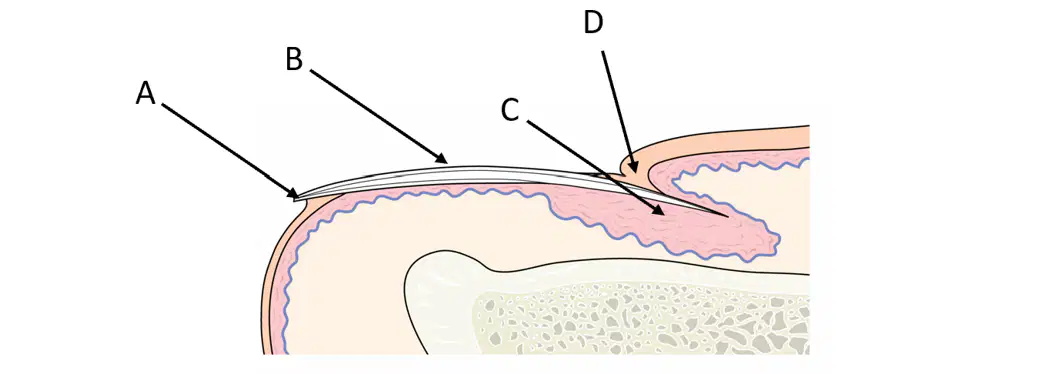
Which letter is marking the eponychium?
a)
A
b)
B
c)
C
d)
D
47.

Which of the following is a function of the hypodermis?

a)

Storage of fat and insulation

b)

Secretion of sweat

c)

Formation of hair follicles

d)

Production of melanin

48.

Which cells are responsible for producing the pigment that gives skin its color?

a)

Langerhans cells

b)

Melanocytes

c)

Fibroblasts

d)

Keratinocytes

49.

Which of the following structures is responsible for producing sebum in the skin?

a)

Eccrine glands

b)

Meissner's corpuscles

c)

Sebaceous glands

d)

Apocrine glands

50.

What is the main function of melanin in the skin?

a)

Protection against UV radiation

b)

Production of sweat

c)

Formation of collagen

d)

Insulation

51.

Which type of tissue lines the surfaces and cavities of organs throughout the body?

a)

Nervous tissue

b)

Adipose tissue

c)

Muscle tissue

d)

Epithelial tissue

52.

Which layer of the skin contains blood vessels, nerves, and hair follicles?

a)

Dermis

b)

Stratum corneum

c)

Epidermis

d)

Hypodermis

53.

What is the primary function of keratin in the epidermis?

a)

Pigment production

b)

Waterproofing

c)

Vitamin D synthesis

d)

Sweat secretion

54.

Which type of connective tissue stores fat and insulates the body?

a)

Blood

b)

Bone tissue

c)

Cartilage

d)

Adipose tissue

55.

Which of the following is a function of the hypodermis?

a)

Formation of keratin

b)

Production of sweat

c)

Insulation and energy storage

d)

Protection from UV radiation