wayground logo

Free Printable Worksheets

Font size

S
M
L
XL
Worksheets

General Science: Ch. 1 Review

Total questions: 71

Worksheet time: 36mins

Name
Class
Date
1.

298.15 K = (a)   degrees C (Just put number on the line with decimal places! no units!)

2.

500 K = (a)   degrees C (Just put number on the line with all decimal places! no units!)

3.

273.15 degrees C = (a)   K (Just put number on the line with all decimal places! no units!)

4.

0 K = (a)   degrees C (Just put number on the line with all decimal places! no units!)

5.

100 degrees C = (a)   K (Just put number on the line with all decimal places! no units!)

6.
The Celsius temperature scale is based on what reference?
a)
Absolute zero
b)
The boiling and freezing points of water
7.
The Kelvin temperature scale is based on what reference?
a)
Absolute zero
b)
The boiling and freezing points of water
8.

3200 mg = (a)   kg (Just put number and decimals on line!! No units!!)

9.

25 mL = (a)   dL (Just put number and decimals on line!! No units!!)

10.

2545 dL = (a)   kL (Just put number and decimals on line!! No units!!)

11.

1 g = (a)   mg (Just put number and decimals on line!! No units!!)

12.

16 hs = (a)   s (Just put number and decimals on line!! No units!!)

13.

151 m = (a)   dam (Just put number and decimals on line!! No units!!)

14.

28 cm = (a)   mm (Just put number and decimals on line!! No units!!)

15.
A paperclip has a mass of about 1 ______________.
a)
kilogram (kg)
b)
gram (g)
c)
liter (L)
d)
millisecond (ms)
16.
The width of a fly is about 1 _______________.
a)
gram (g)
b)
centimeter (cm)
c)
milliliter (mL)
d)
kilometer (km)
17.
Viruses, such as AIDS and the flu range in length from 17-1000 _______________.
a)
milligrams (mg)
b)
nanometers (nm)
c)
centimeter (cm)
d)
milliseconds (ms)
18.
A bottle of cough medicine says to take 5 ____________ every 4 hours.
a)
milliliters (mL)
b)
milligrams (mg)
c)
millimeters (mm)
d)
centimeters (cm)
19.
When I swallow two pills of Advil, I am ingesting 200 _________ of ibuprofen.
a)
centimeters (cm)
b)
milligrams (mg)
c)
kilograms (kg)
d)
Kelvin (K)
20.
Ski usually comes in 1 or 2 ____________ bottles.
a)
gram (g)
b)
liter (L)
c)
meter (m)
d)
kilogram (kg)
21.
In Europe on vacation I saw the speed limit signs are in _________/_________!
a)
miles/hr (mi/hr)
b)
miles/second (mi/s)
c)
kilometers/hour (km/hr)
d)
meters/second (m/s)
22.
When I run a 5K race, it is 3.1 miles long. The 5K stands for a distance of 5 ___________.
a)
miles/hr (mi/hr)
b)
meters (m)
c)
kilometers (km)
d)
kiloseconds (ks)
23.
A human heart has a mass of about 1.05 ___________.
a)
kilogram (kg)
b)
meters (m)
c)
kilometers (km)
d)
milligrams (mg)
24.
SI unit for temperature
a)
kg (kilogram)
b)
Kelvin (K)
c)
second (s)
d)
degrees Celsius
e)
degrees Fahrenheit
25.
SI unit for mass
a)
kg (kilogram)
b)
m^3 (meters cubed)
c)
Kelvin (K)
d)
second (s)
e)
gram (g)
26.
SI unit for time
a)
m^3 (meters cubed)
b)
Kelvin (K)
c)
second (s)
d)
meter (m)
e)
hour (hr)
27.
SI unit for volume
a)
kg (kilogram)
b)
m^3 (meters cubed)
c)
Kelvin (K)
d)
second (s)
e)
meter (m)
28.
Anything that has mass and takes up space...
a)
matter
b)
volume
c)
mass
d)
chemistry
29.
The International System of Units - the improved, universally accepted version of the metric system that is based on multiples of ten...
a)
standard
b)
units
c)
SI
d)
English system
30.
The mass per unit volume of a material...
a)
volume
b)
mass
c)
density
d)
matter
31.
The amount of matter in an object...
a)
volume
b)
mass
c)
density
d)
stuff
32.
The amount of space an object takes up...
a)
volume
b)
mass
c)
density
d)
matter
33.
The process of observation and investigation through which information about the natural world is learned...
a)
physics
b)
chemistry
c)
science
d)
hypothesis
e)
matter
34.
The study of matter...
a)
physics
b)
chemistry
c)
science
d)
hypothesis
e)
matter
35.
The study of energy and how it changes matter...
a)
physics
b)
chemistry
c)
science
d)
hypothesis
e)
matter
36.
The process through which scientists attempt to answer questions about the natural world...
a)
scientific method
b)
observation
c)
experiment
d)
hypothesis
37.
A proposed explanation for an observation...
a)
scientific method
b)
observation
c)
experiment
d)
hypothesis
38.
An investigation in which information is collected under controlled conditions...
a)
scientific method
b)
observation
c)
experiment
d)
hypothesis
39.
Information gained using your senses...
a)
scientific method
b)
observation
c)
experiment
d)
hypothesis
40.
The group in an experiment that is used for comparison...
a)
Experimental group
b)
Control group
41.
The variable that the scientist changes in an experiment...
a)
Independent
b)
Dependent
42.
A statement that uses evidence from an experiment to indicate whether a hypothesis is supported...
a)
results
b)
inference
c)
observation
d)
conclusion
43.
A visual display of data or information...
a)
percentages
b)
graph
c)
numbers
d)
picture
44.
Information in a circle graph is shown as...
a)
percentages
b)
bars
c)
lines
d)
circles
45.
What step of the scientific method tests the hypothesis?
a)
conclusion
b)
experiment
c)
conduct research
d)
record results
46.
The variable that is manipulated by the scientist is called the _____________ variable.
a)
dependent
b)
independent
47.
In a line graph, the ____________ axis is called the x-axis.
a)
vertical
b)
horizontal
48.
On a line graph, the independent variable is plotted on the ___-axis.
a)
x
b)
y
49.
The type of graph that is useful for showing how data changes with time is a ___________ graph.
a)
circle graph
b)
bar graph
c)
line graph
50.
What are expectations that change how results are viewed?
a)
standard
b)
society
c)
constant
d)
bias
51.
What is the volume of the rectangular prism shown below?
a)
40 cm^2
b)
10 cm
c)
80 cm^3
d)
80 cm^2
52.
The process of using a conversion factor to change from one unit to another...
a)
dimensional analysis
b)
scientific notation
c)
density
d)
meniscus
53.
The ratio of equal values used to express the same quantity in different units...
a)
dimensional analysis
b)
scientific notation
c)
conversion factor
d)
meniscus
54.
Which of the following is a derived unit?
a)
second
b)
grams/cm^3
c)
kilogram
d)
meter
55.
Which of the following is NOT a reason all scientists use the International System of Units?
a)
easy to use
b)
we don't want to share our findings with other countries
c)
based on the units of 10
d)
the metric system is easier than the English system
56.
T or F: The curve that can be seen at the top surface of a liquid is called a meniscus.
a)
True
b)
False
57.
T or F: The facts and figures that a scientist collects during an experiment is called data.
a)
True
b)
False
58.
A student pours 14.2 mL of water into a graduated cylinder. She then places a stone in the cylinder. The water rises to 18.8 mL. Calculate the volume of the rock.
a)
4.6 cm^3
b)
4.6 mL
c)
14.2 mL
d)
33 mL
59.
Scientists who study living things are studying which branch of science?
a)
Earth and space science
b)
physical science
c)
chemistry
d)
life science
60.
What is the density of water that exactly fills a 150 mL graduated cylinder? The water has a mass of 300 g.
a)
2 mL
b)
2 g/mL
c)
0.5 g/mL
61.
A block of copper (Cu) has the dimensions of 5 cm x 3 cm x 2 cm. When the block is placed on the balance it has a mass of 90 g. What is the density of copper (Cu)?
a)
3 g/mL
b)
3 g/cm^3
c)
0.33 g/cm^3
62.
A lead ball with a mass of 175 g is added to a graduated cylinder containing water. The water level rises from 30 mL to 55 mL. What is the density of the lead ball?
a)
25 mL
b)
7 g/mL
c)
7 g/cm^3
63.
What is the mass of liquid mercury (Hg) that exactly fills a 250 mL graduated cylinder? The density of mercury is 13.6 g/mL.
a)
3400 mL
b)
3400 g
c)
18.38 g
64.
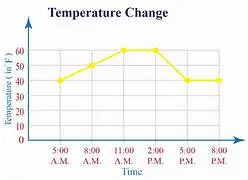
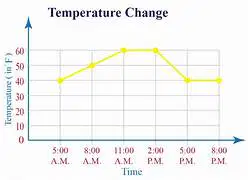
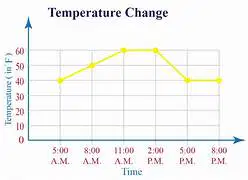
What is listed on the y-axis?
a)
Time
b)
Temperature
c)
Temperature change
65.
What is listed on the x-axis?
a)
Time
b)
Temperature
c)
Temperature change
66.
What is the temperature at 8:00 AM?
a)
40
b)
50
c)
60
d)
55
67.
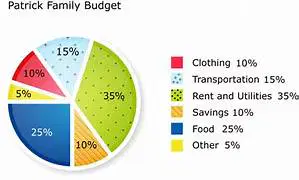
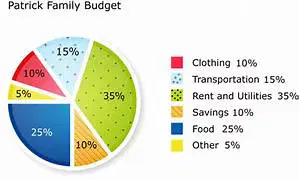
In the Patrick family budget, what does the family spend the most money on?
a)
savings
b)
food
c)
transportation
d)
rent and utilities
68.
All the percentages in a circle graph add up to what percent?
a)
0%
b)
50%
c)
35%
d)
100%
69.
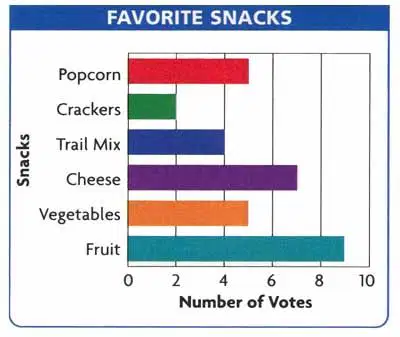
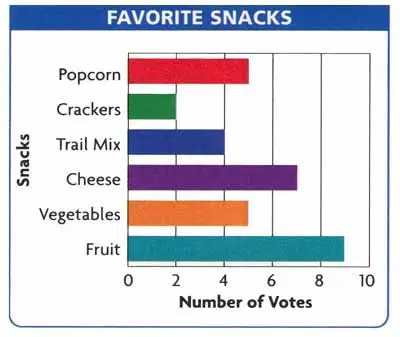
What is the label on the x-axis?
a)
Favorite snacks
b)
Number of votes
c)
Snacks
70.
How many votes did fruit receive?
a)
2
b)
5
c)
7
d)
9
71.
BONUS*: What occurs at absolute zero?
4 lines