
Font size
 Worksheets
Chapter 3. Biological Macromolecules 1- 30
Total questions: 100
Worksheet time: 50mins
Understand ________ synthesis. (Fill in the blank)
macromolecule
micromolecule
atom
ion
Explain ________ (or condensation) and hydrolysis reactions. (Fill in the blank)
dehydration
oxidation
sublimation
fermentation
Discuss the role of ________ in cells and in the extracellular materials of animals and plants.
carbohydrates
lipids
nucleic acids
enzymes
Explain ________ classifications.
carbohydrate
protein
lipid
vitamin
List common ________, disaccharides, and polysaccharides. (Fill in the blank)
monosaccharides
lipids
nucleotides
amino acids
Describe the four major types of ________.
lipids
proteins
carbohydrates
nucleic acids
Explain the role of fats in storing ________.
energy
oxygen
protein
vitamins
Differentiate between ________ and unsaturated fatty acids.
saturated
monounsaturated
polyunsaturated
trans
Describe ________ and their role in cells.
phospholipids
carbohydrates
nucleic acids
enzymes
Define the basic structure of a ________ and some steroid functions.
steroid
protein
carbohydrate
nucleic acid
Explain how ________ helps maintain the plasma membrane's fluid nature.
cholesterol
glucose
hemoglobin
cellulose
Describe the functions ________ perform in the cell and in tissues. (Fill in the blank)
proteins
carbohydrates
lipids
nucleic acids
Discuss the relationship between ________ and proteins. (Fill in the blank)
amino acids
carbohydrates
lipids
nucleic acids
Explain the four levels of ________ organization.
protein
carbohydrate
lipid
nucleic acid
Describe the ways in which protein ________ and function are linked.
shape
color
weight
temperature
Describe nucleic acids' structure and define the two types of ________ acids. (Fill in the blank)
nucleic
amino
fatty
carboxylic
Explain DNA's structure and ________.
role
color
taste
weight
Explain RNA's structure and ________.
roles
colors
flavors
weights
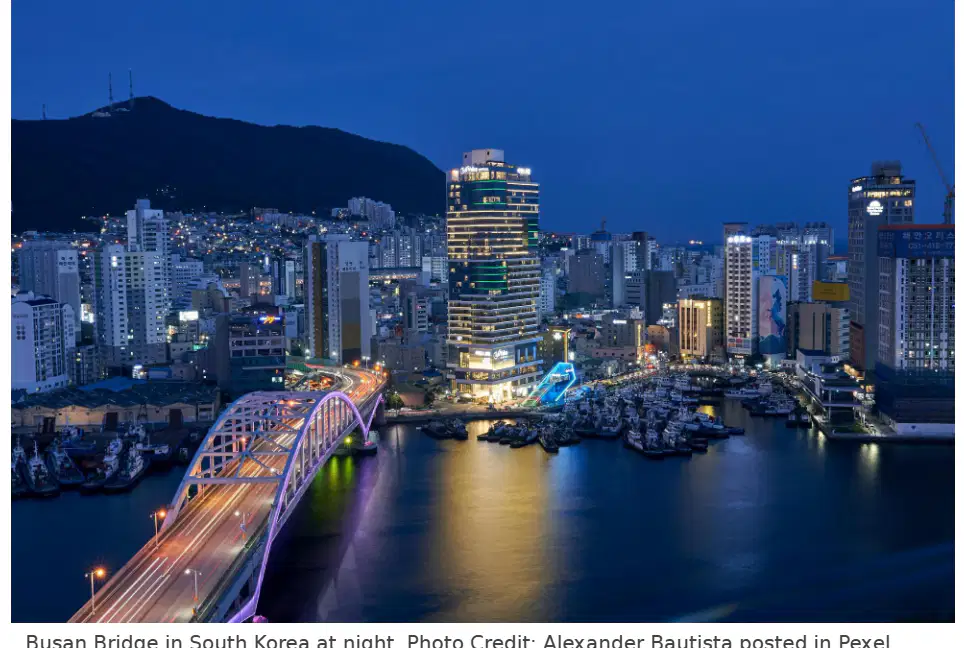
What raw materials make buildings, roads, and infrastructure possible?
Raw materials such as sand, metal, and clay make buildings, roads, and infrastructure possible.
Raw materials such as cotton, wool, and silk make buildings, roads, and infrastructure possible.
Raw materials such as sugar, salt, and pepper make buildings, roads, and infrastructure possible.
Raw materials such as paper, ink, and glue make buildings, roads, and infrastructure possible.
Just like a city is built from raw materials like sand, metal, and clay, living organisms are built from how many major types of macromolecules?
Four
Two
Five
Six
What are the four major classes of macromolecules?
Carbohydrates, Lipids, Proteins, Nucleic Acids
Sugars, Starches, Enzymes, Hormones
Vitamins, Minerals, Water, Fiber
Amino acids, Fatty acids, Glucose, DNA
Which of the following is NOT a major class of biological macromolecules?
A) Carbohydrates
B) Lipids
C) Proteins
D) Vitamins
All organic molecules contain which element?
Carbon
Oxygen
Nitrogen
Hydrogen
Organic molecules may also contain which of the following elements?
Hydrogen
Oxygen
Nitrogen
All of the above
True or False: All organic molecules contain carbon.
True
False
What does it mean for a molecule to be 'organic'?
It contains carbon (C) bonded to hydrogen (H)
It contains only oxygen (O)
It is made only by humans
It contains only nitrogen (N)
Organic molecules often include which of the following elements?
Oxygen (O)
Nitrogen (N)
Phosphorus (P)
Sulfur (S)
All of the above
Organic molecules are made by or found in _________.
living organisms
rocks
metals
plastics
Why is carbon uniquely versatile in forming molecules?
It can form 2 stable covalent bonds
It can form 4 stable covalent bonds
It cannot form covalent bonds
It only forms ionic bonds
Carbon acts like a ________ that other atoms and functional groups can attach to.
backbone
enzyme
solvent
ligand
Carbon can form which of the following structures?
Chains
Branches
Rings
All of the above
Match the functional group to its property:
Polar
Polar
Nonpolar
Nonpolar
Polar
Polar
Charged, ionizes to release H+, considered acidic
Charged, ionizes to release H+, considered acidic
Charged, accepts H+ to form NH3+, considered basic
Charged, accepts H+ to form NH3+, considered basic
Which functional group is nonpolar?
Hydroxyl
Methyl
Carbonyl
Sulfhydryl
Which functional group is charged and considered acidic because it ionizes to release H+?
Carboxyl
Amino
Sulfhydryl
Methyl
Which functional group is charged and considered basic because it accepts H+ to form NH3+?
Carboxyl
Amino
Phosphate
Hydroxyl
Fill in the blank: ________ are the smallest subunit of larger molecules that are polymers.
Monomers
Polymers
Ions
Atoms

Fill in the blank: ________ are large molecules made by covalently bonding many monomers.
Polymers
Ions
Atoms
Electrons
What is dehydration synthesis?
A reaction in which the hydrogen of one monomer combines with the hydroxyl group of another, releasing a molecule of water.
A reaction in which water is absorbed by a polymer.
A reaction that breaks down polymers into monomers by adding water.
A reaction that forms a gas from two liquids.
Fill in the blank: In dehydration synthesis, a water molecule is formed as two __________ are linked by a covalent bond.
monosaccharides
nucleotides
fatty acids
amino acids
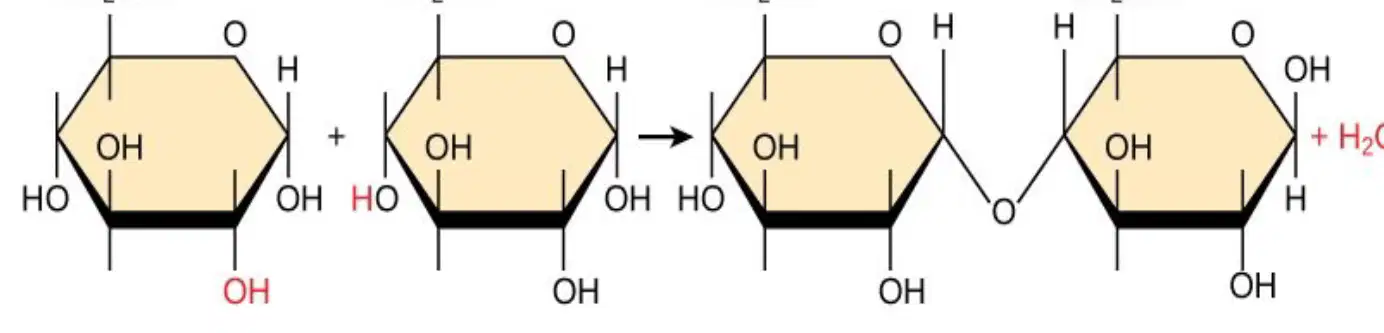
According to the diagram, what are the products when two glucose molecules undergo dehydration synthesis?
Two glucose molecules
Maltose and water
Glucose and oxygen
Maltose and carbon dioxide
Dehydration synthesis is also described as 'to put together while losing water.'
True
False
What is hydrolysis?
A reaction in which a water molecule is used to break down polymers into monomers
A reaction in which monomers are joined to form polymers
A reaction that does not involve water
A reaction that produces energy
Fill in the blank: Hydrolysis means "to split with _____."
water
fire
air
light
During hydrolysis, one molecule gains the ______ atoms and the other gains a ______ molecule from a split water molecule.
hydrogen; hydroxyl
oxygen; hydrogen
hydroxyl; oxygen
carbon; hydrogen
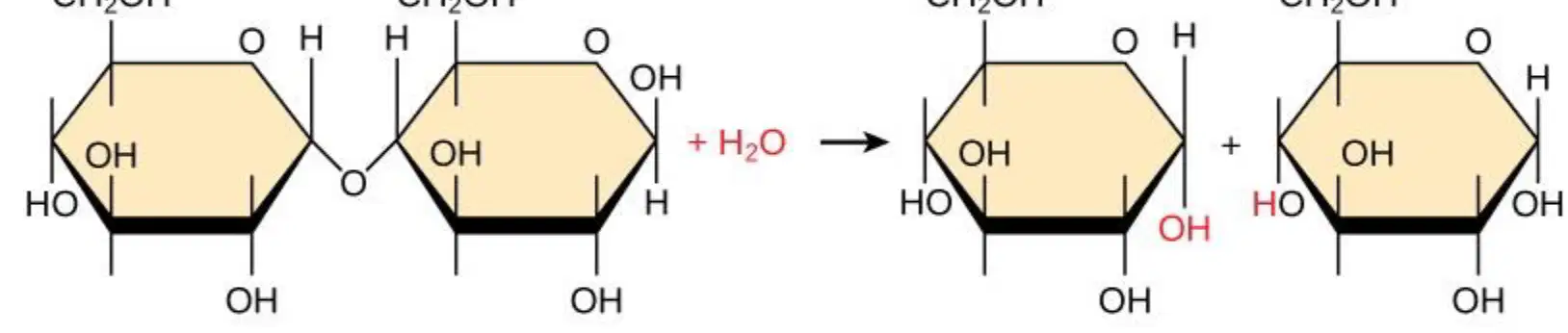
What is the result of adding H2O to the disaccharide maltose in the hydrolysis reaction shown?
Two glucose monomers are formed
A larger polymer is formed
No change occurs
Energy is released
Dehydration synthesis can be defined as:
A process where two molecules join together by removing a water molecule.
A process where water is added to break a molecule apart.
A process where energy is released by breaking chemical bonds.
A process where oxygen is added to a molecule.
Hydrolysis can be defined as:
A chemical reaction where water is used to break down a compound.
A process where heat is used to combine two substances.
A reaction where oxygen is removed from a molecule.
A method of forming a solid from a solution.
Identify what is released or consumed in each reaction.
Energy and matter are released or consumed.
Only heat is released in all reactions.
No substances are released or consumed.
Only light is consumed in each reaction.
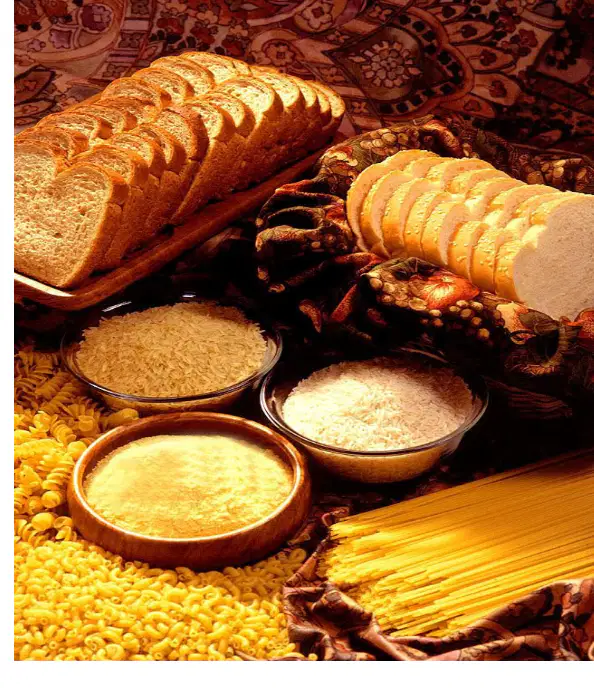
Carbohydrates are found in which of the following? Select the correct answer.
Meat and dairy
Grains, fruits, and vegetables
Fish and eggs
Oils and fats
What is the main function of carbohydrates in the body?
Provide energy to the body in the form of glucose
Build and repair body tissues
Regulate body temperature
Aid in the absorption of vitamins
Carbohydrates are represented by the general formula (CH2O)n.
True
False
The ratio of Carbon:Hydrogen:Oxygen in carbohydrates is ________.
1:2:1
2:1:2
1:1:2
2:2:1
Which of the following is a main subtype of carbohydrates?
Monosaccharides
Proteins
Lipids
Nucleic acids
What is the simplest carbohydrate called?
Disaccharide
Monosaccharide
Polysaccharide
Oligosaccharide
Monosaccharides usually have how many carbons?
2-5
3-7
6-10
8-12
Monosaccharides end with the suffix _____
-ose
-ase
-ine
-ate
Which functional group do monosaccharides contain?
Hydroxyl (OH)
Amino (NH2)
Carbonyl (C=O)
Carboxyl (COOH)
What is the molecular formula for the structural isomers glucose, galactose, and fructose?
C6H12O6
C5H10O5
C7H14O7
C6H10O6
Glucose is an important source of _____
energy
protein
vitamin
fiber
Galactose is part of _____
lactose/milk sugar
sucrose/table sugar
starch
cellulose
Fructose is part of _____
sucrose/fruit sugar
starch
cellulose
glycogen
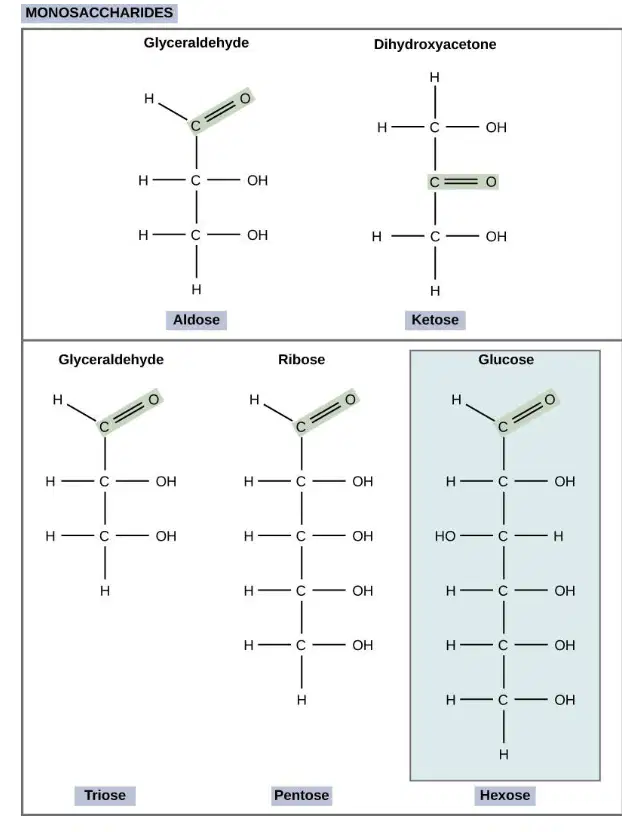
Which type of monosaccharide has a carbonyl group at the end of the carbon chain?
A) Aldose
B) Ketose
What are isomers?
Molecules with different molecular formulas and different structures
Molecules with the same molecular formula but different structures
Molecules with the same structure and same molecular formula
Molecules with different atoms
Which of the following is a structural isomer of glucose?
Galactose
Fructose
Both A and B
None of the above
A stereoisomer of glucose has the same structure and functional groups, but atoms are oriented differently in _________.
3D space
the nucleus
the cytoplasm
the cell wall
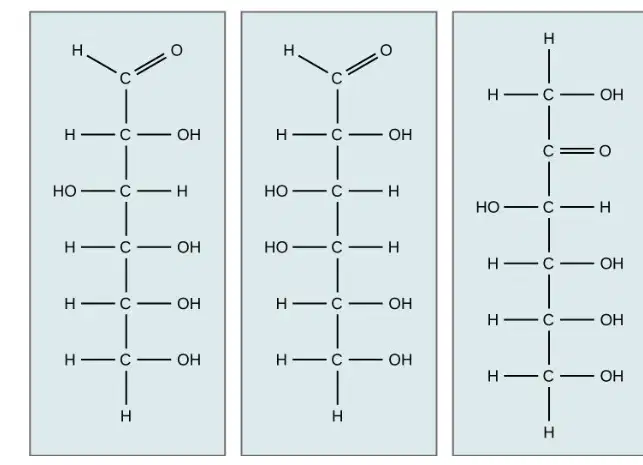
Based on the diagram, which molecule is a stereoisomer of glucose?
Glucose
Galactose
Fructose
None of the above
Which functional group position change distinguishes fructose from glucose?
A) Ketone vs. aldehyde
B) Alcohol vs. ketone
C) Aldehyde vs. alcohol
D) None of the above
Disaccharides form when two ______ are linked in a dehydration reaction. (Fill in the blank)
monosaccharides
polysaccharides
nucleotides
fatty acids
Which of the following is formed when glucose and fructose combine?
Maltose
Sucrose
Lactose
Cellulose
What type of bond joins two monomers in a disaccharide?
Peptide bond
Glycosidic bond
Hydrogen bond
Ionic bond
A glycosidic linkage is a bond formed by a ______ reaction between two monosaccharides with the elimination of a water molecule. (Fill in the blank)
dehydration
hydrolysis
oxidation
reduction
The formation of sucrose results in a ______ glycosidic linkage.
1,2
1,4
2,6
1,6
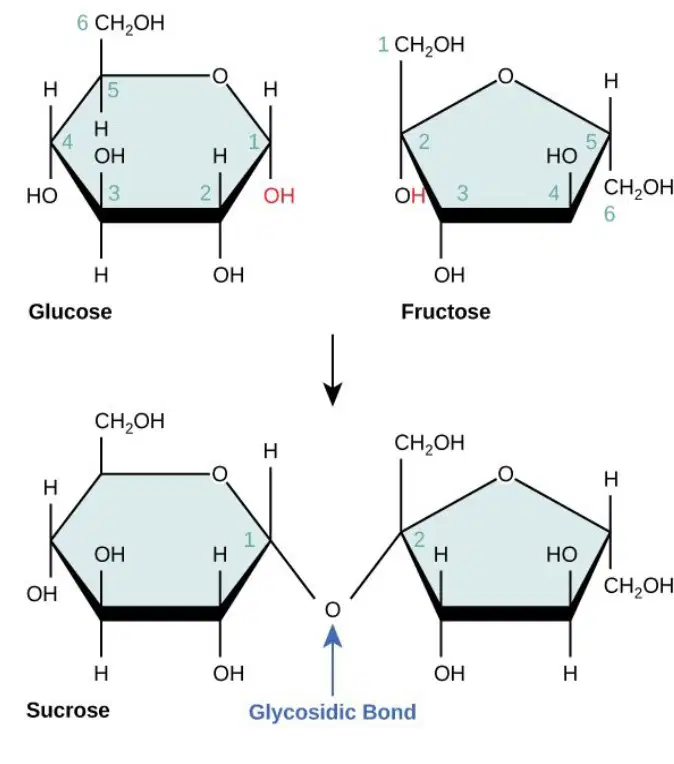
Refer to the diagram showing the formation of sucrose. Which carbon atoms are involved in the glycosidic linkage?
Carbon 1 in glucose and carbon 2 in fructose
Carbon 2 in glucose and carbon 1 in fructose
Carbon 1 in both glucose and fructose
Carbon 2 in both glucose and fructose
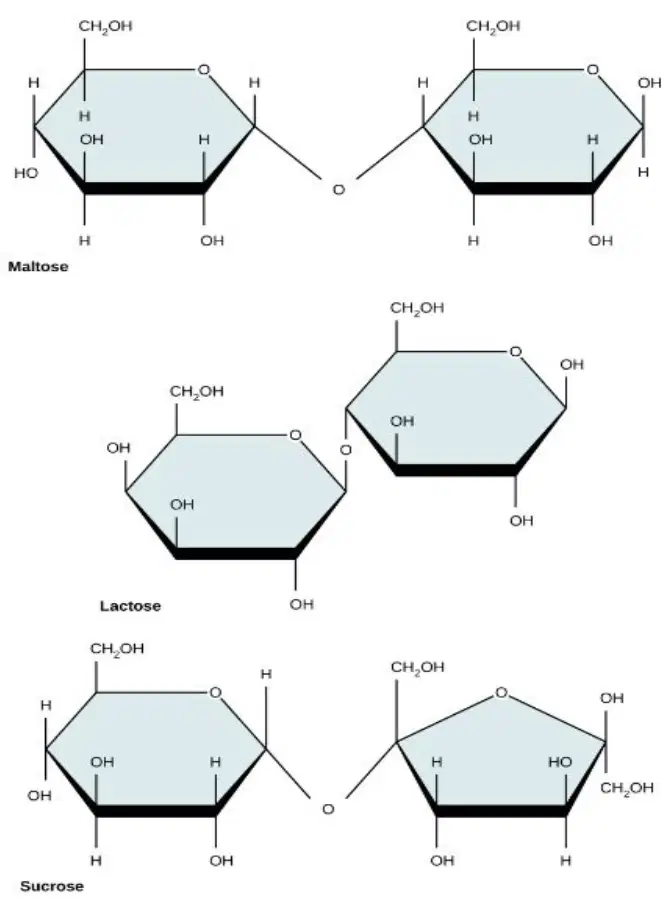
Maltose is also known as ________ (grain sugar).
maltose
sucrose
lactose
fructose

Lactose is also known as ________ (milk sugar).
lactose
glucose
sucrose
fructose
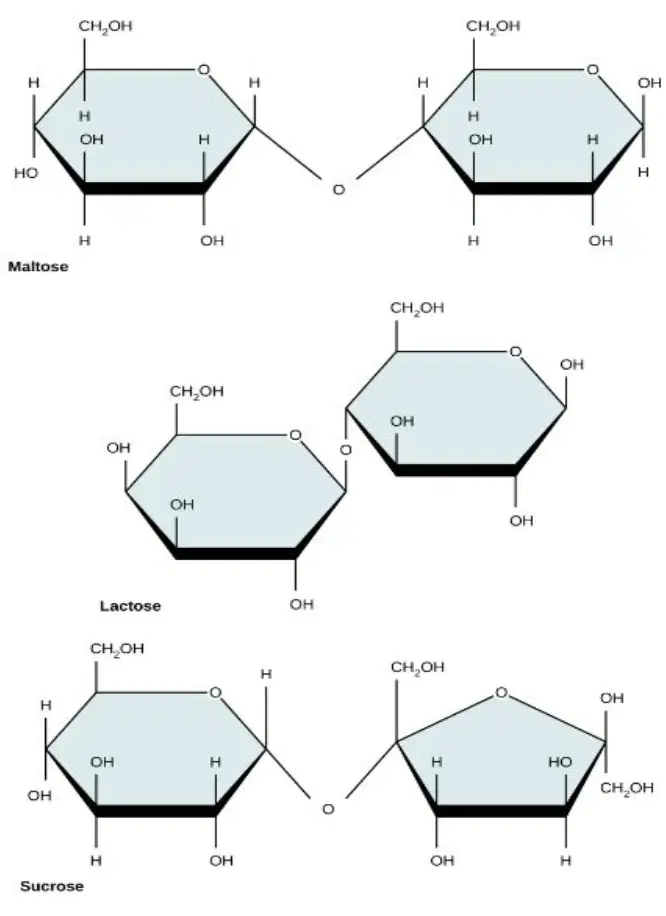
Sucrose is also known as ________.
sucrose
glucose
fructose
lactose
How are all common disaccharides created?
By formation of ionic bonds
By formation of covalent glycosidic linkages
By hydrogen bonding
By van der Waals forces
What are polysaccharides?
Short chain of monosaccharides joined by glycosidic linkages
Long chain of monosaccharides joined by glycosidic linkages
Long chain of disaccharides joined by peptide bonds
Short chain of monosaccharides joined by peptide bonds
Polysaccharides may be ______ or unbranched.
branched
linear
cyclic
ionic
Polysaccharides may consist of multiple types of ________.
monosaccharides
lipids
nucleotides
amino acids
The molecular weight of polysaccharides could be greater than ______ daltons.
10,000
1,000
100,000
100
Which of the following are primary examples of polysaccharides?
Starch, glycogen, cellulose, and chitin
Glucose, fructose, and galactose
Sucrose, lactose, and maltose
DNA and RNA
What is the most abundant natural biopolymer?
Cellulose
Chitin
Starch
Keratin
Cellulose mostly comprises which part of a plant?
Cell wall
Nucleus
Chloroplast
Vacuole
What is the main function of cellulose in a plant's cell wall?
It provides structural support.
It stores genetic information.
It aids in photosynthesis.
It transports water and nutrients.
Wood and paper are mostly _______ in nature.
cellulosic
proteinaceous
metallic
plastic
Glucose monomers comprise cellulose that β 1-4 glycosidic bonds link.
True
False
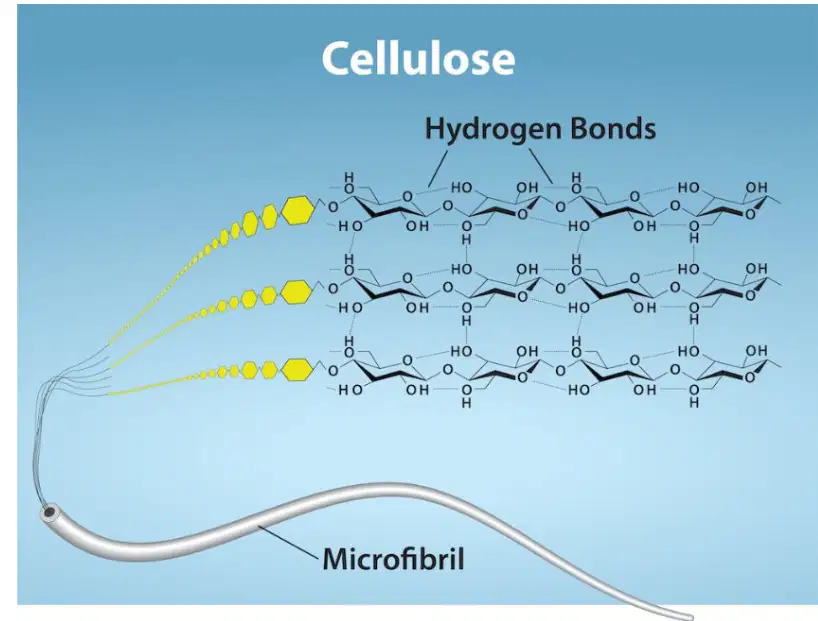
What type of bonds hold the glucose chains together in cellulose?
Hydrogen bonds
Ionic bonds
Peptide bonds
Disulfide bonds
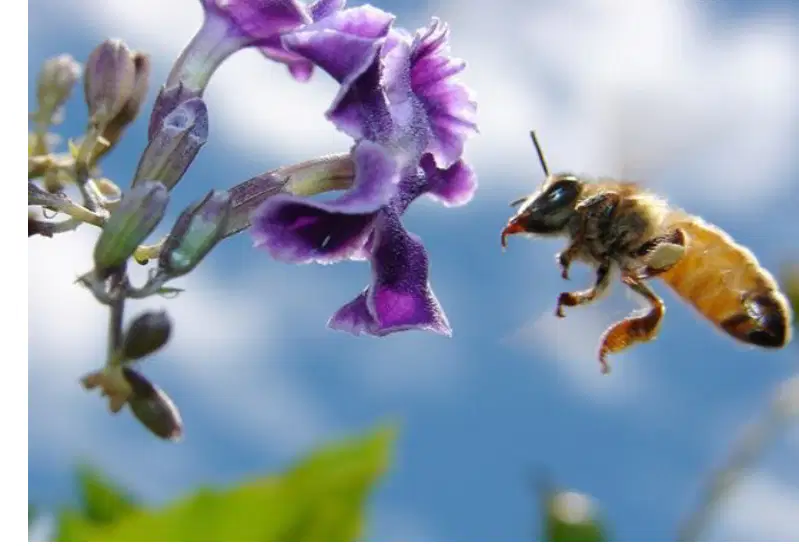
Arthropods (insects, crustaceans, and others) have an outer skeleton called the exoskeleton. What is the exoskeleton composed of?
Protein
Cellulose
Chitin
Keratin
Chitin contains nitrogen.
True
False
Fill in the blank: Chitin is also a major component of ______ cell walls.
fungal
plant
bacterial
algal
Which of the following statements is true about chitin?
It is found in plant cell walls
It is a protein
It is a polysaccharide found in arthropod exoskeletons
It does not contain nitrogen
What are lipids?
A) A type of protein
B) A diverse group of non-polar hydrocarbons
C) A type of carbohydrate
D) A type of nucleic acid
Non-polar hydrocarbons are ________ (water-fearing).
hydrophobic
hydrophilic
amphipathic
ionic

Hydrophobic lipids in aquatic mammals' fur protect them from the elements.
True
False
Which of the following is a function of lipids?
Short-term energy storage
Long-term energy stores
Provide structure to DNA
Transport oxygen in blood
Which of the following is NOT a function of lipids?
Provide insulation from environment for plants and animals
Serve as building blocks for some hormones
Important component of cellular membranes
Synthesize proteins
Name one function of lipids in living organisms.
Long-term energy stores (other acceptable answers: Provide insulation, Serve as building blocks for hormones, Important component of cellular membranes)
Catalyze chemical reactions
Store genetic information
Transport oxygen in the blood
List any two types of lipids.
Fats, Oils
Glucose, Starch
Amino acids, Proteins
Cellulose, Hemoglobin
Which of the following is NOT a type of lipid?
Fats
Oils
Proteins
Steroids

