wayground logo

Free Printable Worksheets

Font size

S
M
L
XL
Worksheets

Midterm Exam 2019-2020

Total questions: 100

Worksheet time: 2hrs 57mins
Name
Class
Date
1.
Which property of matter is determined by dividing its mass by its volume?
a)
elasticity
b)
buoyancy
c)
density
d)
viscosity
2.
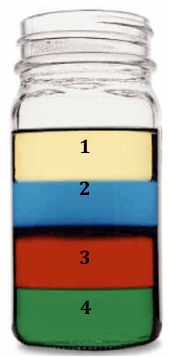
The following liquids are poured together in a beaker: alcohol (density=0.79), corn syrup (density=1.38), water (density=1.0), and cooking oil (density=0.93).  Which of these liquids will sink to the bottom of the beaker?
a)
alcohol
b)
corn syrup
c)
water
d)
cooking oil
3.
Put the liquids in order from most dense to least dense?
a)
4, 3, 2, 1
b)
1, 2, 3, 4
c)
3, 4, 2, 1, 
d)
4, 3, 1, 2
4.
Which box has a higher density?  
a)
Box A
b)
Box B
c)
cannot be determined
d)
they are the same
5.
Which lab tool might you use to measure the volume of a liquid?
a)
electric scale
b)
bunsen burner
c)
test tube
d)
graduated cylinder
6.
Density is...
a)
the amount of mass in an object
b)
the amount of space an object takes up
c)
the amount of mass in a given space
d)
the weight of an object
7.
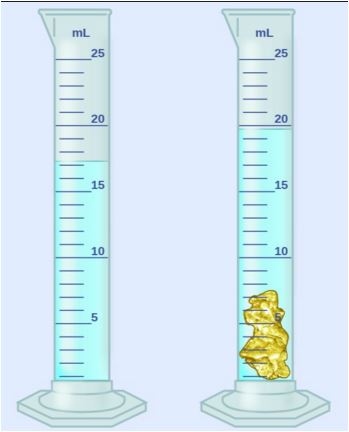
An irregularly shaped piece of gold was lowered into a graduated cylinder holding a volume of water equal to 17 ml. The height of the water rose to 20 ml. If the mass of the gold was 27 g, what was its density?
a)
9 g/mL
b)
10.5 g/mL
c)
6.5 g/mL
d)
8 g/mL
8.
The proper technique for smelling chemicals is ______________
a)
keeping your nose close to the glassware
b)
wafting
c)
to sniff only a small amount
d)
Trick question; you never are allowed to smell chemicals in class
9.
What is an ion?
a)
A Charged Atom
b)
A Large Atom
c)
A Small Atom
d)
A Cute Atom
10.
Cations are...
a)
Positive
b)
Negative
c)
Neutral
d)
Purring
11.
Anions are...
a)
Positive
b)
Negative
c)
Neutral
d)
Crying
12.
An atom becomes _________ when it gains electrons.
a)
Positive
b)
Negative
c)
Neutral
d)
Invinsible
13.
An atom becomes _______ when it loses electrons.
a)
Positive
b)
Negative
c)
Neutral
d)
Invinsible
14.
Valence electrons are: 
a)
Electrons farthest away from the nucleus
b)
Electrons closest to the nucleus
c)
Electrons that just come and go - they don't stay with the atom
15.
Ions are: 
a)
atoms with a positive or negative charge
b)
atoms with no charge
c)
atoms with ONLY a positive charge
d)
atoms with ONLY a negative charge
16.
When an atom loses a valence electron, it becomes a(n) _____________ ion.
a)
positive
b)
negative
c)
neutral
d)
polyatomic
17.
Negative ions form when atoms _________ valence electrons.
a)
lose
b)
gain
c)
share
18.
all matter is made of what 
a)
energy 
b)
atoms 
c)
electrons 
d)
compounds 
19.
The positive particles of an atom are 
a)
electrons 
b)
positrons 
c)
neutrons 
d)
protons 
20.
the central region of an atom where its neutrons and protons are is its 
a)
nucleus 
b)
electron cloud
c)
core 
d)
center 
21.
an atom with atomic number 6 would have how many protons 
a)
6
b)
12
c)
3
d)
cannot be determined 
22.
GOLD
a)
Al
b)
Ag
c)
Ar
d)
Au
23.
CHLORINE
a)
C
b)
Ca
c)
Cl
d)
Cu
24.
CALCIUM
a)
C
b)
Ca
c)
Cu
d)
Cl
25.
CARBON
a)
C
b)
Ca
c)
Cl
d)
Cu
26.
COPPER
a)
C
b)
Ca
c)
Cu
d)
Cl
27.
SODIUM
a)
S
b)
So
c)
N
d)
Na
28.
How many different elements are in this chemical formula: C2H2ClK3
a)
6
b)
8
c)
2
d)
4
29.
Which of the following is a pure substance?
a)
O2
b)
Al2CO5
c)
C6H12O6
d)
SiO2
30.
Which of the following atomic symbols for bromine is written correctly?
a)
bR
b)
BR
c)
Br
d)
br
31.
Which of the following chemical formulas represents a compound? 
a)
C3
b)
O2
c)
CH3CHO
d)
H2
32.
What is water?
a)
element
b)
compound
c)
mixture
33.
When two or more elements chemically combine
a)
element
b)
compound
c)
mixture
d)
solution
34.
a)
Element
b)
Compound
35.
The atomic number tells you what?
a)
number of electrons
b)
number of protons
c)
number of neutrons
d)
both electrons and protons in an atom.
36.
Elements which are shiny, conduct electricity and heat are called
a)
metal
b)
nonmetal
c)
metalloid
d)
nonexistent
37.
What is the formula to solve for the neutron?
a)
Mass + Atomic Number= Neutrons
b)
Mass x Atomic Number = Neutrons
c)
Mass - Atomic Number = Neutrons
d)
Mass + Number of Protons = Neutron
38.

How are elements organized in the periodic table ?

a)

Alphabetically

b)

Based on physical and chemical properties

c)

Increasing number of electrons

d)

Most reactive to least reactive

39.

Most elements on the periodic table are classified as ____________.

a)

Gases

b)

Metalloids

c)

Metals

d)

Nonmetals

40.
What is a mixture?
a)
elements chemically combined
b)
a combination of different things
c)
it is found on the Periodic Table 
d)
it is made of chemical
41.
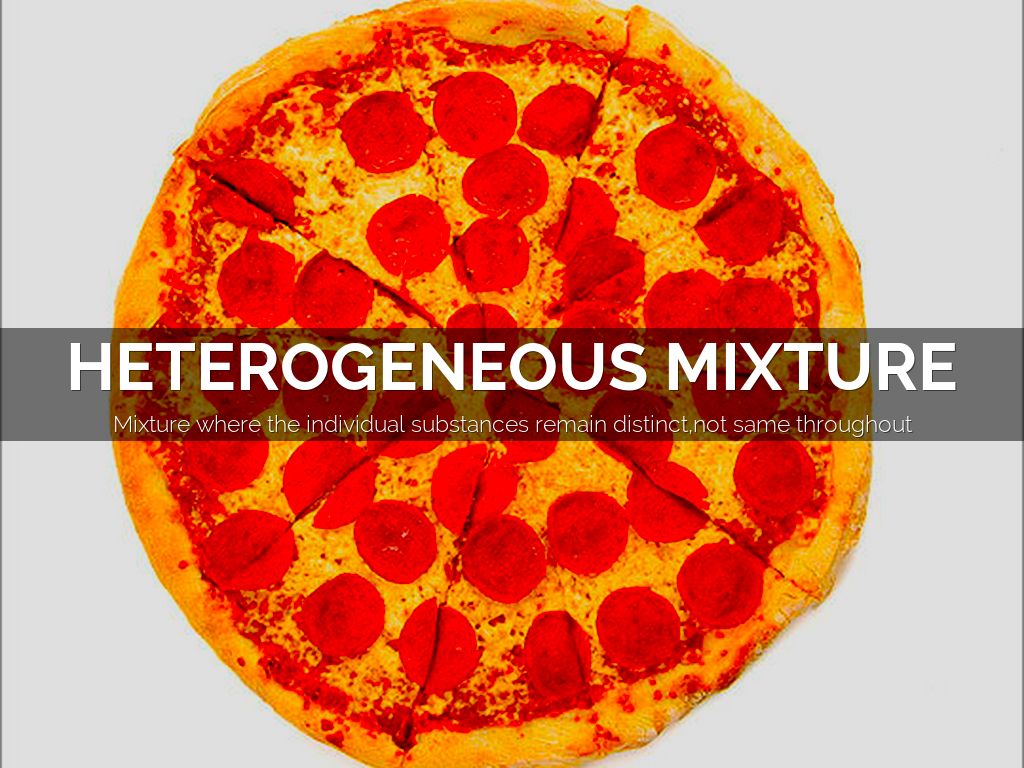
What does it mean if a mixture is heterogeneous?
a)
you can see the different parts
b)
cannot tell one part from another
c)
very well blended
d)
made of elements
42.
What does it mean if a mixture is homogeneous?
a)
you can see the different parts
b)
cannot tell one part from another
c)
chunks of particles
d)
made of elements
43.
Elements and compounds are always ___.
a)
pure
b)
mixed
44.
Mixtures are always ___.
a)
pure
b)
mixed
45.
_____ means to spread out evenly in a liquid. 
a)
melt
b)
mix
c)
dissolve
46.

Mixture or Solution?

a)

Solution

b)

Mixture

47.
Which of the following is the smallest unit of life that can carry out all life functions?
a)
the mitochondria
b)
the vacuoles
c)
the nucleus
d)
the cell
48.
Which structures are found in every living cell?
a)
cell membrane and cytoplasm
b)
chloroplasts and mitochondria
c)
a cell wall and nucleus
d)
chloroplasts and cell wall
49.
Which cell structure is found in plant and animals cells and controls what can come into or leave a cell?
a)
cell membrane
b)
cytoplasm
c)
nucleus
d)
vacuole
50.
What is the function of the cell nucleus found in both plant and animal cells?
a)
to produce energy
b)
to control cell activity
c)
to remove waste products
d)
to allow molecules to enter the cell
51.
Cell organelles that are responsible for digesting food, worn out organelles and other cellular wastes are called ___________________.
a)
Mitochondria
b)
Vacuoles
c)
Lysosomes
d)
Chlororplasts
52.
What is one basic function of the vacuoles?
a)
circulating oxygen
b)
producing food
c)
controlling cell processes
d)
storing water
53.
Chloroplasts in plant cells allow the plant to perform a function that animal cells cannot do.  What is the main function of the chloroplasts found in plant cells?
a)
to absorb light energy and manufacture food
b)
to remove waste materials by active transport
c)
to manufacture chemical energy from food
d)
to control the shape of the cell
54.
All cells need energy to function.  Which cell organelle is responsible for producing energy in the cell?
a)
chloroplasts
b)
mitochondria
c)
nucleus
d)
vacuoles
55.
What is the function of a cell wall?
a)
to protect and support the cell
b)
to perform different functions in each cell
c)
to prevent water from passing through it
d)
to prevent oxygen from entering the cell
56.
In what part of the plant cell does the process of photosynthesis take place?
a)
nucleus
b)
mitochondria
c)
chloroplasts
d)
vacuoles
57.
 Starch and water molecules in potato cells are stored in what organelle?
a)
mitochondria
b)
nucleus
c)
cell wall
d)
vacuole
58.
_ are organelles responsible for digesting certain materials within the cell.
a)
vacuoles
b)
chloroplasts
c)
lysosomes
d)
cell membrane
59.
Which of the following is not part of the cell theory?
a)
cells must contain DNA 
b)
all living things are made from cells
c)
cells can only come from other cells
d)
cells are the basic unit of life
60.
What are the states of matter?
a)
solid, liquid, and juice
b)
solid and liquid
c)
solid and gas
d)
solid, liquid, and gas
61.
Which state of matter has particles arranged like this?
a)
solid
b)
liquid
c)
gas
62.
Which state of matter has particles arranged like this?
a)
solid
b)
liquid
c)
gas
63.
Which state of matter has particles arranged like this?
a)
solid
b)
liquid
c)
gas
64.
Characteristic that can be observed such as color, state, or hardness
a)
physical property
b)
chemical property
c)
density
d)
mass
65.
Which of the following is not a way to know if a chemical reaction has occurred?
a)
Sound is given off
b)
Gas bubbles escape
c)
The shape of the object changes
d)
The temperature changes
66.
The total amount of mass in a system does not change during a chemical reaction
a)
Chemical Reaction
b)
Counting Atoms
c)
Law of Conservation of Mass
d)
Law of Conservation of Volume
67.
A sample of a substance has a mass of 7.3 g and a volume of 2.8 cm3. What is the objects density?
a)
2.61 g/cm3
b)
10.1 g/cm3
c)
0.38 g/cm3
d)
20.44 g/cm3
68.
What is the Law of Conservation of mass?
a)
Mass is created in a chemical reaction
b)
Mass is created in a physical change
c)
New chemicals formed from a chemical reaction have a larger overall mass than the original reactants
d)
Mass is never created or destroyed
69.
In a reaction A + B ----> C,  reactant A has 5g and product  C has 9g. How many grams does reactant B should have? 
a)
4g
b)
5g
c)
9g
d)
14g
70.
What is the difference between weight and mass?
a)
Weight depends on gravity and mass is constant
b)
Weight depends on density and mass depends on gravity
c)
Weight depends on gravity and mass depends on volume
d)
Mass depends on gravity and weight is constant
71.
One side of a cube is 5 cm long.  What is the cube's volume?
a)
125 cm3
b)
5 cm3
c)
15 cm3
d)
25 cm3
72.
The dip that you use to measure liquid volume is called the
a)
dip
b)
meniscus
c)
patella
d)
hibiscus
73.
The positive particles of an atom are 
a)
electrons 
b)
positrons 
c)
neutrons 
d)
protons 
74.
An atoms overall charge is 
a)
positive 
b)
depends on its mood 
c)
neutral 
d)
negative 
75.
What is the atomic number for an element with three protons?
a)
2
b)
1
c)
3
d)
6
76.
Which of the following is not a compound?
a)
HCl
b)
Cl
c)
NaCl
d)
CO2
77.
a)
1
b)
2
c)
3
d)
4
78.
a)
1
b)
2
c)
3
d)
4
79.
You drop two Alka-Seltzer tablets in a glass of water and immediately see bubbles coming up through the water. They probably indicate:
a)
A change of color
b)
Formation of a gas
c)
A change in temperature
d)
Formation of a precipitate
80.
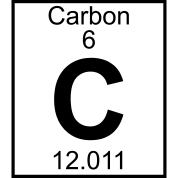
What does the C represent?
a)
atomic mass
b)
atomic number
c)
element name
d)
chemical symbol 
81.

Both elements and compounds are pure substances.

a)

Agree

b)

Disagree

82.

Can elements be changed into other elements by physical or chemical changes?

a)

No

b)

Yes

83.
a)
element
b)
compound
c)
mixture of elements
d)
mixture of compounds
84.
a)
element
b)
compound
c)
mixture of elements and compounds
d)
mixture of compounds
85.
What is the picture displayed?
a)
Atom
b)
Element
c)
Molecule
d)
Compound
86.

What is the chemical formula for oxygen gas?

a)

N2

b)

H2

c)

O2

d)

Fe2O3

87.

What is the chemical formula for Nitrogen gas?

a)

N2

b)

H2O

c)

O2

d)

Fe2O3

88.

Flammable materials, like alcohol, should never be dispensed near

a)

an open door

b)

an open flame

c)

another student

d)

a sink

89.

Why would you wear goggles in the lab?

a)

to prevent eye strain

b)

to improve your vision

c)

for protection from UV rays

d)

for protection from chemicals, heat, or glassware

90.

If you do not understand a direction or part of a lab procedure, you should

a)

figure it out as you do the lab

b)

try several methods until something works

c)

ask the instructor before proceeding

d)

skip it and go on to the next part

91.

After completing an experiment, all chemical wastes should be

a)

left at your lab station for the next class

b)

disposed of according to your instructor's directions

c)

dumped in the sink

d)

taken home

92.

If a lab experiment is not completed, you should

a)

discuss options with your instructor

b)

keep working after the bell to finish up

c)

sneak in after school and work alone

d)

come in during lunch and work while finishing your lunch

93.

You are heating a substance in a test tube. Always point the open end of the tube

a)

toward yourself

b)

toward your lab partner

c)

toward another classmate

d)

away from all people

94.

When you heat a piece of glass and need to pick it up, you should

a)

use a rag or paper towels

b)

pick up the end that looks cooler

c)

use tongs

d)

pour cold water on it

95.

The first thing you should do if you get injured in the lab is

a)

tell the instructor immediately

b)

see a doctor after school

c)

visit the school nurse after class

d)

apply first aid yourself

96.

When gathering glassware and equipment for an experiment, you should

a)

use a beaker to drink water

b)

carry as much as you can at one time

c)

stack the glassware to carry it

d)

examine all glassware to check for chips and cracks

97.

Long hair in the laboratory must be

a)

cut short

b)

held out of the way with the hand you aren't using

c)

always neatly groomed

d)

tied back with a hairband or something similar

98.

Which of the following should not be worn in the lab?

a)

closed toe shoes, hair ties

b)

watches, short sleeved shirts

c)

loose clothing, dangling jewelry

d)

long pants, boots

99.

Horseplay or practical jokes in the laboratory are

a)

always against the rules

b)

OK

c)

Acceptable if you are working alone

d)

Not a big problem as long as there are no injuries

100.

When you finish working with chemicals, biological specimens, and other lab substances, always

a)

treat your hands with lotion

b)

wash your hands with soap and water

c)

wipe your hands with a cleansing wipe

d)

dry your hands with a paper towel