
 Worksheets
Unit 2 Study Guide: States of Matter
Total questions: 52
Worksheet time: 2hrs 44mins
The sum of the kinetic and potential energy of particles in an object.
Boiling Point
Aqueous
Amorphous Solid
Bose-Einstein condensates
Alloy
Energy in motion ( = ½ mv² ).
Kinetic Energy
Boiling Point
Alloy
Amorphous Solid
Aqueous
List the three principles of the kinetic molecular theory: I. __________ II. __________ III. __________
1. Gases consist of large numbers of tiny particles that are far apart relative to their size. 2. Collisions between gas particles and between particles and container walls are elastic collisions. 3. Gas particles are in continuous, rapid, random motion.
1. Gases are made up of particles that are close together. 2. Gas particles lose energy during collisions. 3. Gas particles move in a fixed, predictable path.
1. Gases consist of a small number of large particles. 2. Collisions between gas particles are inelastic. 3. Gas particles are stationary.
1. Gases are made up of charged particles. 2. Collisions between gas particles create new substances. 3. Gas particles move only when heated.
Tell me one way that KMT applies to each of the three main states of matter:
Gas: Particles are tightly packed and vibrate in place. Liquid: Particles are far apart and move rapidly. Solid: Particles move freely and are far apart.
Gas: Particles are closer together and move more slowly than in liquids. Liquid: Particles vibrate in place and are tightly packed. Solid: Particles move rapidly and are far apart.
Gas: Particles vibrate in place and are tightly packed. Liquid: Particles move rapidly and are far apart. Solid: Particles are closer together and move more slowly than in gases.
Gas: Particles move rapidly and are far apart.
Liquid: Particles are closer together and move more slowly than in gases.
Solid: Particles vibrate in place and are tightly packed.
Complete the table below to compare gases, liquids, and solids. STATE OF MATTER → PROPERTIES ↓ Gases | Liquids | Solids
Volume and Shape (definite/indefinite): __________ | __________ | __________
Gases: Volume (definite), Shape (definite)
Liquids: Volume (indefinite), Shape (definite),
Solids: Volume (indefinite), Shape (indefinite)
Gases: Volume (indefinite), Shape (indefinite),
Liquids: Volume (definite), Shape (indefinite),
Solids: Volume (definite), Shape (definite)
Gases: Volume (definite), Shape (definite)
Liquids: Volume (definite), Shape (definite),
Solids: Volume (indefinite), Shape (indefinite)
Gases: Volume (definite), Shape (indefinite).
Liquids: Volume (indefinite), Shape (definite)
Solids: Volume (indefinite), Shape (indefinite),
What is the term for the repeating coordinated formation of a crystalline solid?
Molecule
Lattice
Isotope
Alloy
What is another possible term for an amorphous solid (because of fluidity)?
Supercooled liquid
Crystalline solid
Ionic compound
Metallic solid
What is the most common state of matter in the universe? Give three examples of this type of matter.
Gas. Examples: oxygen, nitrogen, carbon dioxide.
Solid. Examples: rocks, ice, metals.
Liquid. Examples: water, mercury, oil.
Plasma. Examples: stars, lightning, neon signs.
Why did scientists create Bose-Einstein condensates (the fifth state of matter) in 1995?
To discover a new element for the periodic table.
To develop new types of lasers for medical applications.
To study matter at temperatures close to absolute zero and observe quantum phenomena on a macroscopic scale
To improve the efficiency of solar panels.
Are phase changes physical or chemical? Explain how you know.
Phase changes are physical because the substance does not change its chemical identity.
Phase changes are chemical because new substances are formed.
Phase changes are chemical because the atoms rearrange to form new compounds.
Phase changes are physical because the substance changes into a different element.
Write the correct term for each phase change: Adding Energy: a. Solid → Liquid ____________
Melting
Freezing
Sublimation
Condensation
Write the correct term for each phase change: Removing Energy: Plasma → Gas ____________
Recombination
Freezing
Condensation
Sublimation
Write the correct term for each phase change: Removing Energy: Gas → Solid ____________
Deposition
Condensation
Sublimation
Vaporization
Write the correct term for each phase change: Removing Energy: Gas → Liquid ____________
Condensation
Recombination
Freezing
Sublimation
Write the correct term for each phase change: Removing Energy: e. Liquid → Solid ____________
Freezing
Condensation
Sublimation
Deposition
Write the correct term for each phase change: Adding Energy: Gas → Plasma ____________
Ionization
Recombination
Sublimation
Deposition
Write the correct term for each phase change: Adding Energy: Solid → Gas ____________
Sublimation
Freezing
Ionization
Recombination
Write the correct term for each phase change: Adding Energy: Liquid → Gas ____________
Vaporization
Freezing
Recombination
Condensation
Phase Change Scenarios: Describe a real-world example for each of the eight phase changes: • Condensation: • Deposition: • Freezing: • Ionization: • Melting: • Recombination: • Sublimation: • Vaporization:
Condensation: Water droplets forming on a cold glass. Deposition: Frost forming on a window. Freezing: Water turning to ice. Ionization: Gas in a neon sign becoming plasma. Melting: Ice turning to water. Recombination: Plasma in a fluorescent bulb returning to gas. Sublimation: Dry ice turning to gas. Vaporization: Boiling water.
Condensation: Ice melting on a hot day. Deposition: Water boiling. Freezing: Steam turning to water. Ionization: Water freezing. Melting: Water evaporating. Recombination: Water condensing. Sublimation: Water boiling. Vaporization: Ice melting.
Condensation: Dew evaporating from grass. Deposition: Water turning to steam. Freezing: Water boiling. Ionization: Ice melting. Melting: Water freezing. Recombination: Water boiling. Sublimation: Water condensing. Vaporization: Ice forming.
Condensation: Water boiling. Deposition: Dew forming on grass. Freezing: Water evaporating. Ionization: Water condensing. Melting: Water boiling. Recombination: Water freezing. Sublimation: Water condensing. Vaporization: Ice melting.
What is another possible term for freezing?
Solidification
Evaporation
Condensation
Sublimation
Explain the differences between boiling and evaporation. Label the diagram as well.
Boiling occurs throughout the liquid at a specific temperature, while evaporation occurs at the surface at any temperature. (Diagram: Label as boiling, with bubbles forming throughout the liquid.)
Boiling occurs only at the surface at any temperature, while evaporation occurs throughout the liquid at a specific temperature. (Diagram: Label as evaporation, with bubbles forming only at the surface.)
Boiling and evaporation both occur only at the surface and at any temperature. (Diagram: Label both as surface phenomena, with no bubbles forming in the liquid.)
Boiling and evaporation both occur throughout the liquid at all temperatures. (Diagram: Label both as bulk phenomena, with bubbles everywhere in the liquid.)
A heating curve for a substance with a melting point of 275ºC and a boiling point of 860ºC should be labeled with which of the following features?
Three states of matter, two phase changes, heat of fusion, and heat of vaporization
Only the melting and boiling points
Only the solid and liquid states
Only the heat of fusion
What does STP stand for?
Standard Temperature and Pressure
Standard Test Procedure
Systematic Temperature Process
Static Transfer Point
What is the value for temperature and pressure at STP?
0ºC (or 273.15 Kelvin) and 1 atm
25ºC (or 298.15 Kelvin) and 2 atm
100ºC (or 373.15 Kelvin) and 1 atm
-273ºC (or 0 Kelvin) and 1 atm
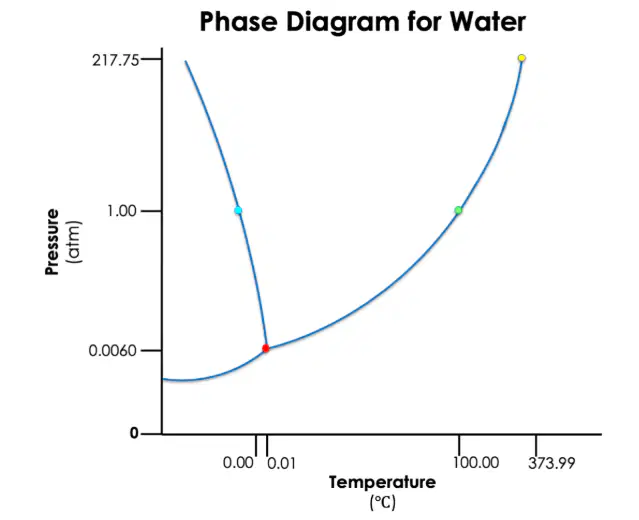
On the following phase diagram, which point represents the triple point?
The point where solid, liquid, and gas phases meet
The highest temperature and pressure on the diagram
The point where the substance changes from liquid to gas at 1 atm
The point where the substance changes from liquid to solid at 1 atm
Which of the following correctly matches each gas law with its description and a real-world example? (Gay-Lussac's Law, Charles's Law, Boyle's Law)
Gay-Lussac's Law: Pressure and temperature are directly related (e.g., a pressure cooker); Charles's Law: Volume and temperature are directly related (e.g., a hot air balloon); Boyle's Law: Pressure and volume are inversely related (e.g., a syringe).
Gay-Lussac's Law: Volume and pressure are directly related (e.g., a balloon); Charles's Law: Pressure and temperature are inversely related (e.g., a tire); Boyle's Law: Volume and temperature are directly related (e.g., a kettle).
Gay-Lussac's Law: Pressure and volume are inversely related (e.g., a syringe); Charles's Law: Pressure and temperature are directly related (e.g., a pressure cooker); Boyle's Law: Volume and temperature are directly related (e.g., a hot air balloon).
Gay-Lussac's Law: Volume and temperature are inversely related (e.g., a kettle); Charles's Law: Pressure and volume are directly related (e.g., a balloon); Boyle's Law: Pressure and temperature are directly related (e.g., a tire).
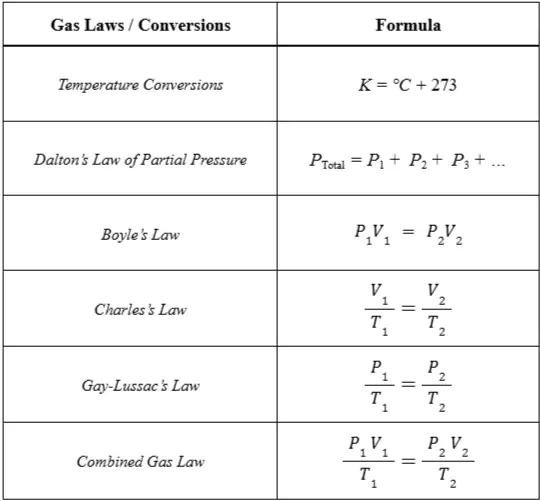
Consider a gas with a volume of 900 mL at STP. What would its new volume be at 425 K and 2 atm?
701 mL (rounded to nearest mL)
450 mL
1200 mL
980 mL

A 130 kPa sample of gas is heated from 0°C to 15°C. What will its new pressure be?
137 kPa
120 kPa
145 kPa
130 kPa

At 30°C, a sample of gas has a volume of 2.15 L. What temperature would change the volume to be 1.75 L?
247 K
273 K
320 K
200 K

A container of hydrogen and oxygen gases has a total pressure of 1,500 mm Hg. If the hydrogen gas has a partial pressure of 840 mm Hg, what is the partial pressure of the oxygen gas in the container?
660 mm Hg
740 mm Hg
1,340 mm Hg
1,500 mm Hg

A 10-L container of hydrogen gas has a pressure of 8.5 atm. What volume is needed to decrease pressure to 4 atm?
V2 = (10 L × 8.5 atm) / 4 atm = 21.25 L
V2 = (10 L × 4 atm) / 8.5 atm = 4.71 L
V2 = (8.5 L × 10 atm) / 4 atm = 8.5 L
V2 = (10 L × 4 atm) / 8.5 atm = 2.35 L
The difference between a miscible and immiscible solution is that miscible solutions mix completely, like alcohol and water, while immiscible solutions do not mix, like oil and water.
Miscible solutions mix completely, like alcohol and water; immiscible solutions do not mix, like oil and water.
Miscible solutions do not mix, like oil and water; immiscible solutions mix completely, like alcohol and water.
Both miscible and immiscible solutions do not mix at all.
Miscible solutions are always solids, while immiscible solutions are always liquids.
Alloys would not be found on the periodic table because they are mixtures of elements. Which of the following is an example of an alloy?
Brass
Oxygen
Gold
Helium
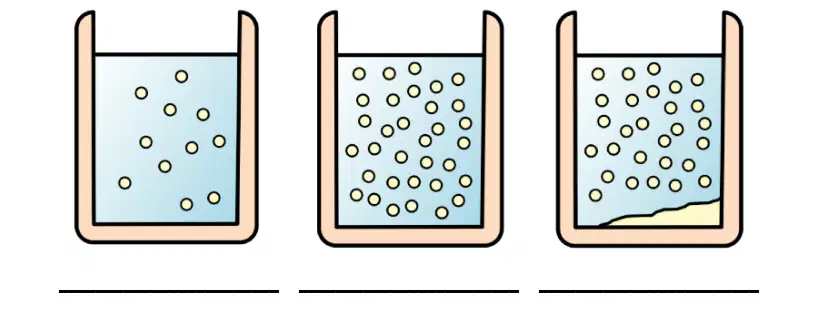
Label each solution below as either a saturated, supersaturated, or unsaturated solution.
From left to right: Unsaturated, Saturated, Supersaturated.
From left to right: Saturated, Unsaturated, Supersaturated.
From left to right: Supersaturated, Saturated, Unsaturated.
From left to right: Saturated, Supersaturated, Unsaturated.
The factor that determines if an electrolyte is considered weak or strong is:
The extent to which it dissociates in water
The color of the solution it forms
The temperature at which it is dissolved
The size of its molecules
Which of the following lists the four factors that affect solubility?
Temperature, pressure, nature of solute, nature of solvent
Color, density, mass, volume
Shape, size, color, taste
Boiling point, melting point, freezing point, condensation point
Two different ways to dilute a solution in order to make it less concentrated are:
Add more solvent or remove some solute.
Add more solute or remove some solvent.
Increase the temperature or add a catalyst.
Mix with another concentrated solution.
Which of the following lists four colligative properties?
Vapor pressure lowering, boiling point elevation, freezing point depression, osmotic pressure
Density, viscosity, surface tension, refractive index
Molarity, molality, normality, formality
Solubility, conductivity, color, taste
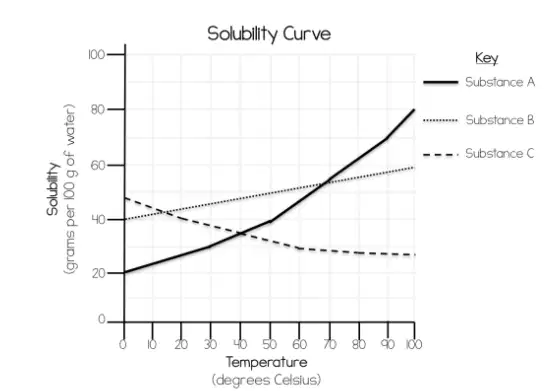
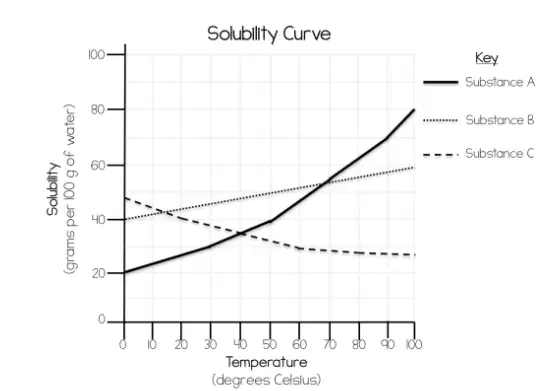
What substance is the most soluble at 0°C?
Substance C
Substance A
Substance B
Substance D
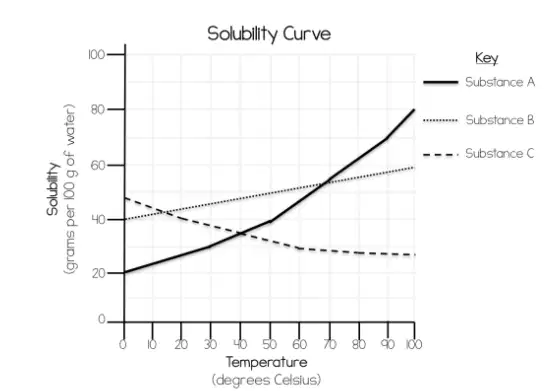
What substance is most soluble at 100°C?
Substance A
Substance B
Substance C
Substance D
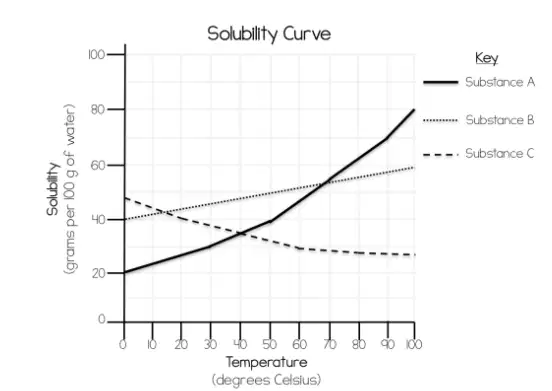
How many grams of Substance B will dissolve in 100 g of water at 60°C?
About 60 grams
About 20 grams
About 100 grams
About 10 grams
How many grams of Substance B will dissolve in 400 g of water at 60°C?
About 240 grams
About 100 grams
About 400 grams
About 60 grams
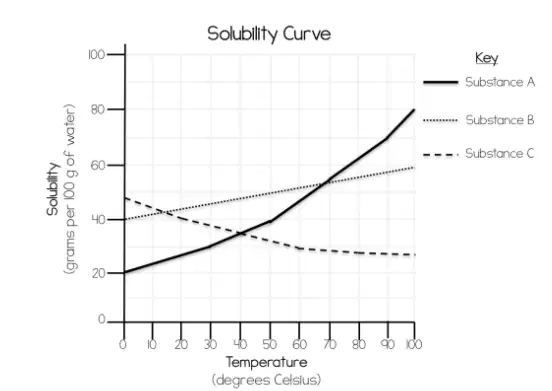
Refer to the Solubility Curve graph. Which substance shows the greatest change in solubility from 0°C to 100°C?
Substance A
Substance B
Substance C
Substance D
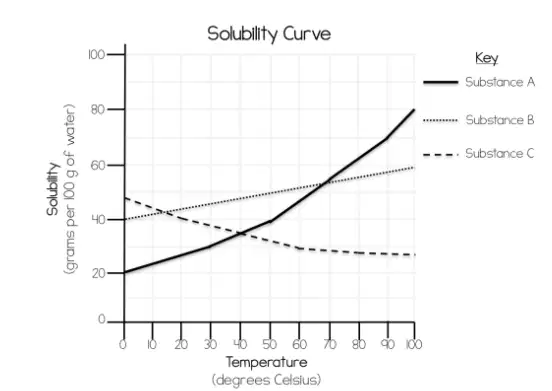
Refer to the Solubility Curve graph. What is the state of matter of each of the three substances?
Substance A: Solid, Substance B: Solid, Substance C: Gas
Substance A: Gas, Substance B: Solid, Substance C: Solid
Substance A: Liquid, Substance B: Gas, Substance C: Solid
Substance A: Solid, Substance B: Gas, Substance C: Liquid
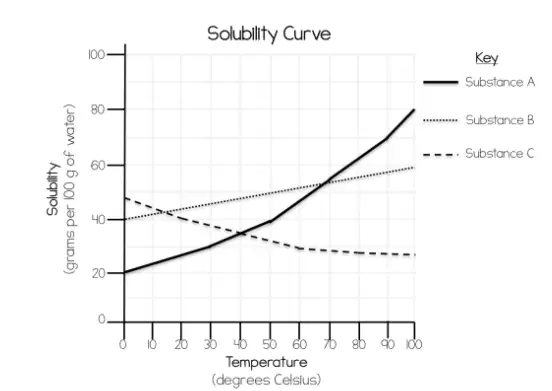
At what temperature is 30 g of Substance C in 100 g of water considered to be a saturated solution?
About 20°C
About 40°C
About 60°C
About 80°C
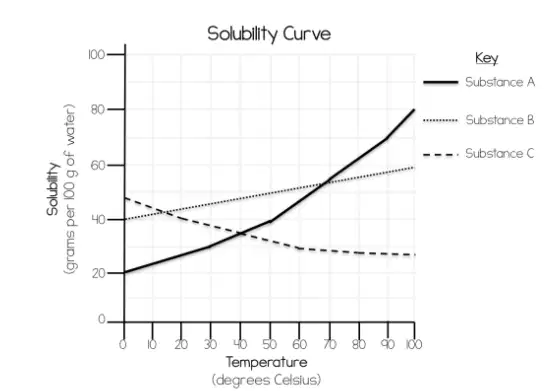
At what temperature do Substances A and B have the same solubility?
About 70°C
About 40°C
About 90°C
About 20°C
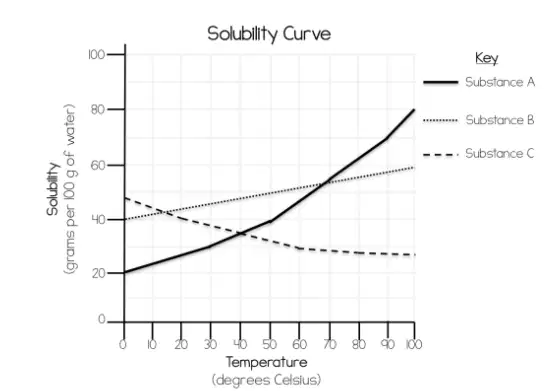
At what temperature do Substances A and C have the same solubility?
About 20°C
About 0°C
About 50°C
About 80°C
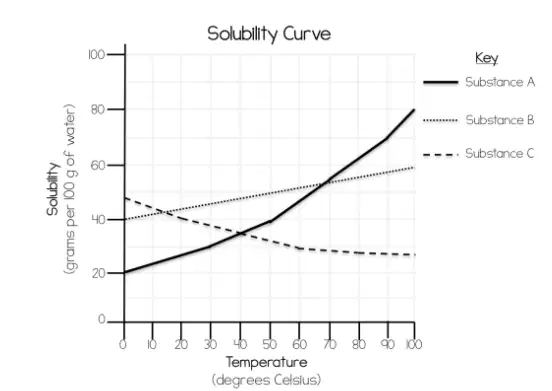
In terms of saturation, if you put 40 g of Substance A into 100 g of water at 50°C, what type of solution would it be?
Unsaturated solution
Saturated solution
Supersaturated solution
Dilute solution
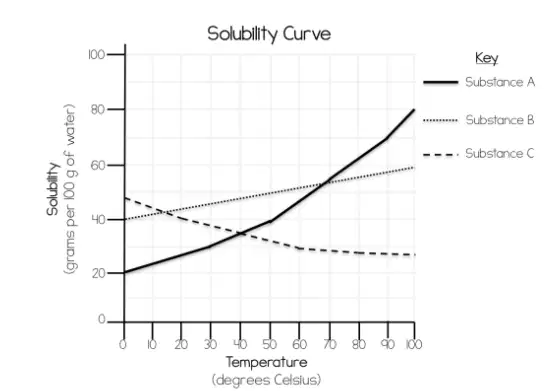
In terms of saturation, if you put 40 g of Substance B into 100 g of water at 50°C, what type of solution would it be?
Saturated solution
Unsaturated solution
Supersaturated solution
Dilute solution
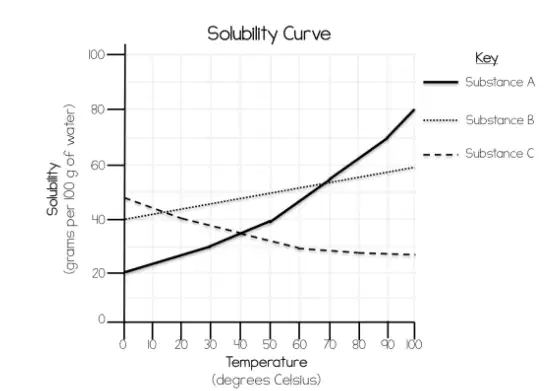
In terms of saturation, if you put 40 g of Substance A into 100 g of water at 20°C, what type of solution would it be?
Supersaturated solution
Unsaturated solution
Saturated solution
Dilute solution
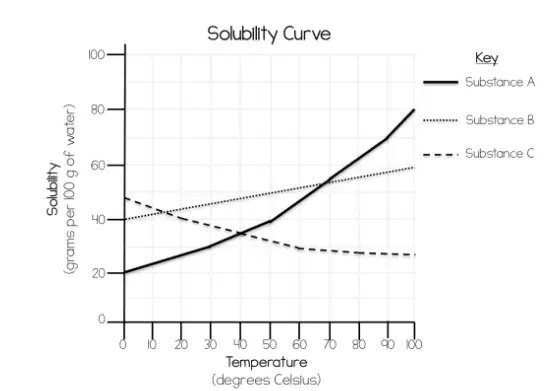
To make a supersaturated solution of Substance B at 90°C, which of the following must be done?
Dissolve more than the maximum amount of Substance B indicated by the solubility curve at 90°C
Dissolve exactly the amount of Substance B indicated by the solubility curve at 90°C
Dissolve less than the amount of Substance B indicated by the solubility curve at 90°C
Cool the solution rapidly without adding more Substance B


