
Font size
 Worksheets
Strategies for Customer Service and Ethics
Total questions: 100
Worksheet time: 50mins
According to the passage, what is probably the most important strategy for an organization to adopt in order to create a positive customer-centric service culture?
Explore your organization’s vision
Partner with customers
Demonstrate ethical behavior
Help communicate the culture and organizational vision to customers—daily
List two techniques mentioned in the passage that can help promote a positive, healthy customer-provider relationship.
Communicate openly and effectively; Smile—project a positive image; Listen intently, and then respond appropriately; Facilitate situations in which customer needs are met and you succeed in win/win situations; Focus on developing an ongoing relationship with customers.
Ignore customer feedback and focus on your own goals; Avoid direct communication; Prioritize speed over quality in all interactions.
Limit communication to written forms only; Avoid building relationships with customers; Focus solely on short-term transactions.
Respond to customers only when necessary; Avoid smiling or projecting a positive image; Discourage ongoing relationships with customers.
What is the purpose of the 'mystery caller' system mentioned in the passage?
It is a means of monitoring compliance with organizational standards, such as answering the phone by the third ring.
It is a system for tracking customer purchases.
It is a method for training new employees.
It is a tool for scheduling staff shifts.
According to the passage, why is it important to help communicate and demonstrate the culture and organizational vision to customers daily?
Because customers have specific expectations and it does no good for the organization to have a vision statement with a future objective in mind if you do not help communicate and demonstrate it to the customer.
Because customers are always interested in the financial status of the organization.
Because it helps reduce the workload of employees.
Because it allows the organization to avoid any form of customer feedback.
What is ethical behavior, as defined in the passage?
A) Acting in a manner that sends a message of positive morality and good values when confronted with a customer situation or problem
B) Always agreeing with the customer
C) Ignoring organizational values
D) Focusing only on sales
According to the text, what is the key to ongoing customer relations?
Trust
Advertising
Pricing
Location
What should you do to identify and improve your service skills?
Take an inventory of your interpersonal and customer service skills
Ignore your weaknesses
Only focus on your strengths
Avoid learning new skills
Becoming an expert on your organization is important for frontline contact persons with customers because:
It allows you to provide accurate information and build customer trust.
It helps you avoid interacting with customers.
It ensures you never have to answer customer questions.
It means you can ignore customer feedback.
Continually upgrading your knowledge and skills related to people, customer service, and products offered positions you as a resource to the customer and an asset to the organization.
True
False
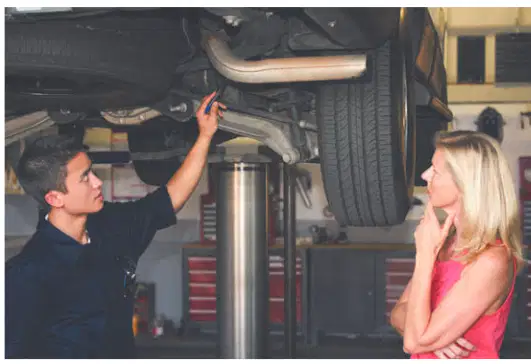
What skills will you need and what information should you give customers in this situation?
You will need communication skills and should provide clear, accurate information to customers.
You will need technical skills and should give customers only written instructions.
You will need artistic skills and should provide customers with unrelated information.
You will need physical strength and should avoid giving any information to customers.
It is important to avoid using 'they' language when dealing with customers because it can sound impersonal. What is a better alternative?
Use 'we' language to create a sense of partnership
Use more technical jargon
Refer to customers by their account number
Avoid addressing the customer directly
Work with your customer’s interest in mind. If you were your customer, what type of service would you expect?
The type of service I would expect is attentive and customer-focused.
The type of service I would expect is slow and inattentive.
The type of service I would expect is indifferent and careless.
The type of service I would expect is unhelpful and dismissive.
Building strong relationships with co-workers and peers throughout the industry can help you provide better customer service by:
Facilitating the sharing of resources and knowledge.
Reducing the need for teamwork.
Limiting communication with others.
Focusing only on individual performance.
The most important strategy for communicating a positive service culture is:
Consistently modeling positive behaviors and attitudes
Focusing only on written communication
Ignoring customer feedback
Limiting communication to management only
Determining the type of service environment in an organization when speaking to supervisors or interviewers can be achieved by:
Asking specific questions about the organization's service processes and culture.
Ignoring the supervisor's responses and making assumptions.
Focusing only on the job description without discussing the environment.
Relying solely on online reviews without direct conversation.
Many employees in small companies lack which characteristic, leading to service problems?
Strong communication skills
Technical expertise
Physical strength
Creativity
From a service perspective, it is better to work for a small company or a large one because:
Small companies often offer more personalized service and flexibility.
Large companies always provide better salaries.
Small companies have more resources than large companies.
Large companies never care about individual employees.
Service providers in small companies differ from their large organization counterparts to what degree?
They often have more personalized service and flexibility.
They have the same resources as large organizations.
They are less responsive to customer needs.
They offer a wider range of services than large organizations.

An owner can make his or her sole proprietorship special or different by:
Providing personalized service to customers
Reducing the number of employees
Limiting business hours
Avoiding customer feedback
A positive service atmosphere can have which of the following impacts on customers and employees?
It can enhance satisfaction and motivation for both customers and employees.
It can lead to confusion and dissatisfaction for customers only.
It can decrease employee motivation but increase customer satisfaction.
It has no significant impact on either customers or employees.
What message does this approach to service say about the organization?
It values customer satisfaction and quality service.
It prioritizes profit over service.
It ignores customer feedback.
It lacks a clear service strategy.
Potential outcomes of such practices by the supervisor include:
Decreased employee morale
Increased transparency
Improved communication
Enhanced job satisfaction
You and other employees can address the situation by:
Reporting the issue to management or HR
Ignoring the situation completely
Spreading rumors about the situation
Quitting your job immediately
According to Policy 2, within how many days of the invoice date must books be received for a return?
Thirty (30) days
Fifteen (15) days
Sixty (60) days
Ninety (90) days
According to Policy 2, in what condition must books be received for a return?
Salable condition. Damaged books will not be accepted for credit.
Any condition, including damaged books.
Only if the books are out of print.
Books must be returned with a receipt, regardless of condition.
According to Policy 2, will refunds be made on videotapes and software if they were not defective at the time of purchase?
Yes
No
According to Policy 2, who is responsible for the cost of returning materials, including customer’s charges, if any?
The shipper (customer) is responsible for the cost of returning materials.
The manufacturer is responsible for the cost of returning materials.
The delivery company is responsible for the cost of returning materials.
The government is responsible for the cost of returning materials.
What should you do to know your exact duties?
Get a copy of your job description in writing, if possible.
Ask a coworker for their opinion.
Assume your duties based on previous jobs.
Wait for your manager to tell you verbally.
Your expectations of me are:
To meet your expectations
To ignore your expectations
To misunderstand your expectations
To avoid your expectations
Handling [name specific] situations involves:
Applying appropriate strategies for the situation
Ignoring the situation completely
Reacting impulsively without planning
Avoiding any form of communication
Who should I see about _________?
a doctor
a mechanic
a chef
a teacher
The location of [materials, policies, equipment] is:
In the designated storage area
In the cafeteria
Outside the building
In the parking lot
The person in charge when you are not available is:
Your designated substitute
A random employee
The newest team member
No one
My level of authority is:
High
Low
Moderate
None
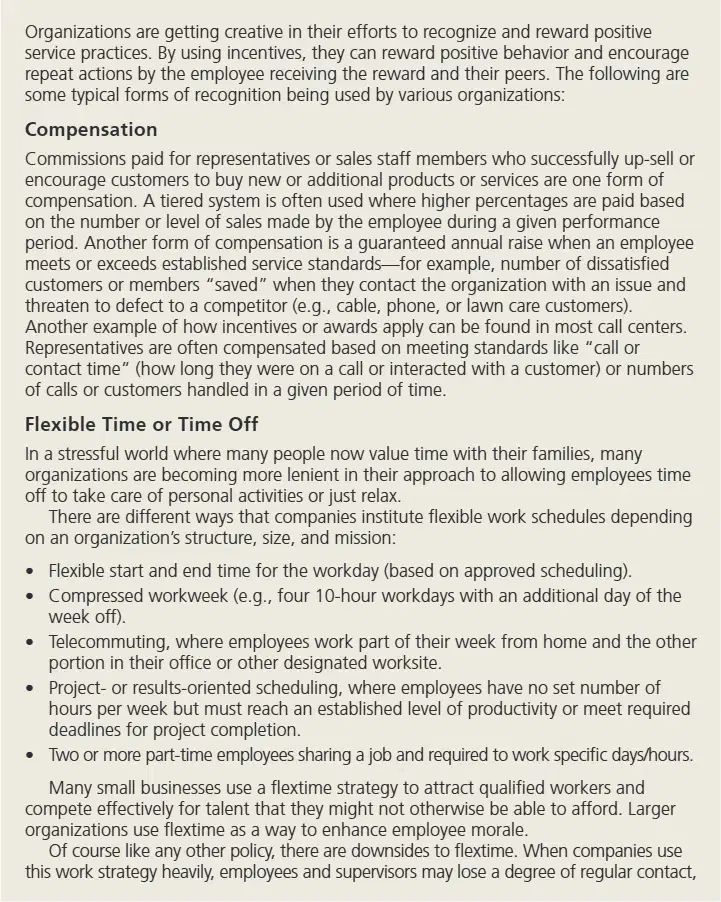
What is the main purpose of using incentives and rewards in organizations, as described in Figure 2.5?
To punish employees for poor performance
To encourage positive behavior and recognize good service practices
To reduce the number of employees
To increase product prices
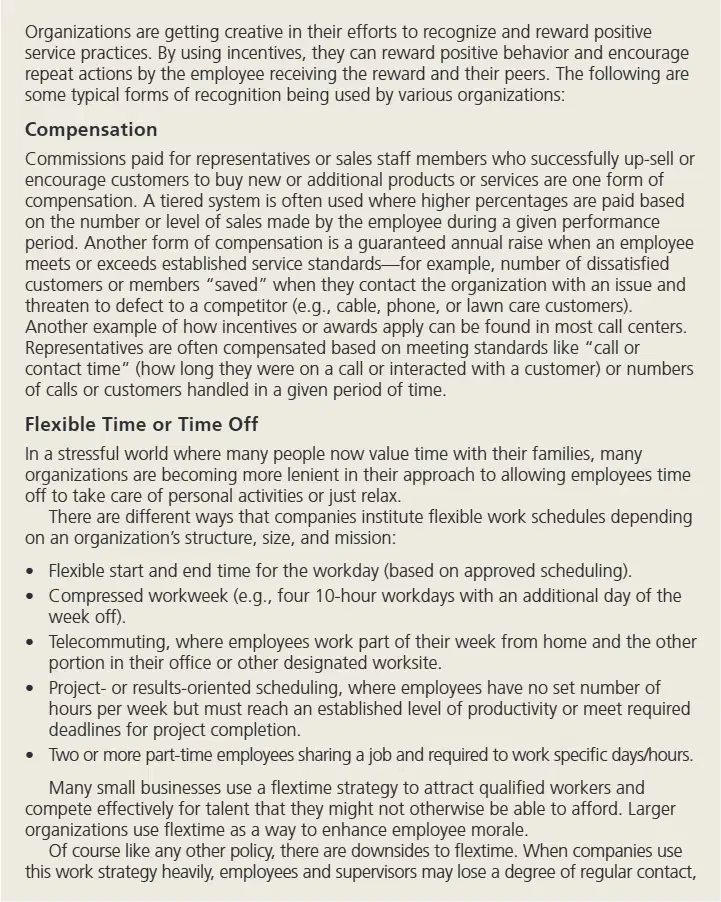
Fill in the blank: Commissions are paid to representatives or sales staff members who successfully ______ or encourage customers to buy new or additional products or services.
up-sell
refund
complain
ignore
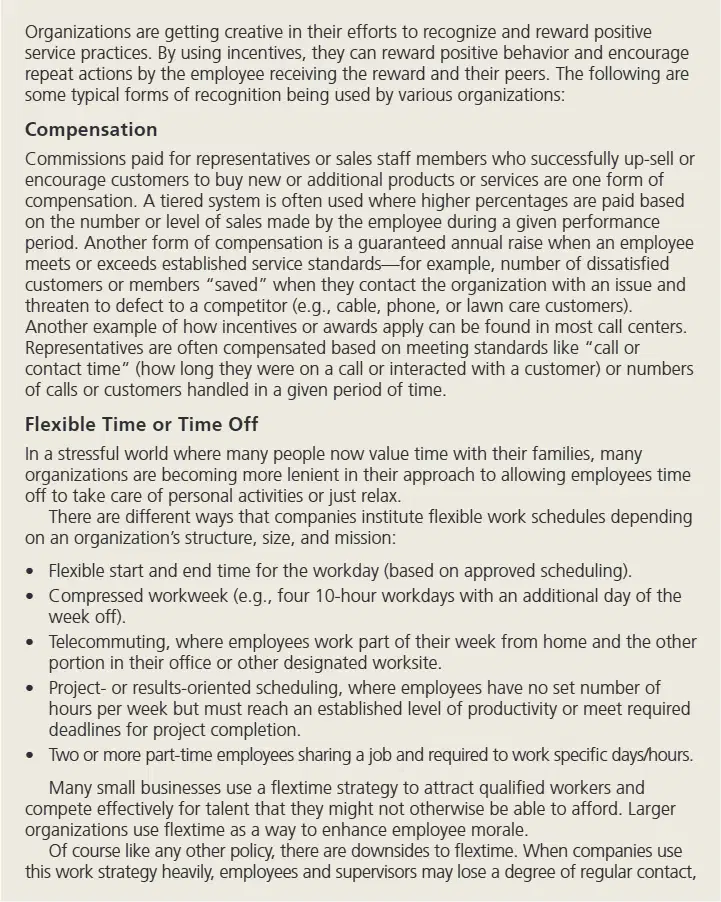
Which of the following is NOT a form of flexible time or time off mentioned in Figure 2.5?
Flexible start and end time for the workday
Compressed workweek
Mandatory overtime every week
Telecommuting
Flexible time or time off can include telecommuting, where employees work part of their week from home and the other portion in their ______ or other designated worksite.
office
car
gym
school

Compensation as a reward can include a guaranteed annual fixed raise when an employee meets or exceeds established service standards.
True
False
Which of the following is NOT mentioned as a way to recognize employees in the 'Employee Recognition' section?
Having a buffet breakfast or pizza party once a month
Giving a round of applause for accomplishments
Giving a handwritten note or card from the CEO
Offering a paid vacation to employees
Providing employee-of-the-month parking spaces
Fill in the blank: One of the easiest and least expensive means of rewarding employees is to acknowledge them as ______ and applaud their accomplishments.
people
numbers
machines
resources
According to the text, what is important about rewards for employees?
They should be expensive
They should be perceived as being given fairly and in a timely fashion
They should be given only to managers
They should be given once a year
Management support is always adequate for frontline service providers.
True
False
Fill in the blank: A key role played by your manager, supervisor, and/or team leader is to provide effective, ongoing ______, counseling, and training to you and your peers.
coaching
criticism
punishment
delegation
If you are not receiving the support you need from your supervisor or manager, you should:
Seek assistance from another appropriate resource or escalate the issue.
Ignore the problem and hope it resolves itself.
Complain to coworkers without taking further action.
Quit your job immediately without discussing the issue.
A supervisor or manager sometimes becomes involved in an employee-customer encounter. What typically occurs in such situations?
The supervisor or manager helps resolve the issue between the employee and customer.
The supervisor or manager ignores the situation.
The supervisor or manager always sides with the employee without listening to the customer.
The supervisor or manager leaves the situation unresolved.
The supervisor handled the situation:
effectively and professionally
without any concern
with indifference
in a careless manner
The supervisor’s approach could have been improved by:
Providing clearer guidance and support.
Ignoring employee feedback.
Maintaining the same approach without changes.
Reducing communication with the team.
What is a mentor? Fill in the blank: A mentor is an individual who dedicates time and effort to befriend and assist others. In an organization, they are typically people with a lot of knowledge, experience, skills, and initiative, and have a large personal and professional network established.
An individual who dedicates time and effort to befriend and assist others, typically with a lot of knowledge, experience, skills, and initiative, and a large personal and professional network.
A person who only supervises others without sharing knowledge or experience.
Someone who focuses solely on their own career advancement and ignores others.
An individual who avoids building professional relationships and networks.
What is a protégé? Fill in the blank: A protégé is typically a less-experienced recipient of the efforts of mentors.
A less-experienced recipient of the efforts of mentors.
A highly experienced mentor guiding others.
A person who works independently without guidance.
A supervisor responsible for managing a team.
Which of the following is a characteristic of an effective mentor?
Willingness to be a mentor
Lack of communication skills
Unreliable
Disconnected from the organization
Which of the following is a characteristic of an effective mentor?
Poor motivator
Good coaching skills and a good motivator
Lack of patience
Untrustworthy
Fill in the blank: An effective mentor should be ________ about the organization and industry.
knowledgeable
indifferent
uninformed
careless
disinterested
Fill in the blank: An effective mentor should be a good ________ (verbal, nonverbal, and listening skills).
communicator
observer
critic
organizer
Fill in the blank: An effective mentor should be well-connected ________ and ________ the organization.
inside and outside
above and below
before and after
here and there
Fill in the blank: An effective mentor should be ________ (showing excitement and interest).
enthusiastic
apathetic
indifferent
bored
Fill in the blank: An effective mentor should be ________.
charismatic
impatient
unreliable
distracted
inflexible
Fill in the blank: An effective mentor should be ________ (able to be trusted).
trustworthy
boastful
forgetful
impatient
Fill in the blank: An effective mentor should be ________ (able to wait without frustration).
patient
impatient
arrogant
distracted
Fill in the blank: An effective mentor should be a ________ thinker.
creative
rigid
indifferent
passive
Fill in the blank: An effective mentor should be ________ (having confidence in oneself).
self-confident
timid
indecisive
pessimistic
insecure
Fill in the blank: An effective mentor should be a good ________ solver.
problem
math
puzzle
game
Which of the following is a characteristic of a successful protégé?
Openness to feedback
Unwillingness to learn
Lack of adaptability
Poor communication skills
Fill in the blank: A successful protégé should have ________ to participate, listen, and learn.
willingness
hesitation
ignorance
reluctance
indifference
Fill in the blank: A successful protégé should have a desire to ________ and grow.
improve
complain
ignore
retreat
Fill in the blank: A successful protégé should have ________ to working with a mentor.
commitment
hesitation
indifference
resistance
Fill in the blank: A successful protégé should have self-________.
confidence
doubt
pity
neglect
Fill in the blank: A successful protégé should have effective ________ skills.
communication
mathematical
athletic
musical
Fill in the blank: A successful protégé should be ________.
enthusiastic
indifferent
careless
apathetic
Fill in the blank: A successful protégé should be ________ to feedback.
open
resistant
indifferent
hostile
Fill in the blank: A successful protégé should be ________.
adaptable
stubborn
indifferent
rigid
Fill in the blank: A successful protégé should have willingness to ask ________.
questions
orders
complaints
excuses
Training for Service: Select the type of skills training that would be most valuable for a customer service professional.
Communication skills training
Technical drawing skills training
Physical fitness training
Musical instrument training
Training for Service: Select the type of training required to qualify for a service position.
Customer service training
Medical school training
Engineering certification
Pilot license
Fill in the blank: A cashier has to call a supervisor for approval of a customer's ________.
personal check
grocery list
shopping cart
membership card
coupon
Fill in the blank: A cable television installer has to call the office for approval before adding a ________ for another room.
hookup
television
remote
antenna
Fill in the blank: A computer technician cannot comply with a customer's request that she make a backup CD-ROM of her hard drive before running a diagnostic test because ________ prohibits it.
policy
hardware failure
lack of training
customer preference
Fill in the blank: A call center service representative does not have the authority to reverse late payment charges on the account of a customer who explained that he was in the hospital for three weeks with ________ complications.
surgery
financial
travel
internet
Elements included in a successful service organization are:
Customer focus, effective leadership, employee involvement, and continuous improvement
High prices, limited services, poor communication, and inflexible policies
Minimal training, lack of feedback, and outdated technology
Ignoring customer feedback, rigid hierarchy, and low employee morale
RUMBA is an acronym that stands for which of the following, and how does it relate to your service roles and expectations?
Relevant, Understandable, Measurable, Behavioral, Achievable; it provides criteria for setting effective service goals and expectations.
Reliable, Unbiased, Motivated, Balanced, Accountable; it defines the core values of service roles.
Resourceful, Unique, Methodical, Bold, Adaptable; it describes the qualities needed for service excellence.
Respectful, Upstanding, Mindful, Beneficial, Assertive; it outlines the ethical standards for service roles.
Rewards and management support play what role in successful customer service?
They motivate employees and reinforce positive behaviors.
They decrease employee engagement.
They have no impact on customer service.
They create confusion among staff.
As a service provider, you should do your part in determining needed approaches for service success. From the perspective of a customer service professional, identify who your customer is.
Anyone who receives your service
Only your manager
Only your coworkers
Only the company owner
As a service provider, what should you consider to help achieve organizational excellence?
Determine needed approaches for service success.
Focus only on personal goals.
Ignore customer feedback.
Rely solely on management for direction.
As a service provider, you should do your part in determining needed approaches for service success. From the perspective of a customer service professional, do you focus all your efforts on total customer satisfaction?
Yes, I focus all my efforts on total customer satisfaction.
No, I focus only on company policies.
No, I prioritize my own convenience over customer needs.
No, I ignore customer feedback.
As a service provider, you should do your part in determining needed approaches for service success. From the perspective of a customer service professional, what should you ask yourself regarding your authority to serve customers?
Am I empowered to make the decisions necessary to serve my customer?
Do I need to avoid making decisions for my customer?
Should I always refer customer issues to my supervisor?
Is it unnecessary to discuss authority levels with my supervisor?
As a service provider, you should do your part in determining needed approaches for service success. From the perspective of a customer service professional, what should you consider if there are policies and procedures that inhibit your ability to serve the customer?
Make recommendations about changing policies and procedures.
Ignore the policies and continue as usual.
Complain to your coworkers about the policies.
Refuse to serve the customer until policies change.
As a service provider, you should do your part in determining needed approaches for service success. From the perspective of a customer service professional, when should you ask yourself: When was the last time I told my customers that I sincerely appreciated their business?
Regularly, to ensure customers feel valued
Only when a customer complains
Only at the end of the year
Only after a sale is made
Areas of organizational skills and product and service knowledge where I need additional information include:
Time management and product features
Basic arithmetic and sports rules
Foreign languages and travel destinations
Cooking techniques and movie genres
The most effective way to share these ideas is:
By presenting them clearly and engagingly
By keeping them to yourself
By ignoring feedback from others
By using overly complex language
The most effective way to share these ideas is:
By presenting them clearly and engagingly
By keeping them to yourself
By ignoring feedback from others
By using complex and confusing language
Fill in the blank: Customer-friendly systems refers to the processes in an organization that make service ______ to customers by ensuring that things work properly and the customer is satisfied.
seamless
difficult
expensive
slow
What is the definition of a service delivery system?
The process of selling products to customers
The means by which an organization effectively gets its products and services to customers
The method of advertising products
The way customers pay for products
According to the Customer Service Success Tip, what is one way to contribute to a positive service culture?
By taking the time to slow down and let your customers take the lead and discover what they need or want.
By focusing only on making quick sales without listening to customers.
By ignoring customer feedback and sticking to standard procedures.
By prioritizing your own convenience over customer needs.
According to the passage, what are the key factors involved in delivery of services to customers?
Transportation modes (how products and services are physically delivered) and location (facilities located centrally and easily accessible by customers).
Product pricing and advertising strategies.
Employee training programs and customer feedback surveys.
Quality control measures and supplier relationships.
Why is it important for organizations to provide effective follow-up support to customers?
To ensure ongoing and continuous reevaluation of system success and to keep up with the changing needs of customers.
To reduce the number of employees needed in customer service.
To increase the price of products and services.
To avoid collecting feedback from customers.
List two ways customers may express dissatisfaction if their needs are not met by a service delivery system.
Complaining, speaking negative word-of-mouth publicity, writing letters to consumer advocacy groups, or going elsewhere for their needs.
Praising the service provider and recommending them to others.
Ignoring the issue and continuing to use the service without any feedback.
Requesting additional services without mentioning dissatisfaction.
According to the passage, what is the major difference between direct and indirect delivery systems?
Direct systems use only technology to serve customers
Indirect systems involve direct interaction with people
Direct systems involve customers interacting directly with people, while indirect systems meet needs primarily with self-service through technology
Indirect systems do not use technology at all
Fill in the blank: In an indirect system, customer needs are met primarily with ________ through technology integrated with Internet services.
self-service
face-to-face interaction
manual paperwork
direct supervision
Which of the following is an example of a cost-saving strategy used by banks as mentioned in the passage?
Hiring more staff
Upgrading automated phone systems and adding ATMs
Reducing the number of ATMs
Increasing manual customer service
Many customers prefer a hands-off self-service approach, and none resent it.
True
False

