
 Worksheets
Changes to Education
Total questions: 62
Worksheet time: 31mins
Nora grew up in a low-income neighborhood but, after years of hard work and education, she was able to get a high-paying job and move to a wealthier area. What is the term for the ability to move up or down the social hierarchy?
Cultural Capital
Social Mobility
Stratification
Habitus
At school, Ava notices that besides academic subjects, she also learns about things like following rules, respecting authority, and social expectations, even though these aren't part of the official curriculum. What is this concept called?
Hidden Curriculum
Manifest Functions
Meritocracy
Ascribed Status
Aria grew up in a family that valued art, literature, and classical music, giving her unique insights and skills that help her succeed in school and social settings. What is the term for the resources and advantages a person gains from their cultural background?
Social Reproduction
Cultural Capital
Socio-economic Status
Life Chances
In a certain country, entire groups of people are ranked in a structured way that results in some groups consistently having more economic rewards and power than others. What concept best describes this situation?
Stratification
Social Inequality
Meritocracy
Latent Functions
At a local community center, Ava organizes weekly movie nights to bring neighbors together. While the main goal is entertainment, some attendees end up forming new friendships and support networks, which was not the original intention. What is the term for these functions of a social system that are not immediately apparent or intended?
Manifest Functions
Latent Functions
Conflict Perspective
Achieved Status
Aria is researching how the role of education has changed over time for her school project. She wants to understand whether education has stayed the same or evolved to meet new needs. What should Aria conclude based on her findings?
Education has remained the same throughout history.
Education has evolved to meet societal needs.
Education has become less important over time.
Education has only focussed on technology.
At a school staff meeting, Benjamin notices that decisions are influenced not just by official roles, but also by informal relationships and the ability to persuade others. What are the dimensions of power and politics in educational institutions?
Only financial power is relevant.
Power and politics are not present in education.
Various dimensions including authority and influence.
Power is solely based on student performance.
Emma is researching how schools interact with other organizations in her community, such as local businesses, government agencies, and families. What best describes the relationship between educational institutions and other institutions?
Educational institutions operate independently.
They have no relationship with other institutions.
They interact and influence each other.
Educational institutions only follow government directives.
In a school, students are often grouped into different classes based on their academic abilities. What is the role of stratification in this educational setting?
Stratification has no role in education.
It helps in organising students based on ability.
It only affects teachers, not students.
Stratification is irrelevant in modern education.
Harper attends school where she learns math, science, and history. According to Merton, what is one of the manifest functions of Harper's education?
Teaching knowledge and skills
Promoting individualism
Encouraging competition
Fostering economic growth
In a classroom, Grace learns about her country's traditions, beliefs, and customs through her lessons. Which function of education is being demonstrated here?
Economic development
Cultural transmission of values
Technological advancement
Political stability

While attending university, Avery noticed that many students met their future partners or spouses on campus. Which of the following is considered a latent function of education in this scenario?
Matchmaking/marriage market
Curriculum development
Standardised testing
Classroom management
What is an unintended function of education related to employment?
Providing job-specific skills
Babysitting
Offering career counselling
Teaching time management
Match the following roles of education according to functionalism with their correct descriptions.
To entertain students
Education is seen as a source of amusement for learners.
To train each generation
Education is responsible for passing on knowledge and skills to new members of society.
To create social divisions
Education is viewed as a way to separate people into different groups.
To promote individualism
Education is focused on developing unique personal traits in each student.
Match the following descriptions with how education contributes to cultural transmission.
By isolating cultural values
Education separates cultural beliefs from society
By passing on society's core values to the next generation
Education helps preserve and share important societal values
By eliminating cultural differences
Education removes all distinctions between cultures
By focusing on economic growth
Education prioritizes financial development over cultural aspects
At a school, students from various racial, religious, and cultural backgrounds attend classes together. What is the purpose of social integration in this educational setting?
To separate different subcultures
To integrate members of different racial, religious, or other subcultures into a common culture
To promote individual cultural identities
To focus on economic development
What does the concept of meritocracy in education imply?
Success is based on socio-economic background
Talent and intelligence lead to educational achievement
Education is only for the privileged
Education does not affect social mobility
William is attending school where he learns various skills that he will use in his future career and daily life. According to functionalism, how does this educational experience help in his personal development?
By providing skills expected to be of use later in life
By focusing solely on academic knowledge
By ignoring individual growth
By promoting only physical development
One criticism of the functionalist perspective regarding the role of schools is that schools cannot explain the inequalities of class, status, power, and (a) .
In a city, Charlotte notices that despite attending different schools, students from wealthier neighborhoods often end up in higher-paying jobs, while those from less privileged backgrounds tend to remain in lower-income roles. According to criticisms of the functionalist perspective, what are the schools in this scenario tending to reproduce?
Equal opportunities for all students.
The stratification system generation after generation.
A perfect meritocratic system.
Complete acceptance of societal norms.
According to critics, what does the functionalist perspective overlook when determining an individual's success?
The role of education.
The importance of hard work.
Dominant factors such as inheritance of wealth.
The influence of peer groups.
A criticism of the functionalist perspective regarding socialisation is that not everyone accepts norms and values of society through (a) .
At a high school, different social groups have varying access to advanced classes and extracurricular activities. According to conflict theory, what is one way these groups might use education?
To promote equality among all students
As a means of getting or keeping power, wealth, and prestige
To ensure all students receive the same opportunities
To eliminate social divisions
What is the relationship between education and social inequality according to the conflict perspective?
Education eliminates social inequality
There is no link between education and social inequality
Education perpetuates social inequality
Education reduces social inequality
In a city, Priya notices that students from wealthy families often have access to better resources and opportunities in their schools, while students from less privileged backgrounds face more challenges. According to the conflict perspective, how do schools in this scenario contribute to social divisions?
By promoting equal opportunities for all
By helping members of the elite to maintain dominance
By reducing the gap between different social classes
By encouraging diversity and inclusion
According to the conflict perspective, what role does the Hidden Curriculum play in education?
It promotes creativity and innovation
It helps to perpetuate social inequalities
It encourages critical thinking
It fosters independent learning
What did research by Samuel Bowles and Marks et al. find about students from educated families?
They performed worse than other students
They performed better than other students
They had no difference in performance compared to others
They were less likely to succeed in education
According to research by Samuel Bowles in 1977, which group of students performed better?
Students from educated families
Students from rural areas
Students from single-parent families
Students from urban areas
What does census data reveal about the relationship between income, parental education, and school performance?
They are unrelated
They are closely linked
They are inversely related
They are only linked in urban areas
Bowles and Gintis emphasised (a) in 1976 regarding education.
James notices that in his school, certain students are often encouraged to take on leadership roles and advanced classes, while others are guided towards less challenging paths. According to Bowles and Gintis, what does this hidden curriculum in schools lead to?
Increased social mobility
Selection of students for success or failure
Equal opportunities for all students
Advancement of the working class
Maya and Scarlett attend different schools. Maya's family often takes her to museums and encourages her to read classic literature, while Scarlett's family does not have the same resources or habits. According to Bourdieu, what concept explains how these differences can affect their educational experiences?
Reproduction Theory
Social Mobility
Cultural Capital
Meritocracy
According to Bourdieu, how do schools affect the working class?
They provide equal opportunities
They alienate the working class
They promote social mobility
They support the working class
According to the conflict perspective, why is the educational system considered unfair?
It provides equal opportunities to all students.
It favours children from lower status families.
Children from upper status families have advantages that lead to greater success.
It focuses solely on academic performance.

What does Bourdieu claim about the habitus of children from different class backgrounds?
It has no impact on their educational success.
It disadvantages them in the classroom.
It ensures equal opportunities for all.
It is irrelevant to their behaviour.
What is one criticism of conflict theory?
It focuses too much on social stability.
It neglects the role of change in society.
It emphasises change and neglects social stability.
It provides a comprehensive view of social dynamics.
According to the criticisms of conflict theory, what does it fail to explain?
The role of individual actions in society.
The process of social change.
Social stability and the possibility of compromise.
The impact of technology on social structures.
What change occurred in public school fees following World War II?
Fees were increased
Fees were abolished
Fees were reduced by half
Fees were only for private schools
How are schools divided today according to the document?
By grade level
By geographic location
Into public and private sectors
By student performance

What percentage of schools are government-run today?
50%
72%
18%
10%
What has been a direct result of the diversion of funds from public to private schools?
Increased public school enrolment
Growth in private schools
Decrease in private school tuition fees
Improvement in public school facilities
Why do more parents aspire to private schooling for their children?
They received private education themselves
Public schools are more expensive
Media accounts fuel fears about public schools
Private schools are closer to home
What has eroded faith in public schools over the last decade?
Increase in public school funding
Diversion of funds to private schools
Decrease in private school enrolment
Improvement in public school standards
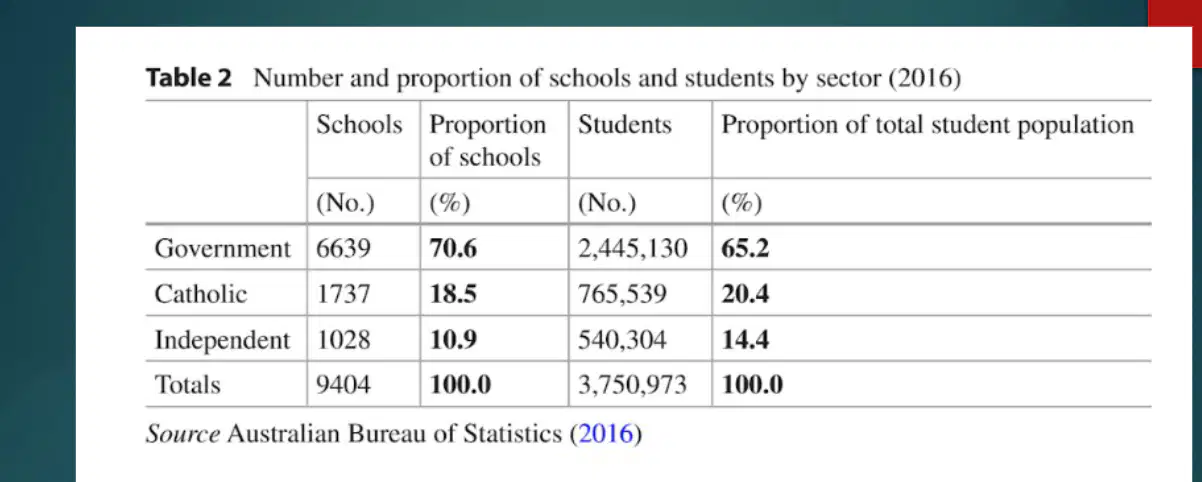
Based on Table 2, what percentage of schools were government schools in 2016?
18.5%
10.9%
70.6%
65.2%

According to Table 3, what was the percentage of primary school enrolments in Catholic schools in 2014?
19.1%
11.8%
22.9%
59.3%

What was the proportion of the total student population in independent schools in 2016 according to Table 2?
20.4%
14.4%
65.2%
10.9%

In Table 3, what percentage of senior secondary enrollments were in independent schools in 2014?
18.6%
22.0%
11.8%
59.4%
During which decades did the feminist movement instigate significant changes to education?
1950s and 1960s
1970s and 1980s
1990s and 2000s
2000s and 2010s
What were the Gateway subjects that special programs encouraged girls to take up?
History and Geography
Literature and Art
Maths and Science
Physical Education and Music
What was one of the goals of feminists regarding the education system?
To make it more competitive
To make it a fairer place for both girls and boys
To focus solely on boys' education
To eliminate all exams
Which of the following was a reason for the gender gap in education?
Equal representation in senior positions
Gender-neutral curriculum
Males often occupying more senior positions
Balanced portrayal of women in texts

What impact did the feminist movement have on women's education and career opportunities?
It limited women's access to education.
It opened up the labor market for women.
It restricted women to traditional roles.
It decreased women's participation in the workforce.
What new challenges are posed by the emergence of new curriculum areas such as computer technology and media studies?
They eliminate gender inequality.
They pose new challenges for investigating gender inequality.
They have no impact on gender issues.
They only benefit male students.
According to Habibis & Walter (2009), what concern is raised about girls' preparation in the computer industry?
Girls are being prepared for leadership roles.
Girls are being prepared for lower status areas like helpdesk and data entry.
Girls are being excluded from the computer industry.
Girls are being prepared for high-level programming jobs.
What was the focus of the 'Success for Boys Initiative' introduced by the Australian government in 2006-2007?
Improving girls' education outcomes
Enhancing boys' learning and outcomes
Increasing funding for all schools
Promoting gender equality in sports
How much funding did the Australian government grant for the 'Success for Boys Initiative'?
$10 million
$15.2 million
$19.4 million
$25 million
(a) was NOT a key intervention area of the 'Success for Boys Initiative'.
What was the main goal of the changes implemented for Indigenous students?
To increase funding for all schools
To close the gap in educational outcomes between Indigenous and non-Indigenous students
To build more schools in rural areas
To introduce new technology in classrooms
What was the national retention rate for Aboriginal and Torres Strait Islander students from years 7/8 to Year 12 in 2013?
39.1%
55.1%
82.9%
27.8%
What is the name of the government policy aimed at providing funding and initiatives in education for Indigenous students?
Education for All
Closing the Gap
Bridging the Divide
Equal Opportunity Education

Based on the data provided, what percentage of Indigenous students are in the AIEF Scholarship Program?
59%
85%
92%
75%

What is the percentage of non-Indigenous students according to the data?
59%
85%
92%
75%

