
 Worksheets
1ST 9 WEEKS PROGRESS CHECK
Total questions: 101
Worksheet time: 2hrs 4mins

The 'inputs' of a chemical reaction. Located on the left side of a chemical equation.
water
energy
resources
reactants

The 'outputs' of a chemical reaction. Located on the right side of a chemical equation.
products
produce
consumers
detritis

Small openings on the underside of a leaf through which oxygen and carbon dioxide can move. Where gas exchange occurs in a plant.
nodules
stomata
chloroplasts
chlorophyll

Location inside of a plant cell where the process of photosynthesis occurs.
nodules
stomata
chloroplasts
chlorophyll

Pigment which 'fills' chloroplast. This pigment absorbs sunlight.
nodules
stomata
chlorine
chlorophyll

A simple sugar that is an important energy source in living organisms
stevia
fructose
glucose
glycerin

A process plants use to turn sunlight into food: Conversion of light energy from the sun into chemical energy (stored in glucose).
toxoplasmosis
photosynthesis
aqua-synthesis
homeosynthesis

A gas that plants release during photosynthesis
oxygen
methane
propane
carbon dioxide

A gas that plants take in through small holes in their leaves for the process of photosynthesis.
oxygen
methane
propane
carbon dioxide

These open up to collect sunlight and contain the chloroplasts which produce food.
roots
leaves
flowers
tree bark

Taken in by the leaves of the plant to give the chloroplasts energy for food production.
chlorophyll
oxygen
water
sunlight

A product for photosynthesis
CO2
O2
H2O
heat

A reactant in Photosynthesis
PB
NACL
H20
CO2

glucose, also known as sugar
ARETMIS1
fructose
C6H12O6
C3POR2D2

needed for plants to grow
sunlight
water
carbon dioxide
soil

Organisms that make their own food
lactic acids
consumers
producers
extinct
3 main ingredients for photosynthesis (a.k.a. reactants)
sunlight
carbon dioxide
water
oxygen
Water+________+Sunlight-->Oxygen + Glucose
carbon dioxide
oxygen
glucose
soil
Oxygen is released into the air through the
stomata
chorophyll
roots
petal
Solar energy is converted into _____and water through photosynthesis.
solar
chemical
wind
physical
Plants are living things.
True
False

What is photosynthesis?
the process plants use to make their own food
the process of making apples
the process of making gas
the process of making a process
Where does photosynthesis take place in a plant?
Leaves
Roots
Flower
Stem


A treeless region found in the Arctic and on the tops of mountains, where the climate is cold and windy
Forest Ecosystem
Tundra Ecosystem
Fresh Water Ecosystem
Rain Forest Ecosystem

The Earth's oldest living ecosystem that consists of very high annual rainfall, high average temperatures. nutrient-poor soil, and high levels of biodiversity.
Grassland Ecosystem
Tundra Ecosystem
Forest Ecosystem
Rain Forest Ecosystem

Open areas of land where grasses or grasslike plants are the dominant species.
Forest Ecosystem
Desert Ecosystem
Grassland Ecosystem
Tundra Ecosystem

Arid/dry region, which is generally associated with warm temperatures, however there are also cold ecosystems. of this type.
Desert Ecosystem
Forest Ecosystem
Tundra Ecosystem
Grassland Ecosystem

A subset of Earth's aquatic ecosystem that include lakes and ponds, rivers, streams, springs, bogs, and wetlands.
Rain Forest Ecosystem
Tundra Ecosystem
Salt Water Ecosystem
Fresh Water Ecosystem

The largest aquatic system on the planet; consisting of oceans and seas.
Salt Water Ecosystem
Fresh Water Ecosystem
Rain Forest Ecosystem
Tundra Ecosystem
The functional role that an organism plays within an ecosystem.
Community
Habitat
Niche
Population
A group of living things, living in the same place.
Community
Habitat
Niche
Population
A particular group of type of living thing in a specific area.
Community
Habitat
Niche
Population
The natural home or environment of an animal, plant, or other organism.
Community
Habitat
Population
Niche
Nonliving things
Abiotic
Biotic
Living things
Abiotic
Biotic

A large region of Earth that has a certain climate and certain types of living things.
Community
Habitat
Biomes
Ecosystems

A large community of living things and nonliving things in a particular area.
Biomes
Ecosystem
Community
Habitat


Which of the following is a true statement about deforestation?
Once trees are cut down, they can never grow back again
Trees provide humans with the carbon dioxide we need to breathe
Animals lose their habitats when too many trees are cut down
Wood and paper products cannot be recycled
Which best describes the role of a producer in an ecosystem?
A producer supplies energy for the consumers in the ecosystem.
A producer supplies oxygen for the consumers in the ecosystem.
A producer supplies water for the consumers in the ecosystem.
A producer supplies light for the consumers in the ecosystem.
Which organism is a producer?
pine tree
earthworm
mushroom
hawk
Which is an example of a consumer eating another consumer in an ocean ecosystem?
a fish eating algae
a shark eating a tuna
a sea turtle eating sea grass
a sea worm eating dead animals
A food chain is shown.
plant -> grasshopper -> bird -> snake -> owl
What will most likely occur if there is a decrease in the bird population?
The owl population will increase.
The snake population will increase
The plant population will decrease.
The grasshopper population will decrease.
How are deer and wolves classified?
as decomposers
as consumers
as carnivores
as producers
Which kind of ecosystem is a combination of salt water and freshwater?
an estuary
an ocean
a lake
a pond

Which area is a rainforest?
1
2
3
4

Arrows in a food web represent...
eating
sunlight
energy
matter
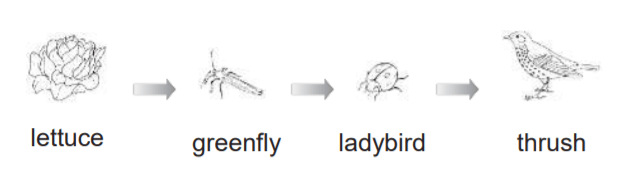
Who is the producer?
lettuce
greenfly
ladybird
thrush

Which type of organism should replace the X in the food web?
an omnivore
an herbivore
a carnivore
a producer

Which list contains only animals that receive energy transferred directly from consumers in this food web?
Red-tailed hawks, snowshoe hares, and caterpillars
Snowshoe hares and caterpillars
Snowshoe hares and shrews
Shrews and red foxes

ow many types of organisms in this food web obtain energy directly from producers?
two
three
four
five

Which statement correctly describes the transfer of energy in a food chain in this wetland?
Energy is transferred from hawks to shrews to grasshoppers to marsh grasses.
Energy is transferred from marsh grasses to crickets to hawks to frogs.
Energy is transferred from grasshoppers to crickets to frogs to hawks.
Energy is transferred from cattails to crickets to shrews to hawks.
Bacteria, fungi, and worms typically serve what role in an ecosystem?


Which of these completes the food chain correctly?
a rock
a fox
a plant
an egg

Which of these is a possible food chain for this environment?
Sun → grass → fly → frog
frog → fly → grass → Sun
Sun ← grass ← fly ← frog
Sun → fly → frog → snake


If the mouse population becomes sick and decreases, which statement about the food web will be true?
The grass population will decrease.
The hawk population will increase.
The grass population will increase.
The wildflower population will decrease.

What organism would most likely fit in the box?
A. Cactus
B. Snake
C. Worm
D. Frog

What is eaten by both the owl and the bird?
A. Grass
B. Mice
C. Grasshopper
D. Grain

What would happen if the owl population decreased?
A. The owl population would increase
B. The insect population would decrease
C. The mouse population would decrease
D. The mouse population would increase

What is the role of the bearded dragon?
A. producer
B. consumer
C. decomposer
D. prey

Which type of organism is missing from this food web?
A. prodcuer
B. consumer
C. decomposer
D. prey
Which of the following food chains are in the correct order?
A. Eagle > Snake > Sun > Mouse > Grass
B. Sun > Grass > Mouse > Eagle > Snake
C. Eagle > Snake > Mouse > Grass > Sun
D. Sun > Grass > Mouse > Snake > Eagle

What is the role of algae?
A. Producer
B. Consumer
C. Decomposer
D. Prey

Suppose that a fire in the African savanna kills many of the grasses and trees in that area. What is likely to happen to the population of herbivores that live there?
A. Herbivore population will decrease
B. Herbivore population will increase
C. Herbivore population will remain the same
D. Carnivore population will decrease
Which of the following is an example of a non-renewable resource?
Solar Energy
Wind Energy
Hydro Energy
Fossil Fuel Energy


Energy sources that will never run out, can be reused
smog
pollution
renewable resources
nonrenewable resources
Which human activity would preserve nonrenewable resources?
deforestation
removing carnivores from a forest
recycling
heating home with fossil fuels
Resources that are not able to be reproduced as quickly as they are used are called _____.
renewable resources
replaceable resources
non renewable resources
non replaceable resources

What pollution is this?
Land
Air
Sound
Water

Sewage, industrial waste, oil, pesticides and fertilizers all __________ water.
enrich
enhance
support
pollute
What are the three R's of conservation?
Reduce, Reuse, Repeat
Reduce, Reuse, Recycle
Reduce, Recycle, Recreate
Reuse, Recreate, Repeat
The clearing and destruction of trees is known as..
Desertification
Soil Depletion
Deforestation
Habitat Loss
What is resource depletion?
Where humans use a resource at a rate that is not sustainable because it cannot be replenished fast enough.
Where humans use a resource at a rate that maintains the supply of the resource.
Where humans use a resource at a rate that is not sustainable because of the changes in the behavior of wildlife.
The use of any resource by humans.
What safety measures should be taken during a hurricane?
Go outside to experience the storm up close
Leave windows open to equalize pressure
Ignore evacuation orders and stay put
Stay indoors, away from windows, secure loose objects, have an emergency kit, follow evacuation orders, stay informed.
Explain the procedure for a tornado drill.
Move to a designated safe area, crouch low, cover heads, hold on to something sturdy, stay until drill is complete.
Scream loudly to alert others
Ignore the drill and continue with regular activities
Run outside to see the tornado up close
What items should you include in a flood emergency kit?
Water, non-perishable food, flashlight, batteries, first aid kit, medications, important documents, clothing, personal hygiene items
Swimming gear
Electronics
Canned goods
What are 2 ways to prepare for a flood?
BEFORE a hurricane, what should be done to mitigate the damage?
Move to higher ground/ higher elevation
Go outside to watch where the hurricane is moving
Go to the basement and stay put
Cover windows and glass doors with plywood or storm shutters

