
 Worksheets
🚀9.22
Total questions: 120
Worksheet time: 1hrs 5mins

Non-Verbal Cues.
Match each of these non-verbal cues with the correct meaning.

Permission to speak

Quiet Please, Classmate.

Restroom

Tissue

Water

Identify the volume of liquid in this graduated cylinder.
205 mL
210 mL
220 mL
250 mL
250 L

Match each lab tool with its name.

Test Tube

Petri Dish

Triple Beam Balance

Beaker

Metric Ruler

Match each of these terms with its definition.
The amount of atoms in an object.
Mass
The amount of space something takes up.
Volume
The distance measured between two points.
Length
A description of matter.
Property
An action of matter.
Change

Match each of these TBB measurements with its correct mass.

536.8g

37.3g

105.6g

290.2g

263.5g

Identify which letter represents the correct length.
A
1.5cm
C
4.2cm
D
5.3cm
F
8.1cm
G
12cm

Match each of these parts with its corresponding part.
Outline of an object.
Shape
Amount of space something takes up.
Volume
Amount of amounts in an object.
Mass
Anything with mass and volume.
Matter
Exactly Measurable.
Definite
Identify the volume of liquid in this graduated cylinder.
205 mL
210 mL
220 mL
250 mL
250 L

Correctly identify the volume of liquid in this graduated cylinder. (a)


For each of these concepts match its corresponding meaning.
Density
The amount of mass per unit of volume of an object
Mass
The amount of atoms in an object.
Volume
The amount of space an object takes up.
Gravity
A measurement of the pull on an object's mass.
Water Displacement
Method used to determine the volume of an irregularly shaped object - uses graduated cylinder.

Match each of these terms with its definition.
Description of Matter.
Property
Action of Matter.
Change
Description of matter, indicates features of a sample of matter
Physical Property
Description of matter, depicts the ability of a sample of matter to participate in a reaction.
Chemical Property
Action of matter, results in the creation of a new substance.
Chemical Change

An example of a physical property is ___ (select all that apply).
shape


Example for chemical property. (select all that apply)
flammability

Example for physical property. (select all that apply)
smell
state of matter

Example for chemical property. (select all that apply)
combustibility
corrosiveness


What is the mass of this object?
615.3 grams
516 grams
165.3 grams
165.3 inches

What is the mass of this object?
421.5 grams
241.5 grams
1.524 grams
421.5 inches

What is the volume of water in this graduated cylinder in ml?
(a)

What is the volume of water in this graduated cylinder in ml?
(a)

Multi-Select: Select the activities that will POSITIVELY impact your learning success.


Multiple Choice: What percentage should be your MINIMAL goal for all homework, activities and assessments in Science?
75%
80%
85%
100%

Positively RIGHT vs. Negatively WRONG
Classify each of these items as a RIGHT choice or a WRONG choice.


Being Respectful of EVERYONE

Pushing YOUR SEAT under the Table after use.


Talking when the Teacher Talks.
Positively RIGHT vs. Negatively WRONG
Classify each of these items as a RIGHT choice or a WRONG choice.
Being Respectful of EVERYONE
Pushing YOUR SEAT under the Table after use.
Talking when the Teacher Talks.
Asking Ms. Hickson for Permission to Speak.


Match each of these terms with its definition.
The amount of atoms in an object.
Mass
The amount of space something takes up.
Volume
The distance measured between two points.
Length
A description of matter.
Property
An action of matter.
Change
Match each lab tool with its name.

Microscope

Graduated Cylinder
Triple Beam Balance

Flask
Metric Ruler

Which diagram best represents the arrangement of particles in a solid?
Particles are far apart and move freely
Particles are closely packed in a fixed pattern
Particles are loosely packed and slide past each other
Particles are ionized and move rapidly

Given a diagram showing particles closely packed but able to slide past each other, which state of matter is represented?
Solid
Liquid
Gas
Plasma

A diagram shows particles arranged in a regular, repeating pattern. What can you infer about the temperature of this substance compared to its liquid state?
It is at a higher temperature
It is at a lower temperature
It is at the same temperature
Temperature cannot be determined

A diagram shows a block of ice turning into water. What is the relative temperature change during this process?
Temperature decreases
Temperature stays the same
Temperature increases
Temperature cannot be determined

Given a diagram of particles in a container, how would you identify if the substance is a liquid or a gas?
By the color of the particles
By the arrangement and movement of the particles
By the size of the container
By the number of particles

If you are given a diagram of particles in a solid, liquid, and gas, how can you determine which has the highest temperature?
The one with the most closely packed particles
The one with the most spread out and fastest moving particles
The one with the largest particles
The one with the most particles

A diagram shows a liquid cooling and turning into a solid. What is the relative temperature change during this process?
Temperature increases
Temperature decreases
Temperature stays the same
Temperature cannot be determined

Given a diagram of particles in a container, how would you determine if the substance is a solid?
Particles are far apart and move quickly
Particles are closely packed and vibrate in place
Particles are loosely packed and slide past each other
Particles are ionized and move rapidly

Which of the following described the properties of particles in solid? (Select all that apply).
Closely packed in orderly manner
Vibrate about fixed position
Very strong forces of attraction
Low kinetic energy
slide past each other

Which of the following described the properties of particles in liquid? (Select all that apply).
Closely packed in orderly manner
slide over each other
Vibrate about fixed position
Low kinetic energy
Closely packed in disorderly,random manner
Match each of these parts with its corresponding part.
State of Matter, definite Shape, definite Volume.
Solid
State of Matter, indefinite Shape, definite Volume.
Liquid
State of Matter, indefinite Shape, indefinite Volume.
Gas
One Form of Matter.
State of Matter
Exactly Measurable.
Definite


Physical Change
Chopping Wood

Chemical change
Fire Burning

Chemical Change
Precipitate Forms

Physical Change
Condensation

Chemical change
Fizzing

Match the following evidence with the observation.

Physical Change - because it is melting.

Chemical Change - because it is burned.

Physical Change - because it is bent.

Physical Change - because size changes.

Chemical change - because acids/bases.

Match the following:
Physical Changes
Changes that change the appearances of the substance, not is identify.
Chemical Changes
changes that cause a substance to change into a new substance
Freezing, Grinding, Chopping, Tearing, Evaporating
Examples of Physical Changes
Combustion, Rusting, Burning, Corroding
Examples of Chemical Changes

Match the following vocabulary word to the correct definition
Luster
shiny
precipitate
when you mix two liquids together and a solid is formed
malleable
being able to bend into a shape
boiling point
the temperature when a liquid becomes a gas.
solubility
the ability to dissolve a solute into a solvent
Match each of these parts with its corresponding part.
Outline of an object.
Shape
Amount of space something takes up.
Volume
Amount of amounts in an object.
Mass
Anything with mass and volume.
Matter
Exactly Measurable.
Definite
Match each of these TBB measurements with its correct mass.
536.8g
37.3g
105.6g
290.2g
263.5g


Look at this image. Which object has the LOWEST density in water? How?

Box A has (a) density than box B. When placed in water, box A will likely (b) and box B will likely (c) .

Given the table below, which sample has the highest density?
Sample A
Sample B
Sample C
Sample D

Which state change is shown in BOX 1 (Hint: The arrow head points to the end state)?
Sublimation
Condensation
Melting
Freezing
Boiling

During a phase change, the temperature _____.

Which two phases changes absorb energy (heat enters)?
(a)
Freezing, Melting
Condensation, Evaporation
Freezing, Condensation

Which two phases changes take away energy (heat exits)?
(a)
Freezing, Melting
Condensation, Evaporation
Melting, Evaporation

Brad is comparing a ceramic cup to the hot water inside the ceramic cup and the water vapor above the cup. What can she say about the motion of the particles in all of the substances?
They do not move.
They are all always moving.
They all move past each other slowly.
They all move very fast in all directions.

When thermal energy is decreased in a liquid, what change in state is happening?
Melting
Freezing
Condensation
Evaporation

What happens to the movement of the particles in a substance when the thermal energy is decreased (Select all that apply)?
Speed Up
Slow Down
They Spread Out.
They Get Closer Together.

What happens to the movement of the particles in a substance when the thermal energy is increased (Select all that apply)?
Speed Up
Slow Down
They Spread Out.
They Get Closer Together.

Match each image with its meaning.

Solid Particles

Liquid Particles

Gas Particles

Graduated Cylinder

Triple Beam Balance

Properties and Changes
Sort each of these examples in the correct grouping. Physical and Chemical Properties & Physical and Chemical Changes.

Toxicity

Flammability

Corrosiveness

Reactivity

Combustibility

Green Color

Shapes

Size

Descriptions about Features

State of Matter

Measurements/ Number Descriptions
Description that indicates its ability to participate in a chemical reaction.
Description that remarks of features.

State Changes

Identity stays the Same

May be Reversible
Action that will not result in an altering of identity.

Cutting Hair

All Cooking

Has Signs (Indicators)

Changes
Sort each of these examples in the correct grouping. Physical and Chemical Changes.
State Changes
Identity stays the Same
May be Reversible
Action that will not result in an altering of identity.
Cutting Hair
All Cooking
Has Signs (Indicators)

Painting a Wall

Melting Ice Cream

Windows Condensating
Creates a NEW Substance

Grilling

Fizzing

Smoke Forming

Forming a Precipitate

pH Change

Automatic Color Change

Souring Milk

Rusting

Broken Glass

This image shows three different phases of water. In which state are the molecules moving the fastest?
A
B
C
A and C
A student claims that when wood burns, matter is destroyed because the wood disappears. Which scientific principle can be used to evaluate this claim?
The Law of Conservation of Energy
The Law of Conservation of Mass
The Particle Theory of Matter
The Law of Definite Proportions

An oil spill cleanup crew needs to separate oil from water. Which properties make this separation possible?
Oil and water do not mix
Oil has a different color than water
Oil and water have different boiling points
Oil floats on top of water
Oil is less dense than water

Dry ice (solid carbon dioxide) changes directly from solid to gas at room temperature. This process is called:
Melting
Evaporation
Sublimation
Condensation

Which of the following processes are examples of physical changes? (Select all that apply)
Paper burning to ash
Sugar dissolving in coffee
Ice melting into water
Water boiling to steam
Clay being molded into a pot

A student claims that when water vapor condenses into liquid water, it becomes a different substance. Which evidence would best refute this claim?
The water looks the same before and after condensation
The process can be reversed by heating
Both water vapor and liquid water have the same chemical formula (H₂O)
The temperature changes during condensation

Which method will allow a person to identify an unknown sample of matter?
Measure the temperature of the sample, and compare it to the temperatures of different samples of elements.
Compare the size of the sample to the sizes of different samples of elements.
Calculate the density of the sample, and compare it to the densities of different elements.
Compare the color of the sample to the colors of different elements.
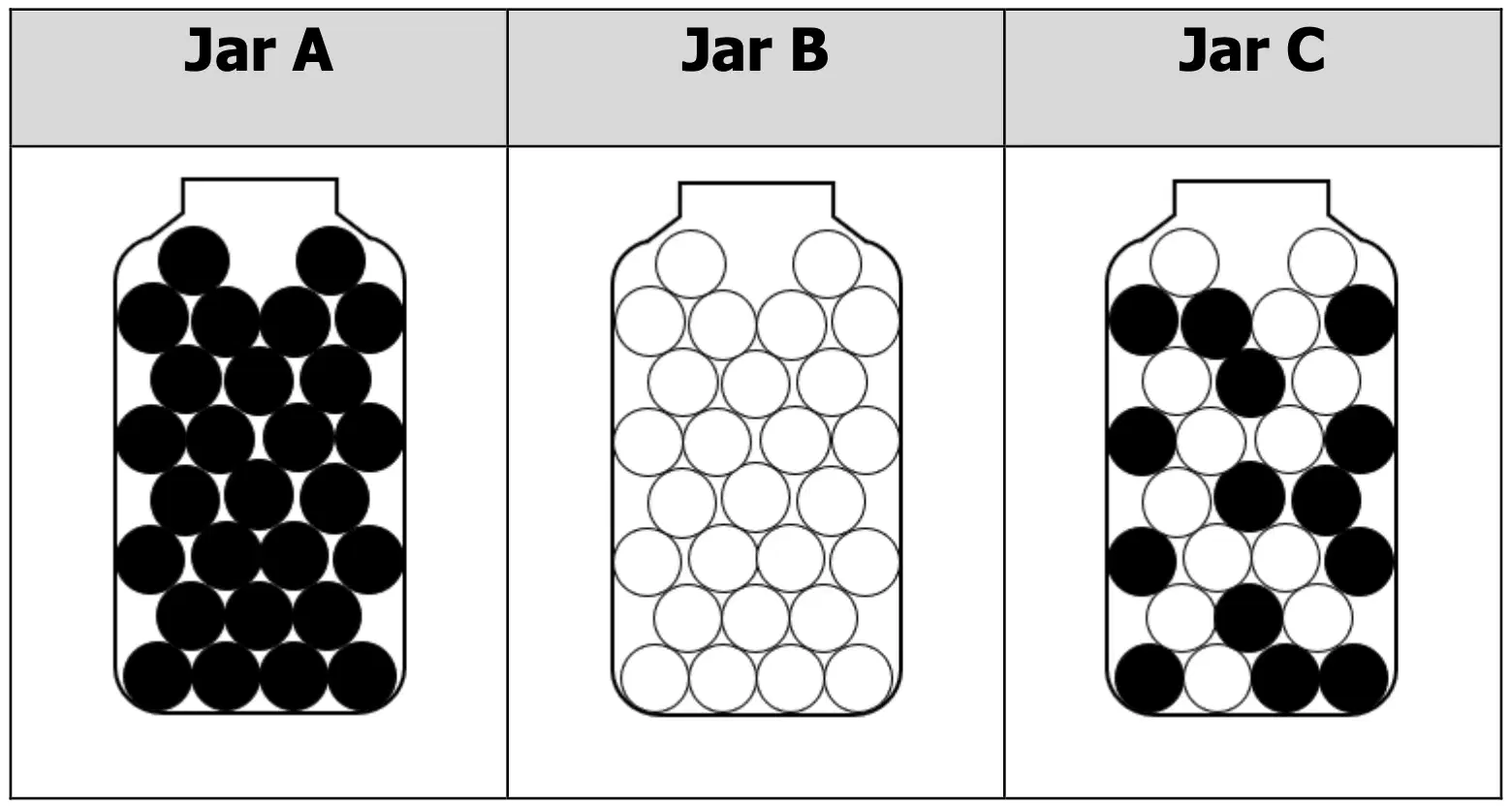
The student wants to model a chemical reaction using marbles from Jar A and Jar B. Which table shows one possible combination of the number of marbles the student can use to show a reaction that follows the Law of Conservation of Mass?
Jar A: 5, Jar B: 5, Products: 5
Jar A: 10, Jar B: 3, Products: 9
Jar A: 4, Jar B: 3, Products: 7
Jar A: 2, Jar B: 8, Products: 6

Which model represents the change in state of dry ice at room temperature? Dry ice undergoes sublimation at room temperature.
[Model showing closely packed particles changing to widely spaced particles]
[Model showing loosely packed particles changing to closely packed particles]
[Model showing widely spaced particles changing to closely packed particles]
[Model showing loosely packed particles changing to widely spaced particles]

What is density, and how does it help identify substances?
Density is the amount of space something takes up and changes based on sample size
Density is mass divided by volume and remains constant regardless of sample size
Density is the weight of an object and varies with location
Density is the color of a substance and helps with visual identification

A student has three different materials: aluminum (2.7 g/cm³), cork (0.24 g/cm³), and water (1.0 g/cm³). If all three are placed in a container together, what will happen?
All materials will float on top of each other
Aluminum will float, cork will sink, water will be in the middle
Cork will float on water, aluminum will sink to the bottom
All materials will mix together evenly

Which of the following represents the correct arrangement of particles as matter changes from solid to liquid to gas?
Tightly packed → loosely arranged → far apart with high motion
Far apart → tightly packed → loosely arranged
Loosely arranged → far apart → tightly packed
Random arrangement in all three states

What does the subscript in a chemical formula tell you?
How many molecules are present
How many atoms are present
How many elements are present
How many neutrons are present
Labeling the Heating Curve.
Indicate the parts of this Heating Curve.
Place your Label on each numbered part.
L -> G (Boiling)
Solid
Liquid
Gas
S -> L (Melting)

Identifying the States of Matter.
Accurately select characteristics of each State of Matter.
Defintion: Definite, Definite
Definition: Indefinite, Definite
Definition: Indefinite, Indefinite
Particles: Packed Close
Movement: Vibrates
Intermolecular Force: Strongest

Temperature: Coolest
Particles: Loosely Touching
Movement: Slide Past One Another
Intermolecular Forces: Medium

Particles: Farthest apart
Movement: Zippy Bumper Cars
Intermolecular Forces: Weakest

Temperature: Warm
Temperature: Hottest
Labeling the State Change Triangle.
Indicate the parts of this State Change Triangle.
Place your Label on each numbered part.
Freezing
Sublimation
Deposition
Boiling/Evaporation
Condensation
Melting

Match each term with its definition.
Solid
Definite Shape and Definite Volume
Liquid
Indefinite Shape and Definite Volume
Gas
Indefinite Shape and Indefinite Volume
Matter
Anything with Mass and Volume
Mass
Amount of Atoms

Arrange the states of matter in order, MOST compacted (close) to LEAST compacted (farthest away).
SOLID
L I Q U I D
G A S
Which state change is shown in BOX 3 (Hint: The arrow head points to the end state)?
Sublimation
Condensation
Deposition
Freezing
Boiling

The slower particles of a substance moves, _____ (Select all that apply).
the colder the particles are.
the warmer the particles are.
the more energy it has.
the less energy it has.

Which statement is CORRECT about matter when the temperature increase?
Speed Up and Move Closer
Speed Up and Move Farther Apart
Slow Down and Move Farther Apart
Slow Down and Move Closer

Which of these state changes result in heat (energy) being removed (Select all that apply)?
Gas to Solid
Solid to Liquid
Solid to Gas
Liquid to Gas
Liquid to Solid

What phase change occurs when you start at C and end at D?
Freezing
Melting
Condensing
Evaporation

Which of the following best describes an endothermic process during a phase change?`
Heat is released as a substance freezes.
Heat is absorbed as a substance melts.
Heat is released as a substance condenses.
Heat is absorbed as a substance cools.

When looking at a heating curve, what does a flat (horizontal) line indicate?
The temperature is increasing rapidly.
The substance is undergoing a phase change.
The substance is cooling down.
The substance is a gas.

On a cooling curve, what happens to the energy of the particles as a substance freezes?
The energy increases.
The energy stays the same.
The energy decreases.
The energy disappears.

Which of the following correctly matches the phase with its location on a typical heating curve (from left to right)?
Gas, Liquid, Solid
Solid, Liquid, Gas
Liquid, Solid, Gas
Gas, Solid, Liquid

Which statement best describes what happens at the boiling point on a heating curve?
The substance is changing from liquid to gas.
The substance is changing from gas to liquid.
The temperature decreases.
The substance is changing from solid to liquid.

If a substance is at its condensation point, what phase change is occurring?
Gas to liquid
Liquid to gas
Solid to liquid
Liquid to solid

Which of the following is an example of an exothermic reaction?
Ice melting in your hand
Water boiling on a stove
Water freezing in a tray
Solid carbon dioxide (dry ice) turning into gas

A student observes a heating curve and notices two flat sections. Explain what is happening to the substance during these flat sections and why the temperature does not increase.
The substance is cooling down rapidly.
The substance is undergoing two different phase changes, and energy is used to break intermolecular bonds rather than increase temperature.
The substance is evaporating and condensing at the same time.
The substance is losing energy to the environment.

A student claims that during boiling, the temperature of the liquid increases until all the liquid has turned to gas. Use your understanding of heating curves to explain whether this claim is correct or incorrect.
Correct, because energy always increases temperature.
Incorrect, because during boiling, the temperature remains constant as energy is used for the phase change.
Correct, because boiling is an endothermic process.
Incorrect, because the temperature decreases during boiling.

Analyze a heating curve and determine at which points the substance is a mixture of two phases. Explain your reasoning.
Only at the beginning of the curve
At the flat sections, because the substance is transitioning between phases (e.g., solid and liquid, or liquid and gas)
At the sloped sections, because temperature is changing
Only at the end of the curve

Suppose you are given a heating curve for an unknown substance. How could you use the curve to estimate the melting and boiling points of the substance?
By finding the highest and lowest points on the curve
By identifying the temperatures at the flat sections of the curve
By measuring the length of the curve
By looking at the steepest slope

If you wanted to design an experiment to show the difference between endothermic and exothermic phase changes, which two processes would you choose and why?
Melting and freezing, because melting absorbs energy (endothermic) and freezing releases energy (exothermic)
Boiling and condensation, because both are endothermic
Melting and boiling, because both are exothermic
Freezing and condensation, because both absorb energy
What term goes on the x-axis? (B)
Heat(Energy)
Temperature
Phase
Type of Matter
What phase change occurs when you start at D and end at C?
Freezing
Melting
Condensing
Evaporation
What phase change occurs when you start at C and end at D?
Freezing
Melting
Condensing
Evaporation
Labeling the Heating Curve.
Indicate the parts of this Heating Curve.
Place your Label on each numbered part.
L -> G (Boiling)
Solid
Liquid
Gas
S -> L (Melting)
Labeling the Cooling Curve.
Indicate the parts of this Cooling Curve.
Place your Label on each numbered part.
L -> S (Freezing)
G -> L (Condensation)
Solid
Liquid
Gas
Labeling the Triple-Point Diagram.
Indicate the parts of this Phase Diagram.
Place your Label on each lettered part.
Solid
Liquid
Triple-Point
Gas

Understanding the Atom's Structure.
Accurately identify the property of each subatomic particle.
Negatively charged subatomic.
e-
Located in the Electron Cloud.
Smallest of the three subatomics.
Positively charged subatomic.
p+
Located in the Nucleus with n0.
Unique to each element.
Neutrally charged subatomic.
n0
Located in the Nucleus with p+.
Does not affect the charge of the Nucleus.

Blue subatomic particle

Green subatomic particle

Red subatomic particle


What letter on the diagram represents the substance only in the gas phase?
A
B
C
D
What letter on the diagram represents a substance only in the solid phase?
A
B
C
D
What phase of matter exists in part C of the graph?
Gas
Liquid
Solid
Plasma


Match the following.
Subatomic particle with +1 Charge.
Proton
Subatomic particle with -1 Charge.
Electron
Subatomic particle with 0 Charge.
Neutron
Center Region of Atom, Positively Charged.
Nucleus
Outer Region of Atom, Negatively Charged.
Electron Cloud
A student observes a heating curve and notices two flat sections. Explain what is happening to the substance during these flat sections and why the temperature does not increase.
The substance is cooling down rapidly.
The substance is undergoing two different phase changes, and energy is used to break intermolecular bonds rather than increase temperature.
The substance is evaporating and condensing at the same time.
The substance is losing energy to the environment.
A student claims that during boiling, the temperature of the liquid increases until all the liquid has turned to gas. Use your understanding of heating curves to explain whether this claim is correct or incorrect.
Correct, because energy always increases temperature.
Incorrect, because during boiling, the temperature remains constant as energy is used for the phase change.
Correct, because boiling is an endothermic process.
Incorrect, because the temperature decreases during boiling.
Suppose you are given a heating curve for an unknown substance. How could you use the curve to estimate the melting and boiling points of the substance?
By finding the highest and lowest points on the curve
By identifying the temperatures at the flat sections of the curve
By measuring the length of the curve
By looking at the steepest slope

A student is analyzing a cooling curve and notices that the temperature remains constant at a certain point even though the substance is still losing energy. What is the best explanation for this observation?
The thermometer is broken.
The substance is undergoing a phase change, and energy is being released as bonds form.
The substance is not losing energy.
The substance is evaporating.
If you wanted to design an experiment to show the difference between endothermic and exothermic phase changes, which two processes would you choose and why?
Melting and freezing, because melting absorbs energy (endothermic) and freezing releases energy (exothermic)
Boiling and condensation, because both are endothermic
Melting and boiling, because both are exothermic
Freezing and condensation, because both absorb energy

Explain how energy transfer is different during the sloped (slanted) and flat portions of a heating.
Energy is only transferred during the sloped (slanted) portions.
During sloped (slanted) portions, energy increases temperature; during flat portions, energy changes the phase without changing temperature.
Energy is not transferred during the flat portions.
Energy is lost during sloped (slanted) portions and gained during flat portions.

A student is given a graph of a cooling curve and asked to label the sections where the substance is solid, liquid, and gas. What strategy should the student use to accurately label these sections?
Label the sections based on the order they appear on the graph.
Use the temperatures at the flat sections to identify phase changes, then label the sloped (slanted) sections between them as solid, liquid, or gas.
Guess based on the length of each section.
Label all sections as liquid.

What is the main difference between evaporation and boiling?
Evaporation occurs only at the boiling point, while boiling can happen at any temperature.
Boiling occurs throughout the liquid, while evaporation happens only at the surface.
Evaporation requires more energy than boiling.
Boiling does not involve energy transfer.

What happens to the particles of a substance as it freezes?
They move faster and spread apart.
They stop moving completely.
They slow down and arrange into a fixed pattern.
They gain energy and move more freely.

Which of the following is an example of deposition?
Water boiling to form steam
Frost forming on a cold window
Ice melting into water
Dew forming on grass

