
 Worksheets
untitled
Total questions: 75
Worksheet time: 40mins
Economics is the study of how ______________, _________________, and ___________________ use their scarce or limited resources.
People
government
nations
businesses
What are the 4 factors of production?
Natural resources
capital
Air
labor
entrepreneurs
What is the difference between wants and needs?
(a)
What is specialization?
resources to produce a single or few kinds of goods/services
amount of goods/services produced by a worker or business in a given time frame
Not enough of a certain resource to satisfy persons wants or needs
Workers
What are the types of economics systems?
Command
Traditional
Market
Mixed
Government
What is a mixed economic system?
both individuals and government make decisions
completed run by the government
Individuals make the decisions
Corporations make the decisions
Tools and machines, a person or a business uses to produce goods and services is called _________?
Capital
Scarcity
Specialization
Opportunity Cost
A _____________________ buys and use goods and services.
Consumer
Seller
Profits
Standard of living
In a pure market system, who controls production?
Government
Businesses
Individuals
the action of making or selling goods and services
Producers
Producing
Consumers
Consuming
people who buy goods or services
Producers
Producing
Consumers
Consuming
people who make goods or provide services
Producers
Producing
Consumers
Consuming
the action of using or buying good and services
Producers
Producing
Consumers
Consuming
A child buying toys is an example of-
producing goods
producing services
consuming goods
consuming services
A person making a call on their cell phone is an example of-
producing goods
producing services
consuming goods
consuming services
A factory making shoes is an example of-
producing goods
producing services
consuming goods
consuming services
A mailman delivering mail is an example of-
producing goods
producing services
consuming goods
consuming services
What are the Factors of Production?
land, money, manufacturing, and workers
labor, capital, supply, and demand
land, labor, capital, and entrepreneurship
entrepreneurship, innovation, natural resources, and money
What is a physical item that is produced and can be weighed or measured?
Consumer
Entrepreneur
Services
Goods
When something is used it, it is _____.
services
consumed
entrepreneur
labor
Entrepreneurs are always considered part of entrepreneurship and that's why you can say they're included as a part of the factors of production.
True
False
There are three questions that we must ask in order to deal with scarcity. They are the reason that economics exist. What are these three questions?
Select all that apply.
What goods and services must be produced?
Why should we produce these goods and services
How will these goods and services be produced?
Who will consume the goods and services?

Which factor(s) of production is/are not present here?
land and labor
capital and entrepreneurship
entrepreneurship
capital
Someone who works for a company is the best description of
(a)
The fact that we do not have unlimited quantities of resources is good example of what term?
Scarcity
Economics
Distribution
Consumption
Which of the following are the best examples of natural resources coming from the land as a factor of production?
shoes, socks, jeans, and buttons
televisions, laptops, phones, and chargers
water, food, computers, and tools
iron, coal, plants, and minerals
The global leading producers of oranges include China, Brazil, Mexico, and Florida. Which factors of production are not most affected by a drought in any of these countries?
Select all that apply.
Land
Labor
Capital
Entrepreneurship
Capital can best be described as
services that people use every day.
goods produced to help create other goods and services.
goods that people eat.
goods and services that are disposable.
A person who uses goods and services is practicing what?
Production
Consumption
Distribution
Entrepreneurship
Which reasons do NOT explain why the factors of production are important to economics?
Select all that apply.
They are not important and economic growth can still occur without them.
They are the building blocks of the economy and are what people use to produce goods and services.
They are the resources that we are able to get from the land.
They provide everything a person needs to everyone in the world.
Which of the following is an economic system in which economic decisions are made according to traditions and culture?
Market
Command
Traditional
Mixed
Which of the following is an economic system in which the government and individuals are used to decide how to use their resources?
Market
Command
Traditional
Mixed
Which of the following is an economic system in which business is based on competition and individuals make decisions on how to use resources?
Market
Command
Traditional
Mixed
In a _______ economy, the government decides how goods and services will be produced.
market
command
traditional
mixed
With what concept does economics deal primarily with?
scarcity
poverty
change
power
For what reason do both households and societies face many decisions?
because resources are scarce
because populations may increase or decrease over time
because wages for households and therefore society fluctuate with business cycles
because people, by nature, tend to disagree
When is a good considered scarce in a society?
when more output of the good is possible
when everyone in that society cannot have all they want of the good
when the government restricts production of the good
when only the richest people in the economy can buy all they want of the good
What does economics study?
how society manages its scarce resources
the government's role in society
how to increase production
How firms make profits
Which of the following is NOT a major area of study for economists?
how people make decisions
how countries choose national leaders
how people interact with each other
how forces and trends affect the overall economy
What concept is illustrated by the adage, "There is no such thing as a free lunch"?
tradeoffs
scarcity
productivity
efficiency
What does the adage, "There is no such thing as a free lunch," mean?
Even people on welfare have to pay for food.
The cost of living is always increasing
To get something we like, we usually have to give up another thing we like
All costs are included in the price of a product
Henry decides to spend 2 hours playing golf rather than working at his job which pays $8 perhour. What is Henry's tradeoff?
the $16 he could have earned working for 2 hours
nothing, because he enjoys playing golf more than working
the increase in skill he obtains from playing golf for those 2 hours
nothing, because he spent $16 for green fees to play golf
Daniel decides to spend the last two hours of the night before his economics exam studyinginstead of sleeping. For Daniel, what would his tradeoff be?
nothing, since no dollar value can be put on sleep
nothing, since studying would be more beneficial than sleep
the six hours of sleep he could have had if he had gone to bed before midnight
the two hours of rest he would have gotten
In which of the following situations would economists use the word equity?
Each member of society has the same income.
Society is getting the most it can from its scarce resources
Those in society who have the least will receive the most.
The benefits of society's resources are distributed fairly among society's members
What is the opportunity cost of going to college?
the total spent on food, clothing, books, transportation, tuition, lodging, and otherexpenses
the value of the best opportunity a student gives up to attend college
zero for students who are fortunate enough to have all of their college expenses paid bysomeone else
zero, since a college education will allow a student to earn a larger income aftergraduation
How do people make decisions at the margin?
by following tradition
by experience
by calculating dollar costs
by comparing costs and benefits
What does making decisions "at the margin" mean?
that people make those decisions that do not impose a marginal cost
that people evaluate how easily a decision can be reversed if problems arise
that people compare the marginal costs and marginal benefits of each decision
that people always calculate the marginal dollar costs for each decision
The invisible hand refers to
how central planners made economic decisions
how the decisions of households and firms lead to desirable market outcomes
the control that large firms have over the economy.
government regulations without which the economy would be less efficient.
The "invisible hand" directs economic activity through
advertising
prices.
central planning
government regulations.
In the circular flow model, what do businesses provide to individuals and households?
Goods and services
Public goods and services
Resources
Taxes
In the circular flow model, what do individuals SELL to businesses
Services
Money
Resources
Goods
In the circular flow model, what do individuals receive from businesses in return for their labor?
Services
Money
Resources
D Goods
What do households provide to the resource market?
land, labor, capital, and entrepreneurship
money
people
income
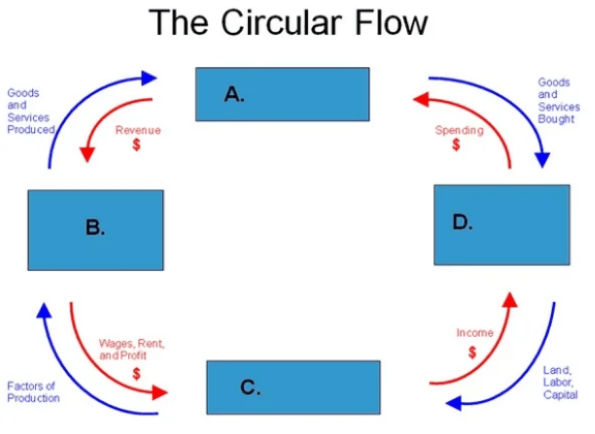
Point B represents
Product Market
Factor Market
Individuals
Businesses
What are the four main parts of the circular flow diagram?
Product Market, Stock Market, Factor Market, Fish Market
Product Market, House Market, Factor Market, Good Market
Factor Market, Product Market, Households, Firms
Factor Market, households, Stock Market, super market
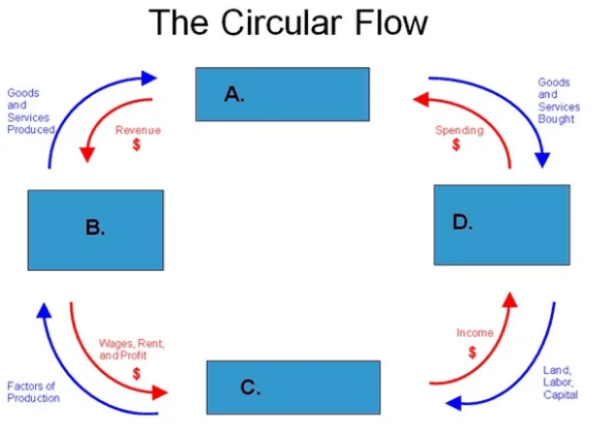
What does point A represent on the Circular flow diagram?
Households
Businesses
Factor Market
Product Market
Where are factors of production (land, labor, etc) exchanged in the circular flow model?
Factor Market
Product Market
Firms
Individuals
Where do factors of production (land, labor, etc) come from in the circular flow model?
Factor Market
Product Market
Firms
Individuals
In the circular flow diagram firms pay wages for which factor of production?
Land
Labor
Entrepreneurship
Raw materials

What does point C represent on the Circular Flow diagram?
Firm
Factor Market
Individual
Product Market

The exchange of money for goods/services to consumers is represented in which part of the circular flow diagram?
1 and 2
3 and 4
5 and 6
7 and 8

The delivery of finished products for sale in exchange for revenue is represented in which arrows?
1 and 2
3 and 4
5 and 6
7 and 8
A person stocks shelves at a grocery store and receives a wage. They have completed an exchange in which part of the circular flow model?
Individuals
Businesss
Factor Market
Product Market
Someone buys a car in exchange for a large amount of money. They have completed an exchange in which part of the circuclar flow model?
Product Market
Factor Market
Firms
Individuals
Money exchanged between businesses and individuals for labor.
wages
revenue
spending
profit
Money exchanged between an individual and a store for a good or service.
Revenue
Wages
Rent
Donation
Consider a country that has discovered new natural resources. How might this discovery affect its PPF?
The PPF will shift inward.
The PPF will shift outward.
The PPF will remain unchanged.
The PPF will become a straight line.
Evaluate the impact of a global pandemic on a country's PPF and provide reasoning.
The PPF will shift outward due to increased healthcare spending.
The PPF will shift inward due to reduced labor force and resource availability.
The PPF will remain unchanged as pandemics do not affect production.
The PPF will become a straight line due to uniform impact across sectors.
How can an increase in infrastructure investment affect a country's PPF?
It can cause the PPF to shift inward due to increased costs.
It can cause the PPF to shift outward by improving production efficiency.
It can cause the PPF to remain unchanged as infrastructure does not affect production.
It can cause the PPF to become a straight line.

