
 Worksheets
Copy of Assessment: The English Colonies in North America
Total questions: 48
Worksheet time: 25mins
Which of these describes an indentured servant?
Someone that pays their debt to a farmer by working for them without pay.
Someone that pays rent on their farm with a portion of their crops.
Someone that makes and sells candles to wealthy landowners.
Someone that was sold to a landowner and forced to work as a cook.
Which of these describes the Separatists?
They were English soldiers.
They shared religious beliefs.
They were wealthy English investors.
They shared a common occupation.
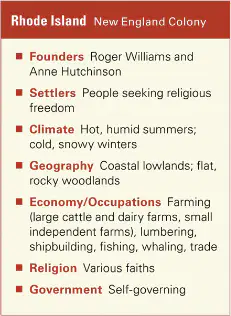
Compare the characteristics of Massachusetts and Rhode Island. What did these and all other New England colonies have in common?
They were self-governing.
They were colonized by Puritans.
They provided financial security.
They provided religious freedom.
Which of these best describes the environment of the New England colonies?
long, hot summers and mild winters
harsh winters and rocky, hilly land
broad coastal plains and fertile soil
broad rivers, swamps, and wetlands
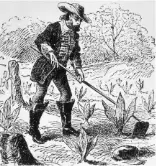
Which of these features made the Southern colonies unique?
self-government
religious freedom
general assemblies
tobacco plantations
Which document served as a written constitution?
Maryland's Act Concerning Religion
Connecticut's Fundamental Orders
Pennsylvania's Great Law of 1682
New York's Charter of Liberties and Privileges of 1683
How did Roger Williams’s colony of Providence differ from the Puritan colony of Massachusetts?
Enslaved people were made free.
Only religious men were allowed to vote.
American Indians were considered enemies.
People of different religious beliefs were welcomed.
How did the government of New York differ from the other colonies?
It was self-governed.
It was ruled by religious leaders.
It was led by a powerful general assembly.
It was ruled by a British-appointed governor.
The actions and beliefs of the Quakers of Pennsylvania predicted which of these events?
the failure of Roanoke
the Mayflower journey
the American Revolution
the French and Indian War
Why did Virginia replace indentured servants with enslaved Africans?
It was required by law.
Africa was closer than Europe.
Indentured servants were too sick to work.
It provided a permanent source of labor.
James Oglethorpe intended that the Georgia colony be colonized by
A. English debtors.
B. indentured servants.
C. religious Separatists.
D. wealthy businesspeople.
Which of these colonies offered the most freedom for European colonizers who lived there?
Georgia
Virginia
Pennsylvania
Massachusetts
Which of these made the laws in most of the colonies?
the church leaders
the king of England
the English governor
the elected assembly
Why did people in the New England, Middle, and Southern colonies adapt different ways of life?
People with specific skills settled in each area.
The regions had different geographies and resources.
The people all had different reasons for colonizing North America.
The leaders of the colonies decided how the people would earn a living.
Which generalization best sums up the founding of the English colonies?
The English colonies were founded by Puritans, Quakers, and Catholics who wanted religious freedom.
The English colonies were founded to provide a new start to poor people throughout Europe.
The English colonies were founded by businesspeople who planned to make money by selling land to new colonists.
The English colonies were founded by people with various goals, from making money to following their faith.
Which of these colonies was most motivated by making a profit?
Virginia
Connecticut
Pennsylvania
Massachusetts
When they signed the Mayflower Compact, the Pilgrims promised
to establish the first colony in Virginia
to obey the laws passed for the general good of the colony
to meet together regularly to make important decisions
to remain loyal to the King of England
This is the method by which England gained a profit from its colonies, mainly by using the natural resources provided by the colony, and controlling who the colonies could trade with.
mercantilism
capitalism
colonialism
industialization
Who founded Pennsylvania?
Gregory Cecil
James Oglethorpe
William Penn
William Gregory
What was the religious tradition of Penn and his followers that came to Pennsylvania?
Puritans
Anglicans
Quakers
Shakers
Which document did the Pilgrims create to explain how they'd govern themselves in America?
Magna Carta
Mayflower Compact
English Bill of Rights
charter
Which was the cash crop that helped colonial Virginia become successful?
Cotton
Sugar
Tobacco
Indigo
Economic policy in which nations tried to gain wealth by controlling trade and establishing colonies.
mercantilism
charter
democratic
slave trade
Formal document issued by the king that outlined a colony's geographic borders and specified how it would be governed
mercantilism
charter
democratic
slave trade
Ruled by people in democracy, citizens elect representatives to make and carry out laws
mercantilism
charter
democratic
slave trade
The business of capturing, transporting and selling people to force them into enslavement
mercantilism
charter
democratic
slave trade

Which of the following was a characteristic of the Middle Colonies?
The economy was mainly based upon trading furs
They were the most religiously and ethnically diverse of the British colonies
The geography allowed for very little agriculture
They had a reputation as being the least tolerant of the British colonies

What colonial region is this?
New England
Middle
Southern
Backcountry

What colonial region is this?
New England
Middle
Southern
Backcountry

These colonies were settled by the Pilgrims in 1620 and Puritans in 1630 to escape religious persecution in England
Middle Colonies
New England
Southern Colonies
Canada

What was stated in the Proclamation of 1763?
Colonists were BANNED from settling west of the Appalachian Mountains.
The Proclamation ended the French and Indian War.
Colonists were ENCOURAGED to begin settling west of the Appalachian Mountains.
The Proclamation proclaimed independence for the American colonists.

Which colonial region was made up of Georgia, Maryland, North Carolina, South Carolina, and Virginia?
Southern Colonies
Middle Colonies
New England Colonies
Northern Colonies

Northern/New England Colonies
Southern Colonies

Which major economic activity did the numbered colonies have in common?
Building ships
Manufacturing textiles
Growing cash crops
Printing books

Based on information in the map, most workers in the southern colonies were engaged in—
agriculture.
manufacturing.
mining.
trade.

Which of the following was not a term for one of the Colonial regions?
Southern Colonies
Middle Colonies
New England Colonies
Northern Colonies

Which original colony is represented by 1 on the map?
Connecticut
New Hampshire
Massachusetts
Rhode Island
New England Colonies
Southern Colonies


Which set of colonies is described best in the illustration?
Middle
New England
Southern
England

Which of the following?
New England Colonies
Middle Colonies
Southern Colonies

Which of the following?
New England Colonies
Middle Colonies
Southern Colonies

A group of people in one place who are ruled by a parent country elsewhere.
colony
joint stock company
debtors
country

Which characteristic is correctly matched with a number in the table?
1: Indigo
2: Moderate
3: Rocky soil
4: Ships
New Hampshire
Rhode Island
Massachuttes
South Carolina
Virginia
Maryland
Georgia
Delaware
New York
New Jersey
Georgia
Louisiana
Alabama

