
NEW
Font size
 Worksheets
CS#9 - The Growth of Labor Organizations
Total questions: 61
Worksheet time: 31mins
According to the passage, what fueled the large-scale industrialization in the United States during the late 1800s?
The American Revolution
Post-Civil War demand and technological advancements
The Great Depression
World War II
Fill in the blank: The U.S. had its highest economic growth rate in the last two decades of the nineteenth century, i.e., _________.
1880-1900
1860-1880
1900-1920
1840-1860
Which iconic event is mentioned as significant to America's rapid economic growth during industrialization?
The opening of the Erie Canal
The opening of the First Transcontinental Railroad in 1869
The signing of the Declaration of Independence
The end of the Civil War
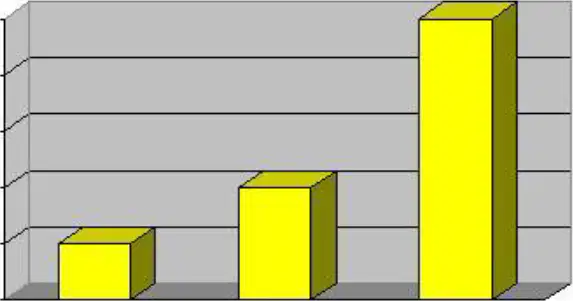
Based on the graph 'Manufacturing Workers in the United States (1850-1900)', in which year was the number of manufacturing workers the highest?
A) 1850
B) 1870
C) 1900
The rise of industrialization led to a rapidly expanding workforce and the growth of labor organizations amidst unregulated working conditions.
True
False
According to the graph, what was the foreign-born population in the United States in 2010?
19.8 million
31.1 million
40.0 million
13.2 million
According to the passage, from 1836 to 1914, over how many Europeans migrated to the United States?
Over 30 million Europeans
Over 5 million Europeans
Over 100 million Europeans
Over 10 million Europeans
The mid-19th century saw mainly an influx from which region?
Southern Europe
Northern Europe
Asia
Africa
True or False: The death rate on transatlantic voyages to the United States was low, with only one in twenty travelers dying.
True
False
In what year did the peak of European immigration to the United States occur, according to the passage?
1907
1924
1882
1914
By 1910, how many immigrants were living in the United States?
13.5 million
5 million
25 million
8 million
According to the graph, what was the percent of total population that was foreign-born in 1910?
13.2%
14.7%
11.6%
9.7%
Within the span of a few decades from the late 19th to the early 20th century, what major transformation did the United States undergo?
From an industrial economy to a rural society
From a rural agrarian society to an industrial economy centered in large metropolitan cities
From a monarchy to a democracy
From a coastal society to an inland society
According to the passage, prior to the American industrial revolution, most Americans lived in ________ households and small towns that were linked to the external world by horse drawn wagons.
largely isolated agricultural
densely populated urban
technologically advanced industrial
coastal fishing
One major factor that changed rural communities in the early decades of the 20th century was:
the introduction of new agricultural machinery
the decline of urban populations
the end of World War II
the discovery of gold in rural areas
By 1920, what percentage of northern farms had automobiles and telephones, according to the passage?
One quarter
One third
One half
All of them
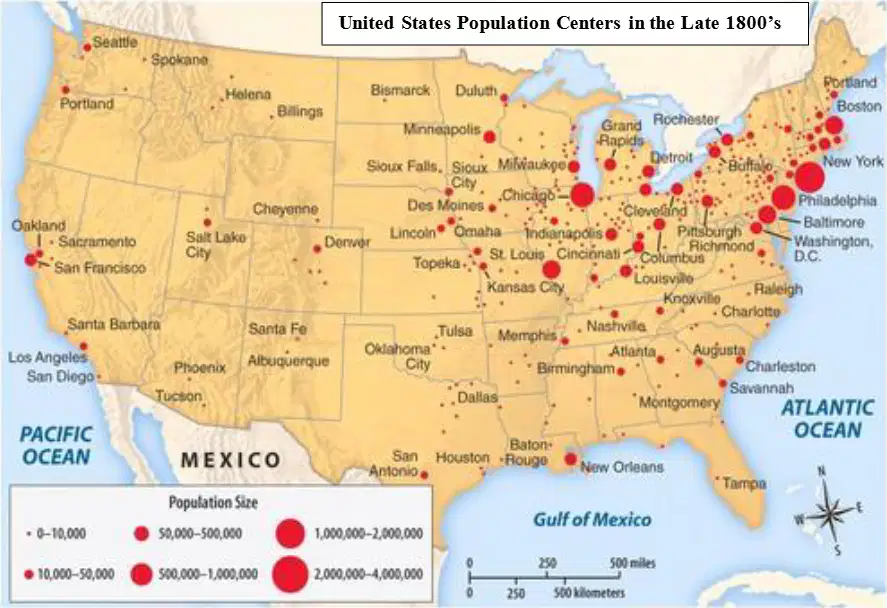
Refer to the map titled 'United States Population Centers in the Late 1800’s.' Which city had the largest population center at that time?
Chicago
New York
Philadelphia
San Francisco
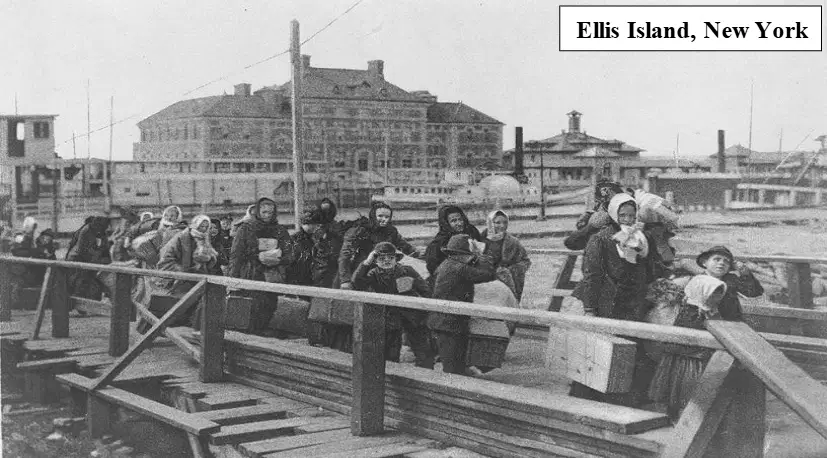
Ellis Island was primarily known for which of the following in the late 19th and early 20th centuries?
Serving as the main immigration station for the United States
Being a major military base
Acting as a center for international trade
Hosting the signing of important treaties
As a result of the changing nature of work, why did some members of the working class form labor organizations such as the American Railway Union and the American Federation of Labor?
To protect their rights and address issues such as working conditions, wages, and terms of employment.
To support the expansion of large corporations and monopolies.
To encourage employers to reduce the number of jobs available.
To promote the replacement of skilled workers with machines.
According to the passage, which of the following statements is TRUE about working conditions in the late 19th century?
Workers typically worked 8 hours a day, five days a week.
Employees were entitled to vacation and sick leave.
Injuries on the job were common and often not compensated.
Child labor was rare in factories.
Fill in the blank: In the late 19th century, seamstresses and factory workers often worked ___ or more hours a day, six days a week.
12
6
8
10
According to the passage, child laborers often had little time or energy left for school because they worked full-time jobs to help their families make ends meet.
True
False
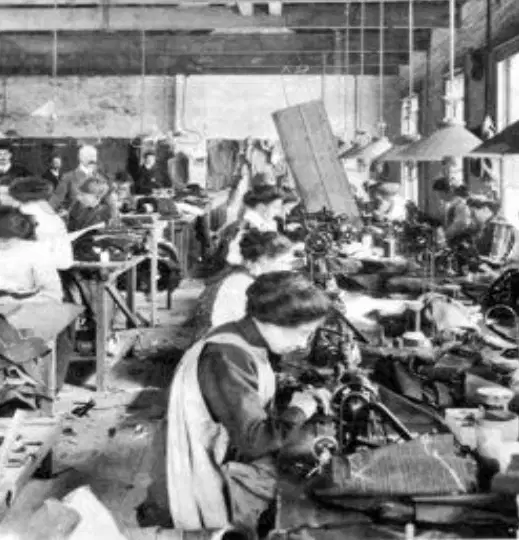
Based on the image labeled 'Sweatshop, 1890,' describe the working environment for laborers during this period.
The working environment was crowded, with many workers in close quarters, likely performing repetitive tasks in poorly ventilated conditions, as described in the passage.
The working environment was spacious, with few workers and plenty of fresh air, allowing for comfortable and leisurely work.
The working environment was outdoors, with workers enjoying natural sunlight and flexible hours.
The working environment was highly automated, with machines performing most tasks and workers supervising from a distance.
According to the passage, what percentage of boys and girls under age 15 held full-time jobs in factories?
Twenty percent of boys and ten percent of girls under age 15 held full-time jobs.
Ten percent of boys and five percent of girls under age 15 held full-time jobs.
Thirty percent of boys and fifteen percent of girls under age 15 held full-time jobs.
Fifteen percent of boys and twenty percent of girls under age 15 held full-time jobs.
According to the passage, what event led to the growth of labor organizations due to violence toward supporters of organized labor?
The Great Railroad Strike
Haymarket Riot
Homestead Strike
All of the above.
Fill in the blank: The Great Railroad Strike of 1877 began on July 14 in ________, West Virginia after the Baltimore and Ohio Railroad (B&O) cut wages for the third time in a year.
Martinsburg
Charleston
Wheeling
Huntington
According to the passage, approximately how many workers supported the strikes at their height?
About 100,000 workers.
About 10,000 workers.
About 1,000,000 workers.
About 50,000 workers.
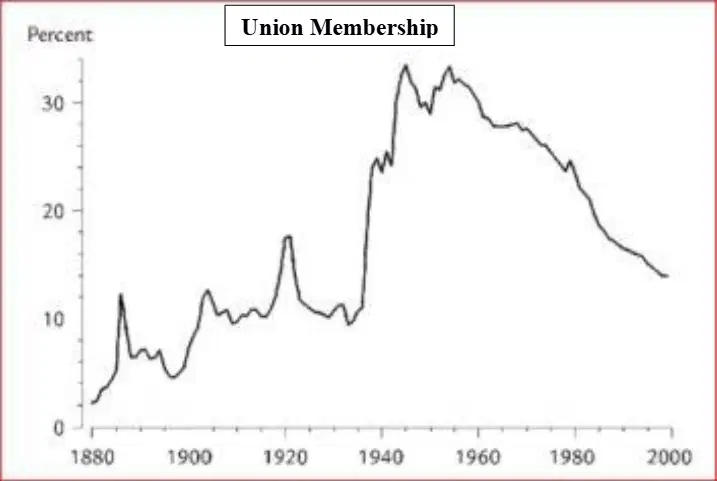
Based on the graph titled 'Union Membership,' during which decade did union membership peak?
Union membership peaked during the 1940s.
Union membership peaked during the 1920s.
Union membership peaked during the 1970s.
Union membership peaked during the 2000s.
The B&O Railroad founded an Employee Relief Association in 1880 to provide death benefits and some health care.
True
False
What was one of the main reasons cities built armories during the period of labor unrest described in the passage?
To store food supplies
To support their militias
To house striking workers
To provide public entertainment
What was the estimated number of people killed in the unrest across the country during the Great Railroad Strike of 1877?
An estimated 100 people.
An estimated 10 people.
An estimated 1,000 people.
An estimated 5,000 people.
What event triggered the Haymarket riot in Chicago on May 4, 1886?
A bombing that took place at a labor demonstration.
A fire that broke out in a factory.
A railroad strike that turned violent.
A political speech by a city mayor.
How many police officers were killed as a result of the bomb blast and ensuing gunfire?
Seven police officers were killed.
Three police officers were killed.
Ten police officers were killed.
No police officers were killed.
Read the passage about the Haymarket riot. True or False: The person who threw the dynamite bomb at the Haymarket rally was never identified.
True
False
How many anarchists were convicted of conspiracy in the legal proceedings that followed the Haymarket riot?
Eight anarchists were convicted of conspiracy.
Five anarchists were convicted of conspiracy.
Ten anarchists were convicted of conspiracy.
Three anarchists were convicted of conspiracy.
Which Illinois governor pardoned the remaining defendants in 1893 and criticized the trial?
John Peter Altgeld
Richard J. Oglesby
Adlai Stevenson II
Otto Kerner Jr.
What was one consequence of the Haymarket affair for the American labor movement?
It was a setback for the American labor movement and its fight for the eight-hour day, but it also strengthened its resistance.
It led to the immediate passage of the eight-hour workday nationwide.
It resulted in the complete dissolution of all labor unions in the United States.
It caused the government to ban all future labor strikes.
What was the final result of the Homestead Strike?
A major victory for the union
A major defeat for the union and a setback for their efforts to unionize steelworkers
No significant change
The creation of new unions
The Homestead Strike occurred at the Homestead Steel Works in which state?
Ohio
Illinois
Pennsylvania
New York
Fill in the blank: The dispute at the Homestead Steel Works was between the Amalgamated Association of Iron and Steel Workers (the AA) and the _________
Carnegie Steel Company
Pullman Company
Standard Oil Company
Union Pacific Railroad
The Homestead strike broke the AA as a force in the American labor movement.
True
False
By what year did not a single steel plant in Pennsylvania remain unionized, according to the passage?
By 1900
By 1920
By 1880
By 1950

Who is shown in the bottom left image, and what company is associated with him?
Andrew Carnegie; Carnegie Steel Company
John D. Rockefeller; Standard Oil Company
J.P. Morgan; U.S. Steel Corporation
Cornelius Vanderbilt; New York Central Railroad
What was the last major unionized steel mill in the country, and what happened to it by 1903?
Carnegie Steel's Mingo Junction, Ohio plant; it successfully withdrew recognition without a fight in 1903.
Bethlehem Steel's Sparrows Point, Maryland plant; it was nationalized in 1903.
U.S. Steel's Gary, Indiana plant; it was destroyed by fire in 1903.
Republic Steel's Youngstown, Ohio plant; it merged with another company in 1903.
According to the passage, what was the main reason the employees of the Pullman Company began a strike on May 11, 1894?
Increase in working hours
Reductions in wages
Unsafe working conditions
Lack of job security
Fill in the blank: The Pullman Strike was a nationwide railroad strike in the United States that began on May 11, _____?
1894
1886
1901
1877
Who ordered the Army to stop the strikers from obstructing the trains during the Pullman Strike?
President Grover Cleveland
President William McKinley
President Theodore Roosevelt
President Benjamin Harrison
What happened to Eugene Debs after the strike collapsed?
Debs was convicted of violating a court order and sentenced to prison; the ARU dissolved.
Debs was elected president of the United States.
Debs retired and moved to Europe.
Debs became a wealthy industrialist.
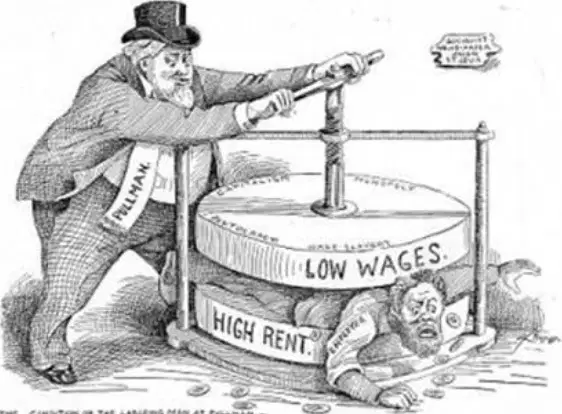
The political cartoon at the bottom right conveys the message that Pullman workers faced which of the following conditions?
Unfair and harsh working conditions
High wages and good benefits
Complete independence from their employer
Opportunities for rapid promotion
According to the passage, what was one of the biggest successes of labor unions in the early 1900s?
Decreased union membership
Increased awareness of poor labor practices and a surge in union membership
Elimination of all labor strikes
Decreased wages for workers
By 1913, union membership rose to ________ members, according to the passage.
2.7 million
1.2 million
4.5 million
3.1 million
The National Child Labor Committee was formed in 1904 to reform child labor laws and draw attention to poor working conditions for children.
True
False
When were minimum employment ages and limited work hours for children regulated by federal laws, as outlined in the Fair Labor Standards Act?
1904
1913
1938
1920
What did the National Child Labor Committee promote to help children, according to the passage?
The Committee promoted anti-sweatshop campaigns and fought for free compulsory public education, funded by the government, for all children.
The Committee encouraged children to work in factories to support their families.
The Committee promoted child labor as a way to build character and discipline.
The Committee supported reducing the school day to allow children more time to work.
Who established the American Federation of Labor in the late 1800s?
Samuel Gompers
Eugene V. Debs
John L. Lewis
Terence V. Powderly
What was the primary purpose of the Sherman Antitrust Act (1890)?
To support labor unions
To curb the power of labor unions (which were considered trusts by the courts)
To prosecute real trusts like Standard Oil
To create new trade unions
True or False: The Sherman Antitrust Act was primarily used to prosecute real trusts like Standard Oil.
True
False
Which labor union was formed in 1900 in New York City and included a large number of Jewish female immigrants?
International Ladies Garment Workers Union
American Federation of Labor
United Mine Workers of America
Knights of Labor
What reforms did women seek through labor unions in the early 20th century?
Better wages, safer working conditions, and more acceptable work hours.
The right to vote in national elections only.
Access to free college education for all women.
Abolition of all taxes for working women.
What was the first national trade association for organizing women workers, established in 1903?
Women's Trade Union League (WTUL)
National Organization for Women (NOW)
American Federation of Labor (AFL)
National Women's Party (NWP)

This image represents which aspect of the labor movement in the early 20th century?
The fight for better working conditions and labor rights
The celebration of industrial leaders
The decline of labor unions
The rise of child labor

