
Font size
 Worksheets
Unit 1 Foundations of A&P Test Practice
Total questions: 82
Worksheet time: 1hrs 13mins
What is the primary focus of anatomy?
The study of the structure of an organism.
The study of how an organism's body functions.
The study of chemical processes in the body.
The study of environmental impacts on the body.
Which type of anatomy focuses on changes during growth from child to adult?
Embryology
Surface Anatomy
Developmental Anatomy
Gross Anatomy
What is the role of protein synthesis in cellular functions?
It provides energy for cellular processes.
It is essential for life, involving transcription and translation.
It regulates the body's temperature.
It transports oxygen in the blood.
How is the transport of materials across the cell membrane managed?
By active transport only
By passive transport only
By both passive and active transport
By diffusion only
Which level of structural organization in the human body is composed of a group of similar cells with a common function?
Organ
Tissue
Organ System
Organism
Which body system is responsible for providing support and protection, and gives the body shape?
Nervous
Skeletal
Muscular
Integumentary
What is the function of the lymphatic system?
Secretes hormones
Fights infection and provides fluid for cells
Exchanges gases
Removes waste from the blood
Which system is responsible for producing cells used in sexual reproduction?
Endocrine
Reproductive
Excretory
Digestive
Which of the following is an example of maintaining boundaries in the human body?
Digestive contractions
Skin protecting from pathogens
Turning toward a sudden noise
Breaking down nutrients from food
What is the primary function of metabolism in the body?
Removing waste products
Sensing changes in the environment
All chemical reactions, including cellular respiration
Increasing cell size
Which essential survival need is supplied by the heart and lungs?
Nutrients
Water
Oxygen
Normal body temperature
What role does normal atmospheric pressure play in the human body?
Allows molecules to move through the body
Provides for appropriate gas exchange between the lungs and the environment
Maintains body temperature
Acquired through digestion and metabolism
What does the term "Superior (Cranial)" refer to in anatomical terminology?
Toward the head end or upper part of a structure.
Toward the back of the body.
Away from the midline of the body.
Farther from the origin of a body part.
Which directional term describes a position away from the midline of the body?
Medial
Lateral
Proximal
Deep
In anatomical terms, what does "Proximal" mean?
Toward the body surface.
Closer to the origin of a body part or the point of attachment of a limb.
Away from the head end or toward the lower part of a structure.
Toward the front of the body.
What is the definition of "Deep" in anatomical terminology?
Toward the body surface.
Toward the front of the body.
Away from the body surface; more internal.
Toward the midline of the body.
Which term is used to describe a position toward the back of the body?
Anterior (Ventral)
Posterior (Dorsal)
Superior (Cranial)
Superficial
What is the function of the median or midsagittal plane in anatomical structures?
Divides the body into anterior and posterior parts
Divides the body into superior and inferior parts
Divides the body into right and left parts
Divides the body into quadrants
Which body cavity encloses the brain and spinal cord?
Thoracic cavity
Dorsal body cavity
Abdominal cavity
Pelvic cavity
Which of the following is a division of the ventral body cavity?
Cranial cavity
Spinal cavity
Thoracic cavity
Dorsal cavity
Which organelle is responsible for converting food into ATP (energy) in an animal cell?
Golgi Apparatus
Mitochondria
Lysosomes
Vacuoles
How many chromosomes are found in every human body cell?
23
46
64
92
What is the main difference between transcription and translation in cellular processes?
Transcription occurs in the ribosome, while translation occurs in the nucleus.
Transcription converts mRNA into DNA, while translation converts DNA into proteins.
Transcription converts DNA into mRNA, while translation converts mRNA into proteins.
Transcription and translation both occur in the cytoplasm.
Which type of cell division results in four different daughter cells?
Mitosis
Meiosis
Binary fission
Budding
What type of cells undergo mitosis?
Sex cells (gametes)
Somatic (body) cells
Bacterial cells
Fungal cells
Which process requires energy to move molecules from low concentration to high concentration?
Diffusion
Osmosis
Active Transport
Facilitated Diffusion
Which system of the body contains glands and hormones?
nervous system
endocrine system
cardiovascular system
lymphatic system
Which is the correct order of these levels of organization from smallest to largest?
organelle, cell, tissue, organ, system, organism
cell, organelle, organ, tissue, system, organism
organism, organ, system, organelle, cell, tissue
Which of the following organs would be found within the abdominal cavity?
stomach
ovaries
lungs
brain
Which body cavity contains all others listed here?
pleural
thoracic
mediastinum
ventral
Which of the following is NOT a correct match between the term and its description?
mitosis -> the division of somatic (body) cells
transcription -> the copying of DNA into an mRNA strand
passive transport -> the movement of molecules from low to high concentration
translation -> the creation of an amino acid chain from an mRNA message
The type of tissue that you would find lining the pelvic cavity is
nervous
vascular
epithelial
muscular
In the spring, you open your windows exposing a screen to let in fresh air. Over time, pollen from your yard spreads into your house through the screen. The screen is an example of a(n) ...
visceral membrane
osmotic membrane
semipermeable membrane
parietal membrane
Which of the following body parts is inferior to the heart?
teeth
stomach
lungs
eyes
Which of the following body parts is proximal to the elbow?
wrist
fingers
toes
shoulder
Which is the deepest membrane of those listed here?
parietal serosa
serous fluid
visceral serosa
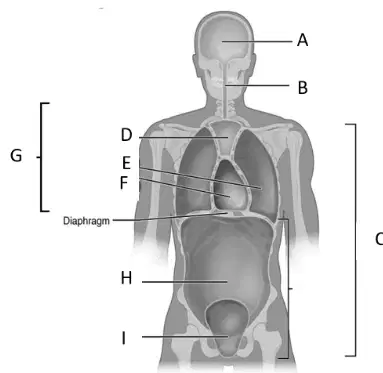
Label A in the diagram below:
cranial cavity
pelvic cavity
thoracic cavity
pleural cavity
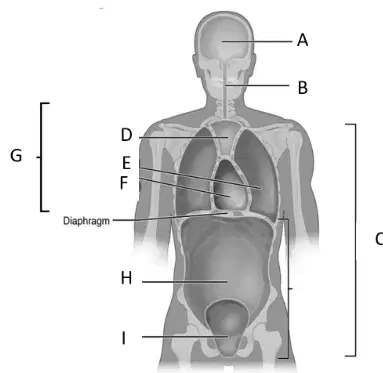
Label B in the diagram below:
Vertebral cavity
Mediastinum
Pericardial cavity
Pelvic cavity
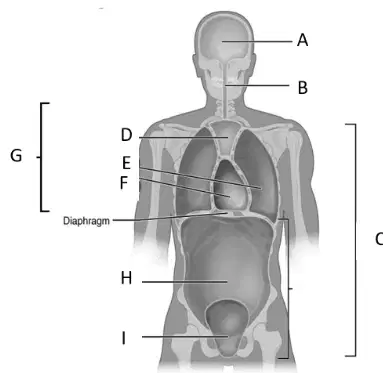
Label C in the diagram below:
Ventral cavity
Dorsal cavity
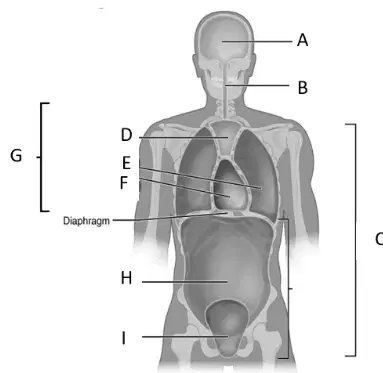
Label D in the diagram below:
Mediastinum
Pelvic cavity
Pleural cavity
Pericardial cavity
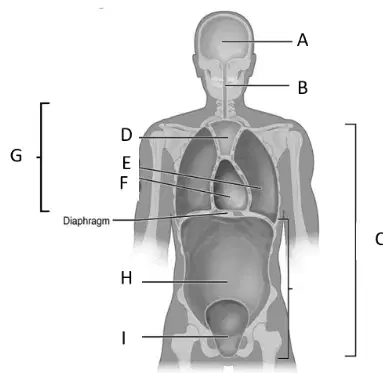
Label E in the diagram below:
Pleural cavity
Mediastinum
Parietal cavity
Pelvic cavity
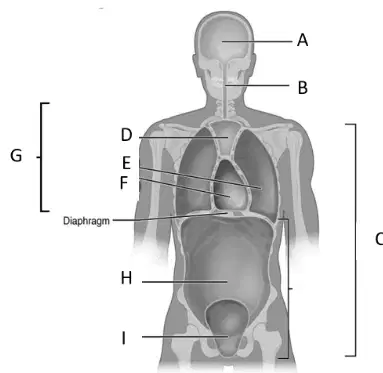
Label F in the diagram below:
Pericardial cavity
Mediastinum
Abdominal cavity
Pleural cavity
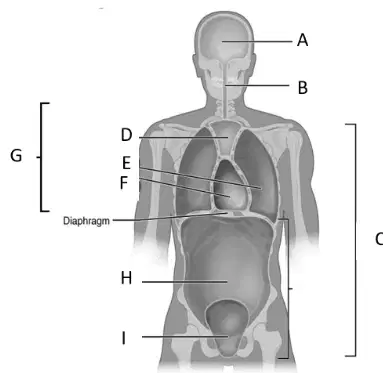
Label G in the diagram below:
Thoracic cavity
Abdominal cavity
Pelvic cavity
Cranial cavity
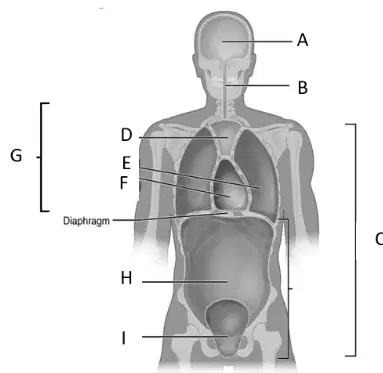
Label H in the diagram below:
Abdominal cavity
Pelvic cavity
Thoracic cavity
Cranial cavity
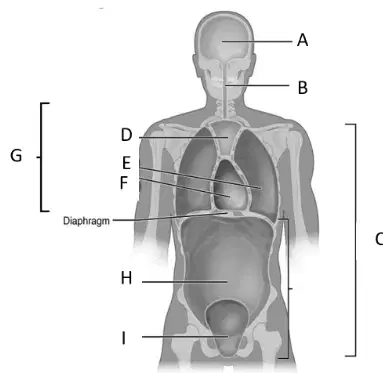
Label I in the diagram below:
Pelvic cavity
Abdominal cavity
Cranial cavity
Thoracic cavity
The abdominopelvic region can be divided into 9 regions. The 3 regions of the abdominopelvic cavity that are just inferior to the lungs are:
Right hypochondriac, epigastric, left hypochondriac
Right lumbar, umbilical, left lumbar
Right iliac, hypogastric, left iliac
Right hypochondriac, umbilical, left iliac
The most common type of feedback loop in the body is:
Negative feedback loop
Positive feedback loop
Feedforward loop
Oscillatory feedback loop
Base pairing allows DNA to be copied (generally) without mistakes because:
each base pairs with its specific partner, ensuring accurate replication
bases pair randomly, leading to frequent errors
What is the purpose of homeostasis in the body?
It causes imbalance.
It helps monitor and maintain a unstable environment.
It helps monitor and maintain a stable internal environment.
It leads to a overactive impulse.
A frontal section divides the body into ____ and ____ parts.
Right and Left
Anterior and Posterior
Superior and Inferior
Which body cavity can be subdivided into four quadrants and nine regions?
vertebral cavity
cranial cavity
abdominopelvic cavity
In order to move information you want to learn from working/short term memory to long term memory in your brain, what is the most effective study strategy?
Staring at your notes and trying to memorize the way they look
Retrieval practice like self quizzing, flashcards, and writing your own summaries
Rewriting notes
Re-reading the textbook chapters
Which of the following would be an example of the life function "responsiveness?"
a mother gives birth to a baby
skeletal muscles are used to walk across the room
as you run, sweat forms on your forehead
you turn towards a sudden noise
the nutrients from your lunch are absorbed into the blood
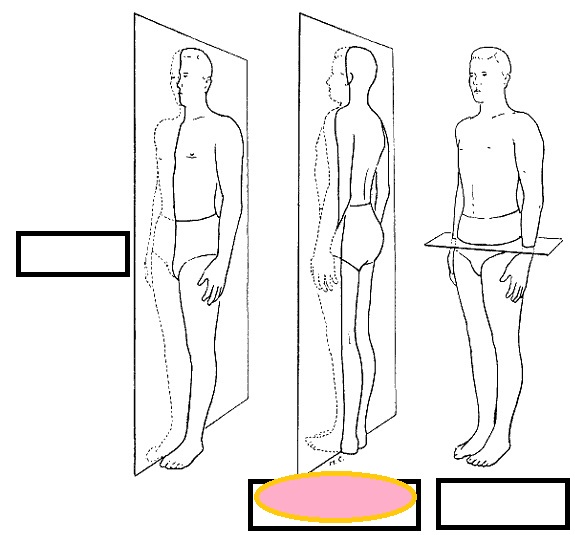
What plane is shown by the circle?
Transverse
Coronal (Frontal)
Sagittal
Oblique

Name the purple cavity?
Thoracic
Abdominal
Pelvic
Cranial

A point that is superior to the abdomen:
neck
hip
foot
wrist
A point that is inferior to the hip:
wrist
shoulder
ankle
sternum
A point that is superior to the nose:
ears
cheek bones
eyes
mouth
The sternum (breast bone) is ______ to the heart.
distal
posterior
anterior
inferior
The brain and spinal cord are located in the:
vertebral cavity
ventral cavity
dorsal cavity
abdominal cavity

What are the 2 main categories of body cavities?
viscera and ventral
dorsal and ventral
dorsal and posterior
anterior and ventral
Body cavity that contains the heart
abdominal
pericardial
pelvic
pleural

In which body section is the above Magnetic Resonance Imaging (MRI) image taken?
Frontal plane
Oblique plane
Sagittal plane
Transverse plane
The eyes are _________ to the ears
medial
lateral
anterior
posterior

Which anatomical plane is the ONLY horizontal plane?
sagittal
transverse
frontal
Which of the following are survival needs of the body?
nutrients, water, movement, and reproduction
nutrients, water, growth, and reproduction
water, atmospheric pressure, growth, and movement
nutrients, water, atmospheric pressure, and oxygen
A body part said to be furthest from point of attachment to trunk is said to be
proximal
distal
lateral
medial
Closest point to the attachment of the trunk is called
proximal
distal
cranial
caudal
Your skin is ___________ to your bones
deep
lateral
superficial
dorsal
Once a stimulus is received by a receptor, it approaches the control center by a(an)
afferent pathway
efferent pathway
motor pathway
reflex pathway
Groups of cells of the same kind make up:
lungs
tissues
organs
systems

Which of the following is not a primary type of tissue?
epithelial
connective
nervous
mitochondrion
This type of tissue include skeletal muscles, cardiac muscles, and smooth muscles.
nervous
muscle
epithelial
connective
This tissue type is found in linings of digestive tract organs, skin surface, and other hollow organs.
nervous
muscle
epithelial
connective
This type of tissue includes bones, tendons, fat and other soft padding tissue.
nervous
muscle
epithelial
connective
This tissue type is found in the brain, spinal cord, and nerves.
nervous
muscle
epithelial
connective

