
 Worksheets
Musculoskeletal Injuries
Total questions: 62
Worksheet time: 31mins
What is the definition of a muscle strain? (Fill in the blank) A muscle strain is a ________, tear, or rip in the muscle or its tendon caused by excessive tension or force.
stretch
bruise
sprain
fracture
Muscle strain results from overuse, overstretching, or a sudden forceful ________.
contraction
relaxation
compression
expansion
Contributing factors to muscle strain include fatigue, muscle imbalance, and inadequate warm-up.
True
False
Fill in the blank: Grade 1 muscle strain is characterized by
mild pain, mild tenderness, minimal loss of function, minimal loss of ROM
severe pain, complete loss of function, and total loss of ROM
moderate pain, moderate tenderness, and partial muscle tear
no pain, no tenderness, and full range of motion
Fill in the blank: Grade 2 muscle strain is characterized by __.
moderate pain, some swelling, palpable defect, decreased ROM, some loss of function, possible bruising
mild discomfort, no swelling, full range of motion, no loss of function
severe pain, complete loss of function, obvious deformity, extensive bruising
no pain, no swelling, normal function, no bruising
Fill in the blank: Grade 3 muscle strain is characterized by ___.
severe pain, loss of function, bruising, decreased ROM/complete loss of movement, visible defect
mild discomfort, no loss of function, slight swelling
moderate pain, some loss of strength, mild swelling
occasional cramps, no visible bruising, full range of motion
What is the definition of muscle cramps? Muscle cramps are __________ that occur suddenly and are often painful.
involuntary muscle contractions
voluntary muscle relaxations
slow muscle growths
intentional muscle movements
Which of the following is a common cause of muscle cramps?
Proper hydration
Balanced electrolytes
Muscle fatigue
Regular stretching
Good nutrition
Which of the following is a sign or symptom of muscle cramps?
Visible muscle contraction
Headache
Nausea
Rash
Fill in the blank: Muscle soreness is defined as ________ in muscles after overexertion or unaccustomed activity.
pain or discomfort
increased strength
rapid healing
loss of flexibility
Fill in the blank: The etiology of muscle soreness is that it results from ________ in muscle fibers caused by eccentric or strenuous exercise.
microscopic tears
increased blood flow
excessive sweating
nerve damage
Fill in the blank: One of the signs and symptoms of muscle soreness is ________ to touch.
tenderness
stiffness
swelling
numbness
What is the definition of tendonitis?
Inflammation of a tendon typically resulting from repetitive stress or overuse.
A fracture of a bone due to direct trauma.
A viral infection affecting the respiratory system.
A genetic disorder causing abnormal cell growth.
What is the etiology (cause) of tendonitis? (Fill in the blank)
Develops from acute or repetitive overloading, often associated with poor mechanics or inadequate recovery.
Caused by bacterial infection of the tendon sheath.
Results from a genetic disorder affecting connective tissue.
Occurs due to a deficiency of vitamin D.
Which of the following is a sign or symptom of tendonitis?
Redness
Nausea
Cough
Dizziness
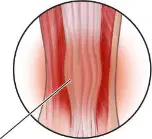
Based on the diagram, what is the main difference between tendonitis and tendinosis in the Achilles tendon?
A) Tendonitis involves inflammation, while tendinosis involves degeneration.
B) Tendonitis involves degeneration, while tendinosis involves inflammation.
C) Both involve only inflammation.
D) Both involve only degeneration.
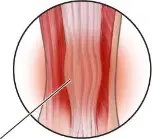
According to the diagram, which condition is associated with inflammation of the Achilles tendon?
A) Tendinosis
B) Tendonitis
C) Both
D) Neither
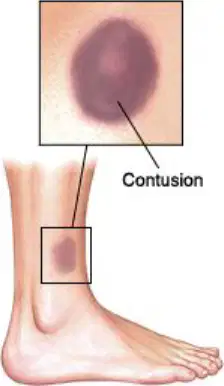
What is shown in the image?
Fracture
Contusion
Sprain
Burn
Fill in the blank: A contusion is the _______ of soft tissue caused by direct impact, resulting in capillary rupture and bleeding beneath the skin.
bruising
swelling
fracture
infection
What is one of the signs of a contusion that involves discoloration of the skin?
Bruising (ecchymosis)
Swelling (edema)
Numbness
Bleeding from a wound
What is the definition of a sprain?
Overstretching or tearing of muscles
Overstretching or tearing of ligaments and/or joint capsule
Breaking of bones
Swelling of joints
Grade 1 sprain: What happens to the ligament?
Ligament stretched
Partial tear
Complete tear
No change
Grade 2 sprain: How does it look (signs)?
Mild pain, little to no swelling, slight tenderness, stable joint
Moderate pain & swelling, tenderness, joint feels loose
Severe pain & swelling, unstable joint
No visible signs
Grade 3 sprain: How does it feel (symptoms)?
Mild pain, stiffness, slight limp
Moderate pain, harder to move, limp
Severe pain at first, then little/no pain
No pain
In a Grade 2 sprain, the ligament undergoes a ________.
Partial tear
Complete rupture
No change
Dislocation
What happens to the bones in a dislocation?
Bones slip out but return on their own
Bones fully separate
Bones partially separate
Bones do not move
In a subluxation, what usually happens to the bones?
A) Bones fully separate
B) Bones slip out but return on their own
C) Bones do not move
D) Bones fuse together
Fill in the blank: In a dislocation, ligaments usually _____
tear
heal
grow
shorten
Fill in the blank: Dislocations usually need medical help to _____.
reset
bandage
massage
ice
Subluxation is usually painful and feels unstable.
True
False
Subluxation can repeat if the joint is loose.
True
False
Which of the following is a sign of Dislocation?
Joint may look slightly "off" but slips back in
Joint visibly out of place
Clicking, popping, or "giving way"
Pain even after it resets
Fill in the blank: A sign of Subluxation is _________.
Swelling
Itching
Sneezing
Coughing
Which of the following is a symptom of Dislocation?
Feels "loose" or unstable
Inability to move joint
Clicking, popping, or "giving way"
Pain even after it resets
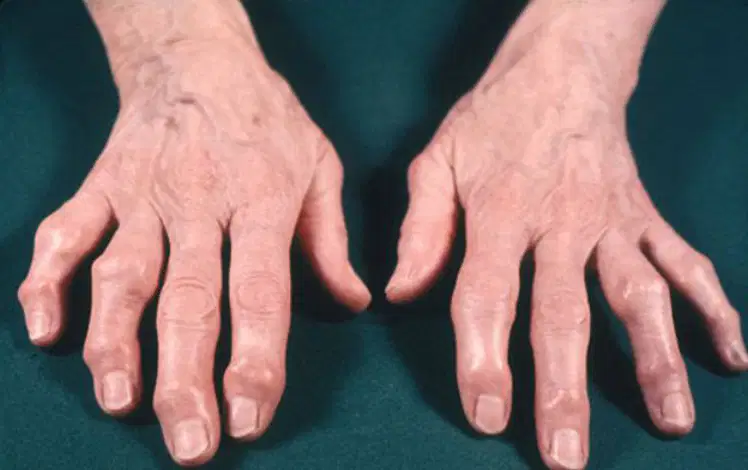
Lily visits her doctor because she has been experiencing pain and stiffness in her hands. The doctor examines her hands and shows her the following image. What condition is being shown in the photograph?
Rheumatoid arthritis
Osteoarthritis
Gout
Psoriatic arthritis
What are bursae?
Small bones in the joints
Small fluid sacs that reduce friction in joints
Muscles that move the joints
Ligaments that connect bones
Where are bursae typically found?
Only between bones
Only between muscles
Between skin and bone, tendons and bone, tendons and skin
Only in the heart
What happens to bursae in bursitis?
Bursae become inflamed and irritated.
Bursae shrink and disappear.
Bursae turn into bone tissue.
Bursae fill with blood.
Which of the following is a cause of bursitis?
Excess movement or acute trauma such as a direct blow
Lack of exercise
Poor diet
Viral infection
Which of the following is NOT a sign or symptom of bursitis?
Swelling and redness
Pain and tenderness
Limited range of motion
Improved flexibility
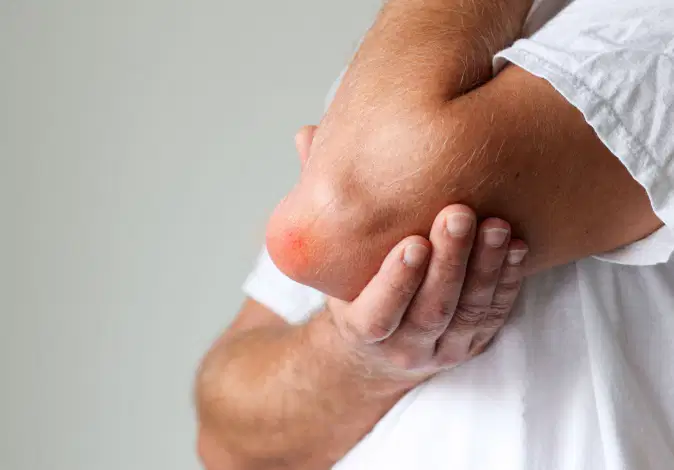
What medical condition is shown in the images, characterized by swelling and inflammation around the joints?
Arthritis
Bursitis
Tendonitis
Fracture
What is the meniscus in the knee?
A bone in the knee
A C-shaped shock absorber made of tough cartilage inside your knee
A muscle in the knee
A ligament in the knee
How many menisci do you have per knee?
One
Two
Three
Four
What are the functions of the meniscus in the knee?
Distribute load
Add stability
Increase flexibility
Produce blood cells
Which of the following is true about swelling in meniscal tears?
Swelling occurs immediately
Swelling occurs hours later, not always right away
Swelling never occurs
Swelling only occurs with fractures
Which of the following are possible sensations or sounds in a meniscal tear?
Clicking/popping
Locking/catching
Both A and B
None of the above
Pain with twisting or deep squat is a sign of a meniscal tear.
True
False
Fill in the blank: A person with a meniscal tear may not be able to fully straighten the knee and may feel ____ or that the knee 'gives way'.
unstable
numb
itchy
warm
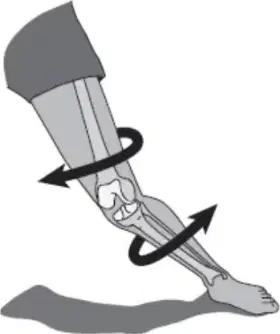
Which of the following is an acute mechanism of injury (MOI) for a meniscal tear?
Twist on planted foot
Sudden cut/pivot
Deep squat + turn
Forced flex/extend
All of the above
Which type of fracture is described as 'Bone breaks but does not pierce skin'?
Closed (simple) Fracture
Open (compound) Fracture
Stress Fracture
Which type of fracture is described as 'Bone penetrates or pierces skin'?
Closed (simple) Fracture
Open (compound) Fracture
Stress Fracture
Which type of fracture is described as 'Small, fine breaks in bone'?
Closed (simple) Fracture
Open (compound) Fracture
Stress Fracture
Overview: Generally, bone fractures can be classified in the following ways: Open (compound) Fracture increases susceptibility to _______.
infection
healing
growth
calcification
Refer to the diagram showing a bone breaking through the skin. What type of fracture is this?
Open (compound) Fracture
Closed (simple) Fracture
Greenstick Fracture
Comminuted Fracture
What is one of the signs and symptoms of a bone fracture? Fill in the blank: ________ deformity.
Obvious
Hidden
Temporary
Internal
What is one of the signs and symptoms of a bone fracture? Fill in the blank: Point ________.
tenderness
swelling
numbness
redness
What is one of the signs and symptoms of a bone fracture? Fill in the blank: ________. (Hint: It is a common response to injury and involves fluid accumulation.)
Swelling
Rash
Cough
Headache
What is one of the signs and symptoms of a bone fracture? Fill in the blank: Ecchymosis (________).
bruising
swelling
bleeding
numbness
What is one of the signs and symptoms of a bone fracture? Fill in the blank: Pain with ________/PROM.
AROM
WBAT
NWB
TTWB
What is one of the signs and symptoms of a bone fracture? Fill in the blank: Crepitus ("________" feeling).
crunch
smooth
tingling
burning
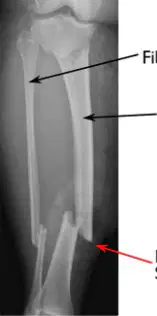
What is one of the signs and symptoms of a bone fracture? Fill in the blank: Confirmed through ________.
X-rays
Blood tests
Ultrasound
Urine analysis
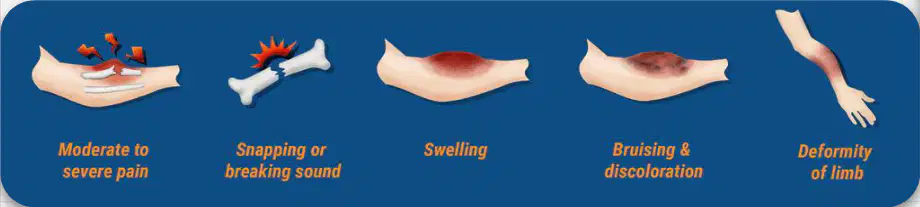
Which of the following is a symptom of a bone fracture?
Snapping or breaking sound
Coughing
Nausea
Rash

