
 Worksheets
Neuromuscular Conditions
Total questions: 68
Worksheet time: 34mins
What is the leading cause of long term disability in the US?
Stroke (Cerebrovascular accident)
Diabetes Mellitus
Chronic Obstructive Pulmonary Disease (COPD)
Osteoarthritis
What is one of the most common health conditions treated by neurorehab therapists?
Stroke (Cerebrovascular accident)
Asthma
Diabetes Mellitus
Hypertension
What does interruption or reduction of blood flow to the brain cause?
Stroke (Cerebrovascular accident)
Asthma attack
Kidney failure
Diabetes
A stroke is commonly caused by a clot that obstructs a blood vessel, resulting in ______.
ischemia
hypertension
hemorrhage
arrhythmia
A stroke can be caused by a weakened blood vessel that bursts and creates ______ (bleeding).
hemorrhage
clot
tumor
scar
Which of the following is NOT a symptom of stroke according to the FAST acronym?
A) Face drooping
B) Arm weakness
C) Speech difficulties
D) Stomach pain
In the FAST acronym for stroke symptoms, what does the 'T' stand for?
Time to call
Take a rest
Turn around
Try to walk
What is one of the main symptoms of a stroke (Cerebrovascular accident)?
Paralysis
Fever
Cough
Rash
What is a possible symptom of a stroke involving partial weakness?
Weakness on the side of the body contralateral to the brain involvement.
Increased appetite and weight gain.
Sudden decline in vision.
Excessive hair growth on the affected side.
Which of the following is a sensory or cognitive impairment that can occur as a symptom of stroke?
Sensory & cognitive impairments
Fever
Headache
Rash
What is a possible speech-related symptom of a stroke?
Difficulty speaking
Increased appetite
Improved vision
Faster heart rate
What is a possible language-related symptom of a stroke?
Difficulty understanding language
Increased appetite
Improved vision
Faster heart rate
What is a swallowing-related symptom of a stroke?
Swallowing deficits
Headache
Nausea
Fever
What is a possible symptom of stroke involving neglect?
Neglect of the involved side
Increased appetite
Improved memory
Enhanced coordination
Which of the following is a treatment for stroke?
Thrombolytic
Antibiotics
Thromboalgia
Thrombolysis
What is a surgical treatment option for stroke?
Surgery to remove excess blood
Physical therapy
Antibiotic medication
Dietary supplements
What is the focus of acute medical management in stroke treatment?
Improving cerebral circulation & oxygen
Reducing muscle mass
Enhancing bone density
Increasing digestive enzymes
What is a significant cause of death & disability caused by external force?
Traumatic Brain Injuries (TBI)
Diabetes Mellitus
Hypertension
Asthma
Which of the following is a symptom of Traumatic Brain Injuries (TBI)?
Altered state of consciousness
Fever
Cough
Rash
Which of the following is NOT a symptom of Traumatic Brain Injuries (TBI)?
Memory difficulties
Neurological deficits
Visual abnormalities
Decreased appetite
Fill in the blank: One of the symptoms of Traumatic Brain Injuries (TBI) is ________ deficits.
Neurological
Respiratory
Gastrointestinal
Dermatological
Fill in the blank: Loss of ________ is a symptom of Traumatic Brain Injuries (TBI).
balance
hearing
appetite
taste
Name 3 types of impairment caused by Traumatic Brain Injuries (TBI).
Cognitive / Physical / Emotional/behavioral
Digestive / Respiratory / Circulatory
Dermatological / Skeletal / Muscular
Reproductive / Endocrine / Lymphatic
Which of the following is NOT a type of impairment caused by Traumatic Brain Injuries (TBI)?
Cognitive
Physical
Emotional/behavioral
Infectious
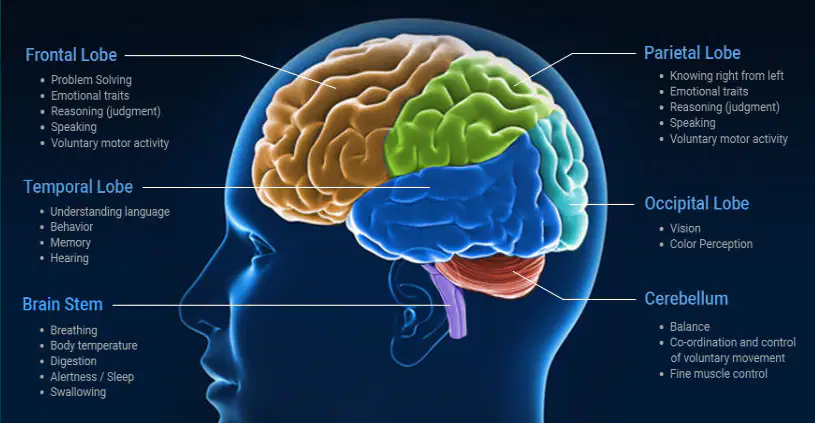
Match the following brain lobes to their primary functions:
Frontal Lobe
Problem Solving
Parietal Lobe
Knowing right from left
Temporal Lobe
Understanding language
Occipital Lobe
Vision
Cerebellum
Balance
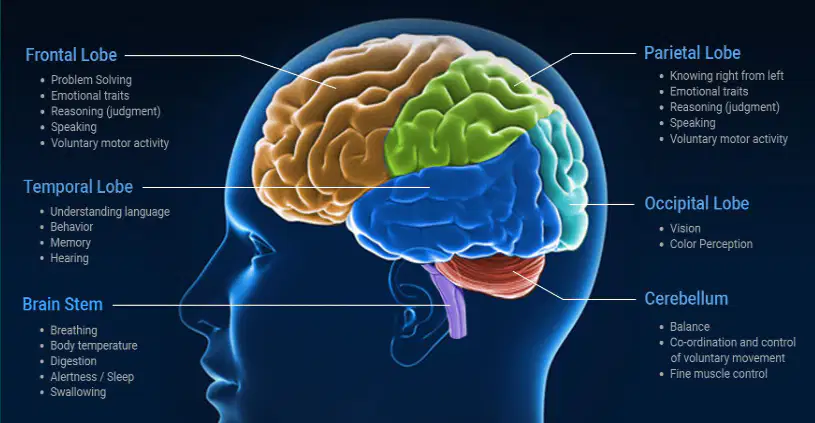
Which lobe of the brain is responsible for problem solving?
Frontal Lobe
Parietal Lobe
Occipital Lobe
Temporal Lobe

Which part of the brain is responsible for balance and coordination?
Cerebellum
Medulla Oblongata
Frontal Lobe
Hypothalamus
Which of the following is a treatment strategy for Traumatic Brain Injuries (TBI)?
Recovery is subjective to the patient
Ignoring cognitive strategies
Avoiding team-based care
Increasing impairment
Which of the following is NOT a potential communication problem following a traumatic brain injury?
Difficulty understanding speech or reading
Inability to organize thoughts and/or ideas
Improved hand-eye coordination
Difficulty speaking or writing
Fill in the blank: Sensory problems following a traumatic brain injury may include sensitivity to ____ or noise.
light
taste
movement
temperature
Which intellectual problem is associated with traumatic brain injury?
A) Memory
B) Enhanced taste
C) Improved vision
D) Increased hearing
Which of the following is an emotional change that may follow a traumatic brain injury?
Depression
Increased frustration tolerance
Enhanced mood stability
Improved anger management
What is effected if there is a spinal cord injury?
Damage to the cerebral spinal fluid
Damage to the spinal cord or nerve root
Damage to the lungs causing breathing issues
Damage to neurosensory receptors
Which of the following can cause a spinal cord injury?
Falls
Gunshot wounds
Sports injuries (diving or football)
All of the above
What is tetraplegia?
Only lower limbs are affected
All limbs function affected
Only upper limbs are affected
No limbs are affected
What is paraplegia?
All limbs function affected
Only upper limbs are affected
Lower part of the body (trunks & legs) affected
No limbs are affected
Control of breathing is at which spinal cord levels?
C1, C2, C3
C3, C4, C5
T1, T2, T3
L1, L2, L3

Match the spinal cord injury level to the type of impairment:
Tetraplegia
C4 injury
Tetraplegia
C6 injury
Paraplegia
T6 injury
Paraplegia
L1 injury
Which of the following is a treatment for spinal cord injury?
Medication to control inflammation & prevent further nerve root damage
Acute physical therapy
Both A and B
None of the above
Fill in the blank: One of the goals of acute physical therapy for spinal cord injury is maintaining and improving __________ endurance.
cardiorespiratory
muscular
skeletal
digestive
Which of the following is NOT a component of acute physical therapy for spinal cord injury?
Flexibility
ROM
Strengthening of unaffected muscles
Increasing nerve root damage

Name one of the regions of the vertebral column shown in the diagram:
Cervical vertebrae (C1-C7)
Femur region
Pelvic girdle
Scapular region
The difference between a Tetraplegic and a Paraplegic is:
Tetraplegic affects all four limbs, while Paraplegic affects only the lower limbs.
Tetraplegic affects only the lower limbs, while Paraplegic affects all four limbs.
Tetraplegic affects only the arms, while Paraplegic affects only the legs.
Tetraplegic and Paraplegic are the same condition.
F.A.S.T stands for:
Face, Arms, Speech, Time
Fast Action Saves Time
First Aid Safety Test
Face, Alert, Speech, Time
The leading cause of disabilities in the US is which Neuromuscular condition?
Multiple Sclerosis
Muscular Dystrophy
Cerebral Palsy
Amyotrophic Lateral Sclerosis
What is a common complaint of patients with Vestibular Disorder?
Dizziness
Chest pain
Blurred vision
Shortness of breath
Which of the following is NOT a symptom of Vestibular Disorder?
Lightheadedness
Unsteadiness
Spinning (vertigo)
Fever
Peripheral dysfunction results from benign paroxysmal positional vertigo (BPPV), which occurs when ________ fall into the semicircular canals causing sensation of spinning.
calcium crystals
red blood cells
nerve fibers
hair cells
Vestibular Disorder is commonly presented with dizziness.
True
False
Which of the following is NOT a cause of Vestibular Disorder?
Viral infections
Vestibulocochlear nerve (8th cranial nerve) tumors
Toxicity to certain antibiotics
Diabetes
Fill in the blank: One of the treatments for Vestibular Disorder is ________ retraining.
Balance
Speech
Vision
Cognitive
Repositioning maneuvers are a treatment for Vestibular Disorder.
True
False
Match the following aspects of Vestibular Disorder with their correct category:
Cause
Viral infections
Treatment
Balance retraining
Purpose of treatment
Minimize vertigo symptoms
What is Multiple Sclerosis (MS)?
A disease where the immune system attacks the myrkub sheath covering motor and sensory nerve fibers
A type of cancer
A bacterial infection
A digestive disorder
Fill in the blank: The specific causes of Multiple Sclerosis (MS) still remain _____
unknown
well-understood
completely preventable
easily diagnosed
fully treated
At what age range is Multiple Sclerosis (MS) most commonly diagnosed?
Between the ages of 20 to 50 years
Between the ages of 5 to 15 years
Between the ages of 60 to 80 years
Between the ages of 51 to 59 years
Multiple Sclerosis (MS) affects women 2x to 3x more than men.
True
False
Which of the following is NOT a symptom of Multiple Sclerosis (MS)?
Visual deficits
Tingling
Numbness and tingling
High blood pressure
Which of the following is NOT part of the 'triad' of motor symptoms in Parkinson's Disease?
Tremors
Rigidity
Bradykinesia
Paralysis
Match the following motor symptoms of Parkinson's Disease with their correct definitions:
Tremors
Slowness of movement and the MAJOR cause of disability.
Rigidity
Alternating contractions of opposing muscle groups, present in 70% of individuals, affects hands & feet at rest.
Bradykinesia
Disturbance in muscle tone, resistance when limbs and trunk are passively moved regardless of speed.
Which of the following is NOT an associated symptom of Parkinson's Disease (PD)?
Fever
Cognitive issues
Sleep disturbance
Apathy
Anxiety
Parkinson's Disease (PD) is caused by a deficiency in which neurotransmitter?
Dopamine
Serotonin
Acetylcholine
GABA
Match the following TRAP features of Parkinson's Disease (PD) with their descriptions:
Tremor
Shaking, usually starting on one side
Rigidity
Stiffness of the limbs, neck, or trunk
Akinesia
Loss or impairment in power of voluntary movement
Posture and balance
Posture and balance
Fill in the blank: Parkinson's Disease (PD) is associated with ________ issues, such as memory and thinking problems.
Cognitive
Respiratory
Digestive
Muscular
Constipation is an associated symptom of Parkinson's Disease (PD).
True
False
What is Guillain-Barré syndrome?
Inflammatory process affecting the peripheral nerve
Viral infection affecting the heart
Bacterial infection affecting the lungs
Genetic disorder affecting the brain
Where does the viral infection associated with Guillain-Barré syndrome typically begin?
Upper extremities
Lower extremities
Head
Abdomen
Guillain-Barré syndrome progresses rapidly over a ___ week period reaching a plateau at ___ weeks.
32 week period, plateau at 4 weeks
4 week period, plateau at 8 weeks
2 week period, plateau at 12 weeks
12 week period, plateau at 32 weeks

