
 Worksheets
Eastern Classical Civilizations
Total questions: 93
Worksheet time: 47hrs 30mins
River valley civilizations declined over time due to several reasons. Which of the following is NOT mentioned as a reason for their decline?
War
Corruption
Climate change
Industrialization
As early river valley civilizations declined, classical civilizations _________
emerged
disappeared
remained unchanged
became river valleys
The classical civilizations of the Eastern Hemisphere included which of the following?
Chinese, Indian, and Persian civilizations
Roman, Greek, and Egyptian civilizations
Mayan, Aztec, and Incan civilizations
Mesopotamian, Egyptian, and Greek civilizations
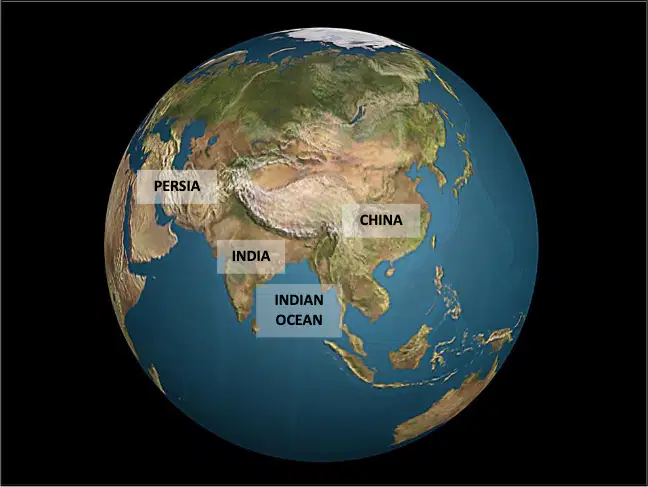
The map shows the locations of Persia, India, and China in the Eastern Hemisphere.
True
False
Which of the following factors contributed to the collapse of river valley civilizations?
Famine
Migration
War
All of the above
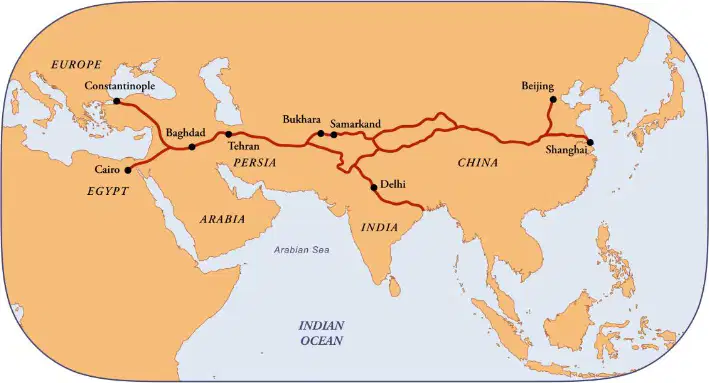
Look at the map titled 'The Silk Road.' Which two major cities are connected by the Silk Road?
Beijing and Constantinople
London and Rome
Cairo and Paris
Delhi and Tokyo
The classical civilizations improved government, art, architecture, and ______ systems.
writing
farming
cooking
hunting
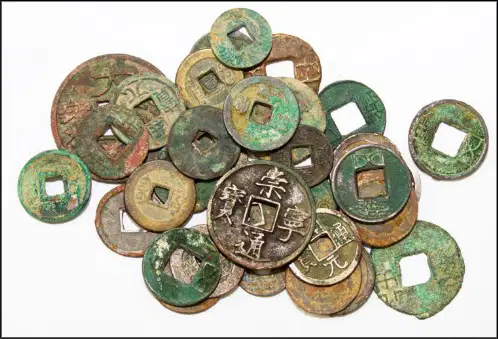
The image shows ancient coins. What does this suggest about classical civilizations?
They used money for trade.
They only bartered goods.
They did not have any form of currency.
They used shells as money.
Major world religions and philosophies were important to classical governments and societies.
True
False
In the Eastern Hemisphere, which of the following belief systems grew during the classical period?
Confucianism
Buddhism
Daoism
Hinduism
All of the above
The rise of classical civilizations is considered a major _______ in world history because the values and traditions established during this time were recognized throughout later time periods.
turning point
conflict
decline
disaster
What are the three major dynasties of Classical China?
Zhou, Qin, Han
Ming, Tang, Song
Sui, Yuan, Qing
Shang, Xia, Zhou
A dynasty is a series of rulers from the ________; the right to rule is passed down through generations. (Fill in the blank)
same family line
same city
same religion
same profession
Which of the following best describes the dynastic cycle in Classical China?
A) A strong ruler is chosen, brings peace and prosperity, then the dynasty declines and the leader is deemed unfit to rule.
B) Dynasties last forever without change.
C) Dynasties are chosen by the people every year.
D) Dynasties never decline.
Match the dynasty with its pronunciation:
[jō]
Zhou
[CHĭn]
Qin
[hăn]
Han
The dynasties of Classical China rose and fell in a cycle.
True
False
What was the Mandate of Heaven in the context of the Zhou Dynasty?
A) A military strategy
B) A divine source of authority used to justify a monarch’s right to rule
C) A type of government tax
D) A trade agreement
According to the information about the Zhou Dynasty, who created the Mandate of Heaven?
Shang dynasty
Zhou dynasty
Qin dynasty
Han dynasty
Fill in the blank: The Mandate of Heaven was based on ________ principles established by the Shang dynasty.
theocratic
democratic
military
economic
Under the Mandate of Heaven, what would happen to an emperor who did not rule well in the eyes of Heaven?
He would lose the mandate and be replaced.
He would be rewarded with more power.
He would become immortal.
He would be sent to another country.
The Mandate of Heaven was used to justify rebellions and the overthrow of dynasties.
True
False
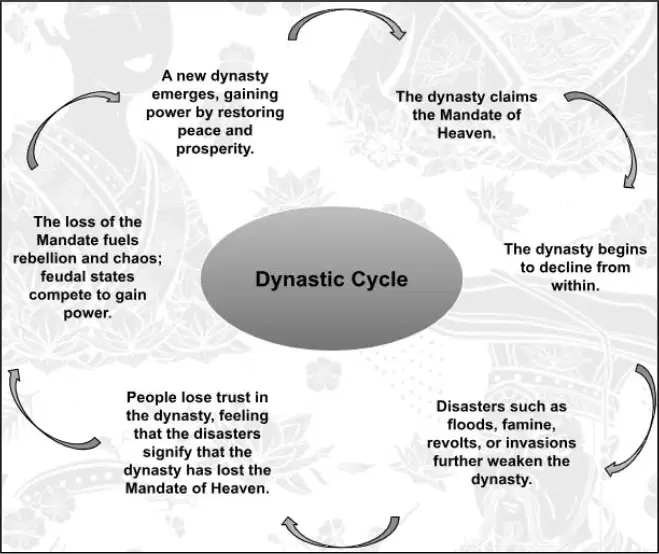
Refer to the diagram of the Dynastic Cycle. What event typically follows the loss of the Mandate of Heaven according to the cycle?
The dynasty claims the Mandate of Heaven
Disasters such as floods, famine, revolts, or invasions further weaken the dynasty
A new dynasty emerges, gaining power by restoring peace and prosperity
The dynasty begins to decline from within
What type of government did the Zhou dynasty use, in which noble lords or wealthy landowners ruled over states and reported to the monarch?
Democracy
Feudalism
Monarchy
Republic
As the Zhou dynasty began to decline, chaos broke out as powerful feudal states began to compete for political dominance in a period known as the _________?
Warring States
Spring and Autumn
Three Kingdoms
Han
Which three major philosophies emerged during the Zhou dynasty period?
A) Buddhism, Confucianism, Daoism
B) Confucianism, Daoism, Legalism
C) Legalism, Buddhism, Shinto
D) Confucianism, Hinduism, Daoism
Match the following philosophies with their time period of emergence:
Zhou Dynasty
Zhou Dynasty
Han Dynasty
Zhou Dynasty
Qin Dynasty
Zhou Dynasty
Confucianism is a Chinese philosophy based on the teachings of whom?
A) Laozi
B) Confucius
C) Buddha
D) Socrates
Confucius believed that people were essentially ______ and established rules for the way individuals should interact with one another within the frameworks of family and society.
good
selfish
evil
indifferent
Which ancient philosophical text is composed of Confucius's teachings and was recorded after his death?
The Analects
The Tao Te Ching
The Art of War
The Book of Changes
Confucianism was foundational in Chinese government because it emphasized the individual's responsibility to contribute to society as a whole.
True
False
Which of the following is NOT one of the Five Relationships in Confucianism?
Ruler and subject
Father and son
Teacher and student
Husband and wife
Fill in the blank: Confucianism is centered around the Five Relationships, which include ______ and subject, father and son, husband and wife, older sibling and younger sibling, and friend and friend.
ruler
teacher
student
citizen
According to Confucianism, what must individuals do to ensure society functions harmoniously?
Individuals must manage their relationships accordingly for society to function harmoniously.
Individuals must focus solely on personal wealth to ensure harmony.
Individuals must avoid all social interactions to maintain peace.
Individuals must follow strict legal punishments to ensure order.
In Confucianism, each of the five relationships contains a hierarchy in which one individual is inferior to the other and must respect and obey them.
True
False
What idea is stressed by the five relationships in Confucianism, which means respect for one's parents, elders, and ancestors?
Filial piety
Legalism
Benevolence
Meditation
What system of social organization is promoted by Confucian relationships, in which males hold authority in family and society?
Patriarchy
Matriarchy
Egalitarianism
Meritocracy
Daoism is a ________ created by Lao Tzu in China. (Fill in the blank)
philosophy
religion
dynasty
festival
The Dao (Tao) was the way, or ________, of the universe.
order
chaos
illusion
beginning
Like Confucianism, Daoism sought to create a sense of order and harmony between humans and their environments, specifically ________.
nature
technology
government
economy
Daoism is a way that some people can achieve ________, or a personal awakening in their own beliefs. (Fill in the blank)
enlightenment
wealth
fame
punishment
Who created Daoism in China?
Confucius
Lao Tzu
Buddha
Socrates

What does the Dao aim to find through balancing opposites, as represented by the Yin and Yang symbol?
Wealth
Harmony
Power
Knowledge
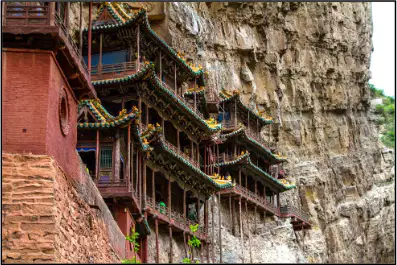
Daoist architecture is made of natural materials such as wood, stone, and clay to create a sense of ______ between the structures and their surroundings.
balance
conflict
distance
chaos
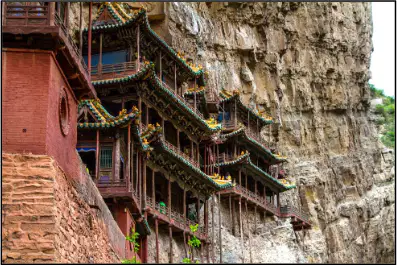
Pagodas, often used as temples in Daoism, were designed to blend in with the ______.
mountains
rivers
deserts
forests

Daoism is represented in medical techniques such as ______, which aims to restore balance in the body.
acupuncture
chemotherapy
dialysis
radiation therapy
Daoism is attributed to the discovery of gunpowder.
True
False
Who led the Qin dynasty and came into power during the Warring States period by overthrowing the Zhou dynasty?
Qin Shi Huangdi
Liu Bang
Wu Zetian
Kublai Khan
Qin Shi Huangdi dissolved the feudal system and unified China under a ________, a system in which power is concentrated and given to a single authority who rules from a capital city.
centralized government
democratic assembly
federal republic
tribal confederation
Qin Shi Huangdi was China's first true emperor.
True
False
Which philosophy did Emperor Qin Shi Huangdi use to govern, which stressed strict obedience to the law and promoted harsh punishment?
Confucianism
Daoism
Legalism
Buddhism
According to Legalism, people were naturally selfish and needed to be ________ to maintain order in society.
strictly managed
left alone
encouraged to be creative
given total freedom
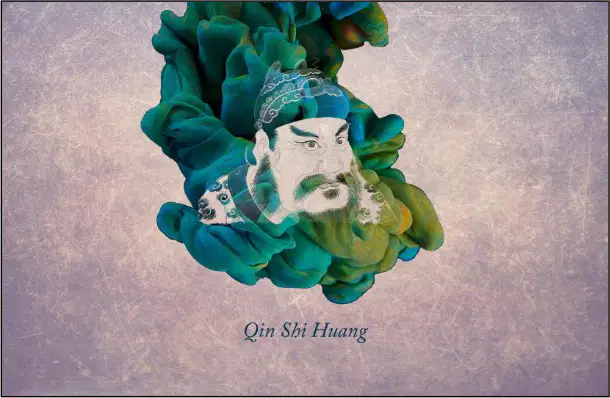
Who is depicted in the image labeled 'Qin Shi Huang'?
Qin Shi Huangdi
Emperor Wu of Han
Sun Tzu
Confucius
What word is shown under a magnifying glass in the image?
legalism
democracy
capitalism
feudalism
Which dynasty is known for the reforms ordered by Qin Huangdi?
Han Dynasty
Qin Dynasty
Ming Dynasty
Tang Dynasty
To strengthen his rule, Qin Huangdi dissolved the feudal system and appointed his own officials. Most of these officials were:
Philosophers
Military officers who had distinguished themselves in battle
Farmers
Merchants
To strengthen his rule, Qin Huangdi ordered the once-powerful noble lords to either ______ from the empire or move to its central city.
move away
pay tribute
join the army
become merchants
Qin Huangdi collected weapons and then:
melted them down to make statues
gave them to his soldiers
sold them to neighboring states
buried them underground
Qin Huangdi ordered all books containing philosophical thoughts of the past to be burned.
True
False
Aside from his legalistic principles and social reform, Emperor Qin Shi Huangdi is known for making significant contributions. Which of the following is NOT one of his contributions?
Building major highways
Digging irrigation canals
Constructing protective barriers
Inventing gunpowder
The barriers constructed by Emperor Qin Shi Huangdi later became known as the _________?
Great Wall of China
Berlin Wall
Hadrian's Wall
Great Barrier Reef
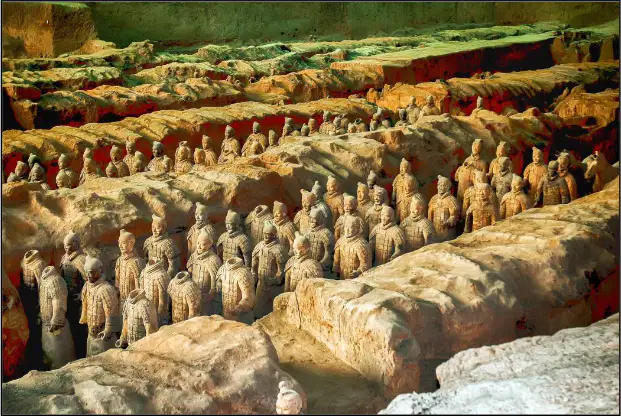
The Qin dynasty is known for the creation of large detailed statues of soldiers, horses, chariots, and government officials. What are these statues called?
Bronze Warriors
Terracotta Warriors
Jade Soldiers
Marble Guards
What happened after Emperor Qin Shi Huangdi died?
The dynasty became stronger
A civil war broke out and the dynasty fell
The Great Wall was completed
The terracotta warriors were destroyed
Emperor Qin Shi Huangdi also standardized the writing and the ________ systems.
weights and measures
calendar
currency
tax
What dynasty did the Han dynasty overthrow to become China’s second imperial dynasty?
Tang dynasty
Qin dynasty
Ming dynasty
Zhou dynasty
Much like the political structure of the Qin dynasty, the Han had a centralized monarchy ruled by an emperor. What law did the Han use to maintain order?
Legalist law
Confucian law
Buddhist law
Daoist law
Fill in the blank: Government titles in the Han dynasty were based on ______, and men had to pass the civil service exams to prove their qualifications.
merit
wealth
birthright
military service
The civil service exams in the Han dynasty were easy to pass.
True
False
What did the civil service exams in the Han dynasty assess knowledge of?
Military tactics
Confucian principles, government, and laws
Mathematics
Agriculture
What was one result of the civil service exams in the Han dynasty regarding social mobility?
A man from any social class could take the exam, and if he passed, he could rise in station.
Only nobles were allowed to take the exam, limiting social mobility.
Women were the primary candidates for the exams, increasing their social status.
Passing the exam meant automatic membership in the royal family.
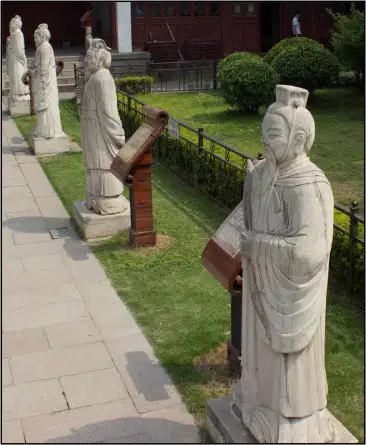
What role did scholar-officials play in the Han dynasty?
Scholar-officials advised the emperor and helped manage different aspects of the empire.
Scholar-officials led military campaigns against neighboring kingdoms.
Scholar-officials were responsible for building and maintaining roads and canals.
Scholar-officials served as merchants and managed trade routes.
China experienced significant ________ and economic growth under the Han dynasty. Fill in the blank.
technological
military
religious
artistic
Which of the following inventions is Han China credited with?
Paper
Seismograph
Wheelbarrow
All of the above
The Silk Road was established as a major trading network under which dynasty?
Han
Ming
Tang
Song
Goods such as silk, spices, tea, and jade were traded along the Silk Road.
True
False
The Silk Road played a vital role in the spread of technology and ________ beliefs, such as Buddhism, during the Han dynasty. Fill in the blank.
religious
political
economic
scientific
Match the following goods with their significance on the Silk Road:
Luxury fabric
Silk
Flavoring and preservation
Spices
Beverage
Tea
Precious stone
Jade
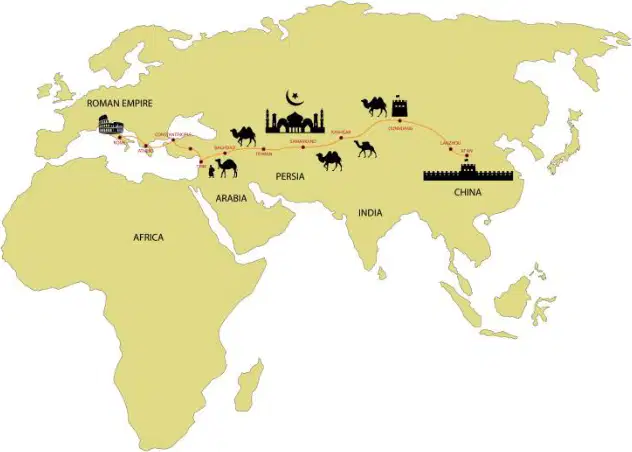
Refer to the map labeled 'Ancient Silk Road.' Which regions did the Silk Road connect?
The Silk Road connected China, India, Persia, Arabia, and the Roman Empire.
The Silk Road connected only China and Japan.
The Silk Road connected Africa and South America.
The Silk Road connected Australia and Europe.
China expanded significantly under the Han dynasty; however, the larger the empire became, the more difficult it was to manage.
True
False
The dynasty grew weak because of government corruption and social unrest. Which of the following was NOT a reason for the dynasty's weakness?
A) High taxes
B) Low unemployment rates
C) Income inequality
D) Government corruption
Chinese citizens were forced to pay ______ under the Han dynasty, which contributed to social unrest.
high taxes
low wages
military fees
tribute to foreign rulers
Unemployment rates were high during the decline of the Han dynasty.
True
False
The rich became wealthier, and the poor became more deprived during the decline of the Han dynasty.
True
False
Rebellions broke out, and invasions from foreign tribes further weakened the Han’s political foothold. What was the result of these events?
The Han dynasty expanded
The Han dynasty collapsed
The Han dynasty became stronger
The Han dynasty united with foreign tribes
The Han dynasty collapsed, and the empire dissolved into ______ kingdoms.
three
five
seven
ten
Who was the Mauryan emperor who eventually inherited the throne from Chandragupta and expanded the empire through warfare?
Bindusara
Asoka
Harsha
Samudragupta
After a particularly violent conquest, Asoka felt remorseful and converted to ________, promoting it throughout his empire.
Buddhism
Hinduism
Jainism
Zoroastrianism
Which of the following actions did Asoka take to promote Buddhism?
Built Buddhist temples and monuments
Sent out missionaries
Issued rock edicts
All of the above
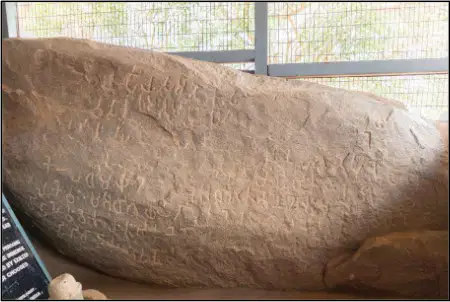
The rock edicts issued by Asoka contained inscriptions of Buddhist teachings and were carved on various forms of stone throughout India.
True
False
Asoka supported religious ________ in his empire.
tolerance
persecution
division
exclusivity
In his commitment to improve the lives of his subjects, Asoka built a network of ________ to increase trade.
roads
temples
palaces
gardens
Which of the following was NOT an initiative taken by Asoka to improve the lives of his subjects?
Built roads
Established hospitals
Promoted agriculture
Built palaces for himself
While China was experiencing the rise and fall of the Zhou, Qin, and Han dynasties, power was also shifting in which country?
Egypt
India
Greece
Persia
Who overthrew the Nanda dynasty and established the Mauryan dynasty?
Ashoka
Alexander the Great
Chandragupta Maurya
Qin Shi Huang

