
 Worksheets
ENV Benchmark Review
Total questions: 48
Worksheet time: 2hrs 20mins
Which TWO statements best describe ENSO?
During El Niño, weakened trade winds reduce upwelling in the eastern tropical Pacific, raising SSTs and shifting rainfall eastward.
During La Niña, strengthened trade winds increase upwelling in the eastern tropical Pacific, lowering SSTs and shifting rainfall westward.
El Niño directly increases volcanic eruptions globally.
La Niña causes sea level to rise worldwide.
Describe the process of eutrophication and explain its impact on aquatic ecosystems.
Eutrophication is nutrient enrichment causing algal blooms, oxygen depletion, and harm to aquatic life.
Eutrophication is the process of removing nutrients from water bodies, leading to increased biodiversity.
Eutrophication is the cooling of water bodies, resulting in higher oxygen levels and healthier fish populations.
Eutrophication is the reduction of sunlight in water due to sedimentation, promoting coral reef growth.
The level of organization that includes all life on earth is called:
Biosphere
Ecosystem
Community
Population
The level of organization that includes all of the biotic and abiotic factors in an area is called:
Community
Ecosystem
Population
Organism
The level of organization that includes all of the different species in an area is called:
community
population
organism
ecosystem
The level of organization characterized by plants, temperature, and precipitation is:
ecosystem
organism
population
cell
The level of organization that includes all of the individuals of the same species in an area is called:
community
population
ecosystem
biosphere
The level of organization that concerns only one individual organism is:
Organism
Population
Community
Ecosystem
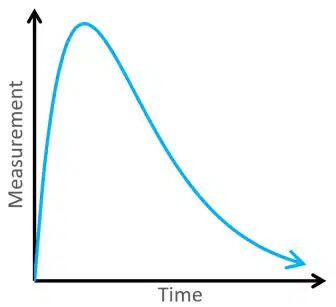
Which feedback loop does the graph best represent?
A positive feedback loop
A negative feedback loop
Both a positive feedback loop and negative feedback loop
Neither
For the following scenario, determine if it is a positive or negative feedback loop and circle accordingly. Ice in the Arctic is melting. As the ice melts, the albedo of the region lowers, which causes the ocean to absorb more of the sun’s radiation, causing warming, causing more ice melt.
POSITIVE
NEGATIVE
For the following scenario, determine if it is a positive or negative feedback loop and circle accordingly. An invasive species invades an ecosystem. It has no natural predators and reproduces rapidly. As the individuals in the species reproduce, the population explodes.
POSITIVE
NEGATIVE
For the following scenario, determine if it is a positive or negative feedback loop and circle accordingly. A predator-prey relationship exists among two species in nature. A boom in prey population will mean more food for predators, which will increase predator numbers. This will then lead to over-predation, and the prey population will again decline. The predator population will decline in response, releasing the pressure on the prey population and allowing it to bounce back.
POSITIVE
NEGATIVE
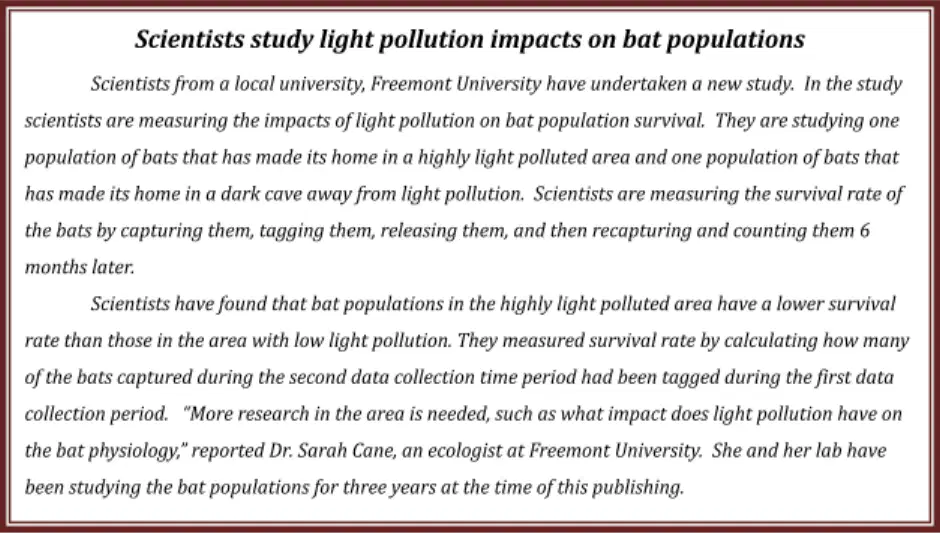
In the article above, what is the hypothesis that the team is testing?
If bats live in areas with high light pollution, then their six-month survival rate will be lower than bats living in low-light (dark) areas.
Tagging and recapturing bats will make them easier to count and track over time.
Light pollution changes bat physiology in specific ways.
The hypothesis that the team is testing is unrelated to the article above.
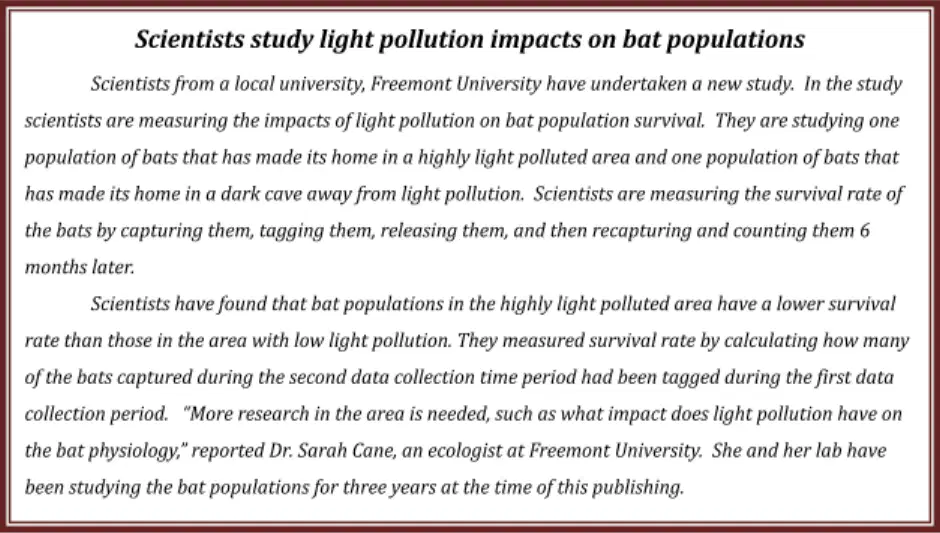
Define a dependent variable, then identify the dependent variable in the above experiment.
A dependent variable is the factor that is measured in an experiment; the dependent variable in the above experiment is the one being observed for changes.
A dependent variable is the factor that is changed by the experimenter; the dependent variable in the above experiment is the one being manipulated.
A dependent variable is the constant factor in an experiment; the dependent variable in the above experiment does not change.
A dependent variable is the factor that is not measured in an experiment; the dependent variable in the above experiment is ignored.
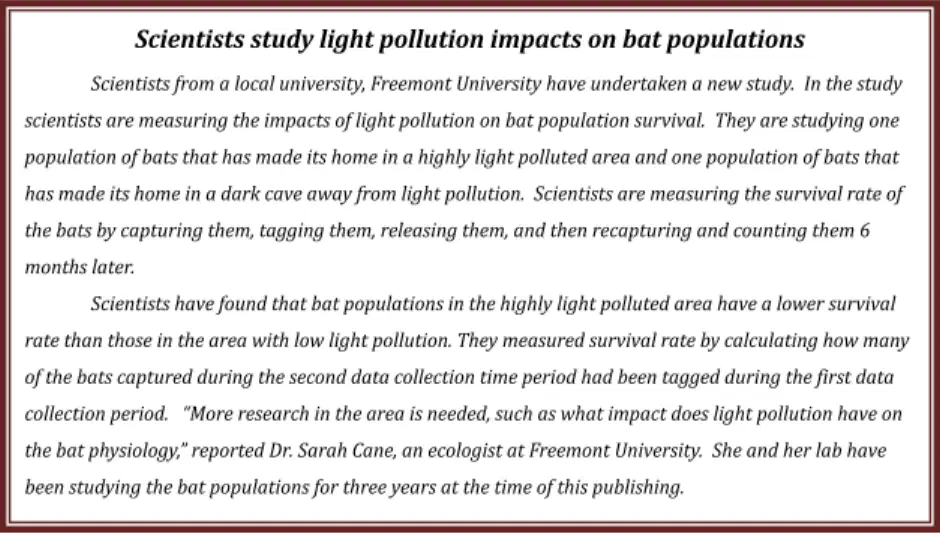
An independent variable is the factor that is changed or controlled in a scientific experiment. Identify the independent variable in the above experiment.
The factor that is changed or controlled in the experiment
The result measured in the experiment
The equipment used in the experiment
The location where the experiment is conducted
Define a constant variable, then come up with one constant variable that is needed for the above experiment.
A constant variable is a variable that is kept the same throughout the experiment.
A constant variable is a variable that changes during the experiment.
A constant variable is a variable that is measured as the outcome of the experiment.
A constant variable is a variable that is not recorded in the experiment.
List one way ecosystems can be disturbed or changed naturally, and one way ecosystems can be disturbed or changed by humans.
Naturally: wildfire, flood, hurricane, etc. By humans: deforestation, pollution, urbanization, etc.
Naturally: planting trees, By humans: rainfall
Naturally: recycling, By humans: animal migration
Naturally: building roads, By humans: volcanic eruption
Has all four seasons, receives moderate rainfall and has moderate temperatures. Can support many types of trees. Indiana and Germany have this type of biome.
Temperate Deciduous Forest
Tropical Rainforest
Desert
Tundra
Has very high temperatures but very low annual rainfall. Cannot support most trees but does have many plants that are adapted to conserve water, such as cactus and succulents.
Desert
Rainforest
Tundra
Grassland
A very cold biome that receives barely any precipitation. No trees grow in this biome because the soil is frozen for most of the year (called permafrost).
Tundra
Desert
Rainforest
Savanna
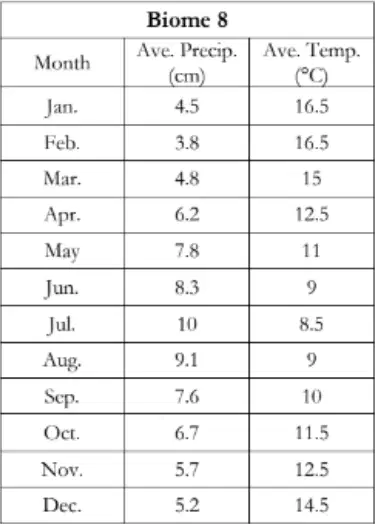
A climatogram is constructed using which of the following types of data?
Temperature and precipitation data
Wind speed and humidity data
Soil composition and altitude data
Sunlight hours and air pressure data
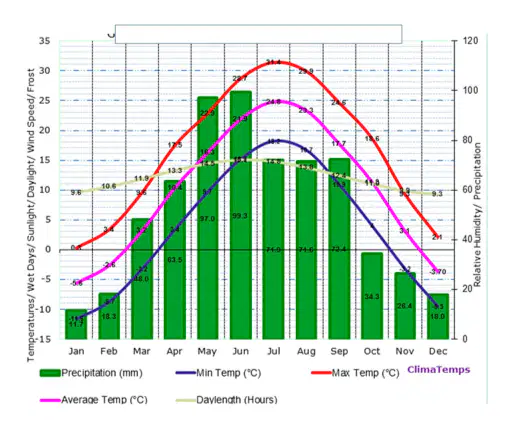
The total precipitation throughout the year is highest during which months and lowest during which months?
It rains more in the summer months and less in the winter months.
It rains more in the winter months and less in the summer months.
It rains equally throughout the year.
It only rains during the spring months.
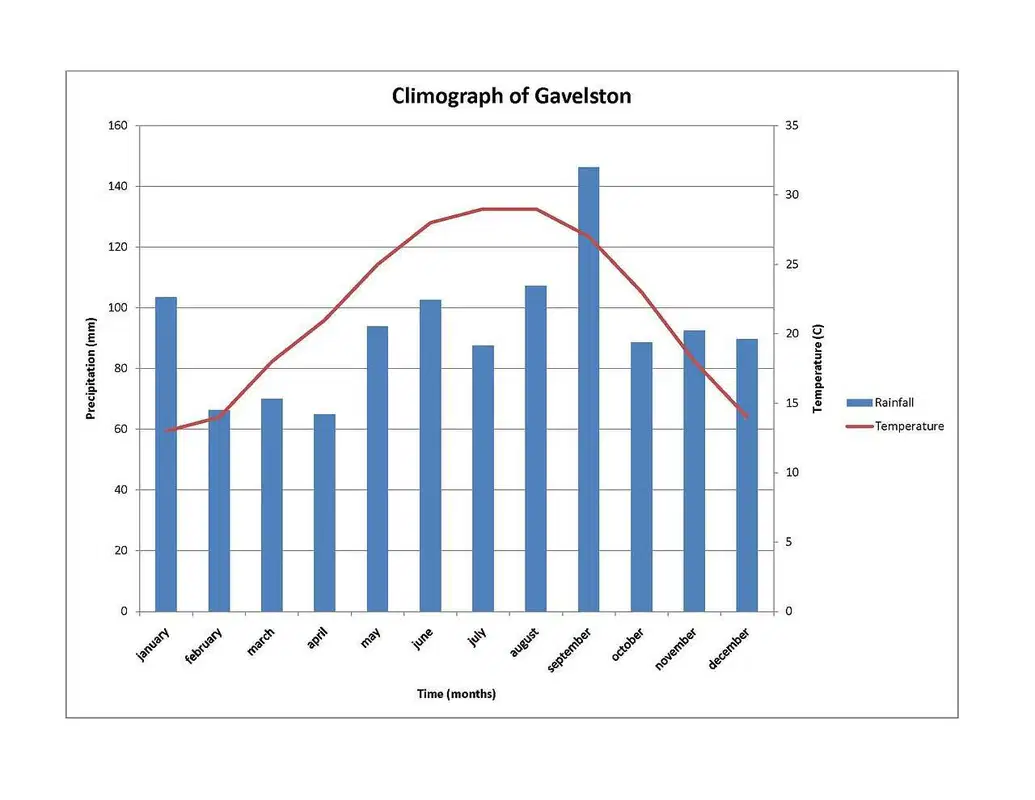
The average temperature throughout the year is calculated and described. Does it fluctuate?
Yes, it fluctuates.
No, it remains constant.
It only increases.
It only decreases.
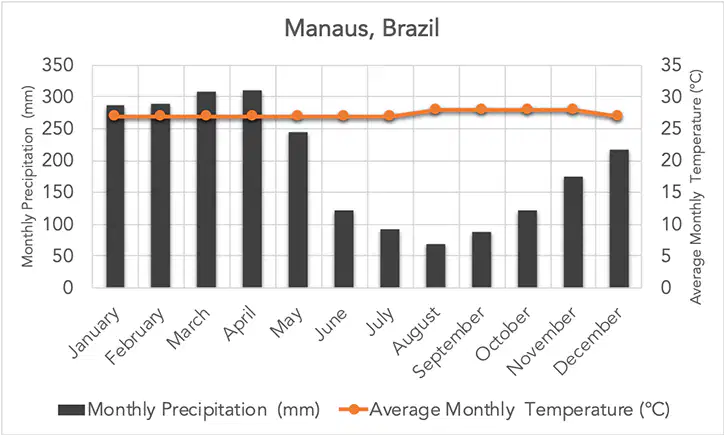
The climatogram above most likely represents which biome?
Tropical Rainforest
Desert
Tundra
Grassland
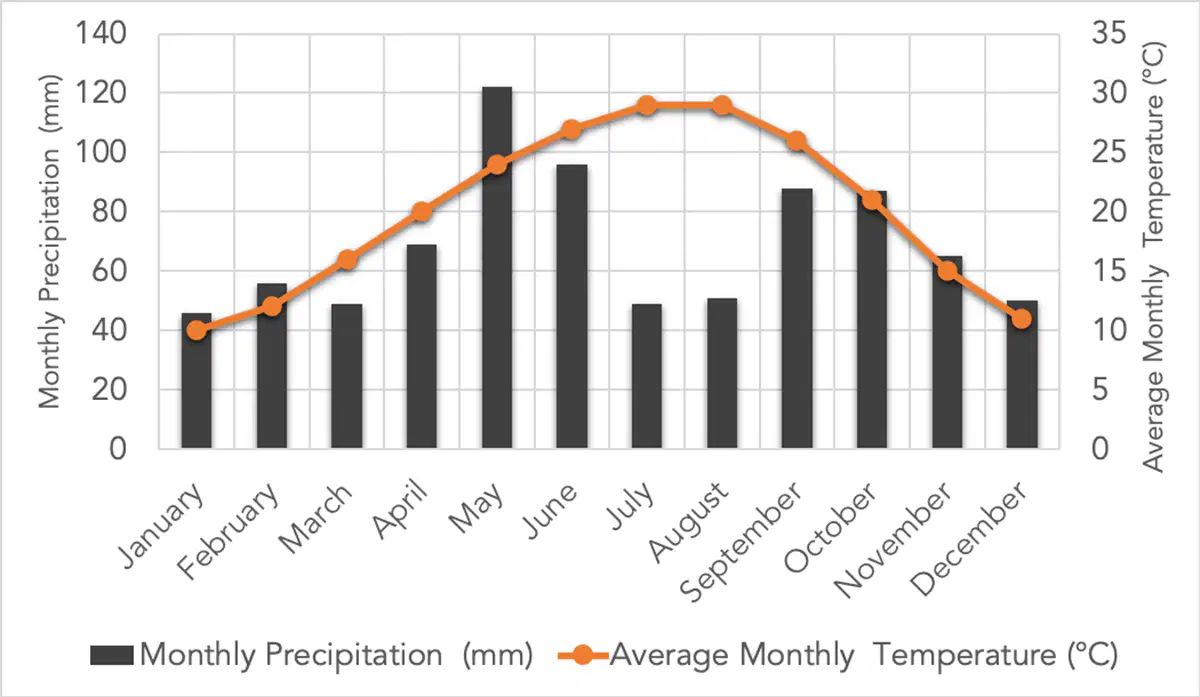
This biome is located in which hemisphere?
Northern Hemisphere
Southern Hemisphere
Eastern Hemisphere
Western Hemisphere
List the terms associated with the processes of the nitrogen cycle
Nitrogen Cycle: Nitrogen fixation, nitrification, assimilation, ammonification, denitrification
Nitrogen Cycle: Photosynthesis, transpiration, respiration, combustion
Nitrogen Cycle: Glycolysis, fermentation, photolysis, chemosynthesis
Nitrogen Cycle: Carbonation, oxidation, reduction, hydrolysis
List the terms associated with the phosphorus cycle
Phosphorus Cycle: Weathering, absorption by plants, movement through food chain, return to soil via decomposition
Phosphorus Cycle: Erosion, condensation, precipitation, evaporation
Phosphorus Cycle: Sublimation, deposition, infiltration, percolation
Phosphorus Cycle: Calcification, leaching, mineralization, volatilization
The main source of excess nitrogen and phosphorus in our ground and water is:
Agricultural runoff
Urban air pollution
Deforestation
Industrial noise
Eutrophication is the process by which:
nutrient levels in water bodies increase, leading to excessive growth of algae
oxygen levels in water bodies increase, supporting more aquatic life
water bodies become more acidic due to pollution
sediments are removed from water bodies, making them clearer
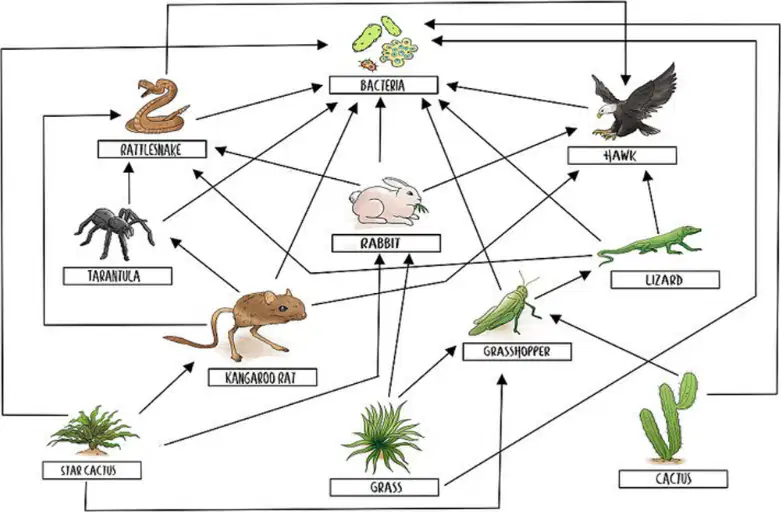
List two producers in the food web shown in the 'Desert Biome Food Web' diagram:
Star cactus, grass, cactus
Coyote, lizard
Hawk, snake
Scorpion, tarantula
What is another term for producers?
Autotrophs
Heterotrophs
Decomposers
Consumers
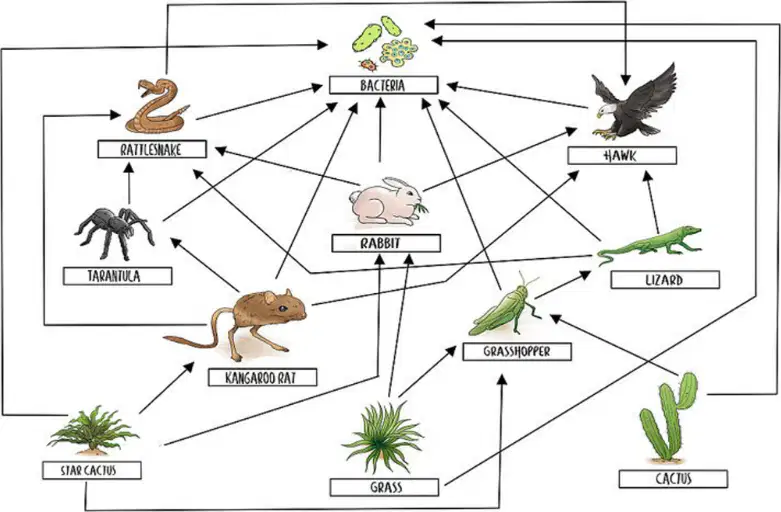
Select a food chain with 5 trophic levels from the 'Desert Biome Food Web' diagram.
Cactus → Grasshopper → Lizard → Snake → Hawk
Cactus → Mouse → Snake → Hawk
Grass → Rabbit → Snake → Hawk
Cactus → Grasshopper → Lizard → Hawk
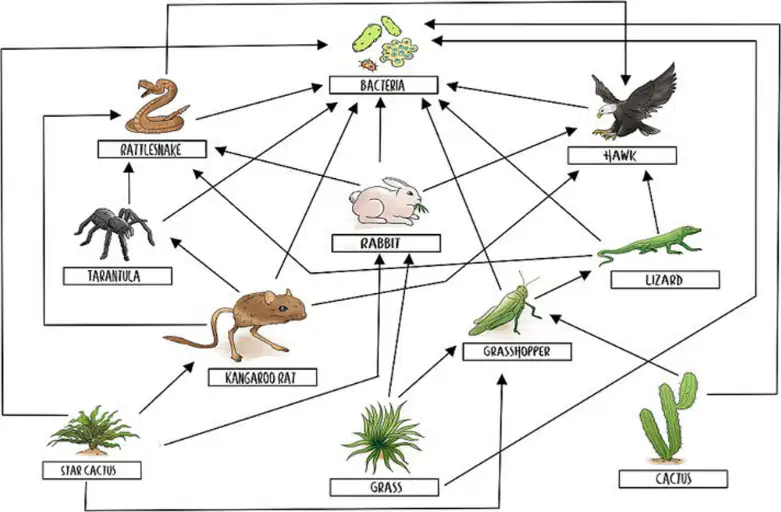
List a tertiary consumer in the food web shown in the 'Desert Biome Food Web' diagram:
Hawk
Grasshopper
Cactus
Mouse
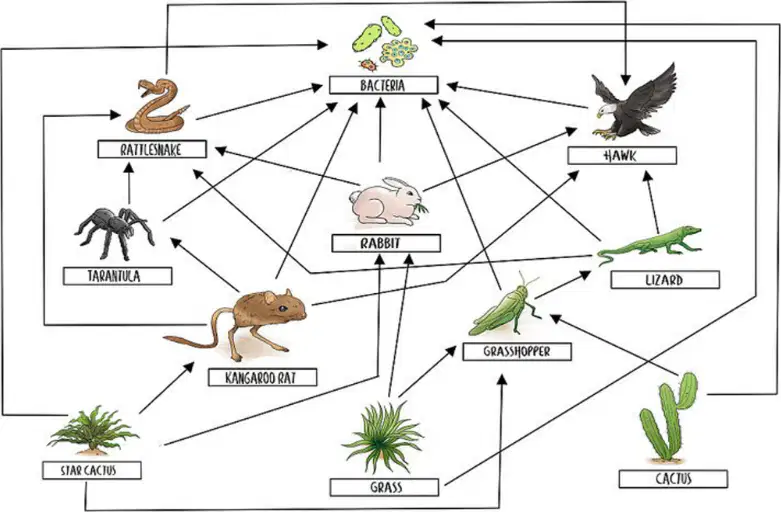
What is the role of bacteria in this food web?
Decomposer (breaks down dead organisms and recycles nutrients)
Producer (creates its own food through photosynthesis)
Primary consumer (eats plants)
Top predator (eats other animals but is not eaten)
What is the source of energy for the star cactus, grass and cactus?
The sun
The moon
The soil
The wind

Two ways the Kangaroo Rat population could increase are:
An increase in food supply and a decrease in predators.
A decrease in water sources and an increase in predators.
A decrease in food supply and an increase in disease.
An increase in competition and a decrease in shelter.
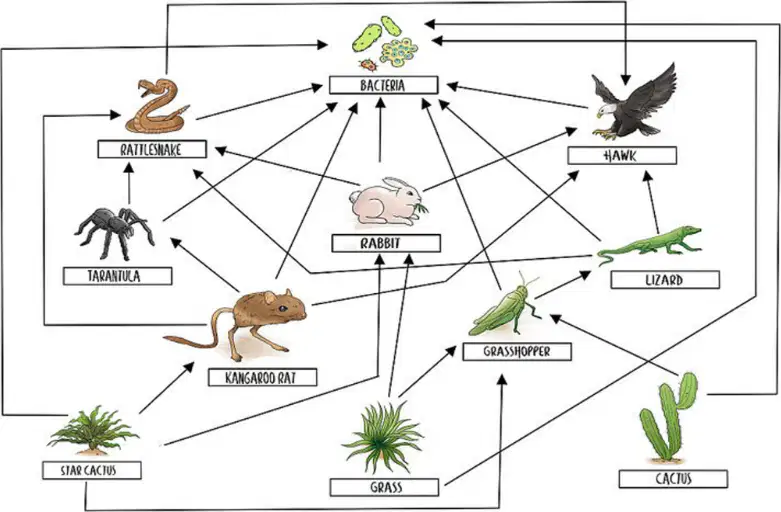
If the star cactus harnesses 73,058 kcal of energy from the sun, how much energy is available to the tarantula?
7,305.8 kcal
730.58 kcal
73.06 kcal
730.6 kcal
Barnacles attach to whales and get a free ride through the ocean and access to abundant food. The whale is not affected in this relationship. What type of relationship is this?
Commensalism
Parasitism
Mutualism
Predation
Termites eat wood, but they cannot digest it on their own. A small protist called a tritonymph lives in the termites’ intestines and digests the woods that the termite eats. The termite gets the nutrients from the digested wood, and the tritonymph lives safely in the termite. What type of relationship is this?
Mutualism
Parasitism
Commensalism
Predation

How does the burning of fossil fuels affect the cycle shown?
It releases ozone into the atmosphere.
It removes carbon from the atmosphere.
It both releases and removes carbon from the atmosphere.
It releases carbon into the atmosphere.

Which type of organisms are responsible for turning nitrogen gas into a form useable by other organisms?
Animals
Plantae
Fungi
Bacteria

Which cycle is represented in this model?
water cycle
carbon cycle
nitrogen cycle
Phosphorus cycle
Which of the following best describes the role of decomposers in an ecosystem?
They produce their own food using sunlight.
They break down dead organisms and recycle nutrients back into the soil.
They compete with plants for sunlight.
They hunt and consume other animals for energy.
Which process in the nitrogen cycle converts atmospheric nitrogen into a form usable by plants?
Denitrification
Nitrogen fixation
Assimilation
Ammonification
What type of relationship exists when one organism benefits and the other is harmed?
Parasitism
Commensalism
Mutualism
Predation
What process in the water cycle is responsible for water vapor turning into liquid water?
Condensation
Transpiration
Evaporation
Precipitation
Which level of organization includes both living organisms and their physical environment?
Organism
Community
Population
Ecosystem
Which process moves carbon from the biosphere directly to the atmosphere?
Nitrification
Photosynthesis
Respiration
Infiltration

