
 Worksheets
FUN101 Introduction to Occupational Safety & Health-Mr. Graham
Total questions: 79
Worksheet time: 40mins
Occupational safety and health is very important to ensure that everyone can work without being ________.
injured
promoted
rewarded
praised
Why is it important to learn about hazards at work?
So you can ignore them
So you can identify them and take action to protect yourself and your coworkers
So you can report them to the police
So you can avoid working
Occupational safety and health is ________ responsibility.
everyone’s
manager’s
employee’s
government’s
What does PPE stand for?
Personal Protective Equipment
Professional Protective Equipment
Personal Preventive Equipment
Protective Personal Equipment
Which of the following is NOT an example of Personal Protective Equipment (PPE)?
Safety footwear
Gloves
Sunglasses
Protective eyewear
Fill in the blank: PPE includes safety footwear, gloves, clothing, ________, and hearing protection.
protective eyewear
sports shoes
casual hats
fashion scarves
summer sandals
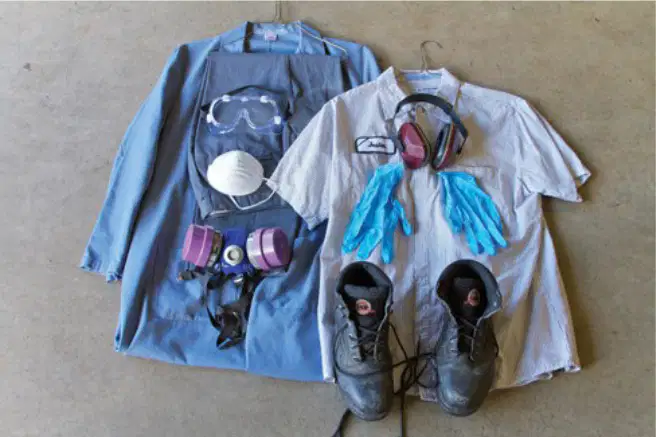
Look at the image of PPE items. Which of the following items is used for hearing protection?
Gloves
Ear muffs
Safety boots
Goggles
Fill in the blank: You should think carefully about what you are doing and how you are ______ it.
doing
eating
reading
writing
Fill in the blank: Think through the steps, trying to anticipate things that may go wrong and taking steps to ______ them.
prevent
ignore
encourage
repeat
Fill in the blank: Be wary of taking ______.
shortcuts
advice
breaks
notes
There is the possibility of an ______ occurring whenever work is undertaken.
accident
holiday
promotion
celebration
Fill in the blank: Almost all accidents are _______ or preventable by taking a few precautions.
avoidable
inevitable
intentional
unpredictable
Most accidents can be prevented if people follow policies and develop a _______ attitude.
careless
safety first
risky
indifferent
Fill in the blank: Learn and follow all of the correct _______ procedures for your workplace.
safety
cooking
painting
dancing
Always wear the right PPE and stay _______ and aware of what is happening around you.
distracted
alert
tired
confused
You will need to know what to do in case of an _________
emergency
holiday
celebration
appointment
What should you do whenever an accident or injury happens?
Ignore it
Document and report it
Wait for someone else to notice
Leave the area
Evacuation routes are a safe way of escaping danger and gathering in a safe place where everyone can be _________ for in the event of an emergency.
accounted
blamed
ignored
punished
What is described as anywhere you work?
Work Environment
OSHA
EPA
Accident
A safe work environment helps to prevent which of the following?
Accidents
Injuries
Illnesses
All of the above
What does OSHA stand for?
Occupational Safety and Health Administration
Occupational Safety and Hazard Association
Office of Safety and Health Administration
Organization for Safety and Health Awareness
What does EPA stand for?
Environmental Protection Agency
Environmental Prevention Association
Environmental Protection Administration
Environmental Policy Agency
What is a policy in the context of shop policies and procedures? Fill in the blank: A policy is a _______ principle that sets shop direction.
guiding
random
temporary
confusing
What is a procedure in the context of shop policies and procedures? Fill in the blank: A procedure is a list of _______ required to get the same result each time a task or activity is performed.
steps
rules
tools
people
Each shop will have its own set of policies and procedures.
True
False
You should always follow shop policies and procedures.
True
False
What is a hazardous environment?
A hazardous environment is where hazards exist.
A hazardous environment is always safe for everyone.
A hazardous environment is a place with no risks.
A hazardous environment is only found in hospitals.
What is a hazard?
A hazard is anything that could hurt you or someone else; most workplaces have them.
A hazard is a type of safety equipment used in workplaces.
A hazard is a reward given for safe behavior at work.
A hazard is a document listing workplace rules.
It is almost impossible to remove all hazards.
True
False
Why is it important to identify hazards and work to reduce their potential for causing harm?
To reduce their potential for causing harm by putting specific measures in place.
To increase the number of hazards in the workplace.
To ignore safety regulations and procedures.
To make the work environment more dangerous.
What should you do to familiarize yourself with the shop?
Familiarize yourself with shop layout.
Ignore the shop rules.
Only use the equipment you like.
Avoid asking questions about the shop.
What is the signal word used in safety signs?
danger
warning
caution
What does the background color in safety signs do?
Draws attention to potential hazards; used to provide contrast so letters or images stand out
Indicates the type of material used for the sign
Shows the age of the safety sign
Represents the company that installed the sign
What is the purpose of the explanatory text in safety signs?
To provide additional safety information
To decorate the sign
To confuse people
To make the sign colorful
What is the function of the pictorial message in safety signs?
Allows safety message to be conveyed to people who are illiterate or who do not speak the local language
To make the sign more colorful
To increase the size of the sign
To confuse people
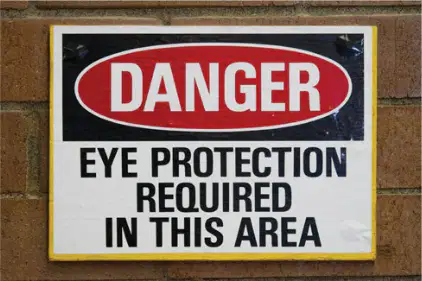
According to the 'Danger' sign, what is required in this area?
Hard hats
Eye protection
Gloves
Ear plugs
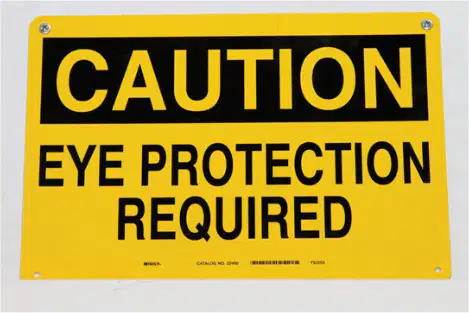
According to the 'Caution' sign, what is required?
Eye protection
Safety shoes
Hearing protection
Respirators
Both the 'Danger' and 'Caution' signs require eye protection.
True
False
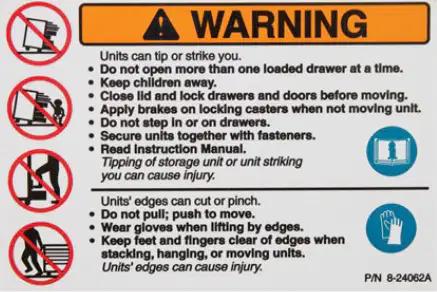
According to the 'Warning' sign, what should you do before moving units?
Open all drawers
Close and lock drawers and doors
Remove all labels
Paint the unit
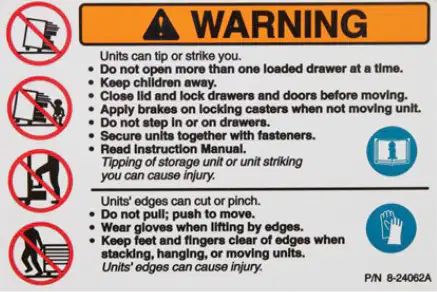
Fill in the blank: Apply ______ on locking casters when not moving unit. (from the 'Warning' sign)
brakes
oil
tape
paint
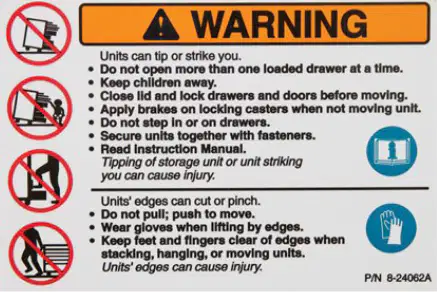
According to the 'Warning' sign, you should keep children away from the unit.
True
False
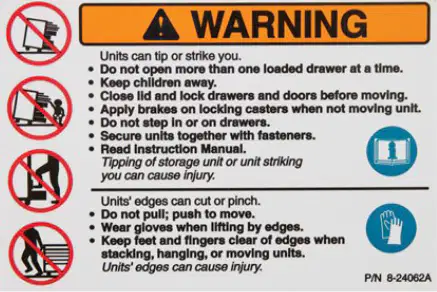
According to the 'Warning' sign, what should you wear when lifting units by edges?
Safety goggles
Gloves
Hard hats
Boots
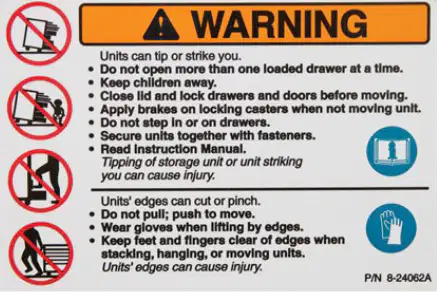
Fill in the blank: Units' edges can cut or ______ you. (from the 'Warning' sign)
pinch
burn
freeze
shock
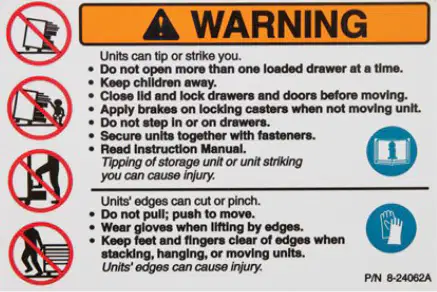
According to the 'Warning' sign, you should not step in or on drawers.
True
False
Which of the following is a type of safety equipment?
Handrails
Ladders
Fire extinguishers
Helmets
Which of the following is a type of safety equipment?
Machinery guards
Fire alarms
Safety shoes
Helmets
Which of the following is a type of safety equipment?
Painted lines
Fire hoses
Safety goggles
Helmets
Which of the following is a type of safety equipment?
Soundproof rooms
Fire blankets
Safety vests
Helmets
Which of the following is a type of safety equipment?
Adequate ventilation
Fire buckets
Safety belts
Helmets
Which of the following is a type of safety equipment?
Gas extraction hoses
Fire alarms
Safety cones
Helmets
Which of the following is a type of safety equipment?
A) Doors and gates
B) Fire extinguishers
C) Safety harnesses
D) Helmets
Which of the following is a type of safety equipment?
Temporary barriers
Fire alarms
Safety glasses
Helmets
Managing air quality helps protect you from potential harm and protects the environment. Which of the following activities can affect air quality?
Running engines
Reading books
Swimming
Playing chess
Which of the following is a reason to manage air quality?
To protect you from potential harm and protect the environment.
To increase noise pollution in cities.
To reduce the amount of sunlight reaching the ground.
To make air more colorful.
Managing air quality helps protect you from potential harm and protects the environment. Name one activity that can affect air quality.
Running engines (other acceptable answers: Welding, Painting, Liquid storage areas, Air-conditioning servicing, Dust particles from brake servicing)
Reading a book
Drinking water
Listening to music
Managing air quality helps protect you from potential harm and protects the environment. True or False: Painting can affect air quality.
True
False
Managing air quality helps protect you from potential harm and protects the environment. List two activities mentioned that can affect air quality.
Running engines, Welding (gas and electric) (other acceptable answers: Painting, Liquid storage areas, Air-conditioning servicing, Dust particles from brake servicing)
Reading books, Writing letters
Playing chess, Solving puzzles
Listening to music, Watching TV
Managing air quality in the workplace is important because:
It helps protect employees' health and well-being.
It increases noise levels in the office.
It reduces the need for safety training.
It makes the workplace more crowded.
What dangerous exhaust gases are produced by running engines?
Oxygen and nitrogen
Carbon monoxide and carbon dioxide
Hydrogen and methane
Ozone and sulfur dioxide
What should you do to ventilate fumes away from an enclosed space when running a vehicle's engine?
Open all windows
Use an air purifier
Couple the vehicle’s exhaust pipe to an extraction system hose to ventilate fumes to outside air
Turn on the air conditioning
Standard Safety Measures - Air Quality: True or False: An engine fitted with a catalytic converter can be run safely indoors.
True
False
Standard Safety Measures - Electrical Safety: Poor electrical safety practices can cause which of the following?
A) Shocks, burns, fires, explosions
B) Only shocks
C) Only fires
D) Only explosions
In an emergency, you should know how to shut off _______ supply to work area or shop.
electricity
water
gas
internet
Standard Safety Measures - Electrical Safety: True or False: It is safe to connect multiple appliances to a single receptacle.
True
False
An extension cord should be made of flexible wiring, fitted with a ground wire, and _______-covered.
neoprene
plastic
paper
cotton
Standard Safety Measures - Electrical Safety: Portable electric tools at 240 volts are often sources of serious shock and burn accidents.
True
False
What voltage should you use for electric tools to ensure safety?
240-volt
110-volt or lower
220-volt
150-volt
Standard Safety Measures - Electrical Safety: All electric tools must be equipped with a _______ or be double-insulated.
ground prong
plastic handle
rubber mat
circuit breaker
Standard Safety Measures - Electrical Safety: When using shop lights, you should follow safety directions because electric droplights are a source of _______.
shocks
light
heat
noise
According to the Standard Safety Measures for Shop Layout, working areas and walkways should be ________ and safe with clearly defined boundaries.
efficient
crowded
slippery
narrow
According to the Standard Safety Measures for Shop Layout, should customers be allowed to wander through work areas unescorted?
True
False
According to the Standard Safety Measures for Shop Layout, where should all flammable items be kept?
In approved fireproof storage container or cabinet
On open shelves near the entrance
Under the workbench with other tools
Next to electrical panels
According to the standard safety measures for preventing fires, what should always be present in a repair shop to handle the danger of fuel fire?
Fire blankets
Correct type and size of extinguishers
Water buckets
Sandbags
Liquid fuel vaporizes to different degrees, especially when ______; vapor is easy to ignite.
spilled
frozen
compressed
diluted
What should be kept nearby as part of standard safety measures to prevent fires in a repair shop?
Spill response kit
First aid manual
Toolbox
Measuring tape
Fill in the blank: To prevent fires, you should drain fuel in a well-ventilated, level space, preferably ______ in open air.
outside
inside
underground
in a closet
Fill in the blank: To prevent fires, do not drain fuel over ______ pit.
inspection
water
sand
gravel
Fill in the blank: Always use fuel retriever, preferably removing fuel through the ______ neck.
filler
radiator
exhaust
oil
You should never weld anywhere near a gas tank or any kind of fuel line.
True
False

