
 Worksheets
Cell Transport and Metabolism Quiz
Total questions: 79
Worksheet time: 43mins
Which of the following is an example of passive transport across a cell membrane?
Endocytosis
Diffusion
Sodium-potassium pump
Exocytosis
What molecule is the primary energy currency of the cell?
DNA
ATP
Glucose
NADH
Which part of an enzyme binds to the substrate?
Allosteric site
Active site
Regulatory site
Inhibitor site
What is the first step of cellular respiration?
Krebs cycle
Glycolysis
Electron transport chain
Fermentation
Which of the following is a product of the Krebs cycle?
Glucose
Pyruvate
Carbon dioxide
Oxygen
Which molecule donates electrons to the electron transport chain in mitochondria?
ATP
NADH
Glucose
Oxygen
Which type of cell transport requires energy input from the cell?
Facilitated diffusion
Active transport
Osmosis
Simple diffusion
What is the main function of ATP in cellular metabolism?
Store genetic information
Provide energy for cellular processes
Act as a structural component
Transport oxygen
Which statement best describes the specificity of enzymes?
Enzymes can bind to any molecule
Enzymes are specific to their substrates
Enzymes are only found in animals
Enzymes are not affected by temperature
During glycolysis, glucose is broken down into which molecule?
Lactic acid
Pyruvate
Acetyl-CoA
Ethanol
Compare and contrast simple diffusion and facilitated diffusion in terms of their mechanisms.
Both require energy and use carrier proteins
Simple diffusion does not require proteins, while facilitated diffusion does
Both move substances against the concentration gradient
Facilitated diffusion moves water only, simple diffusion moves ions only
Explain how ATP is regenerated during cellular respiration.
By breaking down DNA
By phosphorylation of ADP using energy from glucose oxidation
By combining oxygen and water
By converting pyruvate to lactic acid
Which structural feature of enzymes allows them to lower activation energy?
Their rigid structure
Their active site, which binds substrates specifically
Their ability to denature at high temperatures
Their hydrophobic tails
Describe the net ATP gain from glycolysis per molecule of glucose.
2 ATP
4 ATP
6 ATP
8 ATP
Which of the following best summarizes the main events of the Krebs cycle?
Conversion of glucose to pyruvate
Oxidation of acetyl-CoA, production of NADH, FADH 2 , and CO 2
Synthesis of glucose from pyruvate
Reduction of oxygen to water
How does the electron transport chain contribute to ATP synthesis?
By directly phosphorylating ADP
By creating a proton gradient that drives ATP synthase
By breaking down glucose
By producing lactic acid
A cell is placed in a hypertonic solution. Predict and explain what will happen to the cell.
It will swell because water enters the cell
It will shrink because water leaves the cell
It will remain the same size because there is no net water movement
It will burst due to increased internal pressure
Given a scenario where an enzyme's active site is altered by a mutation, predict the effect on the enzyme's function and justify your answer.
The enzyme will function normally because the active site is not important
The enzyme's function will likely decrease or stop because substrate binding is affected
The enzyme will become more efficient
The enzyme will start binding to all substrates
A poison blocks the final electron acceptor in the electron transport chain. Predict the impact on cellular respiration and explain your reasoning.
ATP production will increase
ATP production will stop because electrons cannot be transferred to oxygen
Glycolysis will speed up
The Krebs cycle will produce more CO 2
If a cell is deprived of oxygen, analyze and explain which stage(s) of cellular respiration will be directly affected and why.
Only glycolysis will stop because it requires oxygen
The Krebs cycle and electron transport chain will stop because they require oxygen
All stages will continue normally
Only the electron transport chain will continue
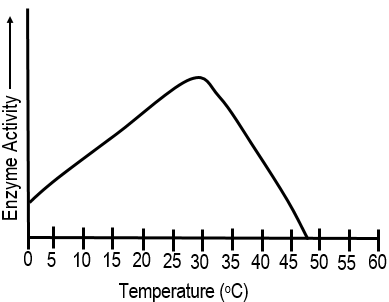
Based on the graph, what is the optimal temperature for this enzyme?
15oC
40oC
30oC
35oC
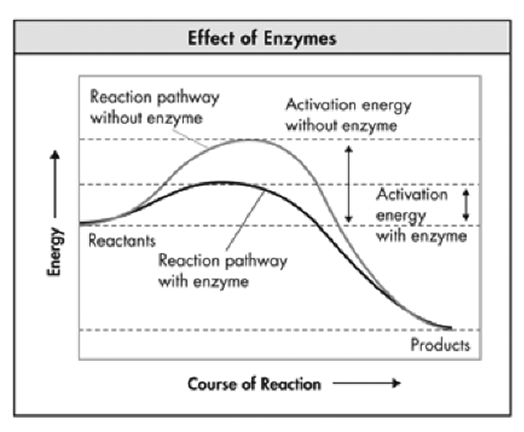
The graph shows how enzymes affect reactions in cells. Which statement best summarizes the information shown in the graph?
Enzymes increase the energy of the reactants.
Enzymes decrease the energy level of the products.
Enzyme decrease the activation energy of the reaction.
Enzymes reverse the direction of the reaction.
What happens when enzymes are heated to a high temperature?
The enzymes die.
The shapes of the enzyme are altered denature
The enzymes' amino acid sequence changes.
The enzymes remain the same

Which letter represents the enzyme?
A
B
C
D
Exothermic reactions:
release energy
absorb energy
Endothermic reactions:
release energy
absorb energy
In anaerobic respiration, an electron gradient drive the synthesis of ATP.
True
False
Oxygen is the final electron acceptor in anaerobic respiration
True
False
Electron energy (a) as they move through the ETC.
What is the name of the enzyme that pumps protons back into the cell/mitochondria?
(a)
What is the final electron acceptor in the ETC in aerobic respiration?
NADH
ATP
Oxygen
Hydrogen
What is the source of electrons at the beginning of the ETS?
O2
ATP
NADH
pyruvate
Where does the Electron Transport Chain take place in eukaryotic cells?
Cytoplasm
Ribosome
Mitochondria
Rough ER
Krebs Cycle takes place in the ______ of the mitochondrion:
Cytoplasm
Matrix
Ribosome
Intermembrane Space
Pyruvate "oxidation" means that pyruvate
loses electrons
gains electrons
What product of pyruvate oxidation continues into the citric acid cycle?
the pyruvate molecule
CO2
Coenzyme A
Acetyl CoA
What molecule is removed from pyruvate as it enters the mitochondrion?
carboxyl group (CO2)
water (H2O)
acetyl group (C2H3O)
Coenzyme A
The process that links glycolysis to the citric acid cycle is
pyruvate oxidation
pyruvate reduction
oxidative phosphorylation
the electron transport chain
Where does glycolysis take place?
cytosol
mitochondrial matrix
cristae
thylakoid
Which of these is a reactant of glycolysis?
pyruvic acid
oxygen
glucose
How many ATP molecules are required to start glycolysis?
Four
Three
Two
One
Glycolysis has a net gain of how many ATP molecules?
2
4
6
During glycolysis, glucose is broken down into how many molecules of pyruvic acid?
2
3
4
1
After the NAD+ receives electrons, what does it change to?
ATP
NADH
ADP
Which of these is broken down into pyruvic acid?
glucose
oxygen
water
Glycolysis requires oxygen
True
False
Where does the pyruvic acid produced by glycolysis go next?
the Calvin Cycle
the electron transport chain
the Krebs Cycle
back through the glycolysis process
Which is a product of glycolysis?
2 molecules of pyruvic acid
1 molecule of glucose
NAD+
oxygen

What is the image an example of in a cell?
Diffusion
Osmosis
Active transport
Photosynthesis
What is equilibrium in a cell?
A state of balance
A state of energy production
A state of growth
A state of division

What is happening with the air molecules in this previous example?
Diffusion
Active transport
Endocytosis
Osmosis
Explain how endocytosis occurs in the process of cellular transport.
The cell membrane envelops particles
Particles move through protein channels
Water moves through the membrane
Particles are expelled from the cell
Moving a fluid from a place of high concentration to low concentration is called?
Diffusion
Active Transport
Endocytosis
Exocytosis
I am moving material in and out of cells USING energy, what is this process called?
Active Transport
Passive Transport
Diffusion
Osmosis
What does cellular respiration provide to cells?
Energy
Oxygen
Glucose
Water
I am the type of transport that requires energy, who am I?
Active Transport
Passive Transport
Osmosis
Diffusion
I am the type of transport that does NOT require energy, who am I?
Passive Transport
Active Transport
Facilitated Diffusion
Endocytosis
What is the function of mitochondria?
Produces ATP
Produces DNA
Produces RNA
Produces NAD
What is the process called that creates stability and internal balance in a cell? (Includes osmosis and diffusion)
Homeostasis
Photosynthesis
Respiration
Metabolism
If a cell has 25% water and 50% water outside of the cell, What type of solution is this?
Hypertonic
Hypotonic
Isotonic
Pinocytosis means
Cell- eat
Cell- drink
Taking in of solid particles
Cell- digestion
Where does the Krebs Cycle occur?
Stroma
Cytoplasm
Thylakoid
Mitochondria Matrix
Which is NOT a characteristic of the 1st Law of Thermodynamics?
Changes in total energy of a system only depends on the initial and final states
Energy is neither created nor destroyed
Energy can undergo transformation from one form to another
A reaction will be spontaneous only if the entropy of a system and it's surroundings increase
Select all that apply: What is produced during Glycolysis?
2 ATP (netted)
2 NADH
2 FADH2
2 Pyruvates
When Delta G is less than zero...
The reaction is favorable
The reaction is exergonic
The reaction is endergonic
The products have less energy than the reactants
The breaking down of complex molecules into simpler ones with the release of energy is what type of metabolic pathway?
Cytobolic
Catabolic
Anabolic
Aerobolic
Phagocytosis and pinocytosis are forms of what method of transport
Passive Transport
Exocytosis
Active Transport
Endocytosis
Which is NOT a characteristic of passive transport?
The movement of a substance w/o the expenditure of energy
Facilitated diffusion
Osmosis
Against the concentration gradient
Which statement best describes the function of ATP?
carries and transmits the genetic information of organisms
provides energy for chemical reactions in the cell
serves as a biological catalyst that speeds up the rate of reactions
acts as a structural sugar in the cell wall of plants
Which statement explains the effect of an inhibitor on an enzymes?
a substrate will be able to bond with the enzyme
the enzymes will likely be attacked by immune cells
the enzyme will be unable to produce more enzymes
a substrate will be unable to attach to the enzyme
An (a) is a substance that serves as a catalyst for reactions that can break large food molecules into smaller useful molecules
If molecules are moving across the cell membrane from an area of high concentration to an area of low concentration, which of the following best describes the processes described
energy conversions and synthesis of new molecules
synthesis of new molecules and homeostasis
transport of molecules and energy conversion
homeostasis and transport of molecules
How does the plasma membrane (cell membrane) help a cell maintain homeostasis?
Controls materials that enter and exit the cell
Converts ATP to glucose for energy storage
Catalyzes protein synthesis
Recieves signals for DNA replication

