
NEW
Font size
 Worksheets
Kine333 Exam 1 Review Game
Total questions: 60
Worksheet time: 32mins
To maintain good health, it is necessary to obtain essential nutrients from the diet because the body cannot produce them in sufficient quantities.
True
False
Plant-based foods usually provide proteins of lower biological value compared to animal-based foods.
True
False
John’s daily food log shows he consumed the following: 2,500 calories, 90 g of fat, 120 g of protein, and 300 g of carbohydrate. What percentage of his total energy intake came from protein?
14%
19%
11%
22%
24%
What is the term for the phenomenon where a country's dietary patterns change from mainly undernutrition to problems of overnutrition as it develops economically?
Dietary shift
Nutrition transition
Industrial nutrition
Economic nutrition change
Food evolution
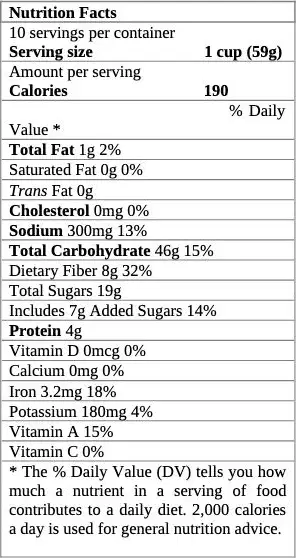
If you ate ¾ cup of this cereal, how many grams of dietary fiber would you consume?
2 grams
4 grams
6 grams
8 grams
What role does the muscularis layer play in the digestive system?
It absorbs nutrients from digested food
It secretes digestive enzymes
It helps propel and churn food along the digestive tract
It protects the GI tract from pathogens
Which two processes are responsible for moving and mixing food through the gastrointestinal tract?
Peristalsis and segmentation
Absorption and propulsion
Digestion and contraction
Homogenization and relaxation
After having her gallbladder removed, your friend asks about possible dietary adjustments. Which nutrient might she have more difficulty digesting and absorbing?
Carbohydrate
Calcium
Protein
Fat
Which condition is characterized by a burning sensation in the chest due to stomach acid moving upward into the esophagus?
Peptic ulcer disease
Gastroesophageal reflux disease (i.e., GERD)
Diverticulitis
Lactose intolerance
More than one answer is correct.
Which factor is responsible for initiating the release of secretin and cholecystokinin (CCK) from the intestinal mucosa?
Entry of partially digested proteins and fats into the duodenum
Release of gastric acid from the stomach
Absorption of glucose in the small intestine
Activation of pancreatic enzymes
Movement of bile into the gallbladder
Which organ is primarily responsible for the absorption of most nutrients in the digestive system?
Stomach
Esophagus
Large intestine
Small intestine
Which of the following is considered a micronutrient?
Carbohydrate
Fat
Protein
Vitamin C
What is the main function of bile in the digestive process?
Breakdown of carbohydrates
Emulsification of fats
Absorption of amino acids
Production of digestive enzymes
Which of the following nutrients cannot be synthesized by the human body and must be obtained from the diet?
Cholesterol
Essential amino acids
Nonessential amino acids
Glucose
USA Today is widely recognized as a peer-reviewed academic journal.
True
False
Which of the following best describes the function of peristalsis in the gastrointestinal tract?
Absorption of water
Propelling food forward through rhythmic muscle contractions
Mixing of food with saliva
Secretion of digestive enzymes
Which enzyme is responsible for the initial breakdown of carbohydrates in the digestive system?
Pepsin
Amylase
Lipase
Trypsin
What is the main function of villi in the small intestine?
Secretion of digestive enzymes
Mechanical breakdown of food
Absorption of nutrients
Production of bile
What does it indicate if a person's nutrient intake is above the AI but below the UL?
Likely sufficient
Deficient
Excessive
Uncertain
Which set of reference values is used on Nutrition Facts labels to help consumers understand the nutrient content of a food in the context of a total daily diet?
Adequate Intakes (AI)
Daily Values (DV)
Dietary Reference Intakes (DRI)
Recommended Dietary Allowances (RDA)
When a researcher's expectations or knowledge about the participants' group assignments unintentionally affect the results of an experiment, what is this type of influence called?
Researcher Bias
Placebo Effect
Double-Blind Effect
Sampling Error
Which of the following dietary assessment methods requires participants to record their food intake as they consume it?
Dietary Record
24-Hour Recall
Dietary History
Food Frequency Questionnaire
Avery is planning her meals and wants to ensure she is getting the right amount of protein in her diet. According to the AMDR, what percentage of her total daily energy intake should come from protein?
10% to 35%
15% to 40%
5% to 20%
25% to 50%

Mason eats a piece of bread and wonders how it moves from his mouth down to his stomach. These wave like motions allow food to move down the esophagus.
villi
peristalsis
digestion
mechanical digestion
Experiments in which neither the experimenters nor the participants know the objects' identities in the setups
Experimental Variable
Control (of an experiment)
Blind Experiment
Double-Blind Experiment
If a nutrient has an RDA, which of the following reference values is not applicable to it?
AI
UL
DV
EAR
CDRR
Luna is studying how the small intestine absorbs nutrients efficiently. She learns that certain tiny projections on the epithelial cells play a crucial role in this process. What are these projections called?
Microvilli
Villi
Crypts
Folds
Rohan just ate a meal, and as the food moves from his stomach into his small intestine, his body releases pancreatic bicarbonate. What is the role of this pancreatic bicarbonate in the digestive process?
It increases the acidity of the stomach to help break down proteins.
It neutralizes stomach acid as food enters the small intestine.
It is secreted into the esophagus to prevent acid reflux.
It helps the liver produce bile for fat digestion.
Sophia has just enjoyed a hearty meal. Which hormone in her body stimulates the gallbladder to contract and the pancreas to secrete digestive enzymes into the small intestine?
Secretin
Gastrin
Cholecystokinin (CCK)
Glucagon
Isla is learning about digestive health. She reads that some foods contain probiotics and others contain prebiotics. Which statement best describes the roles of probiotics and prebiotics in the digestive system?
Probiotics are nutrients for gut bacteria, prebiotics are live bacteria themselves.
Probiotics are live beneficial bacteria, prebiotics help these bacteria grow.
Prebiotics are harmful to gut health, probiotics are beneficial.
Prebiotics and probiotics are both types of live bacteria.
Which substance triggers the immune response in individuals with celiac disease?
Lactose
Gluten
Fructose
Casein
Which of the following lists contains only monosaccharides commonly found in the human diet?
glucose, fructose, galactose
sucrose, lactose, maltose
glucose, sucrose, fructose
galactose, maltose, lactose
Which of the following does the glycemic load account for?
The carbohydrate content and glycemic index of a food
The glycemic load is solely based on the fiber content of carbohydrates.
The glycemic load measures the fat content in foods.
The glycemic load only considers the quantity of carbohydrates.
Which organ converts galactose and fructose into glucose?
Kidney
Liver
Pancreas
Spleen
After a long run, Rohan's body needs to quickly release glucose for energy. What is the breakdown of glycogen to release glucose called?
Glucogenesis
Glycolysis
Glycogenolysis
Glycogenesis
Which of the following best describes the effects of insulin on metabolism?
Stimulates glycogen breakdown and increases blood glucose
Promotes glucose uptake, glycogen synthesis, and possible fat storage
Enhances gluconeogenesis and fatty acid oxidation
Inhibits glucose uptake and stimulates protein breakdown
Which of the following is the most likely side effect of consuming a large amount of dietary fiber?
Gastrointestinal discomfort (bloating, gas, diarrhea)
Improved digestion
Increased blood sugar
Increased risk of diverticulosis
Which of the following foods are rich sources of soluble fiber?
Watermelon, honeydew, potatoes
Potato chips, popcorn, rice
Cereal, bread, carrots
Oatmeal, beans, lentils, grapefruit
Nora is training for a marathon and needs to maintain her blood glucose levels during long runs. Which of the following metabolic pathways increases the availability of blood glucose?
Gluconeogenesis
Glycolysis
Reactive hypoglycemia
Ketogenesis
Samuel is studying for his biology exam and wonders: In which two organs is most of our glycogen stored?
Lungs and skeletal muscles
Brain and heart
Liver and skeletal muscles
Kidneys and pancreas
Which hormone is responsible for promoting the secretion of gastric acid in the stomach?
Pepsin
Insulin
Cortisol
Gastrin
What substance(s) is responsible for denaturing proteins in the stomach?
Sodium bicarbonate
Bile salts
Trypsinogen
Hydrochloric acid (HCl)
What is the name of the condition where protein intake is greater than protein loss?
Nitrogen equilibrium
Positive nitrogen balance
Negative nitrogen balance
Ketosis
Kai is training for a marathon and wants to optimize his nutrition. He consults a sports dietitian who refers to the most recent position paper from the Academy of Nutrition and Dietetics, the Dietitians of Canada, and the American College of Sports Medicine. What protein intake is recommended for endurance and strength-trained athletes like Kai?
More than 3.0 grams/kg per day
1.5 to 2.5 grams/kg per day
1.2 to 2.0 grams/kg per day
0.8 to 1.1 grams/kg per day
After adopting a strict vegan diet, Mark's nutritionist recommended that he pay special attention to a nutrient that is not naturally found in plant-based foods. Which nutrient is the nutritionist most likely concerned about?
Vitamin C
Iron
Vitamin B12
Calcium
Josiah is a college athlete who follows a vegan diet. What is the best way for him to consume adequate amounts of all essential amino acids?
Incorporate a variety of complementary plant-based proteins like legumes, quinoa, nuts, seeds, and soy.
Follow a high-carb diet without considering protein intake.
Eat only fruits and vegetables without any protein sources.
Incorporate eggs and low-fat dairy.
The bran of the wheat kernel is the main source of dietary fiber.
True
False
Oligosaccharides can be found in which of the following foods?
Apples and Potatoes
Chicken and Yogurt
Rice and Fish
Legumes, and Lentils
Maria consumes an average of 90 grams of protein per day, with a total daily energy intake of 2,250 calories. What percentage of her daily calories comes from protein?
12%
16%
20%
10%
David consumes a total of 2,400 calories, 320 grams carbohydrate, 80 grams protein, and 70 grams fat. Does David’s intake meet the AMDR recommendations?
Yes, David's intake falls within the AMDR recommendations.
No, David's intake exceeds the AMDR recommendations for fat.
No, David's intake is below the AMDR recommendations for protein.
Yes, but only for carbohydrates and protein.
Which of the following best describes how a food allergy differs from a food intolerance?
A food allergy triggers an immune response, while a food intolerance does not.
Food intolerances are caused by viruses, while food allergies are not.
Food allergies are always mild, but food intolerances are severe.
Food intolerances are inherited, but food allergies are not.
Emma consumes 2,000 kcal per day. If she drinks three 16-oz. bottles of sweetened iced tea (each providing 120 kcal, 0 g fat, and 0 g protein) as her only source of added sugar, what percentage of her total kcalories comes from added sugar?
14%
18%
9%
6%
Maria is training for a marathon and wants to optimize her diet. Her daily energy requirement is 2,400 calories. She plans to get 60% of her calories from carbohydrates, 20% from protein, and 20% from fat. How many grams of carbohydrates should she consume each day?
360
320
400
280
Nora is learning about how the human body gets essential nutrients. She discovers that some vitamins are actually produced by bacteria living in our intestines. Which of these vitamins is produced by intestinal bacteria?
Vitamin K
Vitamin D
Vitamin C
Vitamin A
After undergoing a partial gastrectomy, Maria developed deficiencies in several vitamins and minerals. What is the most appropriate classification for this type of malnutrition?
Tertiary Malnutrition
Primary Malnutrition
Nutritional Deficiency
Secondary Malnutrition
Which of the following is a disaccharide commonly found in milk?
Fructose
Maltose
Lactose
Sucrose
What is the primary function of hydrochloric acid (HCl) in the stomach?
Emulsifies fats
Absorbs nutrients
Neutralizes stomach contents
Activates pepsinogen to pepsin
Which of the following is considered an essential amino acid that must be obtained from the diet?
Leucine
Glutamine
Alanine
Glycine
What is the primary role of the large intestine in the digestive system?
Emulsification of fats
Production of digestive enzymes
Absorption of most nutrients
Absorption of water and electrolytes
Which of the following best describes the role of dietary fiber in human nutrition?
It aids in digestion and promotes bowel regularity
It provides essential amino acids
It is a primary source of energy
It increases cholesterol absorption

