
 Worksheets
BIO150 Exam 2
Total questions: 96
Worksheet time: 48mins
ATP can provide energy for the cell by:
absorbing energy from sunlight
releasing a phosphate group during hydrolysis
binding to DNA directly
producing glucose from carbon dioxide
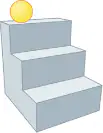
The difference between potential and kinetic energy, with a biological example of each, is:
Potential energy is energy of motion, like a running animal; kinetic energy is stored energy, like energy in a stretched muscle.
Potential energy is stored energy, like energy in a stretched muscle; kinetic energy is energy of motion, like a running animal.
Potential energy and kinetic energy are both forms of heat energy in living organisms.
Potential energy and kinetic energy are only found in non-living things.
What are some other important sources of energy in biology?
Light
Chemical potential
Electron/Ion gradients
All of the above
What is the first law of thermodynamics?
Energy can't be created nor destroyed, but can be transformed from one type to another
Energy can be created and destroyed
Energy can't be transformed
Energy can only be destroyed
Fill in the blank: Kinetic energy is the energy of _______.
motion
heat
light
sound
What is the second law of thermodynamics?
Energy can neither be created nor destroyed, only transformed from one form to another.
Transfer of energy from one form to another increases the entropy, or disorder, of a system. As entropy increases, there’s less energy available for cells to do work.
The total energy of an isolated system remains constant over time.
All spontaneous processes in the universe tend to lead to a decrease in entropy.
What does the delta (Δ) mean when we see ΔG, ΔH, ΔS, etc.?
Describes the change in a component (ex. ΔG = ΔG(final)-ΔG(initial))
Represents the average value of a component
Indicates the absolute value of a component
Shows the rate of change over time
What does thermodynamics mean? What does delta G mean?
Thermodynamics is the study of living organisms. Delta G is the measure of temperature change in a reaction.
Thermodynamics is the branch of physical science that deals with the relationships between all forms of energy. Delta G is the measure of the change in the Gibbs Free energy available in a reaction for work.
Thermodynamics is the study of chemical bonds. Delta G is the measure of the change in atomic number.
Thermodynamics is the branch of mathematics that deals with numbers. Delta G is the measure of gravitational force.
Which of the following reactions are those that require energy input?
A) Exergonic reactions
B) Endergonic reactions
Which of the following reactions are those that release energy?
A) Exergonic reactions
B) Endergonic reactions
Which type of reaction where ΔG < 0 and energy is released?
Exergonic reaction
Endergonic reaction
Which type of reaction where ΔG > 0 and energy is added?
Endergonic reaction
Exergonic reaction
What is the Gibbs free energy equation? Define each of the terms.
ΔG = ΔS – TΔH. ΔG is the gibbs free energy, ΔS is entropy, T is temperature in Kelvin, ΔH is enthalpy.
ΔG = ΔH – TΔS. ΔG is the gibbs free energy (if negative = spontaneous), ΔH is enthalpy (if negative = exothermic), T is temperature in Kelvin, ΔS is entropy (if positive, entropy is increasing).
ΔG = ΔH + TΔS. ΔG is the gibbs free energy, ΔH is enthalpy, T is temperature in Kelvin, ΔS is entropy.
ΔG = ΔS + TΔH. ΔG is the gibbs free energy, ΔS is entropy, T is temperature in Kelvin, ΔH is enthalpy.
How do you convert Celsius to Kelvin?
Celsius - 273 = Kelvin
Celsius + 273 = Kelvin
Celsius x 273 = Kelvin
Celsius / 273 = Kelvin
Which bond has the highest free (potential) energy: C-H or C-O?
C-O bonds have the highest free/potential energy (most reduced state).
C-H bonds have the highest free/potential energy (most reduced state).
Both C-H and C-O bonds have equal free/potential energy.
Neither C-H nor C-O bonds have significant free/potential energy.
Arrange the following in order of increasing entropy (S): solid, liquid, gas.
S (solid) < S (liquid) < S (gas)
S (gas) < S (liquid) < S (solid)
S (liquid) < S (solid) < S (gas)
S (gas) < S (solid) < S (liquid)
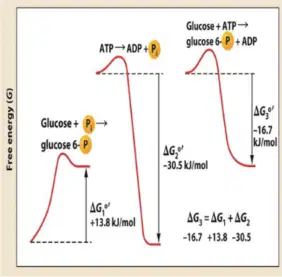
Cells perform nonspontaneous reactions by:
releasing energy as heat
using ATP hydrolysis to provide energy
decreasing the activation energy
increasing the temperature of the cell
Oxidation-Reduction Reactions are used in cellular respiration to:
Break down proteins into amino acids
Transfer electrons to produce energy
Store genetic information
Absorb sunlight for photosynthesis
The characteristics of enzymes are:
They are used up in reactions and cannot be reused.
They are biological catalysts that speed up chemical reactions.
They work best at any temperature and pH.
They are inorganic molecules.
Enzymes make a reaction more favorable by:
increasing the temperature of the reaction
lowering the activation energy required for the reaction
changing the products of the reaction
removing reactants from the reaction
Identify which is an allosteric enzyme and which is a competitive enzyme.
An allosteric enzyme is inhibited by molecules competing for the active site, while a competitive enzyme is regulated by molecules binding at other sites.
An allosteric enzyme is regulated by molecules binding at sites other than the active site, while a competitive enzyme is inhibited by molecules competing for the active site.
Both allosteric and competitive enzymes are regulated by molecules binding at the active site.
Allosteric and competitive enzymes are the same and have no difference in regulation.
Select the correct characteristics of an allosteric enzyme and a competitive enzyme.
Allosteric enzymes compete with substrate for the active site, while competitive enzymes have regulatory sites.
Allosteric enzymes have regulatory sites and show sigmoidal kinetics, while competitive enzymes compete with substrate for the active site.
Both allosteric and competitive enzymes have regulatory sites and show sigmoidal kinetics.
Competitive enzymes show sigmoidal kinetics, while allosteric enzymes compete with substrate for the active site.
Feedback inhibition is a process where which site of an enzyme is inhibited to regulate metabolic pathways?
Allosteric site
Active site
Substrate site
Binding site
The four stages of cellular respiration and their locations are:
Glycolysis (nucleus), Pyruvate oxidation (cytoplasm), Citric acid cycle (cytoplasm), Electron transport chain (outer mitochondrial membrane)
Glycolysis (cytoplasm), Pyruvate oxidation (mitochondrial matrix), Citric acid cycle (mitochondrial matrix), Electron transport chain (inner mitochondrial membrane)
Glycolysis (mitochondrial matrix), Pyruvate oxidation (cytoplasm), Citric acid cycle (nucleus), Electron transport chain (cytoplasm)
Glycolysis (inner mitochondrial membrane), Pyruvate oxidation (outer mitochondrial membrane), Citric acid cycle (cytoplasm), Electron transport chain (nucleus)
Which step of cellular respiration occurs in the cytoplasm?
Glycolysis
Pyruvate Oxidation
Citric Acid Cycle
Oxidative Phosphorylation
Where does the Citric Acid Cycle take place?
Cytoplasm
Mitochondrial matrix
Mitochondria inner membrane
Nucleus
Fill in the blank: The location of Oxidative Phosphorylation is the ___________.
Cytoplasm
Mitochondria inner membrane
Nucleus
Golgi apparatus
What are the general inputs and outputs of Glycolysis?
Input: Glucose (6C Molecule), 2 NADH; Output: Pyruvate (2 3C molecules), 4 ATP (net)
Input: Glucose (6C Molecule), 2 ATP; Output: Pyruvate (2 3C molecules), 2 ATP (net), 2 NADH
Input: Pyruvate (2 3C molecules), 2 ATP; Output: Glucose (6C Molecule), 2 NADH
Input: Glucose (6C Molecule), 4 ATP; Output: Pyruvate (2 3C molecules), 2 ATP (net), 2 NADH
What are the outputs of Pyruvate Oxidation?
4 CO2, 6 NADH, 2 FADH2, 2 ATP
2 CO2, 2 NADH, 2 Acetyl-CoA (2 2C molecules)
ATP (30-34~), H2O
Pyruvate (2 3C molecules), 2 ATP (net), 2 NADH
Fill in the blank: The input for the Citric Acid Cycle is ___________.
2 Pyruvate (2 3C molecules)
2 Acetyl-CoA (2 2C molecules)
2 NADH
2 Glucose (2 6C molecules)
What are the outputs of Oxidative Phosphorylation?
ATP (30-34~), H2O
2 CO2, 2 NADH, 2 Acetyl-CoA
4 CO2, 6 NADH, 2 FADH2, 2 ATP
Pyruvate (2 3C molecules), 2 ATP (net), 2 NADH
Who are NAD+ and FAD+?
Enzymes that break down glucose into pyruvate during glycolysis.
Electron carriers/energy intermediates that will receive electrons throughout glycolysis, pyruvate oxidation, and the citric acid cycle. They transport electrons from glucose to the electron transport chain (ETC). NAD+ is reduced to NADH. FAD+ is reduced to FADH2.
Hormones that regulate the rate of cellular respiration.
Structural proteins found in the mitochondrial membrane.
What is the reaction equation for Glycolysis?
C6H12O6 + 6 O2 → 6 CO2 + 6 H2O + energy
C6H12O6 → 2 pyruvate + 4 ATP + 2 NADH
2 pyruvate → 2 lactate + 2 ATP
C6H12O6 → 2 ethanol + 2 CO2 + 2 ATP
What is the net production of ATP in glycolysis?
net 4 ATP
net 2 ATP
net 1 ATP
net 0 ATP
Is glycolysis an aerobic or anaerobic process?
Anaerobic. Oxygen is not consumed in the process.
Aerobic. Oxygen is required for the process.
Both aerobic and anaerobic, depending on the cell type.
Neither, it does not occur in living organisms.
What is the general formula for Pyruvate Oxidation?
2 Pyruvate → 2 Lactate + 2 NAD+
2 Pyruvate → 2 AcetylCoA + 2 NADH + 2 CO2
2 Pyruvate → 2 Ethanol + 2 CO2
2 Pyruvate → 2 Glucose + 2 ATP
What are other names for the Citric Acid Cycle?
It is also known as the Calvin Cycle and/or the Glycolysis Pathway.
It can also be called the Krebs Cycle and/or the TCA Cycle. They all are referring to the same exact thing!
It is also called the Electron Transport Chain and/or the Urea Cycle.
It is also referred to as the Light Reaction Cycle and/or the Pentose Phosphate Pathway.
What is the overall goal/purpose of the Krebs Cycle? Why is it called a cycle?
The Krebs Cycle is responsible for breaking down fatty acids into glucose, and it is called a cycle because it only occurs once per cell.
During this stage of cellular respiration, the fuel molecules (the glucose) are completely oxidized. The chemical energy in the bonds of acetyl-CoA is transferred to ATP by substrate level phosphorylation and to the electron carriers (NADH and FADH2). Overall, it is a set of eight reactions and is called a cycle because the starting molecule oxaloacetate is regenerated at the end.
The main purpose of the Krebs Cycle is to produce oxygen for the cell, and it is called a cycle because it happens in a circular organelle.
The Krebs Cycle stores energy in the form of starch, and it is called a cycle because it involves only one reaction.
What is the general formula for the Citric Acid Cycle?
(2 AcetylCoA → 4 CO2 + 6 NADH + 2 FADH2 + 2 ATP)
(1 AcetylCoA → 2 CO2 + 3 NADH + 1 FADH2 + 1 ATP)
(2 Pyruvate → 2 CO2 + 2 NADH + 2 ATP)
(2 AcetylCoA → 2 CO2 + 4 NADH + 2 FADH2 + 2 ATP)
What are the reactants of the Citric Acid Cycle? List all of them.
2 Pyruvate, 2 NADH, 2 ATP, 2 CO2
2 Acetyl CoA, 2 FAD, 6 NAD+, 2 ADP + Pi
2 Glucose, 2 NAD+, 2 FAD, 2 ATP
2 Acetyl CoA, 2 NADH, 2 FADH2, 2 GTP
What are the products of the Citric Acid Cycle? List all of them.
4 CO2, 2 FADH2, 6 NADH, 2 ATP
2 CO2, 2 FADH2, 2 NADH, 4 ATP
6 CO2, 2 FADH2, 6 NADH, 2 ATP
4 CO2, 2 FADH2, 4 NADH, 2 ATP
Which molecule is oxidized down to carbon dioxide in the Citric Acid Cycle?
Glucose
Acetyl CoA
Pyruvate
Lactate
How many NAD+ molecules are used as reactants in the Citric Acid Cycle?
6
2
4
8
How many ATP molecules are produced per molecule of glucose out of the Citric Acid Cycle?
2
4
6
1
The TCA Cycle is considered amphibolic because:
it only breaks down carbohydrates.
it functions in both catabolic and anabolic pathways.
it is exclusively involved in energy production.
it is not involved in biosynthetic processes.
Define electrochemical gradient as it relates to cellular respiration.
A uniform distribution of ions across the membrane, resulting in no net charge difference.
An uneven balance of charges across the membrane. In cellular respiration, the inner membrane space becomes very positive due to protons, and the matrix becomes relatively negative.
The movement of glucose molecules across the cell membrane during glycolysis.
The breakdown of ATP to release energy for cellular processes.
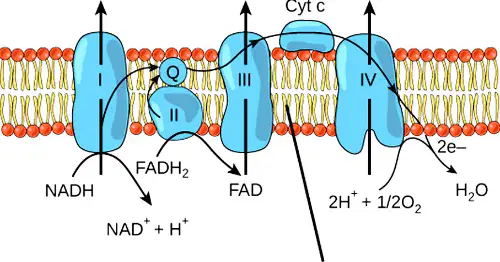
Refer to the diagram showing the electron transport chain. Which molecules donate electrons to the chain?
ATP and ADP
NADH and FADH2
Glucose and Oxygen
CO2 and H2O
What is the product formed from the oxidation of Acetyl CoA?
CO2 (carbon dioxide)
H2O (water)
Glucose
ATP
What is the main function of Complex I in the electron transport chain?
It acts as the final electron acceptor in the chain.
The drop off center for NADH (synthesized in previous reactions); enters the complex to donate electrons and protons.
It synthesizes ATP directly from ADP and Pi.
It transports oxygen into the mitochondria.
Which molecule donates electrons to Complex II in the electron transport chain?
NADH
FADH2
Coenzyme Q
Cytochrome C
Complex II pumps protons across the membrane in the electron transport chain.
True
False
Fill in the blank: Coenzyme Q facilitates the diffusion of _______ through the chain from complex I/II to complex III.
electrons
protons
ATP molecules
oxygen
What is the primary role of Complex III in the electron transport chain?
Complex III pumps protons through the membrane (contributes to electrochemical gradient) and passes its electrons to Cytochrome C for further transport.
Complex III synthesizes ATP directly from ADP and inorganic phosphate.
Complex III binds oxygen and forms water as a final product.
Complex III transports glucose across the mitochondrial membrane.
Which protein facilitates the diffusion of electrons from Complex III to Complex IV?
Complex I
Coenzyme Q
Cytochrome C
FADH2
What is the role of Complex IV in the electron transport chain?
Reduces oxygen to water by donating electrons from cytochrome C to oxygen.
Transfers electrons from NADH to ubiquinone.
Pumps protons from the matrix to the intermembrane space without electron transfer.
Synthesizes ATP from ADP and inorganic phosphate.
Which molecule acts as the final electron acceptor in Complex IV?
Oxygen
NADH
FADH2
Carbon dioxide
What is the reduced form of oxygen after the electron transport chain?
H2O (water)
O2 (oxygen gas)
CO2 (carbon dioxide)
H2O2 (hydrogen peroxide)
Protons are pumped out of which complex for the concentration gradient?
Complex IV
Complex I
Complex II
Complex III
What is the function of ATP synthase in the mitochondria?
Synthesizes ATP through the mechanical rotation of the lollipop head of ATP synthase.
Breaks down ATP into ADP and phosphate.
Transports electrons across the mitochondrial membrane.
Initiates glycolysis in the cytoplasm.
Which reactants are phosphorylated to form ATP in ATP synthase?
ADP + Pi
ATP + H2O
Glucose + O2
NADH + FADH2
In the citric acid cycle, what molecule combines with acetyl CoA to form citrate?
Oxaloacetate
Fumarate
Succinate
Malate
How many carbons are lost as CO2 during one turn of the citric acid cycle?
Two
One
Three
Zero
Photosynthesis is a process where we start with carbon dioxide and water and end with glucose and oxygen. Which of the following best describes what is generally happening in photosynthesis?
We start with carbon dioxide and water and end with glucose and oxygen.
We start with glucose and oxygen and end with carbon dioxide and water.
We start with nitrogen and water and end with glucose and carbon dioxide.
We start with oxygen and glucose and end with nitrogen and water.
The two general steps of photosynthesis are known as which cycles?
Light-dependent reactions and Calvin cycle
Krebs cycle and Electron transport chain
Glycolysis and Fermentation
Citric acid cycle and Light-independent reactions
The equation for photosynthesis is: 6CO₂ + 6H₂O → C₆H₁₂O₆ + 6O₂. In this process, what is reduced and oxidized.
6CO₂ + 6H₂O → C₆H₁₂O₆ + 6O₂; CO₂ is reduced; H₂O is oxidized.
6O₂ + C₆H₁₂O₆ → 6CO₂ + 6H₂O; O₂ is reduced; glucose is oxidized.
6CO₂ + 6O₂ → C₆H₁₂O₆ + 6H₂O; CO₂ is oxidized; H₂O is reduced.
C₆H₁₂O₆ + 6O₂ → 6CO₂ + 6H₂O; glucose is reduced; O₂ is oxidized.
Photosynthesis occurs in which part of the cell?
Chloroplast
Mitochondria
Nucleus
Ribosome
What are the reactants and products of the light reactions?
Reactants: Water and Light; Products: NADPH and ATP
Reactants: Oxygen and Glucose; Products: Water and Carbon Dioxide
Reactants: Carbon Dioxide and Water; Products: Glucose and Oxygen
Reactants: NADPH and ATP; Products: Water and Light
What is the green pigment that traps the light in the plant?
Carotene
Chlorophyll
Xanthophyll
Anthocyanin
What particle does the photon transfer its energy to?
Protons
Neutrons
Electrons
Photons
In the light reaction stage of photosynthesis, what is the location, input, and output?
Location: Thylakoid membrane; Input: Light, H2O; Output: ATP, NADPH, O2
Location: Stroma; Input: CO2, ATP; Output: Glucose, O2
Location: Mitochondria; Input: Glucose, O2; Output: ATP, CO2
Location: Cytoplasm; Input: Light, CO2; Output: Glucose, H2O
In the Calvin Cycle stage of photosynthesis, what is the location, input, and output?
Location: Stroma; Input: ATP, NADPH, CO2; Output: Carbohydrates
Location: Thylakoid; Input: H2O, Light; Output: O2, ATP
Location: Cytoplasm; Input: Glucose, O2; Output: CO2, H2O
Location: Mitochondria; Input: Pyruvate, NAD+; Output: ATP, CO2
Describe what is happening to water in photosystem II.
Water is being split (oxidized) into 2 protons (H+), ½ an O2, and the excited Electrons increase their energy level and travel up to the ETC after impacting the photo center p680. When photosystem II loses an electron, it is able to pull electrons from water.
Water is being converted directly into glucose through a series of enzymatic reactions.
Water is being absorbed and stored in the thylakoid lumen without any chemical change.
Water is being reduced to form hydrogen gas and oxygen gas without electron transfer to the ETC.
Where does the energy from the electron transfer to as it moves down the electron transport chain?
Protons are pumped just like the ETC in cellular respiration and ATP is made!
It is lost as heat to the surroundings.
It is stored in the nucleus of the cell.
It is used to break down glucose molecules.
What happens to the electron in PS I?
It gets hit by another photon, gets excited and bounces around reaction center until it hits P700. Makes NADPH.
It is absorbed by chlorophyll b and used to split water.
It is transferred directly to ATP synthase to generate ATP.
It is lost to the environment as heat energy.
Finally, what does the excited electron transfer its energy to?
NADP+ → NADPH (which moves to the calvin cycle). Photosystem I energizes the electrons with a second round of light energy. Photosystem II alone cannot produce electrons with enough energy to make NADPH, so these photosystems work hand in hand to do so.
ATP synthase to produce ATP directly.
Chlorophyll a in Photosystem II only.
Oxygen molecules to form O2.
We have been talking about carbon fixation. What does that mean? Why does carbon have to be “fixed” in photosynthesis?
Fixed carbon is the carbon in organic molecules, which are the molecules that are used to build the other organic molecules (glucose). Carbon fixation is the process of taking carbon from carbon dioxide (inorganic carbon) and fixing it to be organic carbon.
Carbon fixation is the process of breaking down organic molecules into carbon dioxide for energy.
Fixed carbon refers to carbon that is stored in fossil fuels and released during combustion.
Carbon fixation is the process of converting glucose back into carbon dioxide during respiration.
What is the photosystem of a plant cell?
The photosystem of a plant cell is the primary site of light reactions in photosynthesis. The photosystem will contain multiple components such as chlorophyll, several other proteins, quinones, etc. This site will be primarily responsible for absorbing light and promoting an electron to a higher energy level.
The photosystem of a plant cell is the main site of cellular respiration, where glucose is broken down to release energy.
The photosystem of a plant cell is a storage organelle for water and nutrients, similar to a vacuole.
The photosystem of a plant cell is responsible for synthesizing proteins from amino acids in the cytoplasm.
What is the role of light energy in photosynthesis?
During the light reaction, chlorophyll will entrap light and the solar energy is then converted into chemical energy. The light energy is used in order to split the water molecule.
Light energy is used to directly produce glucose from carbon dioxide.
Light energy is only used to transport water through the plant.
Light energy is responsible for the absorption of minerals from the soil.
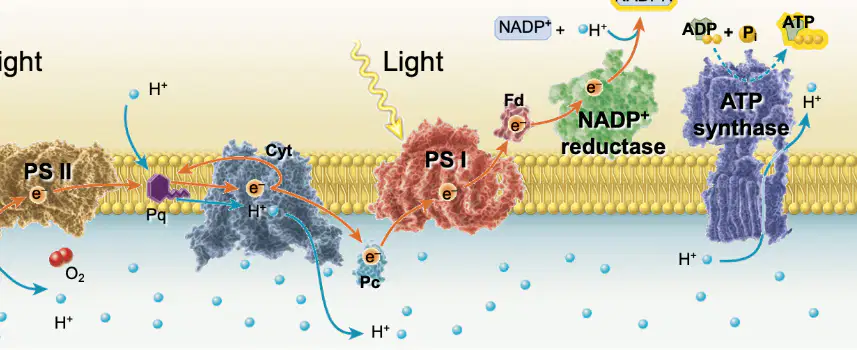
The components of the electron transport chain in photosynthesis include:
Photosystem II, cytochrome b6f complex, Photosystem I, ATP synthase
Ribosomes, mitochondria, chlorophyll, nucleus
Glucose, oxygen, carbon dioxide, water
DNA polymerase, RNA polymerase, helicase, ligase
Fill in the blank: ________ supplies the electrons for the beginning of the electron transport chain by pulling the electrons from water and gets energy from light.
Photosystem II (P680)
Photosystem I (P700)
ATP synthase
Cytochrome b6f complex
Fill in the blank: ________ transports the electrons from PSII to Cytochrome b6f complex.
Plastoquinone
Ferredoxin
NADP+
Plastocyanin
Fill in the blank: ________ transfers electrons from Plastoquinone to Plastocyanin.
Cytochrome b6f Complex
Photosystem II
ATP Synthase
Ferredoxin-NADP+ Reductase
Fill in the blank: ________ carries electrons from the cytochrome b6f complex to photosystem I by diffusing through the thylakoid lumen.
Plastocyanin
Ferredoxin
Cytochrome c
NADP+
Fill in the blank: ________ provides a second energy 'boost' to have enough energy for the next steps in the electron transport chain.
Photosystem I (P700)
Photosystem II (P680)
ATP synthase
Cytochrome b6f complex
Fill in the blank: Ferredoxin transfers electrons from Photosystem I to _______ reductase.
NADP+
cytochrome c
plastocyanin
ATP synthase
Fill in the blank: NADP+ reductase is an enzyme that converts NADP+ to _______ using electrons given by ferredoxin and transfers to NADP+ to create _______.
NADPH, NADPH
NADH, NADH
ATP, ATP
FADH2, FADH2
Fill in the blank: ATP Synthase uses the electrochemical gradient created to synthesize ATP (protons go from the thylakoid lumen to _______ stroma).
chloroplast
mitochondria
cytoplasm
nucleus
Protons accumulate in which location?
Intermembrane space
Mitochondrial matrix
Cytoplasm
Nucleus
Photosystems are energized by light because: What is the Z scheme?
They absorb light energy to drive electron transport in the Z scheme, which describes the flow of electrons from water to NADP+ in photosynthesis.
They use light to produce ATP directly without electron transport.
They are energized by heat, not light, in the Z scheme.
The Z scheme refers to the Calvin cycle, not electron flow.
What happens when the cell needs ATP, but not NADPH?
The cell uses cyclic photophosphorylation to produce ATP only.
The cell stops photosynthesis completely.
The cell increases NADPH production.
The cell uses non-cyclic photophosphorylation exclusively.
The overarching purpose of the Calvin Cycle is:
to synthesize glucose from carbon dioxide and water
to break down glucose for energy
to produce oxygen from water
to absorb sunlight for energy
The Calvin cycle consists of which phases, and what occurs in each phase?
Carbon fixation, reduction, and regeneration; carbon is fixed, reduced, and RuBP is regenerated in each phase respectively.
Glycolysis, Krebs cycle, and electron transport; glucose is broken down, ATP is produced, and electrons are transferred.
Light absorption, photolysis, and ATP synthesis; light is absorbed, water is split, and ATP is made.
Transcription, translation, and replication; DNA is transcribed, proteins are made, and DNA is copied.
How many turns of the Calvin Cycle are needed to make a single G3P molecule that can exit and make a glucose molecule?
1
2
3
6
For every three turns of the Calvin Cycle, how many G3P molecules are produced?
1
3
5
6
Fill in the blank: Rubisco is located in the ________ of plants and is responsible for fixing carbon.
chloroplasts
mitochondria
nucleus
cell wall
The function of the Rubisco enzyme is:
to catalyze the fixation of carbon dioxide in photosynthesis
to break down glucose during glycolysis
to transport oxygen in the blood
to synthesize ATP in the mitochondria

