wayground logo

Free Printable Worksheets

Font size

S
M
L
XL
Worksheets

population ecology

Total questions: 52

Worksheet time: 40mins
Name
Class
Date
1.
The movement of a single caribou into a herd is an example of
a)
population
b)
immigration
c)
emigration
d)
predation
2.
The way in which individuals of a population are spread out is called
a)
population density
b)
survivorship
c)
population dispersion
d)
logistic curve
3.
Which of the following is a density-independent limiting factor?
a)
natural disaster
b)
predation
c)
disease
d)
parasitism
4.
What pattern of growth will a population with limited resources show?
a)
density-dependent
b)
exponential 
c)
logistic
d)
logical 
5.
What type of population growth is shown in the graph?  
a)
logistic growth
b)
logical growth
c)
exponential growth
d)
density-dependent growth
6.
What 2 factors decrease population size?
a)
Immigration, Births
b)
Emigration, Births
c)
Emigration, Deaths
d)
Immigration, Deaths
7.
A population is...
a)
A group of one species in one area
b)
Multiple species that live in one area
c)
All of the living and nonliving things in an area
d)
None of these
8.
What is the carrying capacity of the following graph?
a)
1000
b)
8000
c)
800
d)
600
9.
Carrying Capacity is
a)
the capacity of what one person can carry per day 
b)
how many animals you have in your daily bag limit at the end of the year
c)
wildebeest at a watering hole with zebras
d)
the maximum number of individuals that the environment can support
10.
Diseases may spread more rapidly when an area is crowded, so disease is considered to be a
a)
type I survivorship curve
b)
population crasher
c)
density-dependent limiting factor
d)
population enhancer
11.

Things that prevent a population from growing exponentially.

a)

Population

b)

Carrying Capacity

c)

Limiting Factors

12.

Where on the graph has the population reached its carrying capacity?

a)

A to B

b)

B to C

c)

A to C

13.

Where on the graph does the population experience exponential growth?

a)

A to B

b)

B to C

c)

A to C

14.

How quickly a population grows is called

a)

Limiting Factor

b)

Carrying Capacity

c)

Growth Rate

15.

A species that plays a critical role in the health, maintenance, growth, or definition of an ecosystem.

a)

keystone

b)

invasive

c)

engineer

d)

predator

16.
If there is 1000 Kcal available in the producers in trophic level 1, how much energy is available in the herbivores in trophic level 2?
a)
10 Kcal
b)
1 Kcal
c)
100 Kcal
d)
1000 Kcal
17.
In this Food Web Pyramid Which type of consumer gets only 10% of the energy stored in plants?
a)
Herbivore
b)
Carnivore
c)
Omnivore
d)
Secondary Consumer
18.

What does the graph represent?

a)

Emigration

b)

Exponential growth

c)

Immigration

d)

Logistic Growth

19.
Logistic growth has 3 phases. In Phase 1, the population grows rapidly. In Phase 2, population grows slowly. In Phase 3, growth stops. What causes growth to stop in the 3rd phase of logistic growth?
a)
Emigration
b)
Immigration
c)
Exponential Growth
d)
Carrying Capacity
20.
Which limiting factor would increase due to the number of individuals in a population?
a)
Unusual weather
b)
Natural disaster
c)
Births
d)
Disease
21.
If birth rate plus immigration exceeds death rate plus emigration, a population _______.
a)
grows
b)
declines
c)
stays the same
d)
none of the above
22.
Emigration is the movement of individuals ______ a population.
a)
into
b)
out of
23.
Under ideal conditions with unlimited resources, a population will have ________.
a)
linguistic growth
b)
experimental growth
c)
exponential growth
d)
logistic growth
24.

These organisms occupy stable environments, are larger in size and have longer life expectancies. They produce, during their life spans, fewer offspring, but place a greater investment in each.

a)

k-strategist

b)

r-strategist

c)

m-strategist

d)

s-strategist

25.

These organisms typically live in unstable, unpredictable environments & are able to reproduce rapidly (exponentially). They do not take care of their young & are subject to predation.

a)

k-strategist

b)

r-strategist

c)

m-strategist

d)

s-strategist

26.

Processes that remove individuals from a population.

a)

death and emigration

b)

birth and immigration

27.

What type of growth is represented in this graph?

a)
exponential
b)

logistic

c)

survivorship curve

d)

predator-prey

28.
Refer to the diagram of the survivorship curve.
Which curve best describes an organism that invests a lot of energy in parenting?
a)
A
b)
B
c)
C
d)
this is not a survivorship curve
29.

Which best describes the graph of logistic growth?

a)
S-shaped
b)
J-shaped
c)
W-shaped
d)
U-shaped
30.

What is the largest number of individuals that an environment can support long term?

a)

carrying capacity

b)

emigration

c)

immigration

d)

survivorship

31.

Describes organisms with a high death rate (or low survivorship rate) immediately following birth. Examples include bacteria, fishes, and invertebrates.

a)

Type I

b)

Type II

c)

Type III

d)

Type IV

32.

What term is used to define anything that regulates the size of a population?

a)

density

b)

a limiting factor

c)

carrying capacity

d)

biodiversity

33.
Which of the following would INCREASE the carrying capacity of an ecosystem?
a)
increase in predators
b)
disease
c)
increase in available food
d)
drought
34.

The number of females and males of each age contained in a population...

a)

limiting factor

b)

demography

c)

age structure

d)

logistic growth

35.

Factors that are influential only when population density reaches a certain level...

a)

density-dependent limiting factor

b)

limiting factor

c)

logistic growth

d)

density-independent limiting factor

36.

Factors that are influential only when population density reaches a certain level...

a)

density-dependent limiting factor

b)

limiting factor

c)

logistic growth

d)

density-independent limiting factor

37.

Movement into a range from elsewhere...

a)

immigration

b)

emigration

c)

demographic transition

d)

density-independent limiting factor

38.

The number of individuals per unit of area...

a)

limiting factor

b)

carrying capacity

c)

population density

d)

density-dependent limiting factor

39.

Regardless of population size or density, these factors affect all populations similarly...

a)

density-dependent limiting factors

b)

density-independent limiting factors

c)

carrying capacity

d)

exponential growth

40.

Which type of distribution is best suited for herding animals?

a)

Even

b)

Clumped

c)

Random

d)

Paired

41.

Which type of distribution is best suited for aggressive animals?

a)

Paired

b)

Even

c)

Random

d)

Clumped

42.

What type of dispersion does this picture represent?

a)

Random

b)

Even

c)

Clumped

d)

None

43.
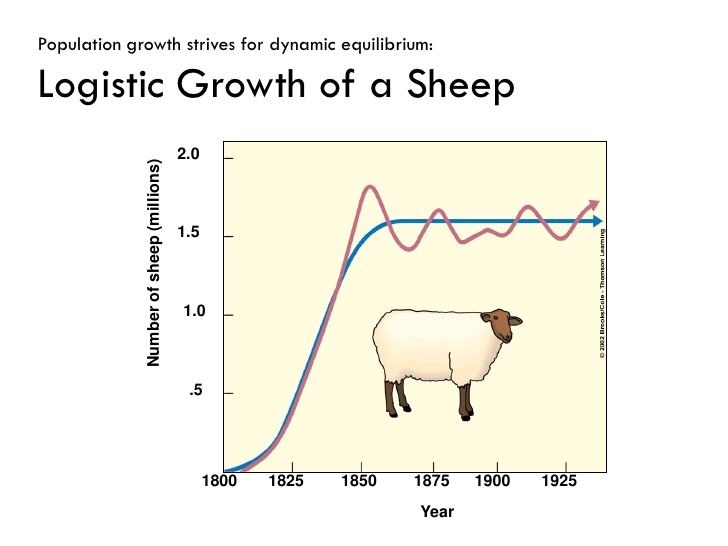
What is the carrying capacity for this sheep population?
a)
1.8 million
b)
1.25 million
c)
1.6 million
d)
1.o million
44.
which statement sounds accurate based on the graph data. 
a)
The zebra and lions do not affect each other
b)
when lions population increases, so does the zebra population
c)
When the zebra population increases, it causes the lion population to also increase
d)
when zebra populations go down, the zebra population goes up. 
45.
What type of growth is represented behind?
a)
exponential
b)
logistics
c)
a good kind
d)
representative
46.
What point on the graph represents the carrying capacity?
a)
A
b)
B
c)
C
d)
D
47.

Which of the following are examples of a density independent factors?

a)

forest fire

b)

seasonal cycles

c)

storms

d)

disease

48.
A type of dispersion where individuals are clumped together such as a herd or school.
a)
clumped dispersion
b)
carrying capacity
c)
birth rate
d)
uniform dispersion
49.
The way in which individuals of a population are spread in an area or volume.
a)
population dispersion
b)
population density
c)
population crash
d)
logistic growth
50.

Tracks organisms that tend to live long lives (low death rate and high survivorship rate); toward the end of their life expectancies, however, there is a dramatic increase in the death rate.

a)

Type I

b)

Type II

c)

Type III

d)

Type IV

51.

Describes organisms with a high death rate (or low survivorship rate) immediately following birth. Examples include bacteria, fishes, and invertebrates.

a)

Type I

b)

Type II

c)

Type III

d)

Type IV

52.

Describes organisms where death is common at all ages.

a)

Type I

b)

Type II

c)

Type III

d)

Type IV