
Font size
 Worksheets
BIO Exam 2
Total questions: 85
Worksheet time: 2hrs 32mins
Which of the following correctly lists the five stages of the cell cycle?
G1, S Phase, G2 phase, M Phase, G0
G1, G2, S, M, C
S, G1, G2, M, T
G0, G1, S, T, M
What structure keeps sister chromatids together?
Centromere
Nucleolus
Spindle fiber
Mitochondria
During prophase of mitosis, what happens to the chromosomes?
They are condensed and can be seen with a light microscope
They are replicated for the first time
They are broken down into nucleotides
They are translated into proteins
What is the main event that occurs during anaphase of mitosis?
Chromatids reach their poles and decondense
The connections between the sister chromatids break apart
Nuclear envelope forms creating two nuclei
Sister chromatids align at the metaphase plate
Which of the following is a key difference between meiosis and mitosis?
Chromosomes condense and form bivalents in mitosis
Sister chromatids form a bivalent or tetrad in meiosis
Cytokinesis only occurs in mitosis
Spindle fibers are only formed in mitosis
During which phase of Meiosis II do sister chromatids separate and move towards the poles?
Prophase II
Metaphase II
Anaphase II
Telophase II
Which event occurs during Prometaphase II of Meiosis II?
Sister chromatids condense
Nuclear envelope destroyed
Chromosomes decondense
Cleavage furrows separate new cells
What is the genetic composition of an organism called?
Genotype
Phenotype
Chromosome
Allele
What is the expected ratio when crossing Tt x tt?
3:1
1:1
2:1
1:2:1
Which of the following describes independent events?
The occurrence of one event affects the probability of the other
The occurrence of one event has no effect on the probability of the other
Both events must occur together
Neither event can occur
What does correlation indicate?
One thing causes another
Two things seem to happen in tandem
There is no relationship
One thing prevents the other
What does the Hardy-Weinberg Equilibrium show?
If a population is evolving
If something is occurring, but no population really applies to it
The ratio of dominant to recessive alleles
The probability of independent events
What is pedigree analysis used for?
To create new breeds
To look at known history in the family tree instead of unethically breeding humans
To determine the Hardy-Weinberg Equilibrium
To calculate sample space
If you cross PPGG with ppgg, what is the phenotype of the F1 generation?
Purple/Green PpGg
Purple/Purple PPGG
Green/Green ppgg
Purple/Green PPGg
Which of the following is NOT one of the four criteria of genetic material?
Information
Replication
Transmission
Mutation repair
What are the three components of a nucleotide?
Phosphate group, pentose sugar, nitrogen-containing base
Phosphate group, ribosome, lipid
Pentose sugar, amino acid, nitrogen-containing base
Phosphate group, glucose, protein
Which bases are classified as purines?
Adenine and Guanine
Uracil and Cytosine
Thymine and Cytosine
Adenine and Thymine
What is the directionality of a DNA strand?
3’ to 5’
5’ to 3’
2’ to 4’
1’ to 6’
Which mechanism is the correct model for DNA replication?
Semiconservative
Conservative
Dispersive
Random
What enzyme adds nucleotides during DNA replication?
DNA polymerase
RNA ligase
Helicase
Topoisomerase
What is required for DNA polymerase to begin synthesizing DNA?
A primer made of RNA
A primer made of DNA
A primer made of protein
A primer made of lipids
What distinguishes the synthesis of the leading strand from the lagging strand during DNA replication?
The leading strand is synthesized as one long molecule, while the lagging strand is synthesized in Okazaki fragments
The leading strand uses RNA primers, while the lagging strand does not
The leading strand is synthesized in the 3’-5’ direction, while the lagging strand is in the 5’-3’ direction
The leading strand is made of RNA, while the lagging strand is made of DNA
Explain why Okazaki fragments are necessary during DNA replication on the lagging strand.
Because DNA polymerase can only synthesize DNA in the 5’-3’ direction, and the lagging strand runs in the opposite direction, requiring synthesis in short segments.
Because the lagging strand is made of RNA
Because the leading strand is too long
Because DNA ligase cannot function on the leading strand
How many chromosomes are found in human somatic cells?
46
23
44
92
What is chromatin?
The complex of DNA and proteins that make up eukaryotic chromosomes
A type of nucleotide
A sugar found in RNA
A purine base
Which statement best describes the function of genetic material?
It contains the information that produces the traits of organisms
It only stores energy
It is responsible for cell movement
It forms the cell membrane
In which direction are the sugars in DNA connected by covalent bonds?
5’ to 3’ direction
3’ to 5’ direction
2’ to 4’ direction
1’ to 6’ direction
Which component of a nucleotide is or are always different when comparing DNA and RNA?
Phosphate group
Nitrogenous base
Pentose sugar
Hydrogen bond
What did the X-ray diffraction data of Franklin help reveal?
The function of ribosomes
The structure of DNA
The process of translation
The sequence of amino acids
What are the ends of linear chromosomes called, and what are they composed of?
Centromeres, composed of proteins
Telomeres, composed of repeated sequences
Exons, composed of coding DNA
Introns, composed of non-coding DNA
The karyotype is the number, size, and form of the complete set of chromosomes of an organism
true
false
Cancer cells are said to be metastatic when they
migrate to other parts of the body
begin to divide uncontrollably
cause mutations in other healthy cells
Invade healthy tissue
Catabolic reactions
create larger molecules from smaller ones
break down reactants
never occur in biological reactions
biosynthesize
Put C3, C4, and CAM plants in order from least amount of energy used or the most efficient method of photosynthesis (on the left) to most amount of energy used or least efficient method of photosynthesis (on the right):
CAM, C4, C3
C4, CAM, C3
C4, C3, CAM
C3, C4, CAM
kinetic energy is the energy possessed due to location or structure
true
false
The first law of thermodynamics states:
Energy can be created
Energy can be destroyed
Energy always increases
Energy cannot be created
Checkpoints during cell cycle are important because they
Ensure the integrity of the DNA
allow the cell to generate enough ATP for cellular division
Allow the organelle activity to catch up to cellular demands
all of these are correct
Crossing over is the physical exchange between chromosome segments of the bivalent or tetrad
true
false
Homologous chromosomes are identical
true
false
C3 photosynthesis has this name as
The first stable product is a 4 carbon molecule
The first stable product is a 3 carbon molecule
The final product is a 3 carbon molecule
The final product is a 4 carbon molecule

How many PAIRS of chromosomes do humans typically have?
23
46
12
92
What is the molecule called that carries genetic information?
Protein
Carbohydrate
DNA
Lipid
In genetics, what does the term "homozygous" refer to?
Having two different alleles for a trait
Having two identical alleles for a trait
The study of genes and their roles in inheritance
A type of genetic cross
In a pedigree chart, men are represented by
Circles
Diamonds
Squares
What is the term for the passing of traits from parents to offspring?
Metabolism
Genetics
Evolution
Photosynthesis
What is the significance of mitosis in multicellular organisms?
It helps in the reproduction of organisms.
It is responsible for genetic diversity.
It aids in growth and repair of tissues.
It produces gametes for reproduction.
Which component of DNA determines the traits that are inherited?
Sugar molecules
Phosphate groups
Nitrogenous bases
Hydrogen bonds
Who is the father of genetics?
George Washington
Gregor Mendel
John Deere
Louis Pasteur
A person who has both a dominant allele and a recessive allele would display which phenotype
The recessive phenotype
50% chance of displaying either
The dominant phenotype
A mix of the two alleles
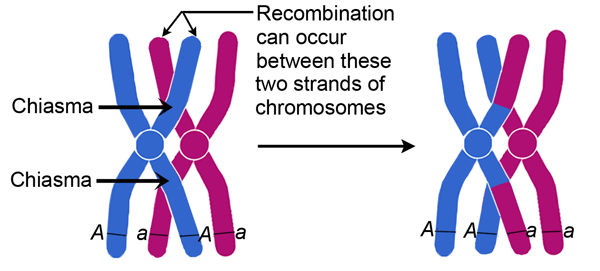

CROSSING OVER INCREASES
LIFE SPAN
GENETIC VARIATION
THE NUMBER OF OFF-SPRING
ALL ARE TRUE

The different forms of a gene are called
traits
pollinators
alleles
hybrids
What is the function of spindle fibers during mitosis?
They help separate sister chromatids
They synthesize proteins
They condense chromosomes
They replicate DNA
Which phase of the cell cycle is primarily responsible for DNA replication?
G2 phase
G1 phase
S phase
M phase
Which one of the following is not one of the conditions that must be met in Hardy-Weinberg?
Random Mating
Small Population Size
No Natural Selection
No Mutations

What pulls the chromosomes apart?
Spinner wheels
Spiral windows
Spindle fibers
Spiral fibers


What is the correct order of the phases of Mitosis?
Anaphase, Telophase, Metaphase, Prophase
Metaphase, Prophase, Anaphase, Telophase
Prophase, Metaphase, Anaphase, Telophase
Prophase, Anaphase, Telophase, Metaphase

A HAPLOID Human cell has...
1 set of chromosomes
2 sets of chromosomes
3 sets of chromosomes
4 sets of chromosomes

What is this equation for?
Cellular Biography
Cellular Respiration
Photosensitizes
Photosynthesis

A green chemical that absorbs sunlight is
nutrients
chlorophyll
seed coat
vegetable


In which part of the plant cell does photosynthesis take place?
Nucleus
Mitochondria
Chloroplast
Ribosome


Which three parts are found in all nucleotides?
sugar, phosphate, base pairs
phosphate, base pairs and cytosine
sugar, phosphate and cytosine
sugar, phosphate and base
You are completing a single factor cross of two true-breeding plants. The character in question comes in two variants, one dominant and one recessive. This trait shows complete dominance. What would you expect the F1 generation’s phenotype to be
3:1 ratio of the dominant to recessive traits
All the plants would be heterozygous
All plants would display the recessive traits
All plants would display the dominant traits
The physical location of a gene on a chromosome is called
pleiotropy
locus
filius
monecious
When the true breeding lines of plants were crossed by Mendel, he created a hybrid generation that we referred to as
The P1 generation
The F2 generation
The F1 generation
The P2 generation
When a non-equal distribution of the chromosomes occurs during meiosis, this is called
Karyotype
Gametophyte
Heterozygous
Non-disjunction
One of the advantages of sexual reproduction is:
The two sexes must be able to find one another
The organisms often need to create a large number of gametes
Specialized body parts are often needed for the production of offspring
The offspring tend to have higher genetic diversity
Which of the following is true for organisms with alternation of generations
During the only stage the organism is multicellular they are 2n
There are multicellular phases that are both 1n and 2n
These organisms do not reproduce sexually and are 2n at every stage of their life cycle
During the only stage the organism is multicellular they are 1n
When looking at simple Mendelian Inheritance if you were looking at flower color, flower color would be considered the______ and the colors purple or white would each be considered the______.
Trait, Character
Character, Trait
Loci, allele
allele, loci
Epistasis is
When incomplete dominance occurs and offspring’s phenotype displays an intermediate form of the trait
When environmental factors can influence the phenotype of the organism
When incomplete dominance occurs and offspring’s genotype displays an intermediate form of the trait
The interaction when the allele of one gene can mask the expression of another gene
In haploid dominant organisms, such as some fungi, the multicellular organism is 1n.
true
false
Human blood types are an example of
Complete Dominance
Codominance
Incomplete dominance
Pleiotropy

