
 Worksheets
Final Review for Science 8R Final
Total questions: 89
Worksheet time: 1hrs 20mins

Select the correct order of waves on the EMS from the longest wavelength to the shortest wavelength
Radio, Micro, Infra, Visible, Ultra, X-ray, Gamma
Gamma, X-ray, Ultra, Vis, Infra, Micro, Radio
Vis, Micro, Infra, Ultra, X-ray, Gamma, Radio
Micro, Radio, Vis, Infra, Ultra, X-ray, Gamma


__________________ is the day-to-day conditions of the atmosphere, including temperature, precipitation and other factors.
Climate
Weather
Temperature
Humidity
_________________ is the average year to year conditions of temperature and precipitation in an area over a long period of time.
Climate
Weather
Temperature
Atmospheric condition
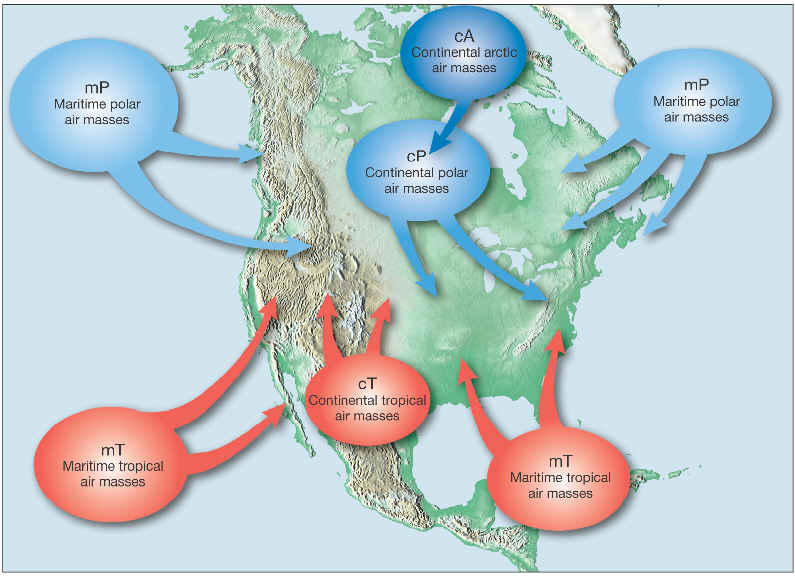
An air mass is a large mass of air that is defined by its temperature and ____________________.
Elevation (altitude)
Water vapor content (humidity)
Strength
Weather

Which type of air mass is dry and warm?
Continental polar
Continental tropical
Maritime polar
Maritime tropical

Which type of air mass is warm and humid?
Continental polar
Continental tropical
Maritime polar
Maritime tropical

Which type of air mass is cold and dry?
Continental polar
Continental tropical
Maritime polar
Maritime tropical

Which type of air mass is pictured in letter "C" (northeastern U.S., around NYC)?
Continental polar
Continental tropical
Maritime polar
Maritime tropical
Where do most earthquakes occur?
In the center of tectonic plates
Near edges of plates, called tectonic plate boundaries
On the moon
In the ocean away from any plates

Measures wind speed.
Rain Gauge
Wind Vane
Wind Sock
Anemometer

Measures air pressure.
Thermometer
Barometer
Hygrometer
Compass
The Law of Conservation of Energy states:
Energy can created or destroyed but not transformed
Energy cannot be created or destroyed, it can only transformed
Energy can't be created, destroyed or transformed
Energy cannot be created or destroyed.
In New York State, dry, cool air masses (cP) often interact with moist, warm air masses (mT). Which statement correctly matches each air mass with its usual geographic source region?
cP is from northern Canada and mT is from the Gulf of Mexico
cP is from northern Canada and mT is from the deserts of the southwestern United States
cP is from the North Atlantic Ocean and mT is from the Gulf of Mexico
cP is from the North Atlantic Ocean and mT is from the deserts of the southwestern United States

Match the air mass to the correct air conditions.
mP
Cold and Humid Air
mT
Warm and Humid Air
cP
Cold and Dry Air
cT
Warm and Dry Air
In what way does the use of digital signals impact the quality of audio and video transmissions compared to analog signals?
Digital signals degrade more over distance
Digital signals maintain quality better due to error correction
Analog signals are always clearer
Analog signals are more reliable

This type of signal is more affected by noise and greatly affects the quality of the signal
Analog
Digital

What happens to light when it hits a white surface?
It is absorbed
It is reflected
It is transmitted
It is refracted

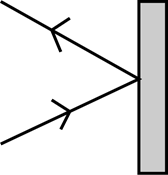
In the illustration, the light ray striking the object is-

What would you call this?
Bounce back
Reflection
Diffraction
Refraction

A carbon nanotube capturing light is an example of:
Reflection
Refraction
Absorption
A student places a sheet of black construction paper on her desk. What happens to most of the light that strikes the black construction paper?
The light passes through the paper.
The light is absorbed by the paper.
The light reflects off the paper.
The light is bent by the paper.

Sound waves can travel through all of the following EXCEPT
a vacuum (empty space)
air
water
steel
As sound waves travel through air, they cause air molecules to ___.
vibrate
bend
lose energy
be absorbed
What do sound waves need to travel through?
a medium
a light
a wave
a vacuum
How long does it take Earth to REVOLVE around the sun?
about a 1 day
about 24 hours
about 3 years
about 1 year

The day of the year with the most daylight hours is the
spring equinox
fall equinox
summer solstice
winter solstice
Global Cooling
Climate Change

What is the energy source for the water cycle?
the Sun
the Earth
water
the Moon
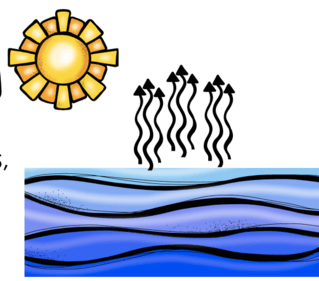


The process by which molecules of water vapor become liquid water.
transpiration
evaporation
condensation
accumulation
Lines on a map that represent equal air pressure are called
isobars
isotherms
isohyets
contour lines
What causes differences in air pressure?
even heating of the Earth
Even cooling of the earth
uneven heating of the earth
global warming
Phase change going from Liquid to Solid...
Melting
Freezing
Condensation
Sublimation

Which liquid has the greatest density?
Corn oil
Shampoo
Antifreeze
Maple syrup
Which liquid is less dense than dish detergent?
DIsh detergent
Shampoo
Antifreeze
Maple syrup
Which liquid has the least density?
Corn oil
Shampoo
Antifreeze
Maple syrup
Earth’s rotation is a process that causes
the sun to appear to rise and set.
stars to appear to move across the sky.
celestial objects in space appear to move daily in circular patterns.
all of the above
What is the difference between insulators and conductors?
Insulators are used only for electricity and conductors are used only for heat
Insulators allow electricity to flow easily and conductors do not.
Conductors allow electricity to flow easily and insulators do not
Conductors are used only for electricity and insulators are used only for heat
Glass, rubber, wood and plastic are all examples of (a) ______ since electricity cannot pass through them
insulators
materials
conductors
Thermal Conductivity
Select all: Examples of good conductors
Copper
Glass
Aluminium
Rubber

What arrangement makes ELECTRIC force attract?
Negative and negative
Negative and positive
positive and positive

In what arrangement does ELECTRIC force repel? Select all that apply
negative and negative
negative and positive
Positive and positive
How do the stars prove Earth's rotation?
Stars and constellations appear to move to the left or clockwise
Stars and constellations do not appear to move
Stars and constellations appear to move around Polaris.
Stars and constellations rise in the west and set in the east
What is the general pattern of the Sun's movement across the sky in the Northern Hemisphere?
The Sun rises in the west and sets in the east.
The Sun rises in the east and sets in the west.
The Sun does not appear to move during the day.
The Sun rises in the north and sets in the south.

What is kinetic energy?
Stored energy
Moving energy
Potential energy
All of the above
What is potential energy?
The amount of energy an object could have if it tried hard enough.
Moving energy
Stored energy
Active energy

Which ball has the greater potential energy and why?
The blue ball has more PE because it is closer to the ground.
The blue ball has more PE because it has more mass.
The green ball has more PE because it's height is greater.
The green ball has more PE because it has less mass.
What factors does the kinetic energy of an object depend upon?
mass and volume
mass and height
force and distance
mass and speed
What is the main cause of flash floods?
Slow melting of snow
Heavy rainfall
Levee break
Ocean waves
What is the best precaution to take when a flash flood warning is issued?
Ignore the warning
Get to higher ground
Stay indoors
Drive through flooded roadways
As wavelength increases: frequency, (a) and energy (b) .
Select all that apply. Sound -
requires a medium (matter) to travel through
does NOT require a medium (matter) to travel through.
CANNOT be heard in the vacuum of space
CAN be heard in the vacuum of space
is mechanical energy
Select all that apply. light-
requires a medium (matter) to travel through
does NOT require a medium (matter) to travel through.
CANNOT be seen in the vacuum of space
CAN be seen in the vacuum of space
is radiant energy
The bigger the amplitude, the ________ energy carried by the wave.
more
less
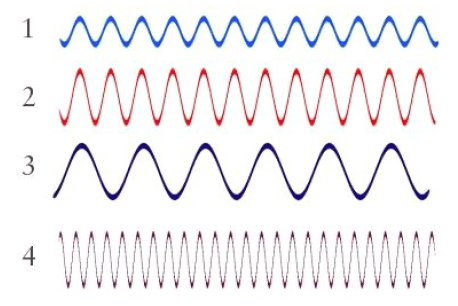

Which wave has the greatest amplitude?
C
D
E
How does a wave's amplitude relate to sound energy?
The higher the amplitude the softer the sound
The higher the amplitude there is no change in sound energy
The higher the amplitude the louder the sound
Amplitude is the same as pitch

light is taken in or soak up
refraction
reflection
absorption
medium
What two things determines the gravity of an object?
mass & weight
mass & distance
density & mass
volume & distance
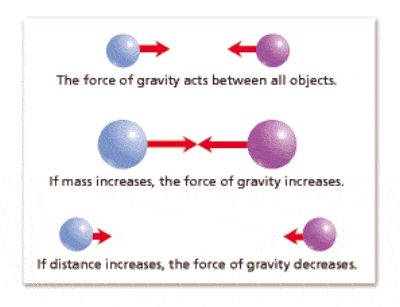
Increases
Decreases
Stays the same
I don't know


