
 Worksheets
Chapter 1 of general medicine
Total questions: 151
Worksheet time: 1hrs 17mins
The anatomical structure that separates the right and left halves of the body longitudinally is the:
Transverse plane
Coronal(frontal) plane
Median plane
Oblique plane
Which of the following is identified as a primary role of the skeletal system?
To circulate blood and nutrients throughout the body.
To serve as the bony framework of the body and provide structure
To produce hormones that regulate growth and metabolism.
To break down food for energy.
Which of the following is a protective role of the skeletal system?
Absorbing sunlight for Vitamin D synthesis.
Forming the cavities and fossae ( depression or hollows) that protect vital structures
Storing excess fat for insulation.
Generating electrical impulses for nerve transmission.
The skeletal system facilitates movement by :
Filtering waste from the blood
Providing flexibility to organs
Creating joints and providing attachment points for muscles
Regulating body temperatures
The two main divisions of the human skeleton are the:
Upper and Lower
Anterior and Posterior
Axial and Appendicular
Internal and External
Which of the following components are part of the axial skeleton ?
Arms, legs, and shoulder girdles
Skull, spine, and rib cage
Hands, feet, and pelvis
Lungs, heart and brain
The appendicular skeleton consists of the:
Skull, rib cage, and spine
Pelvis and vertebral column
Limbs and gridles( shoulder and pelvic)
Sternum and clavicles only
The skull is divided into which two main parts ?
Upper and Lower Mandible
The cranium and the face
The spine and the neck
The cheekbones and the jaw
The part of the skull that contains the brain is specifically called the:
Face
Orbit
Cranium
Maxilla
Which of the following is NOT listed as a function of the skull?
Protecting the eyes.
Protecting the brain.
Protecting the inner ears.
Regulating body temperature
How many movable bones ( vertebrae) are in the vertebral column ?
5
17
20
24
The vertebral column is made up of 24 movable vertebrae plus which two fused bone structures ?
The cranium and the mandible
The sternum and clavicle
The sacrum and the coccyx
The pelvis and the ribs
What is the primary function of the vertebral column ?
To support the weight of the limbs
To create attachment points for all facial muscles
To circulate blood to the brain
To form a central channel along the column, providing strong protection for the spinal cord.
Which of the following is NOT one of the five divisions of the vertebral column ?
Cervical
Thoracic
Lumber
Cranial
Which of the following vital organs is specifically listed as being protected by the thoracic cage ?
The liver and kidneys
The brain and inner ears
The heart, lungs, and major blood vessels
The stomach and intestines
In the function of respiration, the thoracic cage provides attachment for which two key groups of the muscles ?
Diaphragm and intercostal muscles
Skeletal and cardiac muscles
Abdominal and pectoral muscles
Trapezius and latissimus dorsi
Which bones from the vertebral column contribute directly to the formation of the thoracic cage?
Thoracic Vertebrae
Lumber vertebrae
Sacrum and coccyx
Cervical and vertebrae
Which of the following is NOT one of the three components that form the thoracic cage?
1 sternum or breast bone
7 cervical vertebrae
12 pairs of ribs
12 thoracic vertebrae
The term 'breast bone' is an informal name for the sternum. Which structural feature allows it to form the anterior boundary of the thoracic cage?
it is a complex bone structures located in the shoulder girdle
It is a long, narrow bone running vertically down the center of the chest
It is a pair of crescent - shaped bones that curve around the sides
It is a fused section of the spine in the upper back
Which of the following bones is found in the upper limb?
Ulna
Patella
Femur
Tibia
Which set of bones is uniquely part of the lower limbs?
Carpals and metacarpals
Tibia and fibula
Phalanges and humerus
Radius and ulna
The lower limb has 1 patella. The primary function of this bone is to :
Serve as a protective shield for the knee joint
Connect the radius and ulna
Anchor the major muscles of the hip
Form the ankle joint
The bones of the upper and lower limbs are long bones that perform the function of protecting soft tissues, specifically:
Cartilage and meninges
Adipose tissue and skin
Blood vessels and nerves
Ligaments and tendons
Which bones are immediately proximal (closer to the body) to the 14 phalanges in the lower limbs?
Metatarsals
Tibia and Fibula
Tarsals
Femur
Which two bones make up the distal (further away from the body) portion of the upper limb's arm/forearm structure?
Radius and ulna
Carpals and metacarpals
Femur and tibia
Humerus and ulna
The functions of the appendicular skeleton include enabling body movement and producing blood cells. Which other function that they have ?
Supporting the weight of the head and trunk
Protecting soft tissues, especially blood vessels and nerves
Storing calcium for metabolic use
Producing hormones for metabolism
Which one of the four body cavities contained the brain?
Pelvic cavity
Cranial cavity
Thoracic cavity
Abdominal cavity
The body organs are contained and protected within 4 cavities TRUE or FALSE
TRUE
FALSE
The heart, lungs, and major blood vessels are protected within which body cavity?
Pelvic cavity
Abdominal cavity
Cranial cavity
Thoracic cavity
Which cavity is situated inferior (below) the thoracic cavity and superior (above) the pelvic cavity?
Pelvic
Spinal
Abdominal
Cranial
If an injury occurs to the L5 vertebra, which body cavity would immediately be affected?
Cranial
Pelvic
Thoracic
Abdominal
Which skull bone forms the posterior boundary of the cranial cavity?
Occipital bone
Frontal bone
Temporal bone
Parietal bone
Which skull bone forms the anterior boundary of the cranial cavity?
Occipital bone
Parietal bone
Frontal bone
Sphenoid bone
Which skull bone forms the superior boundary of the cranial cavity?
Frontal bone
Parietal bone
Temporal bone
Ethmoid bone
The lateral boundaries of the cranial cavity are formed by which skull bones?
Occipital bone
Temporal bones
Parietal bone
Sphenoid and Ethmoid bones
Besides the Sphenoid and Ethmoid bones, the inferior boundary is also formed by parts of which three other listed skull bones?
Temporal, Occipital, and Ethmoid
Frontal, Temporal, and Occipital
Frontal, Parietal, and Sphenoid
Parietal, Temporal, and Occipital
Which two adjacent tissues form the anterior boundary of the thoracic cavity?
Root of the neck and trachea
Diaphragm and intercostal muscles
Sternum and costal cartilages
Thoracic vertebrae and ribs
The lateral boundary of the thoracic cavity is formed by 12 ribs, supplemented by which type of muscular tissue?
pectoral muscles
Intercostal muscles
Abdominal muscles
Diaphragm tissue
The superior boundary of the thoracic cavity is formed by the:
Diaphragm
Clavicles
Root of the neck
Cervical vertebrae
The inferior boundary of the thoracic cavity is formed by which muscular structure?
The clavicle
The pectoralis major
The diaphragm
The intercostal muscles
Which large, muscular structure forms the superior boundary of the abdominal cavity?
The pelvic floor
The sternum
The lumber vertebrae
Diaphragm
Which is the largest body cavity in human ?
The thoracic cavity
The abdominal cavity
The pelvic cavity
The cranial cavity
The abdominal cavity is divided into 9 regions. TRUE or FALSE ?
TRUE
FALSE
The abdominal cavity is described as being continuous with which other cavity inferiorly?
Pelvic cavity
Thoracic cavity
Pericardial cavity
Cranial cavity
Which specific organs listed are part of the digestive system and are contained within the abdominal cavity?
Heart and lungs
Spleen and kidneys
Stomach, intestines, liver, gall bladder, bile ducts, pancreas.
Adrenal glands and lymphatics
The posterior boundary of the abdominal cavity is formed by which two types of structures?
Lumber vertebrae and posterior abdominal wall muscles
Costal cartilages and sternum
Muscles of the anterior abdominal wall
Diaphragm and lower ribs
The boundaries of the abdominal cavity on the sides (laterally) are formed by:
Costal cartilages only
Only the liver and spleen
Lumber vertebrae only
Lower ribs and part of the abdominal wall muscles
Which boundary structure provides the least bony protection to the organs within the abdominal cavity?
Superiorly : Diaphragm
Posterior : Lumber vertebrae
Laterally : Lower ribs
Anteriorly: Muscles of the anterior abdominal wall
Which set of bones forms the lateral boundaries of the pelvic cavity ?
Innominate (hip) bones
Sacrum and coccyx
Pubic bones
Lumber vertebrae
The female reproductive organs listed (uterus, tubes, ovaries, vagina) are all contained within which part of the trunk?
Cranial cavity
Thoracic cavity
Abdominal cavity
Pelvic cavity
Which structures form the bony component of the posterior boundary of the pelvic cavity?
Lumber vertebrae
pubic bone
sacrum and coccyx
Innominate bones
The inferior boundary of the pelvic cavity is formed by what structures?
Muscles of the pelvic floor
Innominate bones
pubic bones
sacrum and coccyx
The male reproductive organs listed (prostate, seminal vesicles, ducts, urethra) are contained within the pelvic cavity, located adjacent to which organ of the urinary system?
Kidneys
Lower ureters
Venae cavae
Bladder
The anterior boundary of the pelvic cavity is formed by which bones?
Muscles of the pelvic floor
Pubic bones
Lower ribs
Sacrum and coccyx
Besides the sigmoid colon and rectum, which other digestive structure is listed as having portions within the pelvic cavity?
Stomach
Pancreas
Anus
Small intestine loops
Which organ, contained within the pelvic cavity, serves the primary function of storing urine?
Kidneys
Urethra
Bladder
Lower ureters
Which term describes the " cause " of a particular disease or condition ?
Pathogenesis
Prognosis
Aetiology
Complications
The development and progression of a disease, including its effect on normal physiological functions, is defined as:
Pathogenesis
Prognosis
Complications
Aetiology
A doctor informs a patient that their minor condition is likely to resolve completely with no lasting effects. This statement is describing the disease's:
Prognosis
Complications
Aetiology
Pathogenesis
If a patient with a respiratory infection develops pneumonia, the pneumonia is an example of a potential:
Pathogenesis
Prognosis
Complication
Aetiology
Determining that an infection is caused by a specific bacterium is an example of identifying the disease's:
Pathogenesis
Prognosis
Complication
Aetiology
Which concept best informs a clinician's decision on which medication to prescribe, as it details how the disease affects the body?
Pathogenesis
Prognosis
Complication
Aetiology
A patient with a chronic disease is told they have a 90% chance of recovery with long-term medication. This statistical prediction is a statement of the:
Pathogenesis
Complication
Prognosis
Aetiology
A disorder that develops at any point after birth is correctly termed:
Congenital
Acute
latrogenic
Acquired
A severe headache, as described by the patient, is classified as a(n):
Sign
Complication
Syndrome
Symptom
Which term describes a long-standing disorder that often cannot be cured but must be managed over time?
Acute
latrogenic
Chronic
Commumicable
A collection of signs and symptoms that tend to occur together.
Syndrome
latrogenic complication
acute aetiology
Chronic sign
A disease that can be transmitted (spread) from one individual to another is classified as :
latrogenic
Congenital
Communicable
Chronic
An infant diagnosed with a heart defect immediately after birth is an example of a disorder that is:
Acute
Acquired
Congenital
latrogenic
A rapid increase in heart rate (tachycardia) detected by an ECG machine is best categorized as a(n):
Aetiology
Symptom
Syndrome
Sign
A disorder that appears suddenly and is likely to require immediate intervention due to its severe and rapid nature is classified as:
Chronic
Communicable
Acute
Acquired
A severe allergic reaction (anaphylaxis) resulting from the administration of a prescribed drug is an example of a condition classified as:
Communicable
Congenital
Chronic
Iatrogenic
Which term is used to describe a disease for which the cause is unknown?
Idiopathic
Acquired
Iatrogenic
Communicable
When a condition is referred to as spontaneous, what information is being communicated about its aetiology?
It is caused by an external chemical agent
It is caused by a microbe
It is caused by old age or overuse
The cause is unknown, though risk factors may exist
Aetiology: Diseases are usually caused by one or more broad mechanisms, including:
o Genetic abnormalities: inherited or acquired
o Infections: bacteria, viruses, microbes or parasites
o Chemicals oIonising radiation
o Physical trauma
o Degeneration: ageing or overuse
TRUE
FALSE
Which pathogenesis mechanism describes a tissue's response to damage, such as from a physical injury or microbial invasion?
Metabolic abnormalities
Tumours
Inflammation
Degeneration
The blockage of a blood vessel by a traveling mass, such as a piece of fat or a clot, is specifically termed a(n):
Infarction
Degeneration
Embolism
Thrombosis
Uncontrolled proliferation of cells that have escaped normal growth controls leads to the pathogenesis of :
Tumours
Abnormal immune mechanisms
Metabolic abnormalities
Inflammation
The term used to describe the tissue death that is a consequence of a blocked blood supply (due to thrombosis or embolism) is:
Degeneration
Embolism
Ischemia
Infarction
An autoimmune disorder, where the body's own defense cells attack healthy tissues, is an example of which pathogenesis mechanism?
Degeneration
Abnormal immune mechanisms
Thrombosis
Metabolic abnormalities
The steady, predictable loss of kidney function over many years in an elderly patient is an example of which pathogenesis mechanism?
Tumours
Degeneration
Abnormal immune mechanisms
Inflammation
Disease processes resulting from errors in inherited DNA or environmental exposure to mutagens (like ionising radiation) are classified as:
Metabolic abnormalities
Degeneration
Genetic abnormalities
Thrombosis
Which pathogenesis mechanism describes the disruption of fundamental biochemical processes, such as uncontrolled blood sugar levels in diabetes?
Inflammation
Abnormal immune mechanisms
Tumours
Metabolic abnormalities
A key difference between Thrombosis and Embolism is that thrombosis is the clotting inside a vessel, while embolism is the:U
Uncontrolled growth of cells in the vessel lining
Deterioration of the vessel wall due to age
Tissue death caused by the lack of oxygen
Blockage of a vessel by a mass that is traveling
Which type of transport mechanism moves substances from an area of low concentration to an area of high concentration ?
Active transport
Equilibrium movement
Passive transport
Simple diffusion
Movement that occurs down a concentration gradient, from high concentration to low concentration until equilibrium is reached (even distribution), requiring no energy, is characteristic of:
Facilitated movement
Chemiosmosis
Passive transport
Active transport
Which two specific mechanisms are listed as the main ways that Passive movement occurs ?
Exocytosis and endocytosis
Diffusion and osmosis
Pinocytosis and phagocytosis
Sodium-potassium pump and carrier proteins
Diffusion is the primary mechanism for substance movement in which three states of matter ?
Solids, gases, and liquids
Plasma, solids, and solutions
Gases, liquids, and solutions
Gases, solutions, and gels
Which characteristic of a molecule permits it to cross a membrane via simple diffusion?
It must be an ion (charged)
It must be small or soluble (e.g., lipid-soluble).
It must be actively transported by ATP
It must be large and protein-based
In the diffusion, where does oxygen concentration need to be high for it to diffuse into the capillaries( Low concentration)?
Alveoli
Blood plasma
Red blood cells
Capillaries
Which type of molecule is specifically noted as being unable to diffuse across the capillary walls and therefore remains in the blood?
Glucose and electrolytes
Oxygen and carbon dioxide
Blood cells and plasma proteins
Water
Osmosis is fundamentally defined as the diffusion of which specific substance?
Water
Protein
solute (e.g ., sugar)
Salt (electrolyte)
For osmosis to occur, the diffusion of water must happen across a membrane with which specific property?
Active transport channel
Fully permeable membrane
Semipermeable membrane
Non-permeable membrane
The term used to describe two solutions that have reached equal solute concentration after osmosis has stopped is:
Equilibrium
Hypertonic
Isotonic
Hypotonic
If a red blood cell is placed into a solution with a much higher solute concentration than its cytoplasm, water will move:
Out of the cell, causing it to shrink
Equally in both directions, maintaining the cell volume
Into the cell, causing it to swell
Only the solute will move across the membrane
What is the approximate total volume of fluid in the body ( Total Body Water ) for an average adult ?
~28 liters
~12 liters
~40 liters
~60 liters
Total Body Water (TBW) is roughly what percentage of an adult's body weight?
70%
30%
40%
60%
Which of the two main fluid compartments is the largest in the terms of percentage of Total Body Water ?
Blood plasma
Interstitial Fluid
Intracellular fluid (ICF)
Extracellular fluid (ECF)
The fluid that is found outside body cells, including blood plasma and interstitial fluid, is collectively called:
Transcellular fluid
Extracellular fluid (ECF)
Cytosol
Intracellular fluid (ICF)
Which of the following is NOT one of the four main tissue types ?
Nervous tissue
Connective tissue
Endocrine tissue
Muscle tissue
Epithelial tissue (epithelium)
(a) are groups of similar cells classified by size, shape, and function
Which of the following locations is NOT typically covered or lined by epithelial tissue?
The inside of a blood vessel.
The outer surface of the skin.
The internal lining of the stomach.
The hollow center of bone.
Which characteristic of epithelial tissue allows it to effectively serve as a barrier and lining?
Cells tightly packed with minimal intercellular matrix.
Possession of an extensive, thick basement membrane
Abundant blood supply (highly vascular)
The ability to produce movement through contraction
Which statement correctly describes the relationship between epithelial tissue and its basement membrane?
The basement membrane is layer of tightly packed connective tissue cells
The membrane separates simple from stratified epithelial types
The basement membrane is a cellular layer that provides that the tissue's blood supply
The epithelial tissue rests on the membrane, which anchors it to the underlaying connective tissue
• Functions of epithelial tissue:
o Protection (from dehydration, chemical, mechanical damage)
o Secretion
o Absorption
TRUE
FALSE
Which type of simple epithelium is specialized for easy diffusion and filtration due to its flat, thin structure ?
(Squamous) Pavement epithelium
Cuboidal epithelium
Stratified epithelium
Columnar epithlium
Simple epithelium found in the alveoli of the lungs and the lining of blood vessels is classified as:
Simple squamous
Stratified squamous
Simple cubodial
Simple columnar
Which simple epithelium type would you expect to find in structures where secretion, absorption, and excretion are all major functions, such as kidney tubules?
Ciliated epithelium
Simple cuboidal
Simple columnar
Simple squamous
The small intestine is lined with simple columnar epithelium that has an adaptation called microvilli. What is the specific functional purpose of this adaptation?
To secrete digestive enzymes.
To strengthen the tissue against abrasion.
To increase surface area for absorption.
To rapidly propel food along the tube.
Simple epithelium is generally found on surfaces that are not stress-bearing. Why is this a necessary constraint?
They lack the basement membrane necessary for anchoring.
Simple cells are metabolically too active to handle mechanical stress.
hey must be avascular, which limits their regenerative capacity.
A single layer cannot provide the necessary mechanical protection.
The lining of the Uterine Tubes contains simple columnar epithelium with cilia. What specific function does the ciliation serve in this location?
To actively propel the ovum towards the uterus.
To prevent foreign material from entering the tubes.
To increase the surface area for fluid absorption.
To secrete lubrication for the tube lining.
The endocardium (lining of the heart) is composed of simple squamous epithelium. Why is this thin structure appropriate for the heart's lining?
It facilitates the heart's contraction and relaxation cycle.
It actively transports ions necessary for the heartbeat.
It provides strong mechanical reinforcement for the heart wall.
It forms a smooth, friction-reducing surface for blood flow.
Which of the following describes the key relationship between cell shape and function in simple epithelium?
Cell shape is purely arbitrary and does not relate to function.
The thinner the cell, the more it is involved in structural support.
More active processes (secretion/absorption) require taller cells with more cytoplasm.
The wider the cell, the higher the rate of passive diffusion.
If you observe a simple epithelium in the stomach lining that is simple columnar but lacks microvilli or cilia, what is its primary function likely to be?
Providing multi-layered protection against the acidic environment.
Propelling the contents for movement.
Maximizing surface area for rapid nutrient absorption.
Secretion of protective mucus and gastric juices.
The primary function of Stratified Epithelium is to provide:
Maximum surface area for absorption and secretion.
A minimal barrier for easy diffusion.
Protection against mechanical wear and tear.
Active transport of ions and water.
In the process of cell renewal for stratified epithelium, where do epithelial cells divide and originate?
In the intermediate layers, before reaching the surface.
Throughout all layers, as needed.
In the basal layers, close to the nutrient supply.
Only from existing cells in the superficial (top) layers.
In stratified squamous epithelium, the deepest (basal) cells are typically cuboidal or columnar. Why do these cells change to become flat (squamous) as they reach the surface?
They lose cytoplasm and flatten as they die and prepare for shedding.
To increase their surface area for final absorption before being shed.
They actively switch their protein synthesis to create keratin.
They flatten to better withstand stretching forces.
Which specific cell shape dominates the deepest (basal) layer of stratified squamous epithelium?
Pear-shaped cells.
Columnar cells.
Squamous (flat) cells.
Star-shaped cells.
The primary purpose of keratin in keratinised stratified squamous epithelium is to make the surface layer:
More effective at absorbing H2O and nutrients.
Flexible and able to stretch easily.
A site for active hormone secretion.
Tough, waterproof, and protective.
Which of the following locations is lined by non-keratinised stratified squamous epithelium?
The alveoli of the lungs.
The small intestine.
The vagina.
The outer surface of the hand (skin).
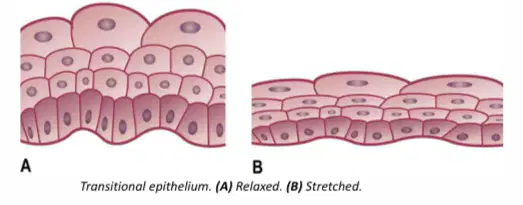
The distinguishing feature of Transitional Epithelium that allows it to stretch is the presence of several layers of:
Keratinised squamous cells.
Pear-shaped or dome-shaped cells on the surface.
Cuboidal cells with microvilli.
Ciliated columnar cells.
Transitional epithelium is found throughout the urinary tract (bladder and ureters). The stretching function is vital because it:
Creates a waterproof barrier that prevents desiccation.
Allows the tissue to act as an effective filter for blood.
Prevents the bladder from rupturing as it fills with urine.
Facilitates the active secretion of urine components.
Which epithelial subtype protects moist surfaces against friction but, due to the lack of keratin, still requires occasional lubrication to prevent drying?
Simple cuboidal epithelium.
Keratinised stratified squamous epithelium.
Transitional epithelium.
Non-keratinised stratified squamous epithelium.
Which characteristic is NOT distinguishes of Connective Tissue ?
It is entirely avascular (lacks blood vessels).
Cells are widely separated (unlike epithelial tissue)
Large amount of intercellular substance (matrix) present.
Matrix often contains fibres forming a supportive network.
Main functions of Connective tissue :
o Binding and structural support
o Protection
o Transport
o Insulation
TRUE
FALSE
(a) tissue: Most abundant and diverse tissue (e.g., bone, blood, fat).
Which specific connective tissue type is described as the most generalised and functions to binds tissues loosely around organs and blood vessels?
Loose (areolar) connective tissue.
Dense fibrous connective tissue.
Adipose tissue.
Lymphoid tissue.
Lymphoid tissue is primarily responsible for which function of connective tissue?
Defense against invaders.
Transport of oxygen.
Rigid structural support.
Insulation and cushioning.
The presence of a rich supply of mitochondria and capillaries in Brown Adipose Tissue enables its unique primary function, which is:
Physical cushioning for the eyeballs and kidneys.
Secreting hormones to signal fullness.
Generating heat (thermogenesis).
Rapidly storing fat for long-term survival.
A tissue sample taken from the capsule surrounding the eyeball (periorbital fat) would primarily be classified as White Adipose Tissue due to its role in:
Immune defense via stored white blood cells.
Facilitating gas exchange.
Physical cushioning and shock absorption.
Generating heat for the eye muscle.
A major homeostatic function of White Adipose Tissue is the secretion of leptin. This hormone functions to:
Bind the skin loosely to underlying muscle.
Actively transport fatty acids out of the cell.
Signal fullness to the brain, reducing hunger.
Increase the body's core temperature.
A tissue sample containing closely packed, parallel bundles of collagen fibers with a few interspersed fibroblasts is most likely:
Elastic tissue.
Fibrous dense connective tissue.
Loose (areolar) tissue.
Hyaline cartilage.
he primary difference in the matrix structure between Compact Bone and Spongy (Cancellous) Bone is that Compact Bone is:
Lined with simple squamous epithelium.
Softer and highly flexible.
Composed of protein only, lacking mineral salts.
Dense and solid.
The three types of cartilage (Hyaline, Fibrocartilage, Elastic Cartilage) are differentiated primarily by the type and amount of fibers within their matrix. Which type is best suited for shock absorption (e.g., intervertebral discs)?
Hyaline cartilage.
Fibrocartilage.
Elastic cartilage.
Dense fibrous tissue.
In Elastic Connective Tissue, the presence of many elastic fibers allows the tissue to be found in locations that require:
Rigid attachment and tension resistance.
Cushioning and smooth gliding surfaces.
Fluid circulation and filtering.
Extension and recoil.
Hyaline Cartilage is found at the ends of long bones in joints. Its primary function in this location is to provide a surface that is:
Smooth and compressible for easy, friction-free movement.
Tough and resistant to tearing.
A primary site of blood cell production.
Highly flexible for bending.
Which location is specifically mentioned as being composed of Elastic Cartilage?
The trachea (windpipe) rings.
The ends of long bones.
The pinna (external ear).
The intervertebral discs.
Which type of muscle tissue is characterized by striated (stripes), multinucleated cells, and voluntary control?
Smooth muscle.
Cardiac muscle.
Simple columnar epithelium.
Skeletal muscle.
The functional mechanism that allows Cardiac Muscle to contract as a coordinated sheet, rather than as individual fibers, is the presence of:
Long, cylindrical fibers.
Intercalated discs.
Pacemaker system cells.
A rich blood supply.
Which of the following describes the control mechanism for Smooth Muscle?
Involuntary (autonomic nervous system, hormones, metabolites).
Primarily voluntary with some subconscious actions.
Intrinsic pacemaker only.
Voluntary (conscious) control only.
The primary function of Smooth Muscle in the walls of the Gastrointestinal Tract (GIT) is to:
Generate heat through rapid shivering.
Maintain conscious posture and balance.
Propel contents (peristalsis) through the GIT.
Pump blood efficiently throughout the body.
Which muscle type is found only in the heart wall and is responsible for pumping blood?
Smooth muscle.
Cardiac muscle.
Fibrous connective tissue.
Skeletal muscle.
If a tissue is described as having non-striated spindle-shaped cells with one central nucleus per cell, it is characteristic of:
Simple columnar epithelium.
Smooth muscle.
Cardiac muscle.
Skeletal muscle.
Which muscle tissue type is unique in that its actions can be both voluntary (conscious) and subconscious (e.g., posture, breathing)?
Transitional epithelium.
Cardiac muscle.
Smooth muscle.
Skeletal muscle.
The primary specialized function of Neurones (Nerve cells) is to:
Generate heat for thermoregulation.
Provide rigid structural support for the brain and spinal cord.
Absorb nutrients and secrete hormones.
Initiate, receive, conduct, and transmit information.
The structural and functional support provided by Glial cells for neurones includes which key role?
Generating conscious, voluntary movement.
Carrying oxygen to the central nervous system.
Filtering blood in the brain to create cerebrospinal fluid.
Maintaining the internal environment and forming myelin sheaths.
Compared to neurons, Glial cells are generally much more numerous in the central nervous system. This high number is necessary because:
They must physically surround and provide support for every neuron.
They constantly shed and are replaced by new neurons.
Glial cells are the primary site of electrical signal generation.
They are the main cells that store energy reserves (glycogen and lipids).
Which connective tissue stores energy and provides insulation?
Areolar tissue
Adipose tissue
Cartilage
Bone
The anatomical position is important because it:
Helps blood circulation
Provides a standard reference for describing body structures
Looks natural for patients
Prevents injuries
The pelvic cavity contains organs from which system?
Nervous system
Respiratory system
Urinary and reproductive systems
Immune system
Fibrocartilage is found in intervertebral discs because it:
Produces blood
Stores energy
Acts as a shock absorber
Helps nerve signals

