wayground logo

Free Printable Worksheets

Font size

S
M
L
XL
Worksheets

Cell Cycle & DNA Replication Test Review

Total questions: 75

Worksheet time: 3hrs 30mins
Name
Class
Date
1.
Which of the following phrases best describes cancer?
a)
absence of cyclins in the DNA
b)
multiple gene mutations on a chromosome of DNA
c)
uncontrolled cell growth caused by mutations in genes that control the cell cycle
d)
presence of genetic defects caused by hereditary disorders
2.
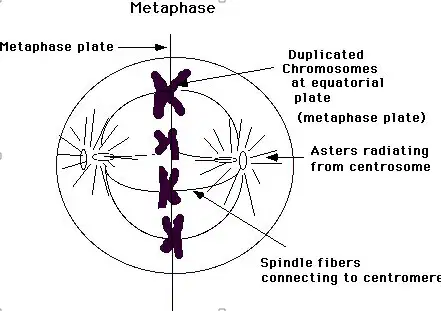
Which of the following phases of mitosis is represented by the diagram below?
a)
prophase
b)
metaphase
c)
anaphase
d)
telophase
3.
At what point in the cell cycle does DNA replication occur and why?
a)
before a cell divides, to provide each of the two resulting cells with a complete set of DNA instructions
b)
before a cell divides, to ensure that the DNA will fit into the resulting cells
c)
during cell division, to ensure that the DNA will fit into the resulting cells
d)
after a cell divides, to provide each of the two resulting cells with a complete set of DNA instructions
4.

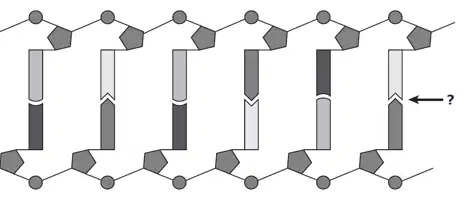
Four different segments of a DNA molecule are represented below.

Which segment(s) show an error in replication?

a)
segment 1 only
b)
segment 3 only
c)
segment 2 and 3
d)
segment 2 and 4
5.
Which choice describes DNA after replication has taken place?
a)
one molecule with two original strands and one molecule with two new strands
b)
two molecules, each with one original and one new strand
c)
two molecules, each with two new strands
d)
two molecules, each with two old strands
6.

The traits of an organism is determined by the
a)
sequence of nitrogenous bases in deoxyribonucleic acid
b)
number of amino acids in a cell
c)
position of the ribosomes on the endoplasmic reticulum
d)
number of nitrogenous bases in a codon
7.
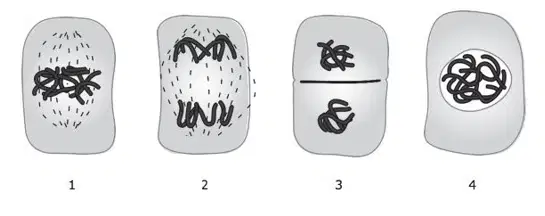
The diagram shows cells in different phases of mitosis. A student is trying to find a cell in a particular phase of mitosis. The student is looking for evidence that spindle fibers are separating the chromosomes to ensure that each new nucleus has one copy of each chromosome.
a)
Cell 1
b)
Cell 2
c)
Cell 3
d)
Cell 4
8.

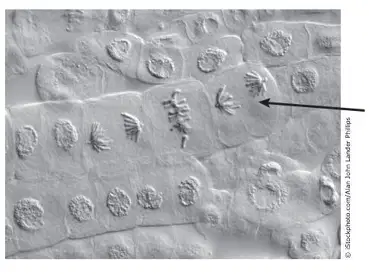
A photomicrograph of onion root tip cells during mitosis is shown below. Which phase of mitosis is occurring in the cell indicated by the arrow?
a)
Prophase
b)
Metaphase
c)
Anaphase
d)
Telophase
9.
Recent studies in bone research indicate that using ultrasound on a broken bone can decrease the healing time by 25%. Which of the following processes will repair the damaged cells?
a)
Mitosis
b)
Passive and active transport
c)
Meiosis
d)
Interphase
10.
Characteristics such as a widow's peak or attached earlobes are determined by the genetic code. Which components of DNA are referred to as the genetic code?
a)
Phosphate groups
b)
Nitrogenous bases
c)
Deoxyribose sugars
d)
Hydrogen bonds
11.
Oncogenes are mutated forms of genes. Oncogenes can transform a cell into a tumor cell. Some tumor cells are benign, while others are malignant. How does the presence of an oncogene lead to the formation of a tumor?
a)
ATP production in the mitochondria is halted
b)
Cell division is unregulated
c)
Cell growth is inhibited
d)
Passive or active transport is unregulated
12.
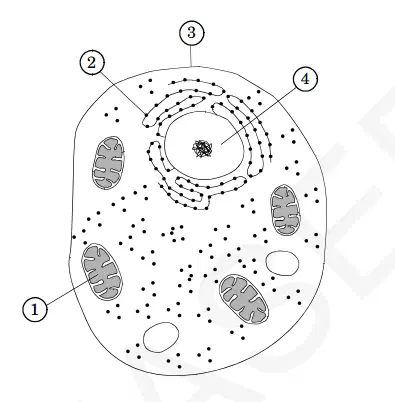
In which organelle does DNA replication take place?
a)
1
b)
2
c)
3
d)
4
e)
5
13.
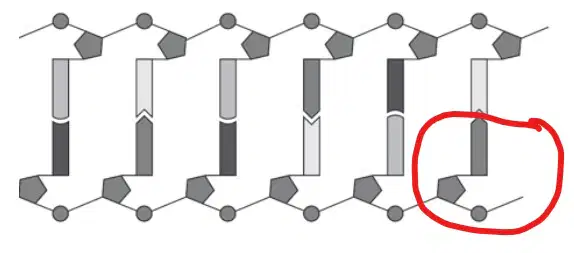
Which of the following choices describes the circled structure in the DNA molecule below?
a)
sugar-phosphate backbone
b)
nucleotide
c)
double helix
d)
nitrogen bases held together by covalent bonds
14.
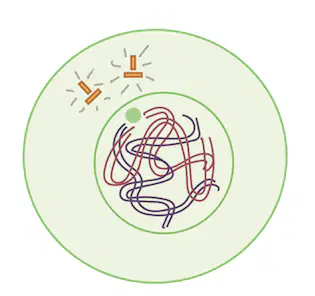
This cell is in which phase of mitosis?
a)
prophase
b)
Late prophase (prometaphase)
c)
Metaphase
d)
Anaphase
e)
Telophase
15.
The cell is in which phase of mitosis?
a)
G1
b)
Prophase
c)
G2
d)
Anaphase
e)
Telophase
16.
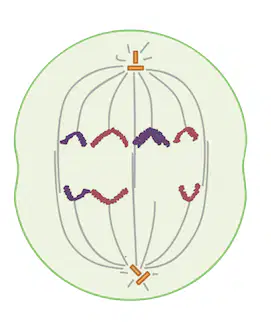
What has gone wrong during this phase of mitosis?
a)
During metaphase, one of the chromosomes failed to bind microtubules from both spindle poles.
b)
During prophase, one of the chromosomes failed to condense.
c)
The cell made too many copies of its chromosomes.
d)
The cell is actually undergoing meiosis.
17.
What will be the result if this mistake is not corrected during mitosis?
a)
The resulting daughter cells will not be identical
b)
The resulting daughter cells will function normally
c)
The cell will repeat the cell cycle to correct its mistake
d)
The cell G1/S checkpoint will redirect the mitosis
18.
There are several enzymes involved in DNA replication. Which of the following correctly pairs the DNA replication enzyme with its function?
a)
Topoisomerases work ahead of the replication fork to prevent supercoiling.
b)
DNA polymerase I opens up the DNA at the replication fork.
c)
Helicase seals gaps between DNA fragments.
d)
DNA ligase extends the backbone by adding nucleotides to the 3' end
19.
A template strand of DNA is 3' TAGGCATTGCA 5'. What is the complementary DNA strand that is created from this template during replication?
a)
5' TGCAATGCCTA 3'
b)
5' ATCCGTAACGT 3'
c)
5' AUCCGUAACGU 3'
d)
5' TAGGCATTGCA 3'
20.
In DNA replication, DNA "unwinds" to form two template strands: the leading strand and the lagging strand. Which of the following statements about these strands is true?
a)
Okazaki fragments are used to synthesize the leading strand of DNA.
b)
The leading strand of DNA is synthesized continuously.
c)
DNA polymerase can only synthesize DNA on the leading strand.
d)
The lagging strand can only be synthesized once the leading strand has been completed.
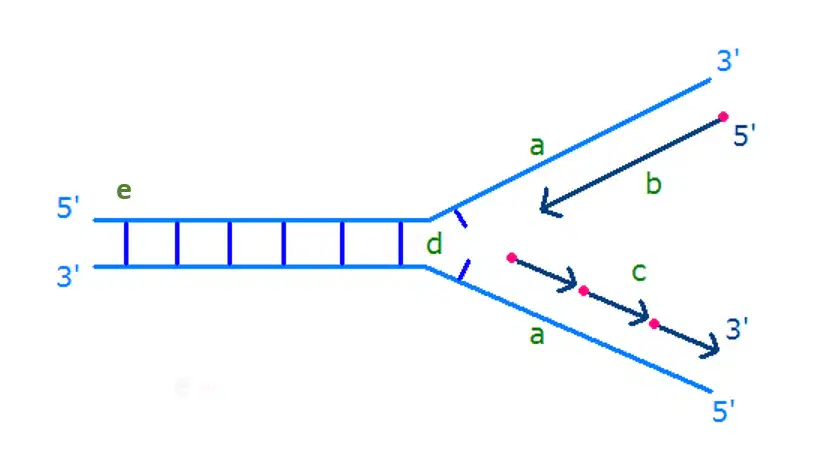
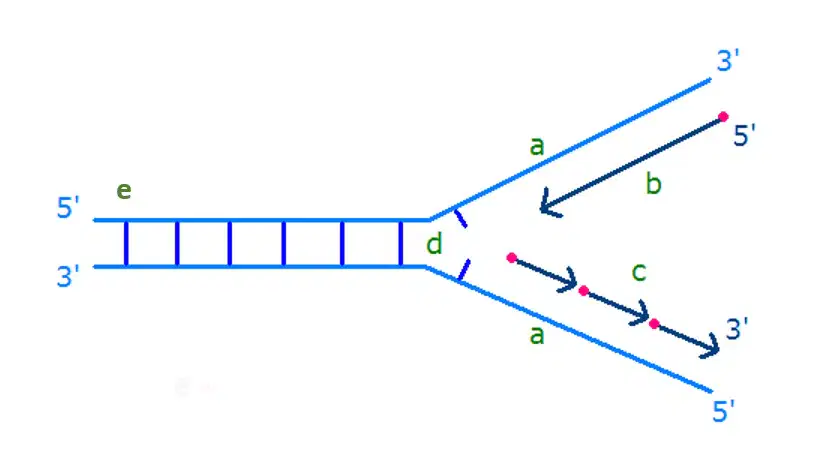
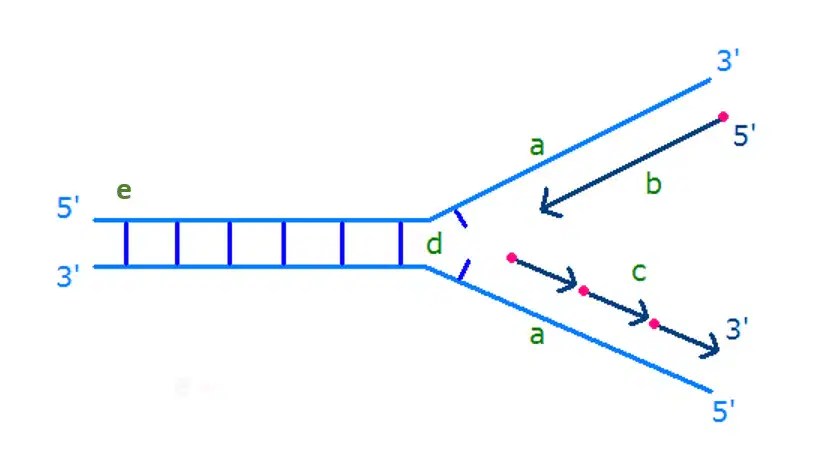
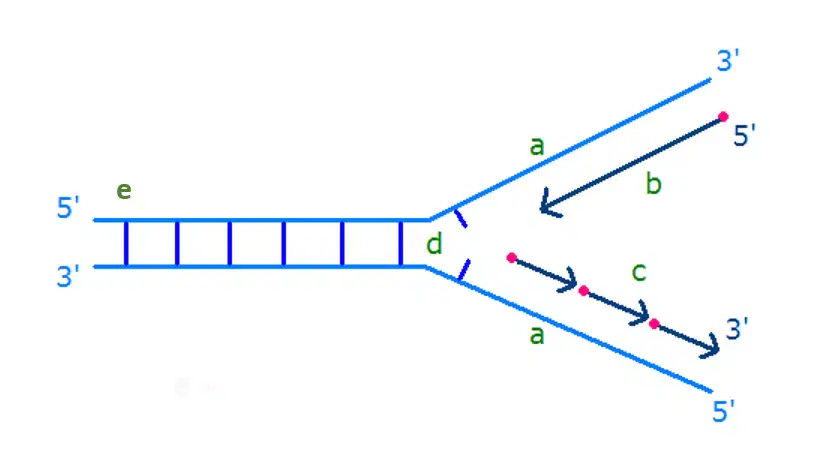
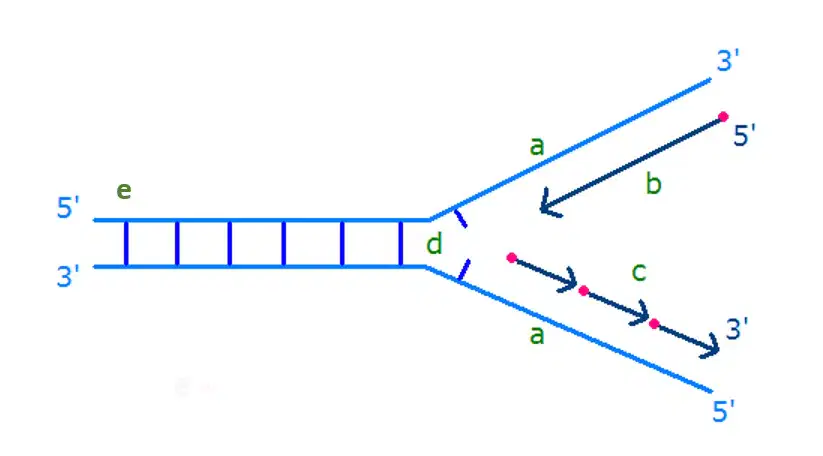
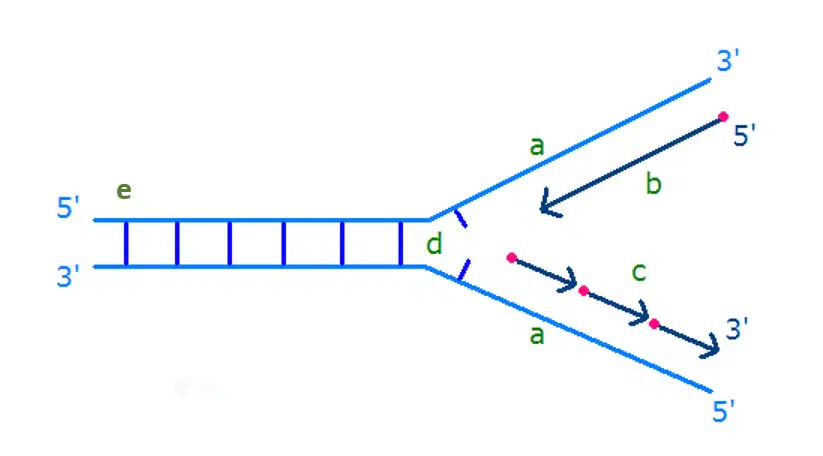
21.
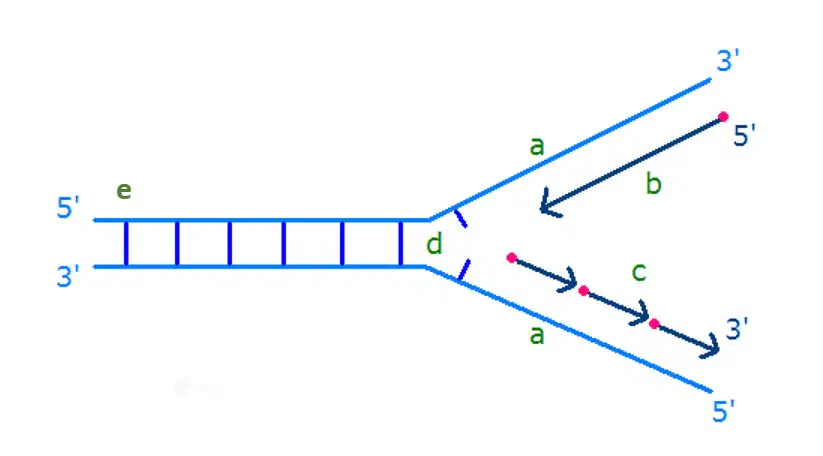
Which of the letters below represents the enzyme DNA helicase?
a)
a
b)
b
c)
c
d)
d
e)
e
22.
Which of the letters below represents the parent (template) strand?
a)
a
b)
b
c)
c
d)
d
e)
e
23.
Which of the letters below represents the leading strand?
a)
a
b)
b
c)
c
d)
d
e)
e
24.
Which of the letters below represents the lagging strand?
a)
a
b)
b
c)
c
d)
d
e)
e
25.
Which of the letters below represents Okazaki fragments?
a)
a
b)
b
c)
c
d)
d
e)
e
26.
Which of the letters below represents the location where the enzyme topoisomerase would have already worked?
a)
a
b)
b
c)
c
d)
d
e)
e
27.
Which of the letters below represents the replication fork?
a)
a
b)
b
c)
c
d)
d
e)
e
28.
Which of the following best describes a DNA molecule?
a)
double helix
b)
contains ribose
c)
made of amino acids
d)
contains Uracil
29.

A model of a DNA molecule is shown below. The arrow indicates
a)
the bond between adjacent phosphate and deoxyribose molecules
b)
the junction of introns and exons in the sense strand of DNA
c)
the hydrogen bond between complementary nucleotides
d)
the junction of a codon and a DNA triplet
30.
Name this structure
a)
double helix
b)
nucelotide
c)
twisted ladder
d)
hydrogen bond
31.

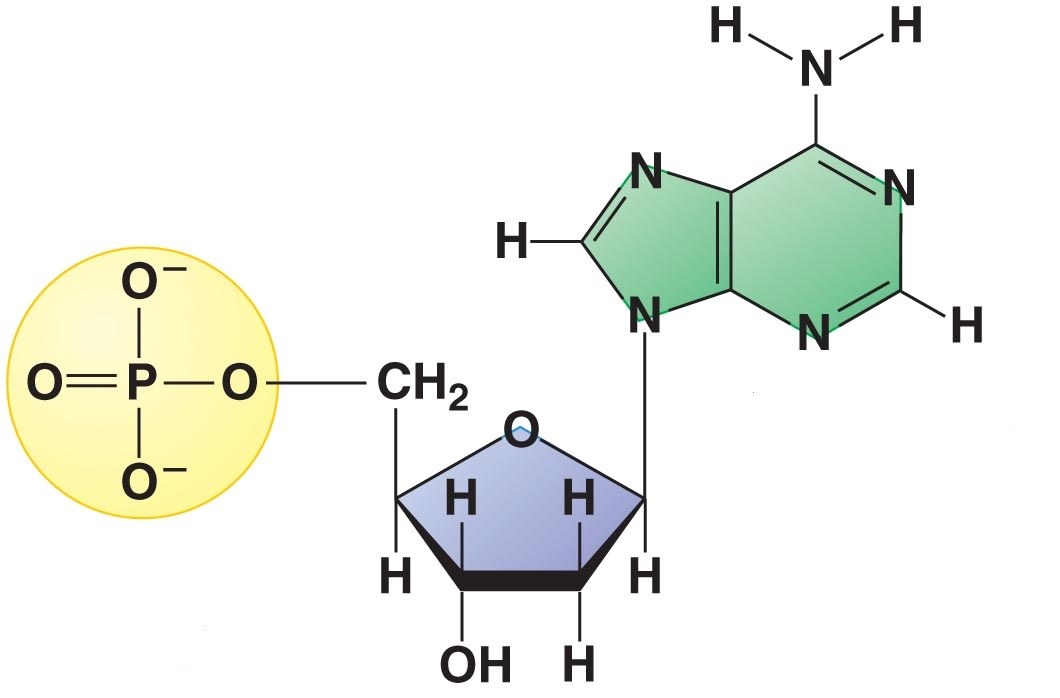
A Nucleotide is shown above. What part of the Nucleotide is labelled "3"?

a)

Sugar

b)

Phosphate

c)

Nitrogenous Base

32.

The backbone (the outer part of the DNA double helix, on both sides) is made of _______________ .

a)

sugar and phosphate

b)

base pairs

c)

mRNA

d)

all of these answers are correct

33.

A model of a DNA molecule is shown below. The arrow indicates

a)
the bond between adjacent phosphate and deoxyribose molecules
b)
the junction of introns and exons in the sense strand of DNA
c)
the hydrogen bond between complementary nucleotides
d)
the junction of a codon and a DNA triplet
34.

Use the image to answer the question

a)

F

b)

G

c)

H

d)

J

35.

Students are given data from an investigation that identified some of the chemical elements present in four different samples.

Which sample was most likely DNA?

a)

Sample 1

b)

Sample 2

c)

Sample 3

d)

Sample 4

36.
Study the image part labeled 1, what holds the two opposite bases together?
a)
a sugar
b)
a nucleotide
c)
hydrogen bonds
d)
a phosphate
37.

The image below shows a DNA double helix that is about to undergo replication to produce two new DNA molecules. Which image best represents the two new DNA molecules? (Note: The original strands are shown as thick lines, and the newly made DNA strands are shown as thin lines.)

a)

Option A

b)

Option B

c)

Option C

d)

Option D

38.

After DNA replication, the 2 DNA molecules are EACH made of

a)

1 original and 1 new strand

b)

2 original strands

c)

2 new strands

39.

Fill in the blanks: In DNA replication, _____ fragments are joined by ____.

a)

Okazaki, DNA polymerase

b)

DNA, Helicase

c)

Okazaki, DNA ligase

d)

RNA, Primase

40.
What is meant by the description "antiparallel" regarding the strands that make up DNA?
a)
The twisting nature of DNA creates nonparallel strands.
b)
One strand is positively charged and the other is negatively charged.
c)
The 5' to 3' direction of one strand runs counter to the 5' to 3' direction of the other strand.
d)
Base pairings create unequal spacing between the two DNA strands
41.
The method of DNA replication is known as:
a)
Semi-conservative
b)
Conservative
c)
Dispersive
d)
Complementary
42.

Leading strand vs. Lagging strand

a)
Leading strand is synthesized continuously, lagging strand is synthesized discontinuously
b)
Leading strand is the template strand, lagging strand is the coding strand
c)
Leading strand is synthesized in the 3' to 5' direction, lagging strand is synthesized in the 5' to 3' direction
d)
Leading strand is synthesized discontinuously, lagging strand is synthesized continuously
43.
The stages of mitosis in order
a)
Metaphase, Anaphase, Prophase, Telophase
b)
Prophase, Anaphase, Metaphase, Telophase
c)
Prophase, Metaphase, Anaphase, Telophase
d)
Anaphase, Prophase, Telophase, Metaphase
44.
Cell division is represented by what letter?
a)
A
b)
B
c)
C
d)
D
45.
Identify the Cell Cycle Stage.
a)
Interphase
b)
Anaphase
c)
Telophase
d)
Prophase
46.

What are the "strings" called that are attached to the chromosomes?

a)

Centrioles

b)

Chromatin

c)

Spindle Fibers

47.

5.A

This model of the cell cycle includes two arrows that each represent a process in the cycle. What stages of the cell cycle are represented by each arrow?

a)

Arrow 1: interphase

Arrow 2: mitosis

b)

Arrow 1: meiosis

Arrow 2: prophase

c)

Arrow 1: prophase

Arrow 2: interphase

d)

Arrow 1: mitosis

Arrow 2: meiosis

48.
Identify the Cell Cycle Stage.
a)
Anaphase
b)
Cytonkinesis
c)
Interphase
d)
Prophase
49.

The diagram shows the major stages of the cell cycle and the percentage of time spent in each phase. Which statement best describes why a cell spends the majority of its time in interphase?

a)

The cell is growing and carrying out processes such as metabolism and DNA replication.

b)

The cell is aging and processes are stopping as lysosomes clear dead cell matter away.

c)

The cell needs time to synthesize spindle fibers to complete mitosis.

d)

The cell needs time to complete cytokinesis.

50.

Which of the following best explains what cancer is and how it is related to the cell cycle?

a)

Cells that have been stopped at G0 and are no longer dividing

b)

Unregulated cell division, where cells grow and divide much quicker than they normally would

c)

Mutated cells that do not grow or divide as efficiently as they normally would

d)

None of the above

51.

Mitosis results in ______.

a)

two identical daughter cells

b)

one identical daughter cell

c)

four diverse daughter cells

d)

multiple diverse daughter cells

52.

These abnormal cells are of a tumor. The tumor is a result of

a)

the cell being in G0

b)

the cell making too much DNA

c)

uncontrolled cell division

d)

all the answers are correct

53.

Refer to the diagram below. During the cell cycle, normal cells enter G0 to rest, which results in the cell cycle being a slower, more regulated process. Cancer cells do not enter G0.As a result, these cells will most likely —

a)

mutate during G2 phase

b)

continuously repeat the cell cycle

c)

die after DNA replication

d)

fail to complete mitosis

54.
Have you ever heard of a skin graft? Skin cells can be harvested from one area and be grown in order to help burn victims or other skin injuries. Which process would result in the development of more skin cells in this treatment? 
a)
Mitosis
b)
Meiosis
c)
Crossing Over
d)
Interphase
55.

This part of the cell cycle is best described as the process that —

a)

duplicates the DNA

b)

completes cell division

c)

maintains genetic homeostasis

d)

synthesizes new molecules

56.

G1, S, G2 are all part of what stage of the cell cycle?

a)

Cytokinesis

b)

Interphase

c)

Mitosis

d)

Telophase

57.

Which of the following is not a phase in mitosis?

a)

S phase

b)

Prophase

c)

Metaphase

d)

Anaphase

58.

Which of the following represents an incorrect description?

a)

Anaphase: movement of chromosome to opposite poles of cell

b)

Metaphase: the nuclear envelope disappears

c)

Prophase: chromosomes become more tightly coiled

d)

Metaphase: chromosomes line up on the equatorial plane of the cell

59.

Which of the following is an accurate definition of cytokinesis?

a)

Division of the centrioles

b)

Division of the cytoplasm

c)

DNA replication

d)

Normal cell growth

60.

Mason was observing a small cut on his hand heal over time. Anika explained that this was due to a certain process. What is the purpose of this process, also known as mitosis?

a)

To increase the surface area of Mason's cell

b)

To allow Mason's cells to divide for growth, repair, and renewal of the cut

c)

For increasing genetic variation within Mason

d)

To allow for DNA replication and protein synthesis in Mason's cells

61.

Daniel, Harper, and Noah are studying biology together. They are trying to remember the correct order of the stages of the cell cycle. They came up with the following order: G2, S, G1, M.  Can you help them put these stages in the correct order?

a)

G1, S, G2, M

b)

S, G1, G2, M

c)

G1, M, G2, S

d)

M, G1, S, G2

62.

In a biology class, Ava and Mia were studying about the cell cycle. They learned that during the "s" phase of the cell cycle, DNA is duplicated. Rohan, their classmate, asked why this is important. What could be the correct explanation?

a)

It allows for each daughter cell to be genetically DIFFERENT.

b)

It allows for each daughter cell to be genetically IDENTICAL.

c)

It allows for each daughter cell to have 2X the amount of DNA as the parent cell.

d)

It allows for each daughter cell to have half the amount of DNA as the parent cell.

63.

During a biology class, Benjamin was asked to explain what happens in the prophase of mitosis. What should his answer be?

a)

The chromosomes become visible; nucleus disappear; spindles form

b)

The chromosomes align in the middle of the cell

c)

The sister chromatids separate

d)

The chromosomes uncoil into chromatin; nucleus reappears; spindles disappear

64.
Identify #2.
a)
nitrogen base
b)
phosphate group
c)
deoxyribose sugar
d)
nucleotide
65.
order of replication
a)
3, 2, 1, 4
b)
2, 1, 4, 3
c)
2, 3, 1, 4
d)
3, 4, 1, 2
66.

DNA polymerase is able to build the new DNA ______ along the leading strand.

a)

continuously

b)

only in short fragments

c)

very slowly

d)

prokaryotically

67.

Okazaki fragments are found on the _______________ strand

a)

Leading

b)

Lagging

68.

Fill in the blank: 'Check points' are pausing points where the cell ensures ________.

a)

it is healthy and ready for the next step

b)

it is dividing

c)

it is dying

d)

it is growing

69.

Label the parts of the Cell Cycle

70.

Match the DNA Replication enzyme to its function

a)

Unwinds the DNA

1.

Topoisomerase

b)

Unzips strands by breaking through hydrogen bonds

2.

Helicase

c)

Joins Okazaki fragments

3.

DNA Ligase

d)

Proofreads newly synthesized DNA

4.

DNA Polymerase I

e)

Builds new strands by complimentary base pairing

5.

DNA Polymerase III

71.

Match the description with its stage of the cell cycle

a)

Cell grows & completes its function

1.

G1

b)

"Resting" phase

2.

G0

c)

DNA is replicated

3.

S

d)

Cell prepares for division

4.

G2

e)

Cell divides into two daughter cells

5.

M

72.

Which section of the cell cycle could be labeled as interphase?

73.

Which model accurately shows a cell progressing through mitosis?

74.

Label the Cell Cycle

75.

Match the description to its phase in mitosis

a)

Chromosomes line up in the middle of the cell

1.

Metaphase

b)

Chromosomes are pulled apart

2.

Anaphase

c)

Cytoplasm is split

3.

Cytokinesis

d)

Chromosomes condense and become visible

4.

Prophase

e)

Two new nuclei form at opposite ends of the cell

5.

Telophase