
 Worksheets
I/O devices
Total questions: 45
Worksheet time: 23mins
Fill in the blank: An Input/Output (I/O) device is any hardware component that allows data to enter or leave the _________
central processing unit (CPU)
keyboard
printer
monitor
Which of the following statements is true about I/O devices?
I/O devices only send data to the CPU.
I/O devices only receive data from the CPU.
I/O devices can either send data to or receive data from the CPU.
I/O devices are not part of the I/O system if used for communication.
Which of the following is an example of a standard input device?
Scanner
Keyboard
Camera
Printer
Which device is used to capture visual information?
Keyboard
Camera
Microphone
Joystick
A scanner is an example of an imaging device.
True
False
Which of the following is an example of a display device?
Printer
Monitor
Speaker
Motor
What is the purpose of actuators/control outputs?
Show text, graphics, or indicators
Perform physical actions
Produce hard copy output
Generate sound output
Fill in the blank: I/O interfacing is all about connecting external devices to the ________ so they can communicate effectively.
microprocessor
printer
keyboard
monitor
What does PPI stand for in the context of I/O interfacing?
Programmable Peripheral Interface
Primary Processor Interface
Peripheral Processing Input
Programmed Processor Input
Fill in the blank: The CPU operates at high clock speeds, while peripherals operate at ______ speeds.
slow
fast
equal
variable
Which of the following is NOT a reason why direct connections between the CPU, memory, and peripherals are impractical?
A) Speed differences
B) Data format differences
C) Color differences
D) Signalling differences
Fill in the blank: The CPU uses specific electrical signaling (e.g., voltage levels, timing), while peripherals have unique ______ requirements.
signaling
storage
display
processing
I/O can happen in three ways. Which of the following is NOT one of them?
Polled I/O
Interrupt-driven I/O
Direct Memory Access (DMA)
Serial Communication
Fill in the blank: In ________, the CPU constantly checks if a device is ready, which is simple but wasteful.
Polled I/O
Interrupt-driven I/O
Direct Memory Access (DMA)
Buffered I/O
Which I/O method allows devices to bypass the CPU for large transfers?
Polled I/O
Interrupt-driven I/O
DMA
Serial Communication
PPI fits mainly into ________ and ________ scenarios.
polled, interrupt-driven
serial, parallel
analog, digital
synchronous, asynchronous
What does 'programmable' mean in the context of PPI?
It means PPI lets software configure the interface on the fly.
It means PPI can only be used with hardware switches.
It means PPI is not compatible with any software.
It means PPI is permanently fixed and cannot be changed.
The 40 pins of the 8255 PPI are arranged in a dual in-line package (DIP), with pins numbered 1 to __ on the left and __ to __ on the right.
1 to 20 on the left and 21 to 40 on the right
1 to 10 on the left and 11 to 40 on the right
1 to 40 on the left and 41 to 80 on the right
1 to 15 on the left and 16 to 40 on the right
Which port is selected when CS' = 0, A1 = 0, and A0 = 0 according to the address pin selection table?
PORT A
PORT B
PORT C
Control Register
Which port is selected when CS' = 0, A1 = 0, and A0 = 1 according to the address pin selection table?
PORT A
PORT B
PORT C
Control Register

Which register is selected when CS' = 0, A1 = 1, and A0 = 1 according to the address pin selection table?
PORT A
PORT B
PORT C
Control Register
How many bits are used to select the port in the 8255 chip according to the description?
2 bits
1 bit
3 bits
4 bits
Which pin on the 8255 chip is used for the +5V power supply?
Pin 7
Pin 26
Pin 35
Pin 6
True or False: The CS (Pin 6) on the 8255 chip activates the chip when high, enabling communication.
True
False
Which pin on the 8255 chip is used as the ground reference?
Pin 7
Pin 26
Pin 35
Pin 5
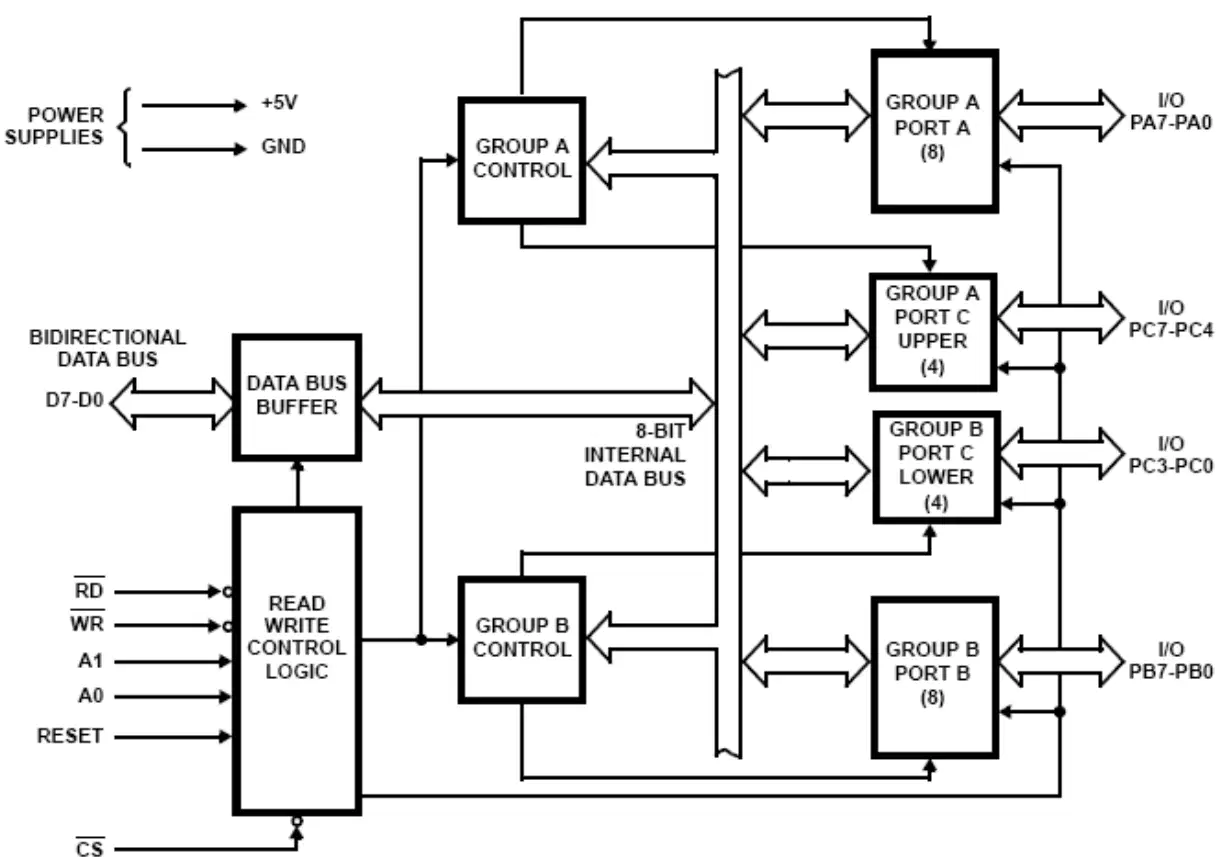
Refer to the block diagram of 8255. How many bits are there in GROUP A PORT A?
4
8
16
2
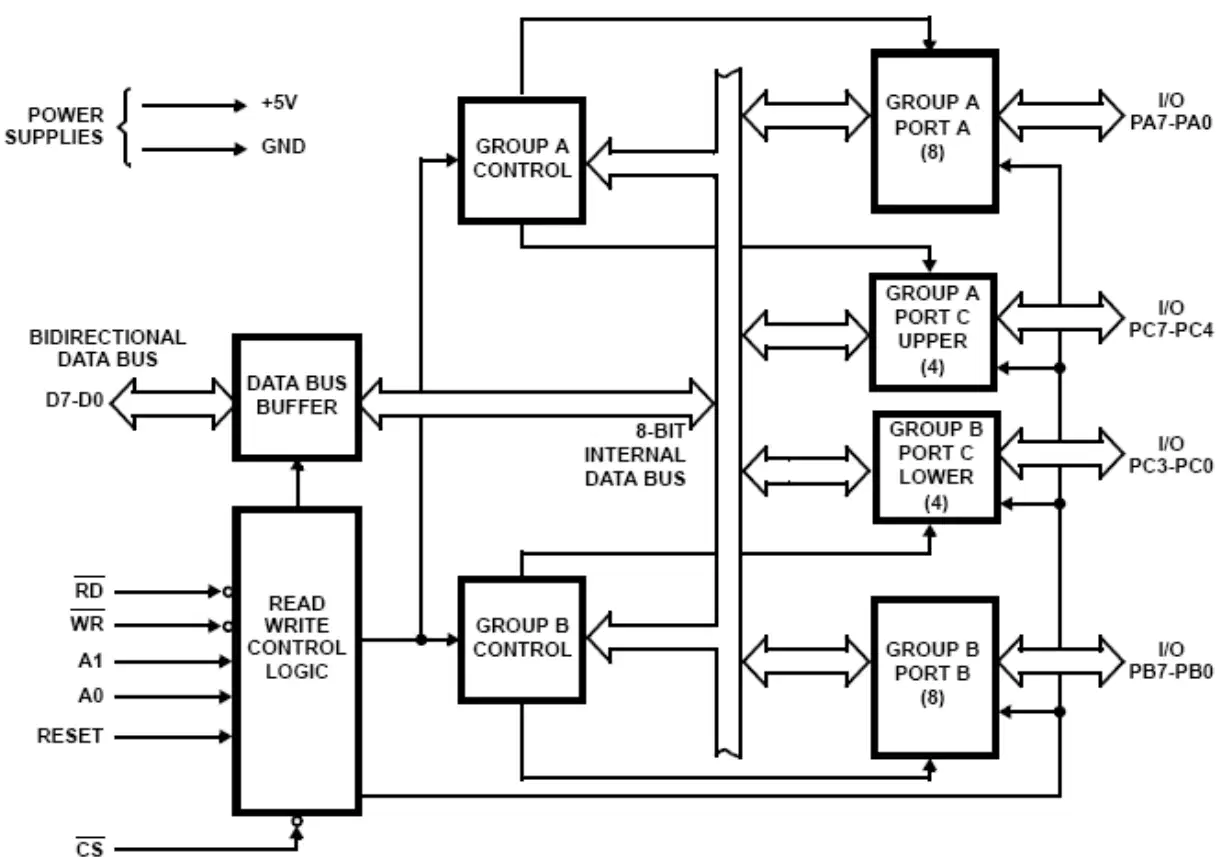
Refer to the block diagram of 8255. The 8-bit internal data bus connects which components in the diagram?
The 8-bit internal data bus connects the DATA BUS BUFFER, GROUP A CONTROL, GROUP B CONTROL, and the ports (GROUP A PORT A, GROUP A PORT C UPPER, GROUP B PORT C LOWER, GROUP B PORT B).
The 8-bit internal data bus connects only the DATA BUS BUFFER and GROUP A CONTROL.
The 8-bit internal data bus connects only the ports (GROUP A PORT A, GROUP A PORT C UPPER, GROUP B PORT C LOWER, GROUP B PORT B).
The 8-bit internal data bus connects only the GROUP B CONTROL and GROUP A PORT C UPPER.
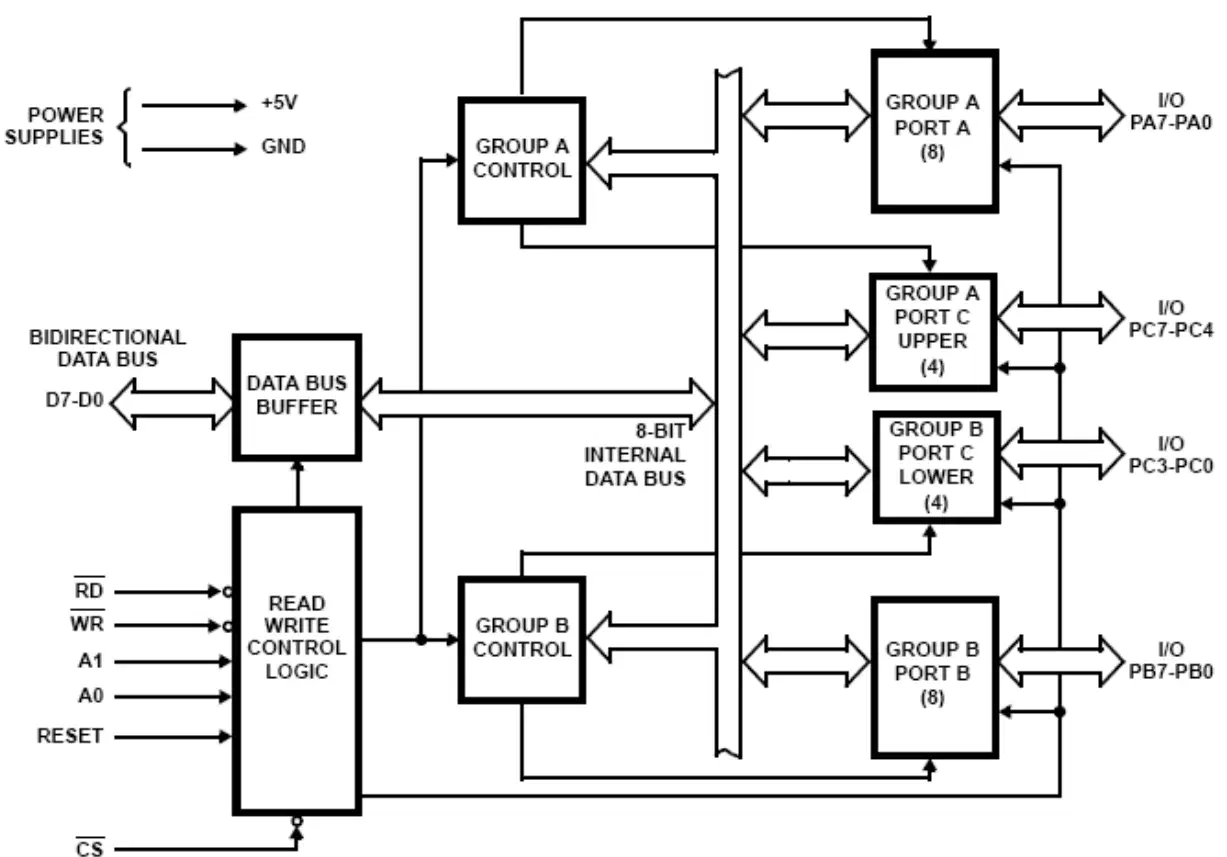
Refer to the block diagram of 8255. The power supplies for the 8255 are ______ and ______.
+5V and GND
+12V and GND
+3.3V and GND
+5V and +12V
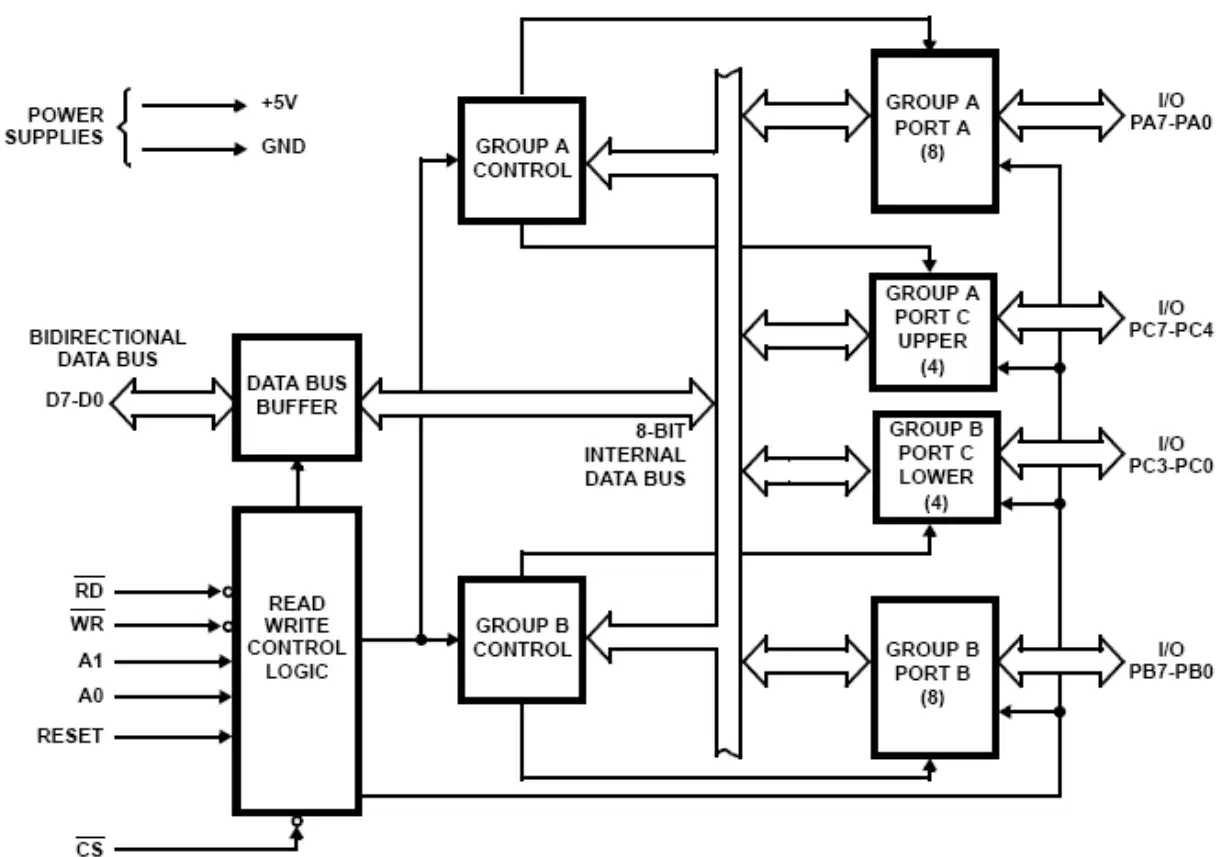
Refer to the block diagram of 8255. Which port is associated with the I/O lines PA7-PA0?
A) GROUP A PORT A
B) GROUP B PORT B
C) GROUP A PORT C UPPER
D) GROUP B PORT C LOWER
The two major modes of operation of the 8255 are ______ and ______.
I/O Mode and BSR Mode (Bit Set/Reset Mode)
Input Mode and Output Mode
Read Mode and Write Mode
Serial Mode and Parallel Mode
Which of the following is NOT a mode of operation of the 8255?
I/O Mode
BSR Mode (Bit Set/Reset Mode)
DMA Mode
Both A and B
How many sub-modes does the Input/Output Mode of the 8255A have?
One
Two
Three
Four
Mode 0 of the 8255A Input/Output Mode is described as _________
Simple I/O (unidirectional, no handshake)
Bidirectional I/O with handshake
Strobed I/O with interrupt
Memory-mapped I/O
Which mode of the 8255A Input/Output Mode is used for a bidirectional bus (for Port A only)?
Mode 0
Mode 1
Mode 2
Mode 3
Port B of the 8255A is typically connected to which peripheral in Mode 1 input?
Printer
Keyboard
Status and control lines
Monitor
Port A of the 8255A is used for ________ in Mode 1 output.
Printer
Keyboard
ADC Interface
Stepper Motor
Port C of the 8255A is used for ________.
Status and control lines
Data storage
Arithmetic operations
Memory addressing
What is the primary purpose of the BSR Mode (Bit Set/Reset Mode) in the 8255A?
Data transfer
Setting or resetting individual bits of Port C
Configuring Ports A and B
Controlling analog signals
Which port's individual bits can be set or reset using the BSR Mode in the 8255A?
Port C
Port A
Port B
Port D
The BSR Mode in the 8255A is used for data transfer.
True
False
Fill in the blank: The BSR Mode in the 8255A controls one bit at a time, specifically from ____ to ____.
PC0 to PC7
PA0 to PA7
PB0 to PB7
PD0 to PD7
Why is the 8255 PPI not used in contemporary PCs?
Due to the shift to integrated, serial, and more efficient I/O technologies.
Because it is too expensive to manufacture.
Because it is incompatible with all modern operating systems.
Because it consumes excessive power compared to modern chips.
8255 PPI was designed for which era of microprocessors?
1990s/2000s
1970s/80s
2010s/2020s
1960s/70s
Modern processors like Intel Core i7 and AMD Ryzen integrate I/O controllers on the CPU chip or motherboard chipset.
True
False
What is the main reason parallel PPI chips like the 8255 are considered obsolete for general use today?
The shift to serial interfaces like USB, SATA, and PCIe, which offer faster data rates and smaller pin counts.
They are more expensive to manufacture than modern microcontrollers.
They are incompatible with modern operating systems.
They consume significantly more power than serial devices.

