
 Worksheets
Unit 2 Review (Colonization and Settlement)
Total questions: 83
Worksheet time: 1hrs 8mins
Which of the following best describes the purpose of the Navigation Acts mentioned in relation to Culpeper’s Rebellion?
They were designed to benefit England by controlling colonial trade.
They were created to promote religious freedom in the colonies.
They were intended to encourage colonists to settle new lands.
They were laws to protect Native American rights.
According to the Navigation Acts, how were colonists required to ship products like tobacco and whale oil?
Directly to England using English ships
To any country using any ships
Only within the American colonies
To France using French ships
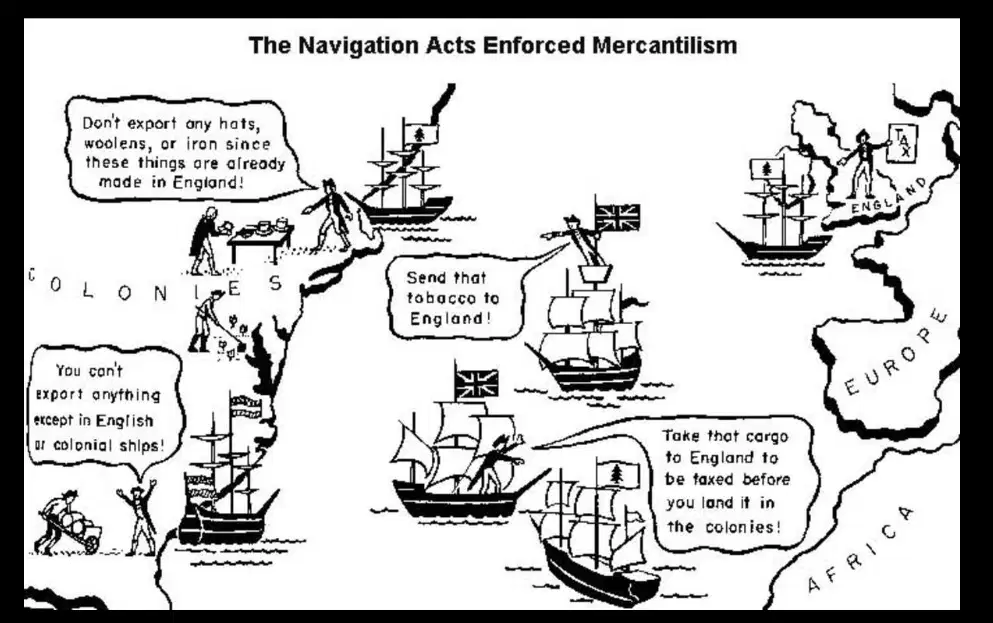
Based on the image, what restriction did the Navigation Acts place on colonial exports?
Colonists could only export goods using English or colonial ships
Colonists could export goods using any country's ships
Colonists could only export goods to Africa
Colonists could only export goods by land
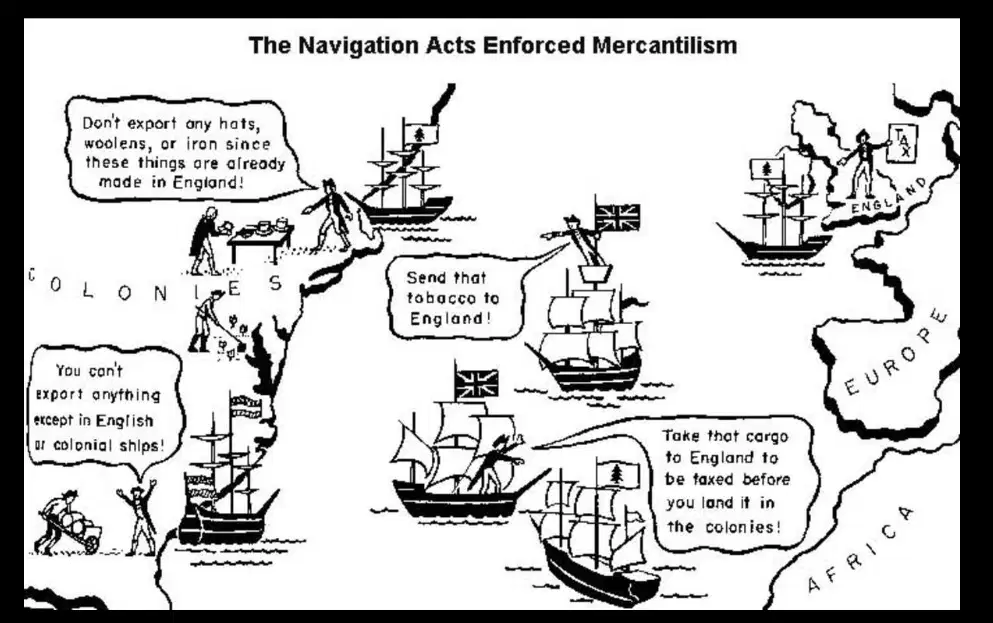
Why did the Navigation Acts require colonial goods to be sent to England before being taxed and sent elsewhere, as shown in the image?
To ensure England collected taxes and controlled trade profits
To make trade faster and more efficient
To allow colonies to avoid paying taxes
To encourage colonies to trade directly with other countries
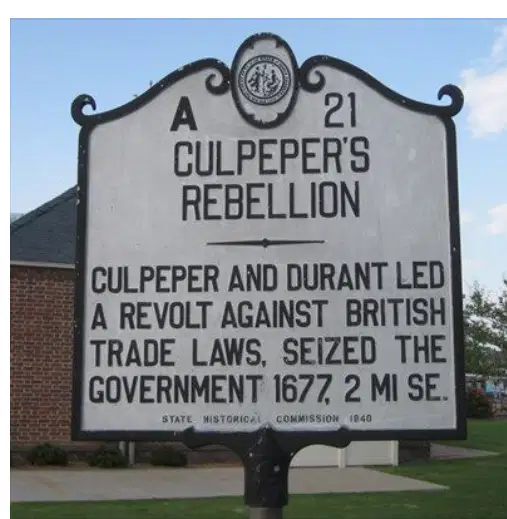
Based on the information, what strategic reason did the proprietors have for not punishing the rebels?
They realized enforcing control from a distance was difficult
They wanted to reward the rebels for their bravery
They hoped to gain support from the rebels for future wars
They were ordered by the King to forgive the rebels
During which time period did piracy flourish in the Caribbean and along the American coasts?
From the mid-1600s to the early 1700s
From the early 1800s to the late 1900s
From the mid-1500s to the early 1600s
From the late 1700s to the mid-1800s
Explain why the oceans between Europe and the Americas were attractive to pirates during the mid-1600s to early 1700s.
Because the ships carried valuable goods like gold, sugar, and lumber
Because the weather was always calm
Because there were no other ships in the area
Because pirates wanted to explore new lands
How did many North Carolinians profit from pirate activity?
By capturing pirates and turning them in for rewards
By buying and selling pirates' stolen goods
By working as sailors for the pirates
By building ships for the pirates
Who was the most famous of the Atlantic pirates?
Edward Teach
Henry Morgan
William Kidd
Bartholomew Roberts
Where did Blackbeard station his ships at a remote outpost?
Ocracoke Island
Jamaica
Port Royal
Nassau
Who was responsible for killing Blackbeard?
Lieutenant Robert Maynard
Captain Kidd
Henry Morgan
Edward Low
What did the Tuscarora Indians do first when faced with English encroachment?
They tried to leave and asked the Quakers in Pennsylvania if they could relocate there
They immediately went to war
They built a wall to keep the English out
They moved to another country
Why did the Tuscarora Indians decide to prepare for war against the colonists?
Because their attempts to peacefully relocate were refused and they wanted to protect their land
Because they wanted to expand their territory
Because they were invited by the Quakers to fight
Because they wanted to trade with the colonists
Why were authorities unable to do much to stop the Tuscarora during the war?
The authorities were out of town.
The authorities did not care about the settlers.
Political conflicts between colonists and government limited their actions.
The authorities were helping the Tuscarora.
Who did the colonists appeal to for help during the Tuscarora War?
The British government
Other colonists
The French army
The Spanish settlers
Which Native American groups did leaders in Charles Town recruit to fight the Tuscarora?
Cherokee and Creek
Yamasee and Catawba
Mohawk and Iroquois
Seminole and Choctaw
What happened to the Tuscarora during the Tuscarora War?
They slowly lost ground
They gained new territory
They formed an alliance with the British
They moved south to Florida
Label the colonial regions.
New England
Middle
Southern
Correctly label the South Colonies.
Georgia
Virginia
Maryland
North Carolina
South Carolina
Select the colony that best fits this description:
1. Settled in 1620
2. Established for religious freedom
3. Economy depended on shipbuilding
Which area would you find slave labor, cash crops such as cotton and plantations?
Label the triangular trade using the answer choice below.
Slave Labor
Raw Materials
Manufactured Goods
Correctly label the New England Colonies.
Rhode Island
Massachusetts
Connecticut
New Hampshire
The (a) Colonies include New York, Pennsylvania, New Jersey, and Delaware, while the (b) Colonies include Maryland, Virginia, North Carolina, South Carolina, and Georgia.
New England Colonies: (a) (b) (c) (d)
Southern Colonies: (a) (b) (c) (d) (e)
What was a major factor influencing the movement of settlers in early Carolina history?
Desire for religious freedom
Search for better farmland due to population growth
Discovery of new trade routes
Conflict with Native Americans
What was the name of the town established by Barbadians along the mouth of the Ashley River?
New London
Charles Town
Jamestown
St. Augustine
Based on the information, what strategic advantage did Charles Town have that contributed to its growth?
Its location in the mountains
Its deep water harbor for shipping
Its proximity to deserts
Its large population from the start
Explain how the availability of pine trees in Carolina contributed to its nickname, "The Tar Heel State."
The plentiful pine trees provided tar and pitch for waterproofing ships, leading to the nickname.
The pine trees were used for building houses, which made the state famous.
The pine trees attracted tourists, giving the state its nickname.
The pine trees were used for making paper, which was important for the state's economy.
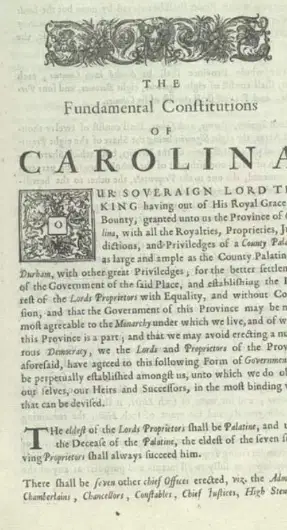
What was the name of the plan crafted by the Eight Lord Proprietors for governing Carolina?
The Mayflower Compact
The Fundamental Constitutions of Carolina
The Magna Carta
The Articles of Confederation
What was one of the main goals of the Lord Proprietors in governing the colonies?
To make English merchants rich and strengthen England’s economy
To promote religious freedom for all colonists
To create a new independent nation
To encourage colonists to form their own government
Which of the following best describes the relationship between the Lord Proprietors and the colonists?
The Lord Proprietors and colonists always agreed on economic goals
The Lord Proprietors wanted to benefit England, but many colonists did not share these goals
The colonists were in charge of making all government decisions
The Lord Proprietors encouraged colonists to become independent from England
Why did many colonists leave England to settle in the colonies?
To escape war
In search of opportunity and independence
To join the English aristocrats
To avoid paying taxes
Where did most settlers to the Carolina colony originally come from while looking for farmland?
Georgia
Virginia
New York
Pennsylvania

What was the original destination of the Mayflower?
Chicago
Virginia
Massachusetts
New York
Which of the following is NOT a principle of mercantilism?
Export more than you import
Import more than you export
Have as many colonies as possible
Gain natural resources from the colonies
A company where investors pay a share of the cost for founding a colony for a return of its future profits is called:
Joint Stock Company
Charter
Virginia Company
Assembly
Which colonial region featured small scale farming and cash crops?
New England
Middle
Southern
Backcountry
Which colonial region featured large farms that used slave labor because of fertile land and long growing seasons?
New England
Middle
Southern
Backcountry
Which of the following is NOT true about the English settlement of Roanoke?
It is known as the Lost Colony.
It was the first permanent English colony.
The first English child born in North America, Virginia Dare, lived at Roanoke.
John White, the leader, left to go back to England for supplies shortly after they arrived
Why was Roanoke called "The Lost Colony"?
The people returned to England.
They moved to Jamestown.
The colonists were gone when John White came back.
The colonist kept losing supplies and couldn't find anything!
What was the first permanent English colony in the New World called?
Roanoke
Jamestown
Plymouth
Charles Town
Which cash crop was introduced to the area that led to it's success as a colony?
Tobacco
Cotton
Corn
Wheat
John Smith is credited with helping Jamestown survive in it's early days. He did so with the motto:
"He that cannot provide food for his family shall never be a man"
"All work and no play makes Jamestown a dull colony"
"He that will not work shall not eat"
"An eye for an eye"
Which is NOT a reason that the colonies began developing their own forms of self-government?
Distance from England
The tradition of self-government (established by the Mayflower Compact)
Salutary Neglect
The policy of mercantilism
What are the inalienable rights stated by Thomas Jefferson in the Declaration of Independence?
Life, liberty and the pursuit of happiness
Freedom, assembly, and press
Life, liberty, and property
Speech, petition, and pursuit of happiness
What is NOT one of the three branches of government created by Charles Montesquieu with the separation of powers?
Legislative
Judicial
Executive
Political
Which colony had the first form of representative government with the _______________ House of Burgesses?
Massachussetts
Pennsylvania
North Carolina
Virginia
Which colony had the first constitution (written by Thomas Hooker) in the colonies that expanded voting rights to all men, regardless of religion?
Connecticut
Rhode Island
Massachussetts
Virginia
The Mayflower Compact was the first agreement for self - government to be created in America
True
False
What is mercantilism?
A system where a mother countries gains money and power from natural resources that come from its colonies.
Where colonies trade gold and silver with each other.
Wars that start over money.
Plantation colonies trading slaves for money.
What does the phrase "favorable balance of trade" mean?
You buy more goods than you sell.
You sell more goods than you buy.
Colonies produced finished products to be sold to England.
This is when Martin Luther posted his 95 Theses (or complaints) about the Catholic Church and as a result, split off and created his own religion.
The Crusades
Exploration
Reformation
Renaissance
This is when European Christians responded to the Pope's call and launched a series of holy wars against Muslims to take back the Holy Land:
The Crusades
Exploration
Reformation
Renaissance
This event led to a more secular spirit, an interest in worldly pleasures and a new confidence in human achievement.
The Crusades
Exploration
Reformation
Renaissance
Which of the following is the primary reason that European rulers became interested in trans-Atlantic exploration beginning in the 15th century?
They were curious about whether or not the world was round.
They were seeking an oversea trade route to Asia.
They wanted to become allies with Western Hemisphere natives
They were looking to relocate their European empires to a new continent.
What is the major industry of the New England Colonies?
Cash crops
Metal work
Slavery
Shipbuilding and fishing
What was the New England economy shaped by?
Rocky soil, long winters
Fertile Soil, short winters
Forest, mild summers
Mountainous land
What ocean is on the eastern coast of the United States and touches all but one of the 13 colonies?
Atlantic
Pacific
Indian
Artic
Why was slavery an important part of the southern economy?
The colonists needed men to build ships.
Puritans needed labor to help catch fish and cut lumber.
The huge farms needed workers to grow the cash crops
The colonists needed someone workers to help with trade.
Which colonial region had the most diverse population, with people coming from Germany, Holland, and France?
New England
Middle
Southern
Eastern
What did the original settlers of the 13 colonies have in common?
They were all looking for great farmland
They were all seeking economic opportunity
They were all seeking religious freedom
They were all in search of a better life
The economics of the colonial regions differed because they had different _________.
Governments
Languages
Traditions
Natural Resources
In general, why were most New England colonies founded?
Make money
Economic Opportunity
Religious freedom
Better soil
The religion practiced by the ___________ valued tolerance, equality, and pacifism (no war).
Quakers
Pilgrims
Puritans
Catholics
A large farm, usually with 50 or more slaves and producing many cash crops.
Tidewater
Plantation
Burgess
Charter

What colony is this?
Georgia
Massachusetts
South Carolina
Pennsylvania

What colony is this?
Virginia
New Jersey
Connecticut
New York

What colony is this?
Delaware
Rhode Island
Pennsylvania
North Carolina

What colony is this?
New Hampshire
Georgia
Massachusetts
Connecticut

What colony is this?
Virginia
North Carolina
Pennsylvania
Massachusetts

What colony is this?
Virginia
New York
Maryland
New Jersey

What colony is this?
Georgia
Pennsylvania
New Hampshire
Maryland

What colony is this?
New York
Maryland
Connecticut
New Jersey

What colony is this?
South Carolina
Georgia
Virginia
Rhode Island

What colony is this?
Connecticut
Rhode Island
Maryland
Pennsylvania

What colony is this?
Massachusetts
Pennsylvania
New Hampshire
North Carolina

What colony is this?
New Hampshire
Massachusetts
New York
Rhode Island

What colony is this?
Pennsylvania
Virginia
Georgia
South Carolina

What are the New England colonies?
Massachusetts, New Hampshire, Connecticut, Rhode Island
Maryland, Virginia, North Carolina, South Carolina, Georgia
New York, New Jersey, Pennsylvania, Delaware
Connecticut, Rhode Island, New York, New Jersey

What are the Middle colonies?
New York, Connecticut, Rhode Island, South Carolina
Maryland, Virginia, North Carolina, South Carolina, Georgia
New York, New Jersey, Pennsylvania, Delaware
Massachusetts, Virginia, New Jersey, Delaware

What are the southern colonies?
New York, South Carolina, Maryland, North Carolina
Massachusetts, New Hampshire, Connecticut, Rhode Island
Virginia, New Hampshire, Georgia, Pennsylvania
Maryland, Virginia, North Carolina, South Carolina, Georgia

