
 Worksheets
Immunity, Antibiotics, and Infections
Total questions: 79
Worksheet time: 42mins
Which statement best describes innate immunity as presented in the study guide?
Developed throughout life after exposure to pathogens
Present at birth and serves as the first line of defense
Transferred from mother to newborn via breast milk or placenta
Built up by vaccines to reduce illness severity on re-exposure
Fill in the blank: (a) immunity is developed throughout life, is already present in the body, and is activated to respond to a problem.
According to the study guide, which is an example of active artificial immunity?
Antibodies passed from mom to newborn via breast milk
Receiving a vaccine that builds up immunity and results in less sickness next time
Being exposed to an illness previously and getting less sick on re-exposure
Getting a rabies shot after being bitten by a bat
A patient was bitten by a bat and received a rabies shot. According to the guide, this represents which type of immunity, and what is a key characteristic of it?
Active natural; produces long-lasting immunity without boosters
Passive artificial; pathogen already in the body and protection does not last a long time, may need shots again after a new incident
Passive natural; lifelong antibodies passed at birth
Active artificial; immediate lifelong protection
Which two patient-teaching points directly address preventing antibiotic resistance as listed in the study guide?
Take antibiotics for the flu or cold; stop when you feel better
Request leftover antibiotics from friends; skip doses to reduce exposure
Only take antibiotics prescribed for you; finish your antibiotic or throw it away if you refuse
Double your dose if symptoms worsen; save extras for later
In the context of infection, which sequence and roles are correctly matched for neutrophils and macrophages?
Macrophages arrive first from bone marrow and create pus; neutrophils arrive later to clean up
Neutrophils are first-line white blood cells from bone marrow that neutralize and eat pathogens then die creating pus; macrophages arrive a few days later to clean up and get rid of pus
Neutrophils circulate for days cleaning up debris; macrophages quickly die forming pus
Both arrive simultaneously; neither contributes to pus formation
Fill in the blank: On a lab report, a high number of _______ compared with _______ indicates infection and is called a shift to the left phenomenon.
(a)
According to the content, when is ART (Antiretroviral Therapy) recommended to start after HIV diagnosis?
Only after CD4 count drops below 500
As soon as possible after diagnosis
After the acute phase resolves
Only when opportunistic infections appear
Fill in the blank: In initiating ART, (a) readiness is the most important concern.
Which outcome is NOT listed as something adherence to drug regimens is critical to prevent?
Disease progression
Opportunistic disease
Viral drug resistance
Perinatal transmission
Per the transmission details, perinatal transmission of HIV can occur during which times?
Only during delivery
During pregnancy, delivery, or breastfeeding
Only during breastfeeding
During pregnancy and casual contact
Select the body fluids explicitly listed as capable of transmitting HIV through contact.
Saliva, tears, sweat, and urine
Blood, semen, vaginal secretions, and breast milk
Sweat, saliva, and nasal secretions
Urine, feces, and saliva
Which activities are identified as NOT spreading HIV through casual contact?
Sharing needles and syringes
Unprotected sexual intercourse
Hugging, dry kissing, shaking hands, and sharing eating utensils or toilet seats
Receiving blood transfusion from screened donors
During the acute stage of HIV infection, which cluster of symptoms best matches the description provided?
Rash only, no systemic symptoms
Flu-like illness with fever, night sweats, headache, fatigue, swollen lymph nodes, muscle and joint pain
Asymptomatic with no physical findings for decades
Severe opportunistic infections and wasting syndrome
Fill in the blank: In the symptomatic stage, CD4 cells are very diminished—about _______ (with normal 800–1200), and immunodeficiency is noted at _______.
(a)
Which symptom pattern is associated with the symptomatic stage prompting HIV diagnosis and treatment?
Intermittent rash with full energy
Persistent fever, frequent night sweats, chronic diarrhea, recurrent headaches, severe fatigue
Only mild cold-like symptoms
No symptoms until CD4 count is normal
At what CD4 cell count threshold is AIDS defined in the content, and what risks increase at this stage?
Under 500; increased risk of seasonal flu only
Under 350; increased risk of hypertension
Under 200; increased risk of infection/opportunistic diseases and opportunistic cancers, with wasting syndrome and cognitive changes
Under 800; increased risk of diabetes
Which vitamin is specifically associated with citrus fruits, tomatoes, green leafy vegetables, strawberries, and peppers as primary food sources?
Vitamin C
Vitamin D
Vitamin E
Vitamin K
Fill in the blank: Vitamins are compounds required in small amounts for normal (a) .
Which of the following is a correct pairing of a fat-soluble vitamin with an example source listed:
Vitamin C — strawberries
Vitamin B-complex — enriched grains
Vitamin A — fatty fish and egg yolks
Vitamin K — fortified milk
According to the content, water-soluble vitamins are categorized as which set?
A, D, E, K
C and B-complex
A, C, E, K
D and K
A patient with chewing issues due to dysphagia and poor dentition should be placed on which diet type as defined here?
Pureed diet
Mechanical diet
Soft diet
Clear liquid diet
Fill in the blank: A clear liquid diet consists of liquids at room temperature with no (a) and reduces fecal matter in the colon.
Which description best matches a nectar-like thickened liquid?
Nonrestrictive, all unthickened liquids
Thin enough to sip through a straw but thicker than thin
Pourable but cannot be sipped through a straw
Creamy liquids like milkshakes and buttermilk only
A full liquid diet at room temperature is indicated for intolerance of solid foods and as a transition diet. Which of the following foods are listed examples for a full liquid diet?
Water, tea, fat-free broth, gelatin
Milk, juice, ice cream, pudding
Ground meat, canned fruit, cooked vegetables
No beans, raw fruit, bread cereal
According to TPN nursing interventions, how often should vitals be monitored for a patient receiving TPN?
Every 1–2 hours
Every 4–8 hours
Once per day
Only when symptomatic
Fill in the blank: If a TPN infusion is temporarily discontinued, administer (a) to avoid hypoglycemia.
Which of the following monitoring parameters are specifically listed for patients on TPN?
BUN
Electrolytes
CBC
Liver enzymes
Serum amylase
A malnourished patient begins TPN with aggressive nutritional support. Which complication should the nurse anticipate and monitor for as part of 'refeeding syndrome' per the protocol on this page?
Hypernatremia and hypercalcemia
Fluid retention with declines in phosphorus, potassium, and magnesium
Metabolic alkalosis with increased potassium
Dehydration with elevated magnesium only
During TPN feeding, which sequence of actions aligns with the page’s feeding protocol for bag safety and change frequency?
Hang the bag for 48 hours; check patient ID only
Check label ingredients against the order, examine the bag for contamination, change the solution every 24 hours
Spike the bag immediately, then check the order later; change every 12 hours
Warm the bag to room temperature for 2 hours; visually inspect only if the patient develops symptoms
According to the preoperative patient teaching, which medication-related instruction should be given to patients?
Hold anticoagulants and continue beta blockers
Stop all medications, including beta blockers
Double the dose of anticoagulants
Begin anticoagulants 24 hours before surgery
Fill in the blank: Preoperative bathing should include (a) chlorhexidine shower or wipes with shaved skin around the incision site.
In the PACU, the main concern during assessment is which of the following?
Pain control and discharge planning
ABCs with monitoring of vital signs
Gastrointestinal function and ambulation
Blood glucose management only
Fill in the blank: Airway obstruction in the PACU may be caused by the (a) falling back and can be accompanied by laryngeal edema/spasm.
A PACU nurse notes pulmonary edema from fluid overload with possible aspiration and bronchospasm. Which oxygenation problem does this indicate?
Hypoventilation
Hypercapnia
Hypoxemia
Metabolic alkalosis
Which combination of signs suggests hemorrhage in the circulation assessment postoperatively?
High BP and low HR
Low BP and high HR
Low BP and low HR
High BP and high HR
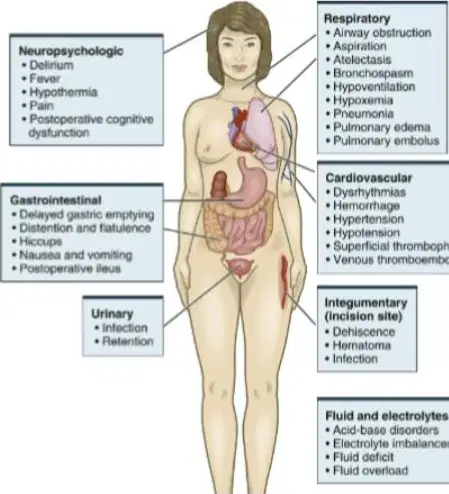
Which of the following is NOT listed as a respiratory postoperative complication in the diagram?
Atelectasis
Bronchospasm
Pulmonary edema
Hypoglycemia
Fill in the blank: Signs and symptoms of infection include (a) .
Which nursing intervention is specifically mentioned for prevention of deep vein thromboses (DVTs)?
Increase IV fluids
Reposition every 2 hours
Limit ambulation for first 24 hours
Apply ice to calves
According to the content, which pain management approach reflects multimodal analgesia?
Using only opioids as needed
Combining opioids, NSAIDs, and epidural analgesia
Relying solely on positioning and ice
Avoiding pharmacologic agents
When instructing a patient with an abdominal incision to cough, the nurse should teach (a) .
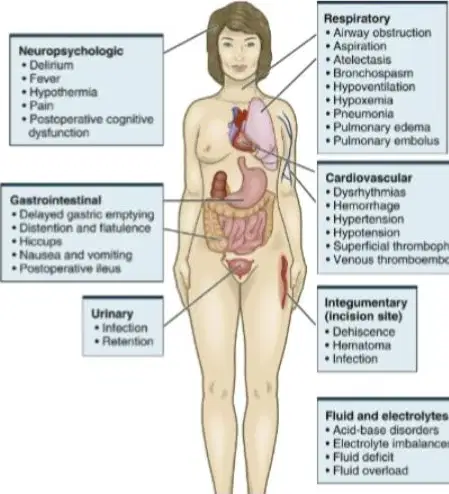
Which combination lists two urinary postoperative complications shown in the diagram?
Infection and retention
Hemorrhage and hypotension
Nausea and vomiting
Delirium and pain
For a patient with an indwelling Foley catheter, what monitoring is emphasized in the first 24 hours?
Serum creatinine every 4 hours
Urine output with I&O; prevent infection
Daily weight twice daily
Bladder scanning each hour
Select the described DVT symptom pattern from the notes: redness, swelling, heat, and _______ in the calf that gets worse with touch and movement.
numbness
sharp chest pain
throbbing pain
pale cool skin
Fill in the blank: Dehiscence is defined as (a) .
Which lab values indicate respiratory acidosis according to the notes?
High pH, low CO2 (<7.35 pH, <35 CO2)
Low pH, high CO2 (<7.35 pH, >45 CO2)
High pH, high CO2 (>7.45 pH, >45 CO2)
Low pH, low CO2 (<7.35 pH, <35 CO2)
Respiratory acidosis is caused by hypoventilation due to conditions such as (a) .
A patient with respiratory acidosis may present with which combination of signs and symptoms?
Bradycardia, deep slow breathing, drowsiness
Tachypnea, anxiety, tachycardia, confusion, shallow breaths
Hypotension, muscle weakness, pins and needle sensation
Fast rapid breathing, anxiety, trouble concentrating
Which nursing intervention is specifically recommended for respiratory alkalosis in the notes?
Intubate immediately
Provide bicarbonate supplementation
Provide O2 and make them breathe slower, use a paper bag
Dialysis if renal
Metabolic acidosis lab indication is described as (a) .
Which of the following is a listed cause of metabolic acidosis?
Prolonged vomiting or gastric suction
Hyperventilation due to anxiety
Ketoacidosis or accumulation of lactic acid; kidney disease; alcohol; strenuous exercise; diarrhea; shock
Opioid overdose leading to hypoventilation
Identify the characteristic breathing pattern described for metabolic acidosis and its purpose.
Cheyne-Stokes respirations to conserve CO2
Kussmaul respirations—deep and rapid attempting to compensate
Shallow breaths due to muscle weakness
Apneustic breathing to increase oxygenation
Which nursing interventions are recommended for metabolic alkalosis according to the notes?
Loss of bicarb—give them bicarb; dialysis if renal
K, Cl supplements; treat cause; stop suction
O2, monitor vital signs, high fowlers, intubate
O2 and paper bag breathing
Which lab values indicate hypercalcemia and hypocalcemia, respectively?
Above 10.2 mg/dL and under 8.6 mg/dL
Above 145 mEq/L and under 135 mEq/L
Above 5.2 mEq/L and under 3.5 mEq/L
Above 2.5 mEq/L and under 1.5 mEq/L
Fill in the blank: Positive (a) or Chvostek's sign, laryngeal stridor, dysphagia, numbness and tingling around the mouth or in the extremities, and dysrhythmias are signs of hypocalcemia.
Which treatment is listed as the gold standard for hypercalcemia?
Calcitonin
Bisphosphonates
Isotonic IV fluids
Low calcium diet
In severe hyperkalemia, which combination therapy is indicated to stabilize the heart while shifting potassium intracellularly?
Loop diuretic and hypertonic saline 3%
IV insulin with dextrose and calcium (e.g., gluconate IV)
Oral KCL supplements and fluid restriction
Demecyclocycline and dialysis
Which ECG change is specifically noted with hyperkalemia in the content?
Flattened P waves
Prolonged QT interval
High T wave
Squashed T wave
According to the notes, what are two key nursing interventions common to both hypercalcemia and hypocalcemia?
Daily weights and strict I&O
Continuous cardiac monitoring (EKG) and mobility encouragement
Fluid restriction and loop diuretics
Administer hypertonic saline 3% and calcitonin
Which statement about sodium and potassium relationships is correct per the material?
Sodium and potassium rise together
Potassium controls water balance
K and Na are inversely related
Ca and Na are inversely related
What patient signs/symptoms are associated with hyponatremia, particularly when severe?
Thirst, heat stroke, HTN, kidney failure
Headache, irritability, difficulty concentrating; severe: confusion, vomiting, seizures, coma
Facial flushing, lethargy, impaired deep tendon reflexes
Bone pain, fractures, nephrolithiasis
Fill in the blank: For hypomagnesemia, nursing teaching on foods should include (a) , nuts, whole grains, tuna, and fish chocolate.
Which intervention principle about potassium administration is emphasized in the content?
May be pushed IV in emergencies
Always dilute; never push; use an infusion pump and infuse slowly
Crush extended-release tablets for faster effect
Administer IM for rapid correction
Select the BEST intervention set for a patient with fluid volume excess showing crackles in lungs, JVD, and hypertension.
Give isotonic bolus and restrict salt
Give O2, raise HOB, give diuretics as ordered, and fluid restriction
Administer vasoconstrictors to raise BP and give hypertonic saline
Encourage high sodium diet and stop diuretics
Fill in the blank: In hypotonic fluids, 0.45% NS moves into the cell, which can cause the cell to (a) .
Which IV fluid type is used to replace water loss and prevent ketosis while expanding the ECF?
D5W (isotonic)
3% NS (hypertonic)
0.45% NS (hypotonic)
D10 (hypertonic)
Match each pressure type with its direction of fluid movement.
Oncotic: fluid pushed from cell into bloodstream; Hydrostatic: fluid pushed out of vessel into cell
Oncotic: fluid pulled from interstitial space into bloodstream; Hydrostatic: fluid pushed out of the vessel and into the cell
Oncotic: fluid pushed out of the vessel; Hydrostatic: fluid pulled into bloodstream
Oncotic: fluid moves into cell; Hydrostatic: fluid moves into bloodstream
Which findings are classic signs/symptoms of hypovolemia listed in the content?
Edema, crackles in lungs, JVD, SOB
Dry mucous membranes, skin tenting, tachycardia, hypotension
Bradycardia, pink frothy sputum, weight gain
Polyuria, bounding pulses, hypertension
A patient with orthostatic hypotension related to fluid status assessment should be evaluated using which consistent method mentioned in the content?
Daily weights at different times using any available scale
Body weight at the same time on the same scale every day in the morning
Weekly weights before dinner on alternating scales
Estimating weight change based on clothing fit
Which symptom is explicitly listed as a common feature across the anemia notes for iron deficiency and hemolytic anemia?
Koilonychia (spoon nails)
Splenomegaly
Fatigue
Internal hemorrhage
Fill in the blank: For oral iron therapy in iron deficiency anemia, students should advise patients to take iron with (a) supplements and expect black stool and constipation.
Which food combination best matches the listed dietary sources to support iron therapy in the notes?
Dairy products and citrus fruits only
Meats, vegetables, beans, fish, legumes, and grains
Leafy greens only
Nuts and seeds only
According to the notes on hemolytic anemia, which management approach is emphasized?
High-dose corticosteroids for all patients
Treat the cause, consider transfusion, and avoid triggers to reduce jaundice and fatigue
Routine iron injections regardless of hemoglobin level
Antibiotics and isolation precautions
A patient with sickle cell disease presents with pain and Hb of 5.8 g/dL. Based on the notes, which immediate interventions are supported? Select all that apply.
IV iron using Z-track without test dose
Transfusion and oxygen with pain medications
DVT prophylaxis and education on hydroxyurea
Avoid transfusion and give only oral iron with vitamin C
Immunodeficiency
When the body has more antigens in it.
Increased ability of the body to fight infections and other diseases.
When the body has more antibodies in it.
Decreased ability of the body to fight infections and other diseases.
Which of the following are true about someone infected with HIV that develops AIDS? Select ALL that apply!
They are at a higher risk of cancer,
They have a weakened immune system
They may develop rare infections
They are less able to fight infections and cancers
The human immunodeficiency virus (HIV) often infects and destroys CD4 T cells. These CD4 T cells are one of many kinds of white blood cells that are an important part of the immune system. The most common danger related to the destruction of CD4 T cells is
an increase in the risk of high blood pressure.
an increase in the threat of diseases cause by microorganisms and viruses.
a decrease in the flow of blood to vital organs.
a decrease in the amount of oxygen being transported to the tissues.
What does AIDS stand for?
Acquired Immunodeficiency Syndrome
Active Immune Deficiency Syndrome
Acquired Immune Disease Syndrome
Active Immunodeficiency System

