
 Worksheets
Thermodynamics Quiz
Total questions: 99
Worksheet time: 50mins
According to the second law of thermodynamics, which of the following processes occurs spontaneously in nature?
Water flows up a waterfall.
Gases compress from a low pressure to a high pressure.
Heat flows from a high temperature to a low temperature.
Heat flows from a low temperature to a high temperature without energy input.
What is required to reverse a spontaneous process, according to the text?
No external input is needed.
External energy must be expended.
The process reverses itself spontaneously.
The second law of thermodynamics must be violated.
What does the first law of thermodynamics state about energy conversion?
Energy can be created or destroyed.
Identical quantities of energy are involved regardless of the feasibility of the process.
Energy flows only in one direction.
Energy conversion is not possible.
Why can't all the water be pumped back up a waterfall using the energy captured from its fall?
The first law of thermodynamics prevents it.
Friction causes energy losses during the process.
Water cannot be collected in a water wheel.
The second law of thermodynamics allows it to happen.
Which of the following statements about heat flow is consistent with the second law of thermodynamics?
Heat flows spontaneously from a low temperature to a high temperature.
Heat flows spontaneously from a high temperature to a low temperature.
Heat flow direction is irrelevant to the second law of thermodynamics.
Heat flow violates the first law of thermodynamics.
What does the first law of thermodynamics primarily concern?
The degradation of energy into less useful forms
The conversion of energy from one form to another
The direction of processes and how much heat is converted into work
The concept of heat reservoirs
According to Joule's experiments, which of the following statements is true?
Heat energy can be completely converted into work energy
Work energy can be completely converted into heat energy
Heat and work are completely interchangeable forms of energy
Energy transfer always increases the usefulness of energy
What does the second law of thermodynamics control?
The conversion of energy from one form to another
The degradation of energy into more useful forms
The direction processes may take and how much heat is converted into work
The stability of heat reservoirs
What is a heat reservoir?
A system that can transfer finite amounts of heat without changing its temperature
A system that always increases in temperature during heat transfer
A system that converts all heat into work energy
A system that only absorbs heat but does not release it
What is a high-temperature heat reservoir called?
Heat sink
Heat source
Thermal equilibrium
Energy converter
What is a low-temperature heat reservoir called?
Heat source
Heat sink
Thermal equilibrium
Energy converter
What is a work reservoir?
A system that undergoes a thermodynamic cycle.
A sufficiently large system in stable equilibrium to which and from which finite amounts of work can be transferred adiabatically without any change in its pressure.
A system that delivers net work in a thermodynamic cycle.
A system that undergoes a series of processes to constitute a heat engine cycle.
What happens to the properties of a system at the end of a thermodynamic cycle?
The properties of the system change completely.
The properties of the system remain the same as at its beginning.
The system loses energy.
The system gains energy.
Which of the following equations represents the condition for a thermodynamic cycle?
P_f = P_i, T_f = T_i, u_f = u_i, v_f = v_i
P_f > P_i, T_f > T_i, u_f > u_i, v_f > v_i
P_f < P_i, T_f < T_i, u_f < u_i, v_f < v_i
P_f ≠ P_i, T_f ≠ T_i, u_f ≠ u_i, v_f ≠ v_i
What is a heat engine?
A system that remains in stable equilibrium.
A thermodynamic system operating in a thermodynamic cycle to which net heat is transferred and from which net work is delivered.
A system that undergoes a thermodynamic cycle but does not deliver work.
A system that only transfers heat without undergoing a cycle.
What does the working fluid in a heat engine undergo?
A single process.
A series of processes that constitute the heat engine cycle.
No processes.
Only adiabatic processes.
What is the thermal efficiency (\( \eta_{th} \)) of a heat engine defined as?
The ratio of the heat input to the net work output
The ratio of the net work output to the heat input
The difference between the heat input and the heat output
The sum of the net work output and the heat input
Which of the following is true about the thermal efficiency of a heat engine?
It is always greater than 1
It is always equal to 1
It is always less than 1 or less than 100 percent
It is always equal to 0
In the formula for thermal efficiency (\( \eta_{th} \)), what does the "desired result" typically represent for a heat engine?
The heat input
The heat output
The net work done
The energy lost to the surroundings
What is the "required input" in the thermal efficiency formula for a heat engine?
The heat supplied to make the cycle operate
The net work output
The energy lost to the atmosphere
The energy stored in the system
What does the subscript "in" and "out" signify in the context of work or heat transfer in the given equations?
The direction of the process (positive or negative)
The magnitude of work or heat transfer (positive value)
The type of energy transfer (heat or work)
The efficiency of the system
According to the first law of thermodynamics for a cyclic heat engine, what is the relationship between $Q_{net,in}$ and $W_{net,out}$?
$Q_{net,in} = W_{net,out}$
$Q_{net,in} > W_{net,out}$
$Q_{net,in} < W_{net,out}$
$Q_{net,in} + W_{net,out} = 0$
How is the net work output ($W_{net,out}$) of a cyclic heat engine expressed in terms of heat transfer?
$W_{net,out} = Q_{in} + Q_{out}$
$W_{net,out} = Q_{in} - Q_{out}$
$W_{net,out} = Q_{out} - Q_{in}$
$W_{net,out} = Q_{in} \times Q_{out}$
What is the formula for the thermal efficiency ($\eta_{th}$) of a cyclic heat engine?
ηth=Wnet,outQin
ηth=QinWnet,out
ηth=QinQout
ηth=QinQin−Qout
What is the formula for the thermal efficiency (η_th) of a heat engine in terms of heat input (Q_in) and heat output (Q_out)?
η_th = Q_out / Q_in
η_th = 1 - (Q_out / Q_in)
η_th = Q_in / Q_out
η_th = Q_in - Q_out
Cyclic devices such as heat engines, refrigerators, and heat pumps operate between which two types of reservoirs?
High-pressure and low-pressure reservoirs
High-temperature and low-temperature reservoirs
High-energy and low-energy reservoirs
High-volume and low-volume reservoirs
In the context of cyclic devices, what does T_H represent?
The temperature of the low-temperature reservoir
The temperature of the high-temperature reservoir
The total heat input to the system
The work output of the system
What is the primary function of a heat engine in a cyclic device?
To transfer heat from a low-temperature reservoir to a high-temperature reservoir
To convert heat into work
To store thermal energy
To maintain constant temperature in both reservoirs
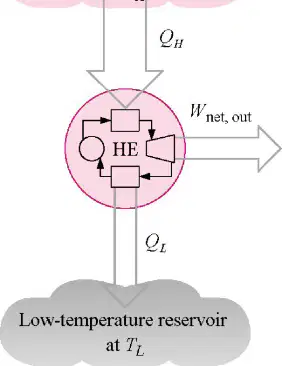
Diagram illustrating a heat engine operating between a high-temperature reservoir at T_H and a low-temperature reservoir at T_L.
Diagram illustrating a heat engine operating between a high-temperature reservoir at T_H and a low-temperature reservoir at T_L.
Diagram illustrating a heat engine operating between two reservoirs at the same temperature.
Diagram illustrating a heat engine operating only at a low temperature reservoir at T_L.
Diagram illustrating a heat engine operating without any temperature reservoirs.
What is the formula for thermal efficiency (\( \eta_{th} \)) of a device in terms of \( Q_L \) and \( Q_H \)?
ηth=1−QLQH
ηth=QHQL
ηth=1−QHQL
ηth=QLQH
A steam power plant produces 50 MW of net work while burning fuel to produce 150 MW of heat energy at the high temperature. What is the thermal efficiency (\( \eta_{th} \)) of the cycle?
25%
33.3%
50%
66.7%
If the heat energy supplied to a steam power plant is 150 MW and the net work output is 50 MW, what is the amount of heat rejected (\( Q_L \)) by the cycle to the surroundings?
50 MW
100 MW
150 MW
200 MW
What is the relationship between \( W_{net, out} \), \( Q_H \), and \( Q_L \) in a thermodynamic cycle?
\( W_{net, out} = Q_H + Q_L \)
\( W_{net, out} = Q_H - Q_L \)
\( W_{net, out} = Q_L - Q_H \)
\( W_{net, out} = Q_H \times Q_L \)
What is the formula for thermal efficiency (\( \eta_{th} \)) of a device in terms of \( Q_L \) and \( Q_H \)?
ηth=1−QHQL
ηth=QHQL
ηth=QLQH
ηth=1−QLQH
What is the primary function of a heat pump in a thermodynamic cycle?
To transfer heat from a high-temperature body to a low-temperature body
To transfer heat from a low-temperature body to a high-temperature body
To generate electricity from heat energy
To cool down a high-temperature body without external energy
What external energy does a heat pump require to accomplish the transfer of heat?
Solar energy
Electrical energy or work
Chemical energy
Nuclear energy
What is the key difference between a refrigerator and a heat pump as described in the text?
A refrigerator operates without a thermodynamic cycle, while a heat pump does.
A refrigerator extracts heat from a high-temperature medium, while a heat pump extracts heat from a low-temperature medium.
A refrigerator rejects heat to a low-temperature medium, while a heat pump rejects heat to a high-temperature medium.
A refrigerator and a heat pump are identical in operation.
Which of the following best describes the term "heat pump" in thermodynamics?
A device that generates heat without external energy
A cyclic device that transfers heat from a low-temperature body to a high-temperature body
A device that cools down a high-temperature body without a thermodynamic cycle
A device that operates only in high-temperature environments
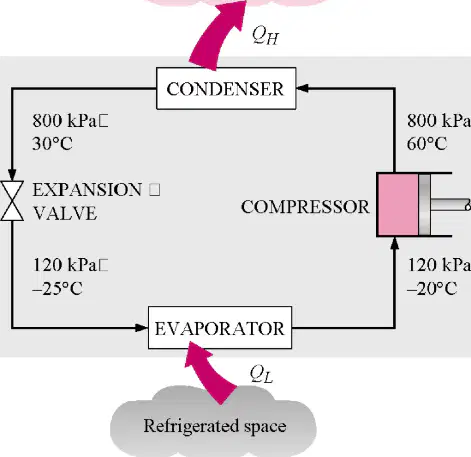
What does the Coefficient of Performance (COP) represent in the context of a refrigerator or heat pump?
The ratio of required input to desired result
The ratio of desired result to input
The difference between input and output
The sum of input and output
Which of the following statements about the Coefficient of Performance (COP) is correct?
COP is always less than 1
COP measures the efficiency of a refrigerator or heat pump
COP is the ratio of heat rejected to heat absorbed
COP is independent of the desired result
What is the desired outcome when optimizing the Coefficient of Performance (COP)?
To make COP as small as possible
To make COP equal to 1
To make COP as large as possible
To make COP equal to the input
What is the formula for calculating the Coefficient of Performance (COP)?
COP = Required Input / Desired Result
COP = Desired Result / Required Input
COP = Desired Result - Required Input
COP = Required Input + Desired Result
What is the primary function of a heat pump acting like a refrigerator or an air conditioner?
To transfer heat from the high-temperature system to the low-temperature system
To transfer heat from the low-temperature system to the high-temperature system
To generate heat within the system
To cool the high-temperature system directly
In the context of a refrigerator, what is the desired result of the device's operation?
The heat supplied at the high temperature
The heat supplied at the low temperature
The work done by the system
The cooling of the high-temperature environment
What does the term $ COP_R $ represent in the context of a refrigerator?
The ratio of work input to heat output
The ratio of heat supplied at low temperature to the net work input
The ratio of heat supplied at high temperature to the net work input
The ratio of net work input to heat supplied at low temperature
What is the equation for the first law of thermodynamics as applied to a cyclic refrigerator?
(Q_L - Q_H) - (0 - W_{in}) = \Delta U_{cycle} = 0
Q_H - Q_L = W_{in}
W_{in} = Q_H + Q_L
Q_L = Q_H - W_{in}
What is the formula for the coefficient of performance (COP) of a refrigerator?
COP_R = QH−QLQL
COP_R = QL−QHQH
COP_R = WinQH
WinQL
What is the primary function of a device acting as a "heat pump"?
To transfer heat to the high-temperature system.
To transfer heat to the low-temperature system.
To generate work from heat.
To maintain a constant temperature in the system.
What is the formula for the coefficient of performance (COP) of a heat pump?
COP_{HP} = QH−QLQH
COP_{HP} = QH−QLQL
COP_{HP} = WinQH
COP_{HP} = WinQL
What is the relationship between COP_{HP} and COP_R under the same operating conditions?
COP_{HP} = COP_R + 1
COP_{HP} = COP_R - 1
COP_{HP} = COP_R
COP_{HP} = COP_R \times 2
What does the SEER rating measure for heat pumps and air conditioners?
The amount of cooling or heating on a seasonal basis per unit rate of power expended in watts
The maximum temperature a heat pump can achieve
The total energy consumption of a heat pump over a year
The efficiency of a heat pump at a single temperature
How many Btu/hr are equivalent to one ton of heating or cooling?
10,000 Btu/hr
12,000 Btu/hr
15,000 Btu/hr
20,000 Btu/hr
What does the Kelvin-Planck statement of the second law of thermodynamics imply about heat engines?
Heat engines can achieve 100% efficiency
Heat engines can produce a net amount of work while exchanging heat with a single reservoir
Heat engines cannot produce a net amount of work while exchanging heat with a single reservoir
Heat engines can operate without any heat exchange
What is the maximum possible efficiency of a heat engine according to the Kelvin-Planck statement?
100%
Less than 100%
50%
Greater than 100%
What does the Clausius statement of the second law state?
It is possible to construct a device that transfers heat from a lower-temperature body to a higher-temperature body without any external work.
It is impossible to construct a device that operates in a cycle and produces no effect other than the transfer of heat from a lower-temperature body to a higher-temperature body.
It is possible to construct a device that violates the Kelvin-Planck statement of the second law.
It is impossible to construct a device that operates in a cycle and transfers heat from a higher-temperature body to a lower-temperature body.
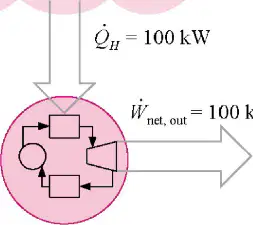
Which of the following best describes a heat engine that violates the Kelvin-Planck statement of the second law?
A heat engine that operates with 100% efficiency.
A heat engine that converts all the heat input into work output without any heat rejection.
A heat engine that transfers heat from a lower-temperature body to a higher-temperature body without external work.
A heat engine that operates in a cycle and rejects heat to a lower-temperature reservoir.
What is the significance of the thermal efficiency (η_th) being less than 100% in a heat engine?
It ensures that the engine violates the Kelvin-Planck statement of the second law.
It indicates that some heat is rejected to the surroundings, making the engine realistic.
It means the engine operates without any heat input.
It shows that the engine transfers heat from a lower-temperature body to a higher-temperature body.
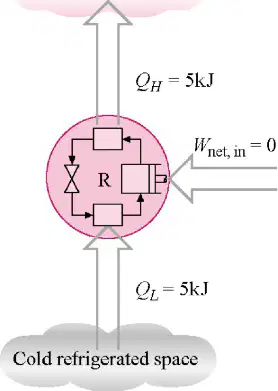
What does the Clausius statement of the second law imply about heat pumps?
Heat can flow from a low-temperature medium to a high-temperature medium without any external work.
Heat pumps can operate with a coefficient of performance (COP) equal to infinity.
Energy in the form of work or heat must be expended to force heat to flow from a low-temperature medium to a high-temperature medium.
Heat pumps can violate the laws of thermodynamics under certain conditions.
What is the maximum possible value of the coefficient of performance (COP) for a refrigerator or heat pump?
Infinity
Zero
One
Five
Why must the COP of a refrigerator or heat pump be less than infinity?
Because the Clausius statement of the second law prohibits infinite efficiency.
Because heat naturally flows from high-temperature to low-temperature regions.
Because work is not required for heat transfer in a heat pump.
Because the second law of thermodynamics allows for infinite energy.
What does a violation of the Kelvin-Planck statement imply according to the second law of thermodynamics?
A violation of the Clausius statement.
The heat engine operates with 100% efficiency.
Heat is transferred from a high-temperature reservoir to a low-temperature reservoir.
Work is produced without any heat input.
In the given scenario, what does the heat pump transfer from the low-temperature thermal reservoir to the high-temperature thermal reservoir?
Q_H + Q_L
Only Q_H
Only Q_L
Work W
What is the key violation described in the Clausius statement of the second law in the given scenario?
Heat is transferred from a low-temperature reservoir to a high-temperature reservoir without external energy input.
Work is produced without any heat input.
Heat is transferred from a high-temperature reservoir to a low-temperature reservoir.
The heat engine operates with 100% efficiency.
What is a perpetual-motion machine of the first kind?
A device that violates the second law of thermodynamics.
A device that violates the first law of thermodynamics.
A device that operates without any energy input.
A device that follows both the first and second laws of thermodynamics.
What is the defining characteristic of a reversible process?
It is a process that cannot be reversed.
It is a quasi-equilibrium process with a restrictive requirement.
It is a process that violates the second law of thermodynamics.
It is a process that leaves permanent changes in the system.
What distinguishes an internally reversible process from an externally reversible process?
Internally reversible processes leave no change in the surroundings.
Externally reversible processes leave no change in the system.
Internally reversible processes leave no change in the system, but not necessarily in the surroundings.
Externally reversible processes cannot be reversed.
What happens in a totally or externally reversible process?
The process cannot be reversed.
The process leaves no change in the system or surroundings.
The process leaves changes only in the surroundings.
The process violates the first law of thermodynamics.
What is an irreversible process?
A process that can be reversed without any loss of energy
A process that is not reversible
A process that occurs only in ideal conditions
A process that involves no heat transfer
Which of the following is NOT a cause of irreversible processes?
Friction
Unrestrained expansion of gases
Perfectly insulated systems
Heat transfer through a finite temperature difference
Who was Nicolas Sadi Carnot?
A French physicist who discovered the first law of thermodynamics
A French military engineer who studied the second law of thermodynamics
A German scientist who introduced the concept of entropy
An English mathematician who developed the concept of heat engines
What is the Carnot cycle composed of?
Two reversible processes and two irreversible processes
Four irreversible processes
Four reversible processes, two isothermal and two adiabatic
Two isothermal processes and two constant pressure processes
Which of the following is an example of an irreversible process?
A perfectly insulated system
Frictionless motion
Mixing of two different substances
A quasi-static process
What happens during Process 1-2 in the Carnot Cycle?
Reversible adiabatic expansion decreases the working fluid temperature.
Reversible isothermal heat addition at high temperature to the working fluid.
The system is brought in contact with a heat reservoir at low temperature.
Reversible adiabatic compression increases the working fluid temperature.
During Process 2-3 of the Carnot Cycle, what happens to the working fluid temperature?
It increases from TL to TH.
It remains constant.
It decreases from TH to TL.
It oscillates between TH and TL.
In Process 3-4 of the Carnot Cycle, what is the role of the heat reservoir?
It provides heat to the system at high temperature.
It absorbs heat from the system at low temperature.
It facilitates reversible adiabatic expansion.
It increases the working fluid temperature from TL to TH.
What is the primary outcome of Process 4-1 in the Carnot Cycle?
The working fluid temperature decreases from TH to TL.
The working fluid temperature increases from TL to TH.
The system performs boundary work.
The system undergoes isothermal heat exchange.
Which process in the Carnot Cycle involves reversible adiabatic expansion?
Process 1-2
Process 2-3
Process 3-4
Process 4-1
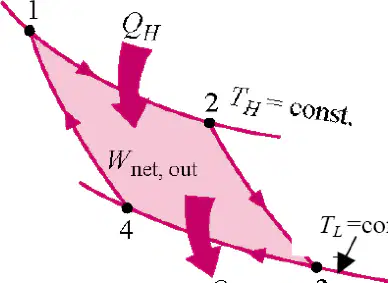
What is the direction of operation for power cycles when plotted on a process diagram?
Clockwise
Counterclockwise
Random
Vertical
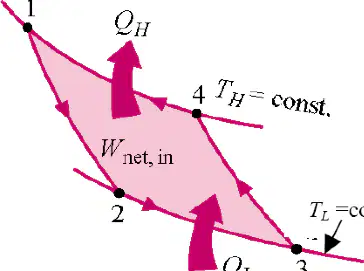
When the Carnot cycle is reversed, what does it operate as?
A refrigerator
A heat engine
A turbine
A compressor
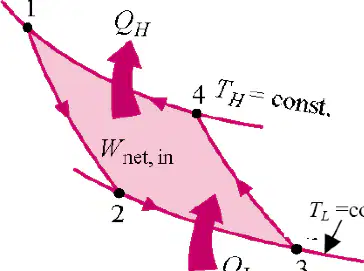
In which direction does the refrigeration cycle operate on a process diagram?
Counterclockwise
Clockwise
Horizontal
Random
What does the second law of thermodynamics state about the operation of cyclic devices?
A heat engine can operate by exchanging heat with a single heat reservoir.
A refrigerator can operate without net work input from an external source.
A heat engine cannot operate by exchanging heat with a single heat reservoir.
A refrigerator can operate without any energy input.
According to the Carnot principles, how does the efficiency of an irreversible heat engine compare to that of a reversible heat engine operating between the same two reservoirs?
The efficiency of an irreversible heat engine is greater than that of a reversible one.
The efficiency of an irreversible heat engine is equal to that of a reversible one.
The efficiency of an irreversible heat engine is always less than that of a reversible one.
The efficiency of an irreversible heat engine is independent of the reservoirs.
What conclusion can be drawn about the efficiencies of all reversible heat engines operating between the same two constant-temperature heat reservoirs?
They have different efficiencies depending on the working substance.
They have the same efficiency.
Their efficiency depends on the external work input.
Their efficiency is always less than that of irreversible heat engines.
What significant contribution did Lord Kelvin make in 1848 regarding thermodynamics?
He discovered the Carnot principles.
He defined temperature using energy as a thermodynamic property.
He invented the first heat engine.
He proved that reversible heat engines are less efficient than irreversible ones.
What is the general formula for thermal efficiency (η_th)?
η_th = Q_H / Q_L
η_th = 1 - Q_L / Q_H
η_th = Q_L / Q_H
η_th = 1 + Q_L / Q_H
For a Carnot engine, the thermal efficiency can be expressed as:
η_th = g(T_H, T_L) = 1 - f(T_H, T_L)
η_th = g(T_L, T_H) = 1 - f(T_L, T_H)
η_th = g(T_H, T_L) = 1 + f(T_H, T_L)
η_th = g(T_L, T_H) = 1 + f(T_L, T_H)
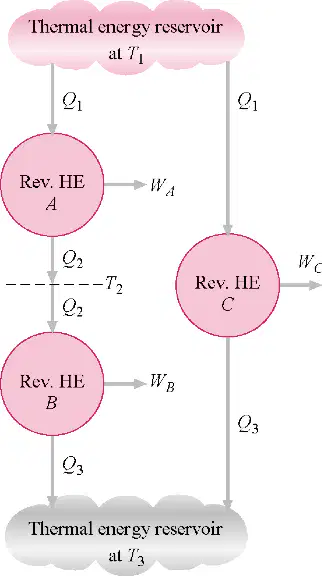
What is the name of the heat engine arrangement shown in the diagram?
Otto engine
Carnot engine
Diesel engine
Stirling engine
What is the simplest form of the θ function in the context of the given material?
θ(T₁) = T₁ / T₃
θ(T₃) = T₃ / T₁
θ(T₁) = T₁²
θ(T₃) = T₃²
What does the Carnot thermal efficiency formula represent?
The maximum possible efficiency of a heat engine operating between two heat reservoirs.
The average efficiency of a heat engine.
The minimum efficiency of a heat engine.
The efficiency of a heat engine at room temperature.
What is the Carnot thermal efficiency formula for a heat engine operating between two reservoirs at temperatures Tₕ and Tₗ?
ηₜₕ,ₐ = 1 - Tₗ / Tₕ
ηₜₕ,ₐ = Tₗ / Tₕ
ηₜₕ,ₐ = Tₕ / Tₗ
ηₜₕ,ₐ = 1 + Tₗ / Tₕ
What does the function f(T₁, T₃) represent in the given material?
The ratio of absolute temperatures.
The product of θ(T₃) and θ(T₁).
The ratio of θ(T₃) to θ(T₁).
The sum of θ(T₃) and θ(T₁).
What is the Kelvin scale related to in the context of heat transfers?
The pressure difference between two reservoirs
The heat transfers between a reversible device and the high- and low-temperature heat reservoirs
The volume change in a heat engine
The speed of heat transfer in a system
For reversible devices, the ratio $ Q_H / Q_L $ can be replaced by which of the following expressions?
$ T_H / T_L $
$ T_L / T_H $
$ Q_L / Q_H $
$ T_H - T_L $
Under what condition is the result $ Q_H / Q_L = T_H / T_L $ valid for heat engines?
When the heat exchange occurs with varying temperature reservoirs
When the heat exchange occurs across a heat engine operating between two constant temperature heat reservoirs
When the heat exchange occurs with heat sources and sinks that do not have constant temperature
When the heat engine operates at maximum speed
How do the thermal efficiencies of actual and reversible heat engines compare when operating between the same temperature limits?
$ \eta_h > \eta_{h,rev} $ for all heat engines
$ \eta_h = \eta_{h,rev} $ for irreversible heat engines
$ \eta_h < \eta_{h,rev} $ for irreversible heat engines
$ \eta_h > \eta_{h,rev} $ for reversible heat engines
Which of the following describes an impossible heat engine in terms of thermal efficiency?
$ \eta_h < \eta_{h,rev} $
$ \eta_h = \eta_{h,rev} $
$ \eta_h > \eta_{h,rev} $
$ \eta_h = 0 $
What does the term "COP" stand for in the context of reversible Carnot devices?
Coefficient of Pressure
Coefficient of Performance
Coefficient of Power
Coefficient of Potential
What happens when a Carnot device operates in the reversed cycle?
It becomes a heat engine.
It becomes a reversible heat pump.
It stops functioning.
It becomes a refrigerator.
Which of the following equations represents the Coefficient of Performance (COP) for a reversible refrigerator?
COP_R = TH−TLTH
COP_R = TH−TLTL
COP_R = TLTH
COP_R = THTL

