
 Worksheets
National Service Reserve Corps and Disaster Management Quiz
Total questions: 100
Worksheet time: 50mins
Which Republic Act created the National Service Reserve Corps composed of graduates of the non-ROTC components?
Republic Act 10121
Republic Act 9163
Republic Act 9003
Republic Act 7277
According to Republic Act 10121, which entities are responsible for the accreditation, mobilization, and protection of disaster volunteers?
Only the private sector
Only government agencies
Government agencies, CSOs, private sector, and LGUs
Only the National Service Reserve Corps
What is the main purpose of mobilizing volunteers as stated in the guidelines of Republic Act 10121?
To provide entertainment during disasters
To augment personnel and logistical requirements in disaster risk reduction programs and activities
To replace government officials
To conduct regular community meetings
What natural disasters are mentioned as affecting the Philippines due to its location in the circumpacific belt?
Floods, typhoons, tornadoes, earthquakes, drought, tsunamis, and volcanic eruptions
Hurricanes, blizzards, and avalanches
Sandstorms and wildfires
Landslides and sinkholes only
Why was the National Disaster Coordinating Council (NDCC) put in the forefront in the early 1990s?
Due to the 1990 killer earthquake and the 1991 Mt. Pinatubo eruption
Because of a new law passed in 1995
To manage economic crises
To organize sports events
What benefit is provided to volunteers who incur death or injury while engaged in activities defined under Republic Act 10121?
Free education
Compensatory benefits and individual personnel accident insurance
Lifetime employment
Free housing
How is the national roster of disaster volunteers and related groups maintained?
By the Department of Education
By the OCD through the LDRRMOs
By the National Police
By the Department of Health
What does the term "CALAMITY" refer to in the context of disaster response?
A situation associated with catastrophic events causing hardship and suffering due to shortage of basic necessities
The process of restoring economic stability after a disaster
The act of limiting the effect of a disaster
The discharge of pollutants into the environment
Which of the following best describes "DISASTER CONTROL"?
The process of cleaning up after a disaster
The act of limiting the effect of disaster through measures before, during, and after a disaster
The overflow of water from natural waterways
The discharge of radioactive materials into the atmosphere
What is the main responsibility of the NATIONAL DISASTER COORDINATING COUNCIL?
To provide medical care to disaster victims
To advise the President on disaster preparedness and coordinate disaster relief and rehabilitation at the national level
To manage pollution control programs
To predict the frequency of hazards
Which term refers to the efficient and effective use of resources to mitigate the impact of unfortunate events and facilitate return to normalcy?
Disaster Control
Disaster Management
Relief
Rehabilitation
How does "POLLUTION" impact the environment according to the definitions provided?
It causes water to overflow from natural waterways
It creates or renders environmental elements harmful or detrimental to living beings and ecological balance
It restores economic stability after a disaster
It refers to the chance of hazards affecting people
A community is preparing for a possible flood due to heavy rainfall. Which two terms from the definitions provided are most relevant to their planning and response efforts, and why?
Calamity and Pollution, because both involve environmental harm
Disaster Control and Disaster Management, because one involves limiting disaster effects and the other involves efficient use of resources for recovery
Relief and Rehabilitation, because both focus on economic support
Hazards and Risks, because both refer to the causes of disasters
If a nuclear weapon is detonated and dust particles with radioactive materials are carried by the wind, which term best describes this phenomenon?
Flood
Pollution
Radio Active Fall-Out
Relief
Which of the following is an example of a "HAZARD" as defined in the text?
The restoration of a person’s economic dependency
A natural or man-induced phenomenon that poses a threat to people’s lives and property
The process of providing food and shelter to disaster victims
The overflow of water from rivers due to heavy rainfall
Why is "RELIEF" important in disaster response operations?
It limits the effect of disasters before they occur
It refers to the restoration of economic stability
It alleviates the condition of those suffering from calamities when they are completely helpless
It measures the frequency of hazards
Which term refers to the degree or chance and frequency that hazards will affect people and communities?
Risks
Disasters
Rehabilitation
Calamity
Which of the following best defines "space debris"?
Remains of artificial satellites and their components that fall back to earth
Natural rocks found in space
Volcanic ash from eruptions
Dust particles in the atmosphere
What is a "state of calamity" as described in the learning material?
A condition declared by the President during widespread destruction to property and lives
A period of economic growth
A time of political unrest
A declaration of war
Which of the following is NOT a characteristic of a volcanic eruption?
Ejection of molten lava
Release of rock fragments and ash
Formation of hurricanes
Emission of steam and other gases
How is "vulnerability" defined in the context of disaster management?
The level of susceptibility or resiliency of people and communities against the impact of hazards
The likelihood of a volcanic eruption
The amount of space debris in orbit
The speed of disaster response
According to the disaster equation, which formula represents the factors that fuel the magnitude of a disaster?
H x R + V = DISASTERS
H + R x V = DISASTERS
H - R + V = DISASTERS
H x V - R = DISASTERS
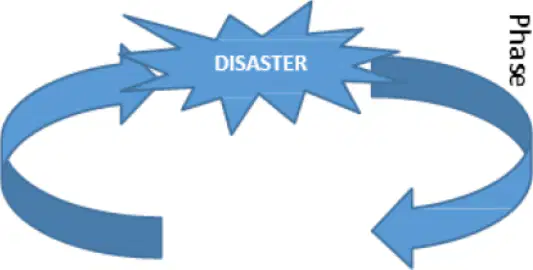
Which of the following is NOT part of the Pre-Disaster Risk Reduction Phase in the Disaster Management Cycle?
Preparedness
Development
Mitigation
Recovery
Which phase of the Disaster Management Cycle includes "Response," "Rehabilitation," and "Recovery"?
Pre-Disaster Risk Reduction Phase
Post-Disaster Recovery Phase
Disaster Preparedness Phase
Risk Assessment Phase
Increasing community vulnerability (V) in the disaster equation H x R + V = DISASTERS can impact the overall magnitude of a disaster, even if the hazard (H) and risk (R) remain constant, because:
It increases the overall magnitude of a disaster as more people or communities are affected, making the impact greater.
It decreases the magnitude of a disaster because people are more prepared.
Vulnerability has no effect if hazard and risk are constant.
It only affects the speed of recovery, not the magnitude.
The Disaster Management Cycle is considered a continuum rather than a single event because:
It involves a series of phased actions aimed at reducing vulnerabilities and managing risks over time.
Disasters only happen once.
It only focuses on recovery.
It ignores preparedness.
Which of the following is NOT listed as a risk management measure in the comprehensive risk management process?
Engineering measures
Land use planning and management measures
Increasing population density
Early warning
What is the main purpose of the comprehensive risk management process as described in the text?
To increase the frequency of natural hazards
To break the cycle of damage and reconstruction by reducing or minimizing the effects of hazards
To eliminate all natural hazards
To delay the implementation of safety measures
Which risk management measure involves preparing in anticipation of a hazard event?
Control and protection works
Preparedness planning
Reconstruction planning
Mainstreaming risk management
Why is the letter "E" represented by a single dot in Morse code?
It is the first letter of the alphabet
It is the most common letter in English
It is the shortest letter in the alphabet
It is the last letter in the alphabet
Which of the following is an internationally recognized distress signal using fire?
Two fires in a circle
Three fires in a triangle or straight line, 100 feet apart
Four fires in a square
One large fire
How does the International Whistle Code signal "Come here"?
One blast of the whistle
Two blasts of the whistle
Three blasts of the whistle
Four blasts of the whistle
Morse code is considered a useful method of telecommunication in emergencies because:
It requires expensive equipment and is difficult to learn.
It can be sent by improvised methods and is internationally recognized.
It is only useful for professional radio operators.
It is not recognized by international treaties.
The relationship between the duration of dots and dashes in Morse code is important for communication because:
Dashes are three times the duration of dots, which helps distinguish between different characters.
Dashes are the same length as dots, making them interchangeable.
Dots are longer than dashes, making the code harder to understand.
The duration does not matter in Morse code.
What is the primary aim of first aid according to the "Three P's"?
Preserve Life
Prevent Infection
Promote Comfort
Provide Medication
Which of the following is an example of "Prevent Deterioration" in first aid?
Performing CPR on an unconscious person
Asking a casualty with a broken limb to stay still and padding around the injury
Giving water to a casualty
Calling for help immediately
Which characteristic is NOT listed as a quality of a good first aider?
Gentle
Resourceful
Aggressive
Empathic
If you do not have a flashlight or torch, how can you signal for help using your body?
Stand still and wait
Wave your arms and hands sideways and down to attract attention
Sit on the ground and shout
Jump up and down quietly
Why is it important for a first aider to be observant?
To avoid causing pain
To notice all signs
To make the best use of things at hand
To maintain a professional attitude
Which of the following best describes the aim "Promote Recovery" in first aid?
Preventing further injuries by removing dangers
Arranging prompt emergency medical help and encouraging early healing
Performing CPR immediately
Giving the casualty food and water
A first aider should never put themselves or others in danger. What does this statement emphasize?
The importance of being resourceful
The need to preserve life, including your own
The need to promote recovery
The importance of being tactful
Which of the following is a correct way to signal SOS at night if you have a torch?
Flash the torch randomly
Cover and uncover the light from the angle of the targeted plane, ship, or helicopter
Wave the torch in circles
Turn the torch on and off slowly
What is the main purpose of first aid as defined by Encyclopedia Britannica?
To cure the patient completely
To prevent further harm being done
To provide medication
To transport the patient to the hospital
How can a first aider promote recovery for a burn victim?
By giving them food
By cooling the burn to reduce the risk of long-term scarring
By moving them immediately
By covering the burn with a thick cloth
Which of the following is NOT considered an unfavorable surrounding for providing first aid?
Night time
Crowded city lights
Well-equipped hospital
Cold and rainy weather
Why is it important to pay attention to the human body’s anatomical shape during wound treatment?
It affects the bandaging method
It determines the type of medicine used
It helps identify the victim
It makes the wound heal faster
What is the main objective of first aid when treating bleeding wounds?
To quickly stop blood outflow
To make the victim comfortable
To call for help
To clean the wound thoroughly
Which of the following is a reason why the presence of crowds can be a challenge for first aiders?
Crowds always provide correct advice
Crowds may demand haste or attempt improper procedures
Crowds help calm the victim
Crowds supply necessary materials
When bandaging a wound, why should the bandage not be tied too tightly?
It will make the wound heal slower
It will stop blood from flowing to the wounded area
It will make the victim uncomfortable
It will cause the bandage to fall off
If a victim is still conscious after an injury, what is the most important thing for them to do?
Move around to stay awake
Remain in a seating or standing position with the head highest
Lie down flat on the ground
Remove the bandage
Which of the following is a principle of treating bleeding wounds?
Stop blood outflow as quickly as possible
Wait for medical professionals before acting
Use any available cloth, clean or not
Ignore the wound if it is small
What should be used to cover a wound to prevent infection?
A sterile cloth or disinfectant
Any piece of clothing
Bare hands
Water only
How can a first aider check if a bandage is not too tight on a victim?
By asking the victim if it hurts
By checking if the pulse can still be felt beneath the bandage
By looking at the color of the bandage
By timing how long it takes to apply
What pressure can relatives or the victim exert on the first aider?
Pressure to perform a good examination
Pressure to act calmly and slowly
Pressure due to hysteria, pain, or possible early death
Pressure to leave the scene
What is an important consideration when applying a bandage to a wound?
The bandage should be very tight to stop the bleeding.
The bandage should be either very loose or very tight.
The bandage should not be too tight or too loose.
The bandage should only cover the wound partially.
If the victim is unconscious, what should you check for when applying a bandage?
The color of the bandage
Pulse signs around the wound area
The victim’s temperature
The victim’s breathing rate
Which of the following is the correct first step in treating a bleeding wound on a round body part?
Apply ice to the wound
Determine if a pressing tool is needed
Pour water on the wound
Remove any bandages already present
What is the correct procedure for binding a bandage around the head for a bleeding wound?
Start binding from the neck and move upwards
Start binding from the wound and bind around the head in circles, crossing the bandage upon arriving opposite the wound area
Bind only once around the head
Bind the bandage in a straight line across the forehead
After crossing the bandage around the head, what should you do next?
Remove the bandage and start over
Tie the bandage in the direction of the first binding
Tie the bandage in the shape of a parcel until arriving at the wound, then tie with a slipknot
Cut the bandage and leave it loose
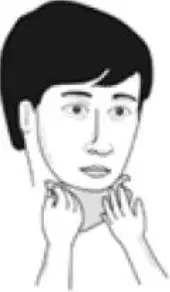
What is the purpose of using a triangular cloth when a wound exists on the chin or upper forehead?
To prevent the bandage from coming loose
To stop the bleeding immediately
To clean the wound
To cover the eyes
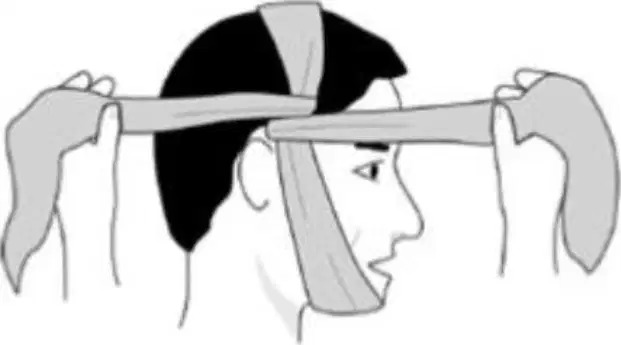
Which of the following is NOT a correct step when tying a bandage for a head wound?
Tie a pair of strings from bottom to behind the head, going above the ears
Tie another pair of strings behind the head via below the ears
Make sure the binding is very tight
Tie with a slipknot
What does the term "broken bone" refer to?
A wound that occurs on a bone, involving cracking, breaking, or sticking out of the body
A wound that only affects the skin
A muscle tear
A sprained ligament
Which of the following is a correct description of a "fractured bone"?
A bone experiences trauma/impact and may crack but not break apart
A bone breaks and sticks out through the skin
A bone breaks but is still inside the body
A bone is only bruised
Which symptom is NOT commonly associated with broken bone wounds?
Black and blue discoloration
Swelling
Itching
Change in form
A person has a bone that is broken and sticks out through the skin. What type of broken bone wound is this?
Fractured bone
Closed broken bone
Open broken bone
Bruised bone
It is important to ensure the binding of a head bandage is not too loose or too tight because:
Too loose may not secure the wound, too tight may restrict blood flow or cause discomfort
Too loose will make the patient sleepy, too tight will make them alert
Too loose will cause swelling, too tight will reduce swelling
Too loose will make the bandage look untidy, too tight will make it look neat
Broken bones are a common injury during an earthquake because:
People may be struck by building debris, trampled on, or squeezed
People may get sunburned
People may catch a cold
People may get dehydrated
Which of the following is a sign of a broken backbone?
Wounds on both head and neck
Difference in the length of the legs
Breathing difficulties
Swelling in the arms
What is the primary purpose of fixation in the first aid treatment of a broken bone wound?
To restore the bone to its original position
To minimize activity of the joints flanking the broken bone
To stop bleeding from the wound
To reduce swelling in the area
Which material is commonly used for splints in the treatment of a broken bone wound?
Metal rods
Wood lined with thin cloth or sponge
Plastic sheets
Rubber bands
What should you do first when treating an open broken bone wound?
Try to restore the bone to its original position
Cover the wound and then conduct a fixation
Apply ice to the wound
Massage the area gently
When treating a broken neck, what is the recommended first aid procedure?
Apply a splint to the neck
Prop up the neck to prevent any movement
Massage the neck gently
Use a cold compress
Why should you not try to restore a broken bone to its original position during first aid?
It may cause further injury
It is too painful for the victim
It is not necessary for healing
It is a waste of time
If no splints are available, what can be used to immobilize a broken lower arm?
Bind the broken arm to the victim’s body
Use a cold compress
Apply a tourniquet
Massage the arm gently
A victim with a broken collarbone should be treated by:
Using a splint and rope
Applying a shoulder binder to retain position
Massaging the collarbone
Forcing the bone back into place
A broken back requires which of the following actions?
Immediate splinting with wood
Lying down and using a flat, hard palanquin for transfer
Massaging the back
Applying a cold compress
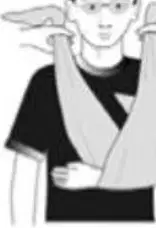
What does the diagram illustrate?
How to treat a broken leg
How to treat a victim with a broken arm
How to perform CPR
How to bandage a head wound
Which of the following best describes Basic Life Support (BLS)?
A level of medical care for life-threatening illnesses or injuries until full medical care is available
A type of surgery performed in hospitals
A routine health check-up procedure
A method for treating minor wounds at home
Approximately how many cardiac arrests occur per year in Europe, according to the learning material?
700,000
70,000
1,000,000
100,000
What is the current survival rate to hospital discharge after cardiac arrest in Europe?
5-10%
20-30%
50-60%
1-2%
Which of the following actions is NOT part of the initial protective device steps in BLS?
Approach safely
Check response
Administer medication
Shout for help
What does the "A" in the ABCs of Basic Life Support stand for?
Airway
Alertness
Assistance
Action
What should you do if a person responds when you check for a response during BLS?
Leave as you find him, find out what is wrong, and reassess regularly
Immediately start chest compressions
Move the person to a different location
Ignore the response and call for help
Why is early resuscitation and prompt defibrillation important in cases of sudden cardiac arrest?
It can result in greater than 60% survival
It prevents all types of injuries
It guarantees 100% recovery
It is only necessary for minor injuries
What is the purpose of the "Chain of Survival" in Basic Life Support?
To restore the circulation of oxygenated blood after sudden pulmonary and/or cardiac arrest
To provide medication to the patient
To transport the patient to the hospital
To diagnose the cause of the cardiac arrest
Which of the following correctly describes the sequence of actions and their importance when you are the first person to arrive at the scene of a suspected cardiac arrest?
Call 9-1-1, wait for help, then check response; only calling for help is important
Approach safely, check response, shout for help, open airway, check breathing, call 9-1-1; each step ensures safety, assessment, and timely intervention
Immediately start chest compressions without checking anything; compressions are the only important step
Move the victim to a different location before starting any assessment; location is the most important factor
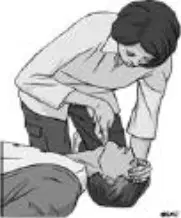
Which of the following is the correct procedure to open the airway in a non-healthcare setting?
Perform a finger sweep immediately
Use the head tilt and chin lift method
Only lay the rescuer down
Use a solid object to open the mouth
What is agonal breathing, and why is it important to recognize during cardiac arrest?
It is normal breathing after exercise and should be ignored.
It is a sign of cardiac arrest and is described as barely, heavy, noisy, or gasping breathing.
It is a type of breathing that occurs during sleep.
It is a sign of recovery from cardiac arrest.
Which of the following is NOT a potentially reversible cause of cardiac arrest according to the 5 H’s and 5 T’s?
Hypoxia
Hyperthermia
Thrombosis coronary
Tension pneumothorax
What is the correct rate and depth for chest compressions during CPR?
60 min-1, 2-3 cm
80 min-1, 3-4 cm
100 min-1, 4-5 cm
120 min-1, 6-7 cm
When performing rescue breaths, what should you do to ensure the breath is effective?
Blow as hard as possible regardless of chest movement
Pinch the nose, take a normal breath, and blow until the chest rises
Only blow for half a second
Do not allow the chest to fall between breaths
Under which circumstances should you stop performing CPR?
When the victim is still unresponsive after 5 minutes
When you feel tired
When trained help arrives or the victim revives
When the victim is breathing agonal breaths
Why might CPR fail even if performed?
The victim is too young
Delay in starting and improper procedures
The victim is breathing normally
The rescuer is a healthcare professional
What is the primary purpose of rappelling?
To ascend a steep terrain using a fixed rope
To descend a steep terrain using a fixed rope
To cross a river using a rope
To tie knots for rescue operations
Which of the following is a key safety consideration before starting to rappel?
Check the weather forecast
Verify the rope reaches the target
Wear brightly colored clothing
Bring extra food and water
What does the “B” in the B.R.A.K.E.S. safety acronym stand for?
Brakes
Buckles
Backup
Balance
Why is it important to keep the brake hand below the descending device while rappelling?
To increase speed during descent
To prevent the rope from tangling
To maintain control and safety during descent
To avoid getting sunburned
Which of the following actions should be avoided during a rappel to prevent dangerously shocking the rappel anchor?
Descending slowly
Bouncing during the rappel
Using a backup Prusik
Wearing gloves
What is the function of a descender or friction device in modern rappelling techniques?
To tie knots in the rope
To provide friction for controlled descent
To anchor the rope to a tree
To signal for help
Which of the following best describes the original body rappel known as the “Dulfersitz”?
Using a mechanical descender for friction
Running the rope around the rappeller’s body for friction
Attaching the rope to a carabiner only
Using gloves to hold the rope

