
 Worksheets
SPS1 - SPS4 EOC Review
Total questions: 112
Worksheet time: 4hrs 26mins
Group 1 of the periodic table is called the...
Halogens
Noble Gases
Transition Metals
Alkali Metals
Group 17 of the periodic table is called the...
Halogens
Noble Gases
Transition Metals
Alkaline Earth Metals
Elements on the periodic table are arranged by...
relative atomic mass
date of discovery
atomic number
number of electrons
The group number tells you
the number of electron shells an element has
the number of electrons in the outer shell of an atom
the number of electrons needed to fill the outer electron shell
the ion that an atom will make
The period number tells you how many
outer electrons there are in an atom
electron shells an atom has
ions an atom can form
bonds an atom can make
Elements from group 2 will form with a charge of
+1
+2
-2
-1
Atoms from group 16 will generally form ions with a charge of
+1
+2
-2
-1
Isotopes of an element have the same atomic number but different mass numbers
True
False

How many neutrons does an atom of Li have?
7
4
3
10
What is the maximum number of electrons in the first shell?
8
4
6
2
What is the optimum number of electrons an atom likes in its outer shell?
2
6
4
8
Hydrogen is the only atom that does not have a neutron.
True
False

What is the atomic number of nitrogen?
7
14.007
N
28

What is the atomic mass of nitrogen?
7
15
14.007
.007
What is an element?
A pure substance that cannot be broken down into simpler substances by chemical means.
A mixture of two or more substances that can be separated by physical means.
A compound formed by the chemical combination of two or more elements.
A substance that can be broken down into simpler substances by chemical means.
What is the mass number defined as?
The number of protons and neutrons
The number of electrons in an atom
The total number of particles in the nucleus
The average mass of an atom
What is an isotope?
Atoms of different elements that have the same number of protons.
Atoms of the same element that have the same number of protons but different numbers of neutrons.
Atoms that have the same number of neutrons but different numbers of protons.
Atoms that are chemically identical but have different atomic masses.
What are charged atoms?
Molecules
Ions
Isotopes
Compounds
Which elements share similar chemical properties?
Na + Mg
Na + K
O + F
Na + F
An atom of Nitrogen has 7 protons, 10 electrons, and 7 neutrons.
What is the atomic number (AN) of this atom?
What is the atomic mass (AM) of this atom?
What is the ionic charge (IC) of this atom?
AN = 7
AM = 7
IC = -3
AN = 7
AM = 14
IC = 0
AN = 7
AM = 14
IC = -3
AN = 7
AM = 7
IC = +3
Which of the following is a property of Alkali Metals (Group 1)?
They are so hard they cannot be cut.
They are very, very reactive.
They are stored in water.
They have few uses.
A Beryllium (Be) atom has 4 protons, 5 neutrons, and 4 electrons. What is the Atomic Mass of Be?
4
5
9
8
Which Group carries a +2 Ionic Charge?
Group 1
Group 2
Group 16
Group 17
Identify the following property as a property of a metal or a nonmetal.
Dull
Metal
Nonmetal
Identify the following property as a property of a metal or a nonmetal.
Mostly gases at room temperature.
Metal
Nonmetal
Identify the following property as a property of a metal or a nonmetal.
Shiny
Metal
Nonmetal
How do ionic bonds form between atoms?
Ionic bonds form when two atoms share electrons equally.
Ionic bonds form when one atom donates an electron to another atom, resulting in the formation of charged ions that attract each other.
Ionic bonds form when atoms collide and fuse together.
Ionic bonds form when atoms are held together by magnetic forces.
Why do noble gases rarely form bonds with other elements?
They have a full outer shell of electrons, making them stable and unlikely to react with other elements.
They have a high electronegativity, which makes them very reactive.
They are found in solid form at room temperature, preventing them from bonding.
They have a low atomic mass, which makes them unstable.
What charge do atoms from group 16 typically form when they become ions?
+1
0
-1
-2
Noah, Lily, and Aiden are in a chemistry class. Their teacher asks, 'Which of the following are most directly involved in chemical bonding during a chemical reaction in a real-world scenario like the formation of water from hydrogen and oxygen?'
protons
neutrons
alpha particles
valence electrons

Aria and David are studying chemistry and they come across the elements magnesium (Mg) and bromine (Br) in the Periodic Table. Avery joins them and asks, 'What would be a characteristic of the compound MgBr2 that we could observe if we had it in our lab?'.
It has a high melting point.
It is formed by covalent bonds.
It is a gas at room temperature.
It does not conduct electricity when dissolved in water.

Mia, Noah, and Maya are studying the structure of a methane molecule for their chemistry project. They are discussing the relationship between the carbon and hydrogen atoms in the methane molecule. Which statement correctly describes their discussion?
They are held together by ionic bonds.
They share electrons to form covalent bonds.
They bond to each other since all are positively charged.
They are attracted to each other because of neutrons.
Liam, James, and Isla are in a chemistry class. Their teacher explains that when cations and anions join during a chemical reaction, they form a specific type of chemical bond. What is the name of this bond?
ionic
covalent
hydrogen
metallic
Benjamin, Abigail, and Kai are working on a science project. They are testing different types of compounds to see which one is more likely to conduct electricity. Which type of compound should they test?
Ionic compounds
Covalent compounds
Neither ionic nor covalent compounds
Both ionic and covalent compounds
Ethan, Mia, and Rohan are in a chemistry class. Their teacher asked them to determine the formula for a stable binary ionic compound that would form if sodium and chlorine were combined in a lab experiment. What would be their answer?
NaCl2
NaCl3
Na2Cl
NaCl
Abigail, Aiden, and Noah are studying chemistry. They come across a problem where they need to determine the formula when magnesium (Mg2+) and fluorine (F-1) combine in an ionic bond. What would be the resulting formula?
Mg2F
Mg2F2
MgF
MgF2

Charlotte, Oliver, and Benjamin are working on a chemistry project. They have a model of sodium and fluorine atoms. They want to change the model to represent an ionic bond between sodium and fluorine. How should they do it?
move 7 electrons from the fluorine model to the sodium model
move one electron from the fluorine model to the sodium model
move one electron from the sodium model to the fluorine model
Nothing. The model already shows an ionic bond.

Benjamin, Avery, and Michael are studying chemistry and they come across a binary ionic compound represented by the atoms shown. Which of the following options correctly represents this compound?
Al2O3
Al3O2
O3Al2
O2Al3
Liam, Kai, and Michael are working on a chemistry project where they have to identify compounds using IUPAC nomenclature rules. They come across a compound: K2O. What should they correctly identify this compound as?
potassium oxide
dipotassium oxide
potassium (I) oxide
dipdipotassium monoxide
Nora, Maya, and Luna are studying chemistry together. They came across a compound with the formula NO. They started debating about its name according to IUPAC nomenclature rules. Can you help them?
nitrogen oxide
nitrogen oxygen
nitrogen monoxide
mononitrogen monoxide
James, Avery, and Benjamin are in a chemistry class. Their teacher asks them to identify the chemical formula for Carbon Tetrafluoride. What should they answer?
C4F
CF
C4F4
CF4
Arjun, Elijah, and Mason are working on a chemistry project about common gases. They came across a gas called dinitrogen tetroxide. Can you help them figure out the correct chemical formula for this gas?
N2O4
N2O3
N3O2
N4O2
Oliver, Noah, and William are studying for their chemistry exam. They come across a question in their textbook: 'Which of the following formula and chemical name combinations is correctly shown?'
N2O2; nitrogen dioxide
N2O5; dinitrogen pentoxide
Ca2P3; dicalcium diphosphide
PCl5; phosphorus tetrachloride
Lily, Jackson, and Abigail are in a chemistry lab. They come across a compound with the formula Ba3N2. They are curious to know its chemical name. Can you help them?
Barium Nitride
Dibarium trinitride
Tribarium dinitride
Nitrogen bariumide
Aria, Harper, and Liam are working on a chemistry project about different chemical compounds. They came across a compound called dinitrogen monoxide. Can you help them figure out the correct chemical formula for this compound?
N2O
N2O2
N3O
N2O3
Charlotte and Benjamin are in a chemistry lab. They are given potassium (K+) and iodine (I-1) to combine in an ionic bond. Scarlett, their lab assistant, asks them to predict the resulting formula. What will it be?
KI
K2I
KI2
K2I2
What is the name of the compound P3O5?
Triphosphorus pentaoxide
Phosphorus pentaoxide
Triphosphorus oxide
Phosphorus oxide
Name the following: MgO
Magnesium Oxide
Monomagnesium monoxide
Magnesium monoxide
Magnesium (II) oxide
Name the following: N2O5
Nitrogen oxide
Dinitrogen pentoxide
Nitrous oxide
Nitrogen pentoxide
A charged atom that has lost one or more electrons and become positively charged.
Anion
Atom
Cation
Ion
A bond between a metal and a nonmetal is called a(n)
covalent bond
ionic bond
metallic bond
transfer bond

Which of these is covalent?
NaCl
KBr
CO2
AlCl3

In an ionic bond the non-metal wants to ______ electron(s).
lose
gain
share
Name the following compound: AlCl3
Aluminum trichloride
Aluminum chloride
monoaluminum chloride
monoaluminum trichloride
What is the formula for lithium nitride
LiN
LiN3
Li3N
LiN2
Hydrazine (N2H4) is a chemical compound used in rocket fuel. Which of the following represents the correct balanced equation for the reaction of hydrazine liquid with oxygen gas to produce nitrogen gas and steam?
N2H4 + O2 N2 + H2O
N2H4 + O2 N2 + 2H2O
N2H4 + 2O2 N2 + H2O
N2H4 + 2O2 2N2 + H2O
An unbalanced chemical equation is shown below.
CH4 + O2 → CO2 + H2O
Which is the correctly balanced equation for the expression?
CH4 + 2O2 → CO2 + H2O
CH4 + 3O2 → CO2 + H2O
2CH4 + O2 → CO2 + H2O
CH4 + 2O2 → CO2 + 2H2O
Potassium chloride can be produced from potassium metal and chlorine gas. Which of the following is the correct, balanced equation for the production of potassium chloride?
4K(s) + Cl2(g) → 2K2Cl(s)
K(s) + Cl2(g) → KCl(s)
2K(s) + Cl2(g) → 2KCl(s)
K(s) + Cl2(g) → KCl2(s)
An unbalanced chemical equation is shown below.
NO + O2 → NO2
Which is the correctly balanced equation for the expression?
NO + O2 → 3NO2
NO + 2O2 → 2NO2
2NO + O2 → 2NO2
2NO + O2 → NO2
During combustion, methane yields carbon dioxide and water. The unbalanced equation for this reaction is:
CH4 + O2 CO2 + H2O
What coefficients are needed in order to balance this equation?
1, 1, 1, 2
1, 2, 1, 2
5, 4, 3, 6
1, 1, 2, 1
An unbalanced chemical equation is shown below.
Al + O2 → Al2O3
Which is the correctly balanced equation for the expression?
4Al + O2 → 2Al2O3
4Al + 3O2 → 2Al2O3
3Al + 2O2 → Al2O3
2Al + 3O2 → Al2O3
Potassium (K) combines with magnesium bromide (MgBr2) to form potassium bromide (KBr) and magnesium (Mg) during a chemical reaction.
Which of the following shows the balanced chemical equation for this reaction?
2K + MgBr2->2KBr + Mg
2K + MgBr -> 2KBr + Mg
K + MgBr2->KBr + Mg
K + MgBr2->KBr2 + Mg

14,18
25,18
2,14
16.18
The chemical equation below shows the process of forming water. Balance the equation by calculating the coefficients.
H2 + O2 H2O
2, 1, 2
1, 1, 2
1, 2, 2
1, 1, 1
Balanced chemical equations demonstrate
the law of conservation of mass.
the law of inertia.
the law of universal gravitation.
the law of superposition.
An unbalanced chemical equation is shown below.
CH4 + O2 CO2 + H2O
Which of the following particle diagrams correctly represents the balanced form of the equation?


What are the changes in nuclear structure as a result of fission and fusion?
The nucleus becomes larger in fission and smaller in fusion.
The nucleus becomes smaller in fission and larger in fusion.
The nucleus remains the same size in both fission and fusion.
The nucleus becomes unstable in fission and stable in fusion.
Which process involves the splitting of a nucleus into two smaller nuclei?
Fusion
Radioactive decay
Half-life
Fission

Uranium is bombarded by a neutron to start the process of fission as shown by the nuclear equation.
What is needed to complete the equation?
3 neutrons
3 beta particles
3 alpha particles
3 hydrogen atoms

The diagram shows 2 hydrogen isotopes combining and producing helium and a neutron. What process is respresented by the diagram?
alpha decay
beta decay
fission
fusion

Uranium-238, the most prevalent isotope in uranium ore, has a half-life of 4.5 billion years and spontaneously decays by alpha emission to thorium-234. If a sample of uranium ore contains 1,000 grams of uranium-238, how long will it take for 875 grams to decay to thorium-234? (875 grams is how much that has been lost/decayed. So 1000-875 = ? Based on that, how many half lives have taken place)
4.5 billion years
9.0 billion years
13.5 billion years
18.0 billion years
What are the benefits of nuclear energy as an alternative energy source?
Nuclear energy has a high energy output and reduces greenhouse gas emissions.
Nuclear energy produces no waste and is completely safe.
Nuclear energy is cheap and readily available.
Nuclear energy is renewable and has no negative impact on the environment.

If the half-life of iodine-131 is 8 days, how much of a 5.0g sample is left after 32 days?
2.5g
1.25g
0.625g
0.3125g

Potassium-40 has a half-life of 1.28 billion years. What is the age of a rock in which 87.5% of the potassium-40 atoms have decayed to argon-40?
1.28 billion years
2.56 billion years
3.84 billion years
7.68 billion years

How many half-lives have elapsed when the amount of a sample’s radioactive isotope is reduced to 3.125% of the original amount?
5
4
3
2
Which of the following is an example of a nuclear energy application?
Solar power
Hydroelectric power
Wind power
Nuclear power plants
What is the main problem associated with nuclear energy?
Nuclear waste disposal
High cost of production
Limited availability
Environmental damage
Barium-122 has a half-life of 2 minutes. A fresh sample weighing 80 g was obtained. If it takes 4 minutes to set up an experiment using barium-122, how much barium-122 will be left when the experiment begins?
40g
2.5g
20g
80g


Which of the following 2 are chemical reactions?
sugar dissolving in water
water turning into steam
burning wood
mixing baking soda and vinegar
tearing paper

nuclear decay
nuclear fission
nuclear fusion
nuclear half-life


What reaction has the following general formula:
A + CD --> C + AD
Synthesis
Decomposition
Single Replacement
Double Replacement
Combustion
What reaction has the following general formula:
AB + CD --> CB + AD
Synthesis
Decomposition
Single Replacement
Double Replacement
Combustion
Al + O2 → 2Al2O3
146C --> 0-1e + ________
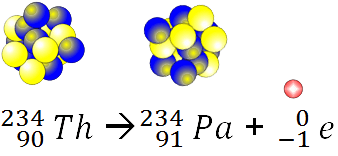
What kind of decay is shown in this reaction?
94Be + 11H → 63Li + 42He
alpha
beta
gamma
fusion


Identify the missing variable in the following reaction.


Identify the missing variable in the following reaction.

Identify the missing variable in the following reaction.

Identify the missing variable in the following reaction.


Which identifies the correct type of decay and shows the correct formula for the reaction shown?



What particle completes this reaction?
42He
0-1 e
00γ
178O

What particle completes this reaction?
42He
0-1 e
00Y
178O
94Be + 11H → _____ + 42He
20985At = ___ + 42He
6027Co = ___ + 0-1e
85209At = ___ + 24He

