
 Worksheets
Life Science CFE Review
Total questions: 107
Worksheet time: 1hrs 7mins
The rat snake is found in a wide array of environments. They are found in woods, along the coast, in cities, and in mountains. They eat rats, birds, mice, and squirrels. Rat snakes also have varied appearances. There are gray ones, yellow ones, black ones, and mixes of these colors, depending on where they live. Which of the following explains the differences in colors of the rat snake?
The rat snakes' colors are adaptations caused by natural selection, which help them blend into and hunt for food in their environment.
The rat snakes' colors vary because they eat different foods in different environments that make their skin color change.
The rat snakes' colors vary as a result of artificial selection, which allows them to choose the best color suited for their environment.
The rat snakes' colors vary because they have the ability to change their color like achameleon in response to a changing environment.

The picture below shows the forelimbs of three different organisms: a bat, a bird, and a horse. All of these animals originally are descended from a common ancestor.
What is most likely responsible for the changes that occurred to form distinctly different organisms over millions of years?
The organisms' environments changed, and natural selection diversified each species.
The damage from basic injuries cause mutations to occur that passed onto offspring.
The organisms created new traits and species through selective breeding.
The introduction of humans allowed for artificial selection to take place.
If scientists were to compare the fossil of a fern that lived millions of years ago with other fern fossils that were formed later, what would they most likely find?
that plants had bones millions of years ago
that plants change over time
that ferns stopped evolving 25 million years ago
that only animals evolve
The longnose butterfly fish has a dark spot near its tail that looks like an eye. Its "eyespot" makes predators think they are attacking the head rather than the tail. Why does the longnose butterfly fish have an evolutionary advantage over other fish?
It is more effective at finding mates than other fish.
It is more effective at catching shrimp and worms than other fish.
It is likely to produce more offspring that survive to maturity.
It uses less energy to swim than other fish.
Which of the following is NOT a domain?
Protist
Bacteria
Archaea
Eukarya
Which of the following lists is in correct order from largest to smallest? (Broadest group to most specific group)
Domain, Kingdom, Phylum, Class, Order, Family, Genus, Species
Domain, Kingdom, Phylum, Class, Family, Order, Genus, Species
Species, Genus, Family, Order, Class, Phylum, Kingdom, Domain
Kingdom, Domain, Phylum, Class, Order, Family, Genus, Species
What terms are included when writing the scientific name of an organism?
genus, species
domain, kingdom
species, class
kingdom, species
Why did Linnaeus use Latin words to name organisms?
To provide a common language that scientists everywhere could understand.
He wanted other scientists to learn Latin.
It was his native language.
To prevent other scientists from copying his notes.
What are the rules for naming an organism with a scientific name?
write it how ever you want
Capitalize Genus, lowercase species, underline or italicize entire word
Capitalize both Genus and species, underline or italicize the entire word
Capitalize Genus, lowercase species, make the entire word in bold print
Which kingdom contains eukaryotic cells; multicellular; cell walls; and producers?
plant
animal
fungi
bacteria
Polar bears live in the Arctic. Ice in the Arctic is melting rapidly, reducing the range in which the polar bear can live. If polar bears do not have adaptations that allow them to survive these changes, what may happen to the polar bear?
They may overpopulate.
They may become extinct.
They may change the environment.
They may become another species.

Using the picture, which statement is correct?
These forelimbs have similar bones, indicating that the organisms share a common ancestor.
These forelimbs have similar bones, indicating that organisms all live in the same habitat.
These forelimbs have similar bones, indicating that the organisms all have the same diet.
These forelimbs have similar bones, indicating that the organisms’ evolution happened quickly.

The diagram below shows the changes over time in a population of mice in the wild after a population of hawks has moved into their environment. The white and dark mice differ only in color. Which statement is the most likely explanation for why the mouse population changed over time?
The hawks eat more dark mice than white mice because the dark mice taste better.
The white mice are able to reproduce more successfully than the dark mice do.
The hawks eat more white mice than dark mice because they can see the white mice more easily.
The hawks eat more dark mice than white mice, because they can see the dark mice more easily.

The picture shows the finches that Darwin observed on the Galapagos Islands in 1835. Why do these finches have different beaks?
because environmental changes have altered the available food sources, allowing the finches with suitable beaks to survive and reproduce
because birds from all over the world have flown to breed the finches, causing the finches to carry the traits of other birds
because the finches were artificially selected to acquire different genetic traits
because the finches' beaks changed shape as they grew from adolescents into adults
Which of the following are in order from smallest to largest?
atom, molecule, cell, tissue, organ, organ system, organism
atom, molecule, tissue, cell, organ, organ system, organism
organism, organ, tissue, cell, molecule, atom
molecule, atom, cell, tissue, organ, organism
What type of cells have many specialized organelles?
eukaryotic cells
prokaryotic cells
stem cells
organ cells
What makes cells particularly special?
They contain a nucleus
They can be observed with microscopes
They're the smallest LIVING thing
They're made of atoms and molecules
Which of the following is the MOST COMPLEX level?
Tissue
Organelle
Cell
Organ

The Cell Theory says:
All organisms are made of cells

The Cell theory says:
The cell is the basic unit of life
What is the purpose of photosynthesis?
to make glucose
make ATP
make light energy
release carbon dioxide
What is the purpose of cellular respiration?
to get usable energy for cells
to get food for cells
to get oxygen to breath
to release water from cells
What is glucose?
sugar
alcohol
chemical element
energy molecules
Which process releases more energy?
cellular respiration
photosynthesis
glycolysis
lactic acid fermentation
Why do animals need to eat food?
to gain glucose which can be broken down
to get oxygen from the plant based products we eat
to get the lactic acid produced during fermentation
to directly gain energy from the sun
Which of the following statements best explains the general process of cellular respiration?
Living organisms use energy from the sun and water to create food in the form of sugar.
Living organisms take in oxygen and water to create food in the form of sugars and energy.
Living organisms breakdown sugar from food to combine with oxygen making usable energy.
Living organisms take in oxygen and release carbon dioxide through the cells thereby providing energy.
In order to improve their recovery after an intense work out or competition, many high-level athletes use "cool downs" to rapidly slow down their movements, by eating a snack, and breathing deeply. What choice below accurately explains how these steps aid cellular respiration?
Eating a snack takes in more energy which converts to sugar needed by the body to produce oxygen to begin cellular respiration.
Cooling down in this way they are able to take in oxygen and sugar, which allows their cells to produce energy through cellular respiration.
Breathing deeply and eating a snack releases more carbon dioxide and sugar, which leads to more energy for cellular respiration to begin.
Cooling down in this way they are able to take in carbon dioxide and water which allows their cells to produce energy through cellular respiration.
Which of the following options best explains how less chlorophyll would affect the process of photosynthesis in plants?
It would increase the rate of photosynthesis because of the increased production of food.
It would limit the amount water plants are able to take in, resulting in a slower rate of photosynthesis.
It would increase the production of oxygen because the plant would need to work hard to feed themselves.
It would limit the amount of light absorbed by the plant and decrease the amount of food the plant is able to produce for itself.
Which option below best explains how animal cells are able to use cellular respiration to carry out cellular functions?
Food provides energy and water provide oxygen, which is used to break down carbon dioxide for other cellular functions.
Water molecules found in cell vacuoles are broken down release energy and oxygen which is used for other cellular functions.
Cellular respiration breaks down stored carbon dioxide found in the body to release oxygen which is then used for cellular functions.
Breathing provides oxygen and food provides glucose, which allows cells to breakdown glucose releasing energy for the cell to carry out other functions.
Which two organelles are only found in plant cells?
chloroplast and cell wall
chloroplast and vacuole
cell wall and vacuole
cytoplasm and chloroplast
The cell theory states that all organisms are made of cells; cells are the most basic unit of life; and
all existing cells come from other cells
all cells have a nucleus
all cells are eukaryotic
all existing cells form by free-cell formation
Which of the following structures are typically present in both plant and animal cells?
mitochondria
cell wall
centrioles
chloroplast
Which structures allow plants to support heavy structures such as leaves and flowers?
the vacuoles because they fill with fluid and provide rigidity
the Golgi apparatus because it packages proteins for storage
the chloroplasts because they convert sunlight into chemical energy
the cell membrane because they regulate what enters and leaves the cell
Which organelle is referred to as the "Power House" of the cell? (It creates usable energy for the cell.)
mitochondria
chloroplast
cytoplasm
ribosome
What are the organelles that store food, water, and waste material are called?
cell membrane
vacuoles
mitochondria
cell wall
What is the stiff outer layer that protects the cells of plants only?
cell membrane
vacuoles
mitochondria
cell wall
What is the flexible protective layer around all animal and plant cells?
cell membrane
vacuoles
mitochondria
cell wall
What are various structures within the cytoplasm of eukaryotic cells?
Golgi Apparatus
Cytoplasm
Nucleus
Organelles
Which organelle is necessary for photosynthesis?
Golgi apparatus
Chloroplasts
Mitochondrion
Rough endoplasmic reticulum
What directs all the activities of the cell?
Golgi Apparatus
Cytoplasm
Nucleus
Organelles
What is the gelatin-like material inside the cell membrane?
Golgi Apparatus
Cytoplasm
Nucleus
Organelles
Where is the energy in food stored until it is released?
cell membrane
vacuoles
mitochondria
cell wall

Having attached or unattached earlobes is an inherited trait. Attached earlobes occur in individuals with the genotype ee. What is the relationship between an individual’s chromosomes and the genes for earlobe attachment?
The genes for earlobe attachment are located on the chromosomes of each cell.
The chromosomes for earlobe attachment are made up of cells.
The genes for earlobe attachment come from one parent and the chromosomes for earlobe attachment come from the other.
The chromosomes for earlobe attachment are located on the genes of each cell.

If a person has attached earlobes (ee) but neither of the parents have attached earlobes, what can we infer?
They inherited the trait from grandparents.
The parents both have a heterozygous genotypes.
The parents both have a homozygous genotype.
At least one parent carries the gene for attached earlobes.

If a unicorn with heterozygous pink hair mates with a unicorn with aqua hair, what are the chances of their offspring having pink hair? (Hair color shows complete dominance in this species.)
50%
100%
25%
0%

What is the proper term for a genotype with one dominant allele and one recessive allele?
heterozygous
homozygous recessive
homozygous dominant
heterozygous dominant
When Mendel crossed his purple hybrid pea plants, what was the resulting phenotypic ratio of the offspring?
3:1
1:2:1
1:1
2:1
G = green, g = teal
The genotype for teal monster fur is ...
gg
Gg
GG
teal
What does heterozygous mean?
An organism that has different genes for a trait
An organism that has the same genes for a trait
When neither gene is fully dominant; offspring is a mixture of both
the different forms of a trait (hair color--> brown, blonde, red

Brown fur(BB) and black fur(bb) are codominant in Wookies. If a heterozygous male mates with a brown female, what is the chance they will have a baby with both black and brown fur?
50%
25%
75%
100%
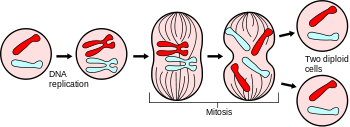
If you fall and scrape your knee, what process is likely to start happening in that area?
mitosis
meiosis
cytokinesis
karyotyping
Which process increases genetic diversity in organisms?
meiosis
mitosis
cell cycle
genetic testing
In meiosis, the daughter cells are identical to the parent cell.
True
False
In mitosis, the daughter cells are identical to the parent cell.
True
False
Why does meiosis take place?
to produce haploid sex cells
to help repair damaged tissue
to provide new cells for growth and development
to provide new cells for growth and development
Which choice correctly matches a type of cell with how it is produced?
Egg cell --> meiosis in males
Sperm cell --> mitosis in males
Body cell --> mitosis in females
Body cell --> meiosis in females
In sexual reproduction, how much DNA is given by each parent?
50%
30%
100%
70%
Which is a type of asexual reproduction?
Mitosis
Meiosis
Which is a type of sexual reproduction?
Mitosis
Meiosis
FERTILIZATION OCCURS WHEN
THE SPERM UNITES WITH THE EGG
THE SPERM UNDERGO MEIOSIS
THE EGG UNDERGOES MEIOSIS
THE EGG AND SPERM UNDERGOES MEIOSIS
The products of cellular respiration are
carbon dioxide and oxygen
carbon dioxide and water
oxygen and water
glucose and oxygen
Which chemical equation best represents the process of photosynthesis?
6CO2 + 6O2 --> C6H12O6 + H2O
6CO2 + 6H2O --> C6H12O6 + 6O2
6O2 + 6H2O --> C6H12O6 + 6CO2
C6H12O6 + 6O2 --> 6CO2 + 6H2O
What is the correct equation for cellular respiration?
6O2 + C6H12O6 -> 6CO2 + 6H2O + ATP
6CO2 + 6H2O -> 6O2 + C6H12O6 + ATP
6O2 + C6H12O6 + ATP -> 6CO2 + 6H2O
6CO2 + 6H2O + ATP -> 6O2 + C6H12O6
What gas is produced by plants during photosynthesis?
oxygen
carbon dioxide
ethanol
water

What process is shown in the diagram?
cellular respiration
photosynthesis
fermentation
mitochondria
What is the name of the pigment contained in the thylakoid membrane that's job is to absorb light?
chlorophyll
chloroplast
hydrophyll
matrix
How are cellular respiration and photosynthesis related?
The products in one process are the reactants in the other process.
They both require sunlight.
They both take place in plants and animals.
They organelles are the exact same for each process.
Which of the following statements best explains the general process of cellular respiration?
Living organisms use energy from the sun and water to create food in the form of sugar.
Living organisms take in oxygen and water to create food in the form of sugars and energy.
Living organisms breakdown sugar from food to combine with oxygen making usable energy.
Living organisms take in oxygen and release carbon dioxide through the cells thereby providing energy.
Which of the following options best explains how less chlorophyll would affect the process of photosynthesis in plants?
It would increase the rate of photosynthesis because of the increased production of food.
It would limit the amount water plants are able to take in, resulting in a slower rate of photosynthesis.
It would increase the production of oxygen because the plant would need to work hard to feed themselves.
It would limit the amount of light absorbed by the plant and decrease the amount of food the plant is able to produce for itself.
Which option below best explains how animal cells are able to use cellular respiration to carry out cellular functions?
Food provides energy and water provide oxygen, which is used to break down carbon dioxide for other cellular functions.
Water molecules found in cell vacuoles are broken down release energy and oxygen which is used for other cellular functions.
Cellular respiration breaks down stored carbon dioxide found in the body to release oxygen which is then used for cellular functions.
Breathing provides oxygen and food provides glucose, which allows cells to breakdown glucose releasing energy for the cell to carry out other functions.
How does the process of photosynthesis provide evidence for the Law of Conservation of Mass?
The total mass of glucose created at the end of photosynthesis equals the amount of carbon dioxide used.
In photosynthesis the total amount of carbon dioxide and water used to produce energy and oxygen will equal the total mass.
In photosynthesis the total amount of glucose and oxygen produced will equal the total amount of water and carbon dioxide initially used.
The total mass will not change in photosynthesis since equal amounts of oxygen and water are produce when equal amounts of energy and carbon dioxide used.
Which example describes a consumer?
an organism that eats other organisms
an organism that makes its own food
an organism that breaks down dead material for food
Humans have symbiotic relationships with bacteria that live in the digestive system. The bacteria help the digestive process, and they receive food in return. What type of symbiotic relationship is this?
mutualism
commensalism
parasitism
predation
Food shortages, natural disasters, disease, and predation can reduce population size. These are examples of
limiting factors
ecosystem
carrying capacity
adaptations

Mangrove trees are common to the Florida Everglades. The tree roots serve as a place for freshwater oysters to attach when the tide is high, as shown in the picture below. The oysters are protected from predators when attached to the roots underwater. The oysters do not harm the trees nor do they provide any benefit to the trees. What kind of relationship exists between the mangrove tree and the oysters?
commensalism
mutualism
parasitism
symbiosis
Jane went for a walk on the farm. First, she saw a mosquito land on her arm and bite her. Second, she saw a hawk capture a mouse. Last, she noticed a bird riding on the back of a cow and eating the bugs off it. What is the order of the relationships Jane saw at the farm?
parasitism, predation, mutualism
commensalism, parasitism, symbiosis
predation, competition, mutualism
competition, predation, commensalism
Devon noticed that it has rained much more this year than it did in each of the previous 10 years. How might this increase in rainfall affect populations in the area?
Populations for whom water is a limiting factor will decrease in size
Populations for whom water is a limiting factor will increase in size
Populations for whom water is not a limiting factor will increase in size
Populations for whom water is not a limiting factor will decrease in size
Oxygenated blood is necessary for proper bodily functions. If there isn’t enough oxygen in a person’s blood they can become light headed, disoriented, and feel extremely tired. If a person has these symptoms, what two systems need to work together to correct the problem?
the digestive system and the nervous system
the circulatory system and the digestive system
the circulatory system and the respiratory system
the respiratory system and reproductive system
Due to poor diets or health issues, the lower intestines can become blocked from time to time. What answer below best explains what system is affected and what function is occuring?
The excretory system is unable to remove waste.
The digestive system is creating more waste than the body can process.
Muscle contraction in the musculoskeletal system prevents the removal of waste.
The circulatory system is unable to move waste through the body due to a lack of exercise.

Which two human body systems are interacting in this diagram?
Skeletal and Muscular
Nervous and Endocrine
Reproductive and Digestive
Respiratory and Circulatory
The flu is an illness that causes coughing , runny nose, diarrhea, and fever. Which organ systems would be directly affected by the flu?
Muscular and Skeletal
Circulatory and Nervous
Respiratory and Digestive
Respiratory and Circulatory

The main function of the system in the picture is:
fight infection
gas exchange
response to stimuli
removes nutrients from food
What answer choice below best explains the body systems involved in the process of consuming food and distributing the nutrients?
The digestive system breaks down the food. The circulatory system distributes the food to the rest of the body. The musculoskeletal system extracts the nutrients from the food.
The musculoskeletal system extracts the nutrients from the food. The digestive system distributes the nutrients to the rest of the body. The circulatory system crushes and breaks down the food.
The circulatory system extracts the nutrients from the food. The musculoskeletal system crushes and breaks down the food. The digestive system distributes the nutrients to the rest of the body.
The musculoskeletal system helps crush and break down the food. The digestive system extracts the nutrients from the food. The circulatory system distributes the nutrients to the rest of the body.
A group of students are discussing the function of the lungs in the human body and are summarizing the information they have learned in a statement. What answer choice below best summarizes the function of the lungs?
The lungs break down and digests food to be distributed throughout the body.
The lungs are responsible for the exchange between gasses the body requires and waste gas.
The lungs are responsible for the movement of the body by contracting and extending different tissues.
The lungs are responsible for sending and receiving signals and reacting according to the message the signal carries.
Jorge tries to tell his teacher that some of his Human Body Systems aren't even that important. He tells them that all he really needs to be able to do in order to survive is eat and breathe. So he believes he only needs his Respiratory and Digestive systems. Is he correct? Why or why not?
Yes, he is completely correct. The other body system do interesting things, but they are not necessary to survive.
He is partially correct. He needs his Respiratory and Digestive Systems, but also his Nervous system because of his Brain. The other systems are not totally necessary.
He is incorrect. He needs all of his body systems, but he just uses them all at different times for completely different jobs.
He is incorrect. He uses all of his body systems, and they all interact simultaneously. He would not be able to eat or breathe without all of his systems.

