
 Worksheets
Roman Achievements review
Total questions: 14
Worksheet time: 11mins
Which aspect of the Roman Republic most directly shaped the organization of the United States government?
A. The emperor’s authority over legislation
B. The three-branch (tripartite) system of government
C. The gladiatorial approach to justice
D. The military-dominated government
What was the primary goal of the checks and balances system in ancient Rome?
A. To increase the authority of the Senate
B. To let citizens make laws directly
C. To stop any single branch from becoming too powerful
D. To limit the role of the assemblies
In ancient Rome, what did civic duty encourage citizens to do?
A. Stay out of political matters
B. Participate in voting and serve in the military
C. Concentrate solely on personal riches
D. Pursue a career as a soldier
Greco-Roman art can be characterized as a combination of:
A. Egyptian and Persian elements
B. Greek idealism with Roman realism
C. Byzantine and Gothic features
D. African and Asian styles
Which structural innovations did the Romans master to construct expansive and durable buildings?
A. Pyramids
B. Arches, vaults, and domes
C. Wooden beams
D. Stone columns only
Why was the Roman innovation of concrete significant?
It made their buildings less permanent
It was mainly for decoration and not strong
It enabled the construction of bigger and more durable buildings
It was exclusively used in private residences
Which feature of Roman city planning is still commonly used in modern urban design?
A. Circular street layouts
B. Grid-based cities with public spaces
C. Underground palaces
D. Pyramid-shaped housing
What was the main function of the Twelve Tables in ancient Rome?
A. To outline military tactics
B. To provide written laws accessible to all citizens
C. To discuss philosophical and religious ideas
D. To restrict foreign trade
The importance of the Latin alphabet lies in the fact that it:
A. Is not used in any country today
B. Served as the foundation for many modern Western languages
C. Was exclusive to religious use in ancient Rome
D. Consisted only of symbolic characters
Which of the following languages are derived from Latin?
A. Spanish and French
B. Mandarin and Turkish
C. Klingon and Wookiee
D. Russian and Arabic
In what way did the Roman concept of Natural Law shape modern views on justice?
A. The strongest have authority
B. Every individual possesses rights
C. The leader always knows best
D. Everyone is equally wise
Who held the greatest political influence in ancient Rome?
A. Patricians
B. Plebeians
C. Women
D. Enslaved people
What was Emperor Constantine's influence on the spread of Christianity?
A. Emperor Constantine organized violent campaigns against Christians.
B. Emperor Constantine was the first Roman Emperor to embrace Christianity and made it legal throughout the empire.
C. Emperor Constantine punished Christians by sending them to the colosseum.
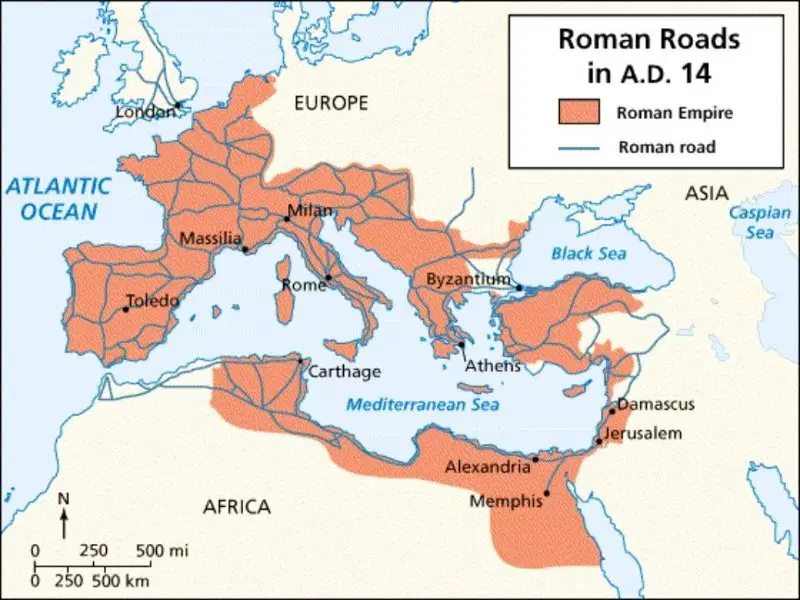
Study the image and explain how the network of Roman roads may have contributed to the expansion of Christianity across the empire.
A. Roman roads were restricted to military use, so few people traveled on them.
B. The roads enabled Christian missionaries to reach faraway areas quickly and securely.
C. The roads isolated Roman provinces from one another, stopping cultural interaction.
D. Roman roads were designed mainly for moving goods, not for people to travel.

