
 Worksheets
Module 14 Routing Concepts
Total questions: 87
Worksheet time: 44mins
Which of the following is a primary function of a router?
To store user data
To determine the best path to forward packets
To provide wireless connectivity
To encrypt network traffic
Each network that a router connects to requires which of the following?
A separate interface
A wireless access point
A firewall
A DNS server
When a router receives an IP packet on one interface, what does it determine?
Which protocol to use for encryption
Which interface to use to forward the packet to the destination
The MAC address of the sender
The physical location of the device
Explain how a router uses its routing table to forward packets toward their destination.
By randomly selecting an interface
By using the information in its routing table to determine the best path
By broadcasting packets to all interfaces
By storing packets until the destination requests them
A network administrator wants to connect multiple networks using a router. What must be considered regarding the router’s interfaces?
Each network requires a separate interface, which may be set up with sub-interfaces
Only one interface is needed for all networks
Interfaces are not necessary for network connections
The router must have wireless capability for each network
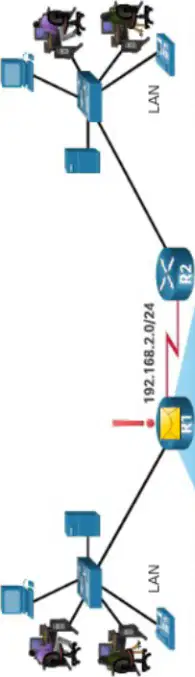
What does a router use to determine which path to use to forward a packet?
Its routing table
Its MAC address
Its hostname
Its subnet mask
Which process do R1 and R2 follow to forward a packet in a network?
They use their IP routing tables to determine the best path and then forward the packet.
They broadcast the packet to all connected devices.
They use only static routes to forward packets.
They forward packets randomly without checking any tables.
Routers use the routing table like a map to discover the best path for a given network. Which of the following best describes this function?
Routers analyze the routing table to select the optimal route for packet forwarding.
Routers ignore the routing table and forward packets to the default gateway.
Routers use the routing table only for local traffic.
Routers use the routing table to block all incoming packets.
Which type of network is added to the routing table when a local interface is configured with an IP address and subnet mask and is active?
Directly Connected Networks
Remote Networks
Default Route
Static Routes
How do routers learn about remote networks?
Through static routes and dynamic routing protocols
By configuring local interfaces
By using default routes only
By disabling routing protocols
What is the purpose of a default route in a routing table?
To specify a next-hop router when no specific route matches the destination IP address
To connect directly to local networks
To manually configure static routes
To learn about remote networks dynamically
A default route has which prefix length?
/0
/24
/32
/8
If a routing table does not contain a specific route that matches the destination IP address, what happens?
The default route is used to forward the packet
The packet is dropped immediately
The router requests a new IP address
The router creates a static route automatically
Explain the difference between static routes and dynamic routing protocols in the context of remote networks.
Static routes are manually configured, while dynamic routing protocols allow routers to learn about remote networks automatically.
Static routes are used only for local networks, while dynamic routing protocols are used for default routes.
Static routes require a default route, while dynamic routing protocols do not.
Static routes are less secure than dynamic routing protocols.
Why is the default route sometimes referred to as a gateway of last resort?
Because it is used when no other route matches the destination IP address
Because it is always the fastest route
Because it is only used for local networks
Because it is manually configured for every network
What is the best path in the routing table also known as?
The shortest match
The longest match
The fastest match
The default match
What does the routing table contain?
Only network addresses
Only prefix lengths
Route entries consisting of a prefix (network address) and prefix length
Only destination addresses
How is the prefix length of the route in the routing table used?
To determine the minimum number of far-right bits that must match
To determine the minimum number of far-left bits that must match
To determine the average number of bits that must match
Which prefix length provides the longest match for the destination IPv4 address 172.16.1.10?
/24
/16
/22
/0
If a router receives a packet destined for 172.16.1.10, which route entry will it select based on the longest prefix match rule?
Route Entry 2: 172.16.1.0/24
Route Entry 1: 172.16.0.0/16
Route Entry 3: 172.16.2.0/22
Route Entry 4: 0.0.0.0/0
Explain why the route entry 172.16.1.0/24 is considered the longest match for the destination address 172.16.1.10.
Because it matches the most number of bits with the destination address.
Because it is the first entry in the routing table.
Because it has the smallest prefix length.
Because it is the default route.
What does "egress routing" mean in the context of packet forwarding?
Specifying only the exit interface
Specifying only the entry interface
Specifying both entry and exit interfaces
Specifying the next hop address
On Ethernet networks, what must always be specified for packet forwarding?
Only the exit interface
Only the entry interface
A next hop address
The source MAC address
Which of the following is the correct way to specify an egress route on Ethernet networks?
ip route 10.50.13.0 255.255.255.0 GigabitEthernet 0/0/0
ip route 10.50.13.0 255.255.255.0 FastEthernet 0/0/0
ip route 10.50.13.0 255.255.255.0 Serial0/0/0
ip route 10.50.13.0 255.255.255.0 10.50.13.1
What is the difference between ingress and egress in packet forwarding?
Ingress is outgoing, egress is incoming
Ingress is incoming, egress is outgoing
Both ingress and egress are outgoing
Both ingress and egress are incoming
Why should you NOT specify only the exit interface for egress routing on Ethernet networks?
It causes routing loops
Ethernet always requires a next hop address
It increases network speed
It improves security
Given a diagram showing a router with arrows labeled "Ingress" and "Egress," what do these arrows represent?
The physical location of the router
The direction of traffic flow: ingress is incoming, egress is outgoing
The speed of the network
The type of cables used
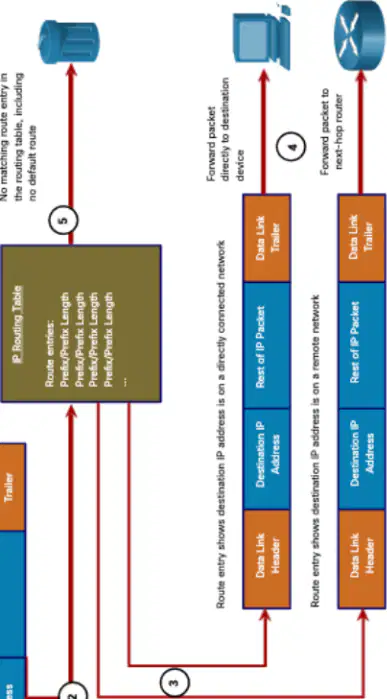
Which step occurs first in the packet forwarding decision process?
The router finds the longest matching prefix in the routing table.
The router examines the destination IP address in the packet header.
The data link frame with an encapsulated IP packet arrives on the ingress interface.
The router encapsulates the packet in a data link frame and forwards it out the egress interface.
What does the router do after examining the destination IP address in the packet header?
Drops the packet immediately.
Finds the longest matching prefix in the routing table.
Forwards the packet to the next-hop router.
Encapsulates the packet in a data link frame.
If there is no matching route entry in the routing table, what happens to the packet?
It is forwarded to the next-hop router.
It is sent back to the source device.
It is dropped.
It is encapsulated in a new data link frame.
Why does the router consult the IP routing table during packet forwarding?
To determine the source IP address.
To find the longest matching prefix for the destination IP address.
To check the packet's data link header.
To encapsulate the packet in a new frame.
A network engineer notices that packets are being dropped at a router. Based on the packet forwarding decision process, what is the most likely reason?
The router failed to encapsulate the packet.
The router could not find a matching route entry in the routing table.
The data link frame was corrupted.
The destination device was offline.
Which protocol does a router use to determine the destination MAC address for a host in an IPv4 network?
ARP
ICMP
OSPF
BGP
After determining the best path, what can a router do if the destination device is on a directly connected network?
Forward the packet directly to the destination device
Drop the packet
Send the packet to a remote server
Encrypt the packet before forwarding
Explain why a router needs to determine the destination MAC address before forwarding a packet to a device on a directly connected network.
To ensure the packet reaches the correct device at the data link layer
To encrypt the packet for security
To assign a new IP address to the device
To compress the packet for faster transmission
Which protocol is used by routers to determine the destination MAC address for the next hop router in an IPv4 Ethernet network?
ARP
ICMP
OSPF
BGP
What does a router do if the route entry indicates that the destination IP address is on a remote network?
Forwards the packet to the next-hop router
Drops the packet
Sends the packet back to the sender
Broadcasts the packet to all devices
Explain the difference between how a router forwards packets in IPv4 and IPv6 Ethernet networks when determining the destination MAC address for the next hop router.
IPv4 uses ARP, while IPv6 uses Neighbor Discovery
Both IPv4 and IPv6 use ARP
IPv4 uses DHCP, while IPv6 uses OSPF
Both IPv4 and IPv6 use RIP
Which of the following best describes the process a router follows after determining the best path for a packet?
It checks for a match in the routing table and drops the packet if no match is found and no default route exists.
It always forwards the packet regardless of the routing table.
It encrypts the packet before forwarding.
It sends the packet to all connected devices.
Which of the following protocols is used for encapsulating packets over serial connections?
PPP - Point-to-Point Protocol
Ethernet
TCP - Transmission Control Protocol
UDP - User Datagram Protocol
What must happen to packets before they are sent out through an interface?
They must be encapsulated into the appropriate data link frame type.
They must be encrypted.
They must be compressed.
They must be fragmented.
Which of the following is an example of a data link frame type used in packet forwarding?
Ethernet
IP
HTTP
SMTP
HDLC is an example of which type of protocol in the context of packet forwarding?
High-Level Data Link Control protocol
Hypertext Transfer Protocol
Internet Protocol
Simple Mail Transfer Protocol
Suppose you are configuring a router to forward packets over a serial interface. Which encapsulation options might you consider, based on common data link frame types?
PPP or HDLC
Ethernet or Wi-Fi
IP or TCP
SMTP or FTP
What is the primary responsibility of the packet forwarding function in a router?
To encapsulate packets in the appropriate data link frame type for the outgoing interface
To encrypt all packets before forwarding
To store packets indefinitely
To discard all incoming packets
Which of the following is NOT a packet forwarding mechanism supported by routers?
Process switching
Fast switching
Cisco Express Forwarding (CEF)
Packet mirroring
Why is it important for a router to perform packet forwarding efficiently?
Because faster packet forwarding allows more packets to be forwarded by the router
Because it increases the size of the packets
Because it reduces the need for routing tables
Because it prevents network congestion
Compare the three packet forwarding mechanisms supported by routers and discuss a scenario where Cisco Express Forwarding (CEF) would be preferred over process switching.
CEF is preferred in high-performance networks where speed and scalability are critical, unlike process switching which is slower and less efficient.
Process switching is preferred in all scenarios due to its simplicity.
Fast switching is always preferred regardless of network size.
CEF is only used in small home networks.

Which component matches the destination address with an entry in the routing table during process switching?
CPU
RAM
NIC
GPU
What is another name for process switching in packet forwarding mechanisms?
Software Switching
Hardware Switching
Fast Switching
Cut-through Switching
Why is process switching considered slow in packet forwarding?
Because the router performs the lookup for every packet
Because it uses hardware acceleration
Because it only checks the first packet in a stream
Because it uses parallel processing
Which of the following statements best describes the procedure of process switching in routers?
The router forwards each packet after matching its destination address in the control plane’s routing table.
The router forwards packets without checking the destination address.
The router uses hardware to forward packets instantly.
The router forwards only the first packet and ignores the rest.
If a stream of packets has the same destination, how does process switching handle them?
It performs a lookup for every packet, even if the destination is the same.
It performs a lookup only for the first packet.
It forwards all packets without any lookup.
It drops all packets except the first one.
What is a disadvantage of recursive lookups in process switching?
They are slow.
They are fast.
They use less CPU.
They require no routing table.
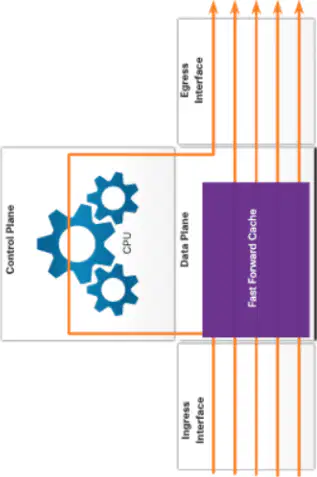
Which component searches for a match in the fast-switching cache during packet forwarding?
CPU
RAM
Network Interface Card
Hard Drive
What happens if another packet going to the same destination arrives on an interface after the information is stored in the fast-switching cache?
The information in the cache is re-used without CPU intervention.
The packet is dropped.
The cache is cleared.
The packet is sent to the control plane for processing.
Which of the following best describes the purpose of a fast-switching cache in packet forwarding mechanisms?
To store next-hop information for faster packet forwarding.
To encrypt packets before transmission.
To monitor network traffic for security threats.
To compress data for efficient storage.
Explain why fast switching can improve packet forwarding efficiency in a network device. Use evidence from the mechanism described.
It allows repeated packets to be forwarded using cached information, reducing CPU involvement.
It increases the size of the cache, allowing more packets to be stored.
It encrypts packets for secure transmission.
It sends all packets directly to the control plane for processing.
Which packet-forwarding mechanism is the most recent and default in Cisco IOS?
Cisco Express Forwarding (CEF)
Fast Switching
Process Switching
Static Routing
What does CEF build to assist in packet forwarding?
Forwarding Information Base (FIB) and adjacency table
Routing Information Protocol (RIP) table
Access Control List (ACL)
Network Address Translation (NAT) table
How are CEF table entries updated?
They are change-triggered, such as when something changes in the network topology.
They are updated every minute automatically.
They are updated only when a packet is dropped.
They are updated by manual configuration only.
When a network has converged, what do the FIB and adjacency tables contain?
All the information that a router would have to consider when forwarding a packet
Only the IP addresses of neighboring routers
Only the MAC addresses of connected devices
Only the routing protocol information
Explain why CEF is preferred over older packet-forwarding mechanisms in Cisco IOS.
Because CEF provides faster and more efficient packet forwarding by maintaining up-to-date tables that contain all necessary information, reducing the need for per-packet processing.
Because CEF uses more memory than older mechanisms.
Because CEF requires manual updates for every packet.
Because CEF is only used for wireless networks.
Which method of packet forwarding solves a problem by doing math long hand, even if it is the identical problem that was just solved?
Process switching
Fast switching
CEF
Load balancing
What is the main difference between fast switching and process switching in packet forwarding?
Fast switching remembers the answer for subsequent identical problems, while process switching does not.
Process switching is faster than fast switching.
Fast switching solves every possible problem ahead of time.
Process switching uses a spreadsheet to solve problems.
Which packet forwarding method solves every possible problem ahead of time in a spreadsheet?
CEF
Process switching
Fast switching
Dynamic routing
If a network device needs to solve a problem by doing math long hand one time and remembering the answer for subsequent identical problems, which packet forwarding method is being used?
Fast switching
Process switching
CEF
Static routing
Strategically, why might CEF be preferred over process switching in a high-performance network environment?
CEF solves every possible problem ahead of time, reducing the need for repeated calculations and improving efficiency.
Process switching is faster than CEF.
CEF does not remember any answers for identical problems.
Process switching uses a spreadsheet for calculations.
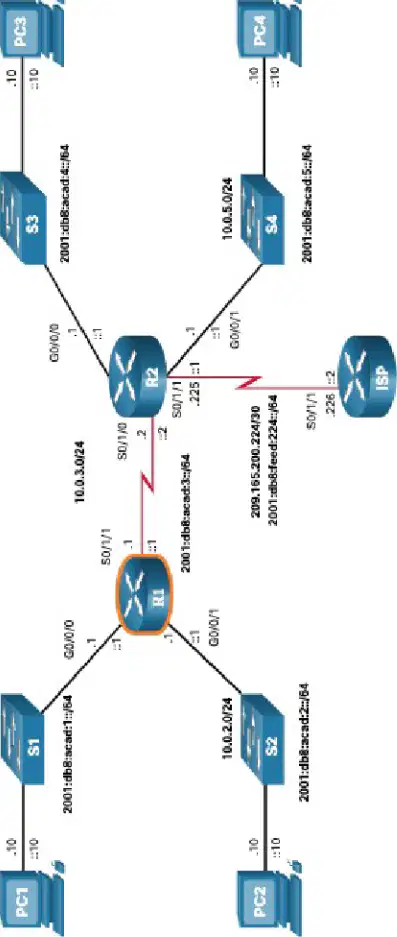
What is the main purpose of the topology shown in the figure?
To be used for configuration and verification examples
To demonstrate wireless network setup
To show server virtualization
To illustrate cloud computing architecture

Which device in the topology connects directly to the Internet?
ISP
PC1
S1
H2
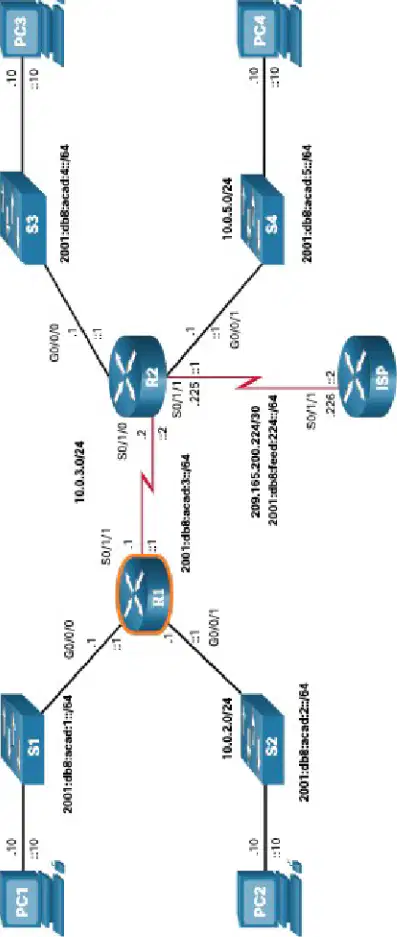
Based on the topology, which network device is most likely responsible for routing traffic between different subnets?
Router (R1)
Switch (S1)
PC3
ISP
What is the purpose of the 'no shutdown' command in interface configuration?
It activates the interface
It sets the IP address
It enables password encryption
It changes the hostname
Which command is used to save the running configuration to the startup configuration file?
copy running-config startup-config
service password-encryption
enable secret class
banner motd
If you want to set the router's name to R1, which command should you use?
hostname R1
enable secret R1
login R1
interface R1
Why is the 'service password-encryption' command used in router configuration?
To encrypt passwords in the configuration file
To enable SSH access
To set the router hostname
To activate an interface
A network administrator wants to configure an interface with the IP address 10.0.2.1 and subnet mask 255.255.255.0. Which command should they use?
ip address 10.0.2.1 255.255.255.0
ipv6 unicast-routing
service password-encryption
hostname R1
What is the effect of the 'banner motd' command in router configuration?
It displays a message to users when they access the router
It sets the router's hostname
It encrypts passwords
It activates an interface
Which command should be avoided in the lab according to the provided material?
copy running-config startup-config
service password-encryption
hostname R1
interface gigabitethernet 0/0/0
How would you configure a router to accept SSH connections on the vty lines?
transport input ssh
enable secret class
banner motd
logging synchronous
A network engineer wants to ensure that unauthorized access is prohibited. Which command can be used to display a warning message to users?
banner motd
service password-encryption
hostname R1
enable secret class
Which command is used to display a brief summary of the interfaces on a router?
show ip interface brief
show ip route
ping
show running-config
What is the purpose of the command "show running-config | include ip route"?
To display only the lines in the running configuration that contain "ip route"
To show all interface details
To test network connectivity
To display routing table information
If you want to verify the current routing table on a router, which command should you use?
show ip route
show interfaces
show running-config
ping
A network engineer suspects there are competing static routes configured on a router. Which command would best help them confirm this?
show running-config | include ip route
show ip interface brief
ping
show interfaces
Which of the following is NOT a source of information for a routing table?
Directly connected networks
Static routes
Dynamic routing protocols
Wireless access points
What does the code 'C' represent in a routing table?
Identifies the address assigned to a router interface
Identifies a directly connected network
Identifies a static route created to reach a specific network
Identifies a dynamically learned network from another router using the OSPF routing protocol
Which code in a routing table identifies a static route created to reach a specific network?
L
C
S
O

