
 Worksheets
Intro to Metabolism and Diabetes
Total questions: 134
Worksheet time: 1hrs 14mins
Chemical messengers secreted by various glands that regulate:
growth, reproduction, gender differentiation
fluid and electrolyte balance
(a)
Process of biochemical reactions in body's cells that:
produce energy, repair cells, maintain life
(a)
The endocrine system is responsible for:
Sexual differentiation during fetal development
Stimulating growth and development during childhood and adolescence
Filtering waste products from the blood in the kidneys
Controlling muscle contractions in the heart
As we age we have an increase in adrenalgland hormones, decrease in thyroid
stimulating hormone (basal metabolic rate),
decreased production of lipase (reduced fat
absorption), insulin resistance
False
True
Alterations to metabolism include:
Disorders of structure and function
Hormone production increases or decreases
Sexual differentiation during fetal development
Stimulating growth and development
Common alteration of metabolism:
Diabetes mellitus
Obesity
Osteoporosis
Hyperthyroidism
Less common alterations of metabolism include:
Cushing's disease
Addison's disease
Dwarfism
Obesity
Diabetes mellitus
What is the CAGE questionnaire used to identify in liver disease?
What does CAGE questionnaire stand for?
CAGE stands for Cut back, Annoyed with self, Guilty, Eye-opener.
Metabolism and Endocrine gland functions assessed with:
Dietary supplements and exercise routines
Physical assessment to collect objective data
Health assessment interview to collect subjective data
Findings from diagnostic tests
What are some good health history questions to ask in your nursing assessment for alterations to metabolism?
Hx of diabetes mellitus, diabetes insipidus, thyroid disease,
growth problems, obesity in family?
Extreme growth in child?
Shoe size change as an adult ?
Medications such as steroids?
Are you taking antibiotics?
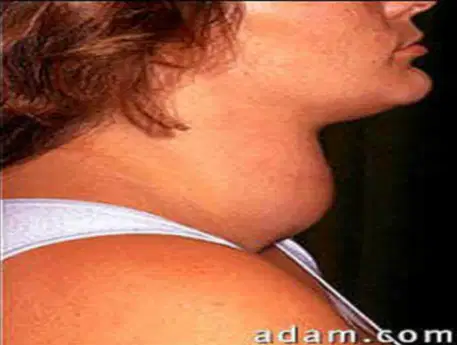
What is shown above?
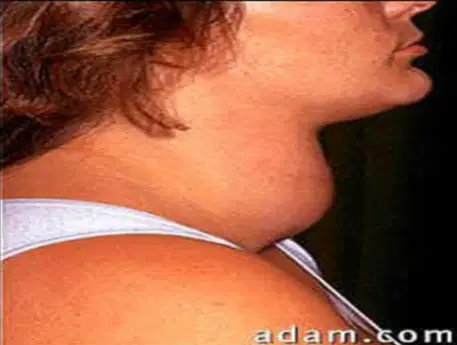
What could the following picture be caused by?
Hyperthyroidism

Your patient presents with a rounded, puffiness of the face as shown above. You know this is known as ______ and is caused by hypothyroidism.
moon face
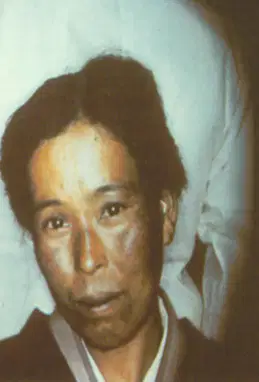
Your patient presents with darker patches of skin around their eyes and on their face. You know that this is called ________ and is a common result of hyperthyroidism.
myxedema
hyperpigmentation

Your patient is admitted with the following symptoms. You know that your patient has a history of hypothyroidism. What condition is your patient most likely experiencing?
Nails and hair tend to become fine and brittle with ________,
and dry and course with _________.
Hyperthyroidism, hypothyroidism
Hypothyroidism, hyperthyroidism
Cushing's disease, Addison's disease
Hyperpigmentation, myxedema
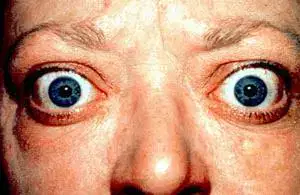
Your patient is admitted and this following symptom is charted. You know that this is known as ______ and is a result of Grave's disease or hyperthyroidism.
_______ a medical condition characterized by involuntary muscle spasms and nerve hyperexcitability, most often caused by hypocalcemia (low calcium) or sometimes magnesium deficiency.

________ _____ is a clinical sign characterized by twitching of facial muscles when the facial nerve is tapped, and it is often associated with hypoparathyroidism.

________ ____ a medical indication of hypoparathyroidism, identified by a carpopedal spasm—a hand and wrist contraction—that occurs when the brachial artery is compressed by a blood pressure cuff inflated for 3 minutes.
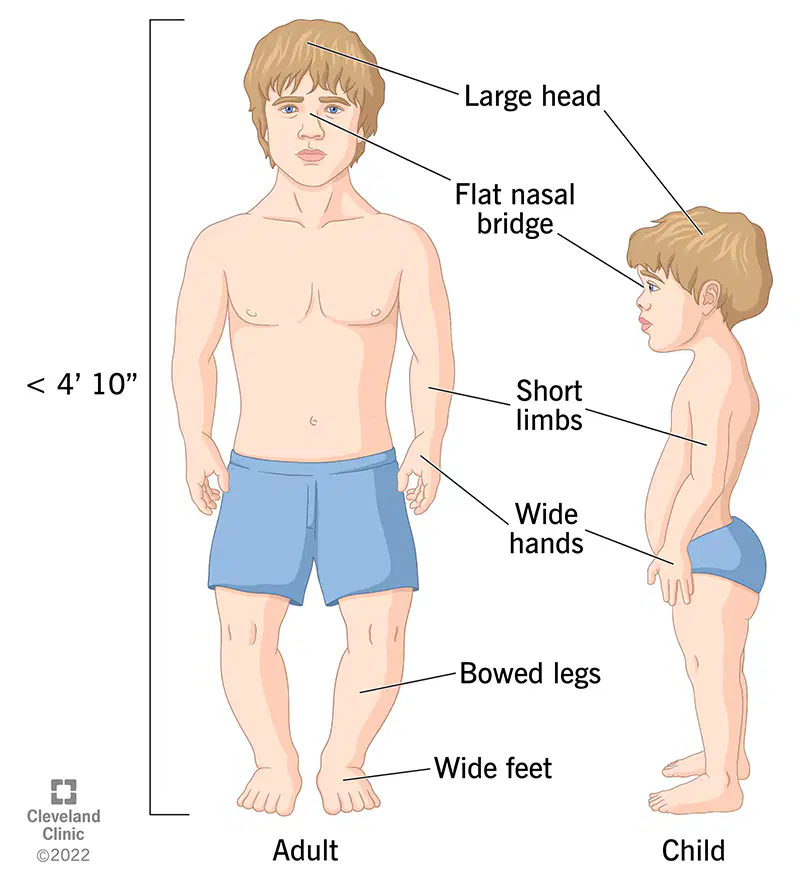
The following is characterized by Lack or dysfunction of growth hormone (GH) from the pituitary gland.
Dwarfism

During your musculoskeletal assessment of your patient, you notice they have abnormal growth in various parts of their body. They have an enlarged facial structure, overgrowth of hands and feet, and an increase in body size and height after adulthood. You know that this can be described as _________ and is an excessive production of the growth hormone by the pituitary gland.
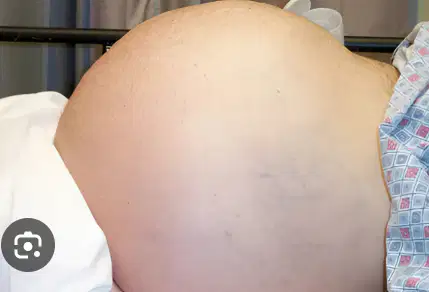
Your patient has an abnormally round and protruded stomach as presented in the image above. You know that this is most likely ______ which is an accumulation of fluid in the abdominal cavity.
What is most commonly the cause of ascites? (Notice: all of the following are potential causes of ascites but there is one that is most common when dealing with ascites)
What diagnostic test is completed when assessing for gestational diabetes?
What does the process of an oral glucose tolerance test consist of?
When completing diagnostic testing for a patient with thyroid issues, we rule out this type of medication, as it is known to affect thyroid function:
Antibiotics
Antihistamines
Corticosteroids
When working with patients that have problems with metabolism, you may collaborate with these other health professionals to help the patient:
Dietitians
Behavioral therapists
Endocrinologist
Cardiologists
Podiatrists
The following pharmacologic therapy is used to help treat what metabolic disorder?
-Calcium regulation agents, Selective estrogen-receptor modulators, Synthetic parathyroid hormone, Bisphosphonates
Insulin is a pharmacologic therapy that is used to treat which metabolic disorder?
Oral hypoglycemics are a pharmacologic therapy used to treat which metabolic disorder?
Hyperglycemic state resulting from defects in insulin secretion, insulin action, or both
(a)
Type 1 is the most common type of diabetes.
True
False
The following risk factors are associated with which type of diabetes?
-hereditary
-tissue types HLA-DR or HLA-DQ
-Exposure to environmental triggers: certain drugs, pollutants, dietary considerations, stress, infections, and gut flora
The following risk factors are associated with which type of diabetes?
-obesity
-family history
-increasing age
-race/ethnicity
-smoking
-sedentary lifestyle
-medications
-metabolic syndrome
The following risk factors are associated with which type of diabetes?
-age >25
-previous baby >9lbs
-family history of type II
-overweight
-race/ethnicity
-polycystic ovary syndrome
Blood requires constant supply of glucose.
True
False
Not all tissues require insulin (liver, brain, and red blood cells) but the rest do need insulin
Normal blood glucose in healthy clients is regulated by:
Which of the following describes the pathophysiology of Type 1 diabetes?
Autoimmune disorder in which beta cell derestriction results in absolute insulin deficiency
In type 1 diabetes, fat begins to breakdown, so _______ form as a result of fat breakdown.
In type 1 diabetes, the accumulation of ketones leads to....
Which of the following describes type 2 diabetes pathophysiology?
condition where there is too much glucose in the blood because the body doesn't have enough insulin
(a)
The three P's indicating type 1 diabetes include:
Which of the following are symptoms of type 1 diabetes?
Frequent urination
Excessive thirst
Weight gain
The following characteristics describe what?
-High blood glucose levels in mother
-Brings extra glucose to baby
-Causes baby to put on extra weight
Fasting plasma glucose- <100mg/dL (70-100mg/dL)
Casual plasma glucose <140mg/dL
Hemoglobin A1C <5.6%
Diabetes
Pre-Diabetes
Normoglycemia
Fasting plasma glucose 100-125mg/dL
Hemoglobin A1C 5.7-6.4%
Fasting plasma glucose >126 mg/dL
Hemoglobin A1C >6.5%
Which type of diabetes usually ends up in the hospital at first following their diagnosis?
Three main ways to manage diabetes:
Exercise
Medication
Diet
Though exercise is helpful with diabetes, it cannot help insulin to work better or decrease the need for insulin.
What is the recommended protocol for
Type 2 diabetic clients that want to
loose weight?
A. Participate in an aerobic program twice a
week for 20 minutes each session
B. Slowly increase insulin dosage until mild
hypoglycemia occurs
C. Reduce calorie intake moderately and
increase exercise
D. Reduce daily caloric intake to 1000 calories
and monitor for urine ketones
A
B
C
D
What is the general guideline for eating carbohydrates with diabetes?
30-60 grams per meals
15-30 grams per meal
15-30 grams with snacks
5-10 grams with snacks
Five grams/serving or more fiber can be subtracted from total carbohydrates
False
True
How many grams of carbohydrates are in one serving
15 grams per serving
What is the gold standard when it comes to meal planning strategies with diabetes?
Carbohydrate counting.
1800 kcals – 225 g CHO (50% of total kcals)
B (7:30) 45 g CHO (3 CHO)
L (noon) 60 g CHO (4 CHO)
Snack (3:00) 30 g CHO (2 CHO)
D (6.00) 60 g CHO (4 CHO)
HS snack (9:30) 30g CHO (2CHO)
What is the total carbohydrates (CHO) consumed and total servings of carbs?
225 g CHO/day (15 servings/day)
15 CHO/day (225 servings/day)
125 CHO/day (5 servings/day)
225 CHO/day (225 servings/day)
In developing an individualized meal plan for
the diabetic client, which goals are the focus
of the plan? Select all that apply
A. Maintaining blood glucose levels at or as close
to the normal range as possible
B. Patient food preferences
C. Allowing patients to eat as much as they
desire
D. Eliminating fats
E. Eliminating carbohydrates
A
B
C
D
E
What statement about dietary
concepts is true?
A. Alcoholic beverage consumption is
unrestricted
B. Carbohydrate counting is emphasized when
adjusting dietary intake of nutrients
C. Artificial sweeteners should be avoided
because of the side effects
D. Fiber should be limited
A
B
C
D
The following medications describe treatment of which type of diabetes:
-insulin to cover basal needs (given 1-2 times a day)
-sliding scale to cover prandial needs (given 2-4 times a day)
*sliding scale coverage may be combined with basal coverage in one shot
The following medications are treatment for which type of diabetes?
-none, can be diet controlled
-oral antidiabetics (one or more per day)
-insulin
Type 1 diabetes
Type 2 diabetes
The following medications and treatment is used for which type of diabetes:
-glucose monitoring 4 times per day
-postprandial levels below 140
-insulin if needed
-some oral hypoglycemics *safety of these is important
-comprehensive prenatal care is essential
Basal coverage of insulin means ______ ______
basic needs
meal coverage
Prandial coverage of insulin means _____ ________
meal coverage
basic needs
Types of insulin include:
Rapid Acting
Long Acting
Short Acting
Intermediate
Which type of insulin is described below?
Given subcutaneously and in pumps
-lispro (Humalog)
-Aspart (Novolog, Fiasp)
-Glulisine (Apidra)
Short-acting insulin
Which type of insulin is described below?
Often given on sliding scale or on bolus-correction scale
-regular (Humulin R) (Novolin R) (ReliOn R)
Long-acting insulin
Rapid-acting insulin
Short acting insulin
Intermediate-acting insulin
Which type of insulin is described?
Cloudy, can be mixed with rapid or short acting
-NPH (Humulin N, Novolin N)
Ultra-rapid insulin
Long-acting insulin
Regular insulin
Intermediate
Which of the following types of insulin is described?
Used for basal needs, over the length of 24 hours
*clear
-glargine (Lantus, Basaglar, Toujeo)
-detemir (Levemir)
-degludec (Tresiba)
Long acting
Intermediate
Short acting
Rapid acting
Which of the following are considered prandial (bolus) or correction insulins?
Rapid acting
Short acting
Intermediate
Long acting
Which of the following are considered basal insulin?
Short acting
Long acting
Intermediate
Rapid acting
When mixing insulins, you mix two clears.
True
False
ONSET of insulin is when it ______
PEAK of insulin is when it....
reaches its maximum effect.
DURATION of insulin is when it ...
The following onset, peak and duration would describe which type of insulin that mimics normal insulin production
Onset: 5-15 minutes
Peak: 1 hour
Duration: 3-5 hours
Insulin is only given through IV during emergencies
With rapid-acting insulin, you need to be eating within __ minutes
Your patient's insulin prescription is below
20u NPH (Humulin N) at 8 am
8u NPH (Humulin N) at 8 pm
Give regular (Humulin R) as follows based on sliding scale below:
< 150 0 units
151-200 2 units
201-250 4 units
251– 300 6 units
301-350 8 units
>350 call MD
Your patient's blood sugar is 224. What insulin will be given at 8 am?
10u NPH (Humulin N) 2u (Humulin R) at 8 am
20u NPH (Humulin N) and 6u (Humulin R) at 8 am
25u NPH (Humulin N) and 4u (Humulin R) at 8 am
20u NPH (Humulin N) at 8 am
Your patient needs 20u of NPH (Humulin N) and 6u of regular insulin (Humulin R).
Can this be given in one shot or two?
What is an automated insulin delivery system also known as?
Hardening of tissue associated with a complication of insulin therapy?
Loss of tissue which is common in insulin therapy
Lipoatrophy
Which insulins are considered to have
a rapid onset of action?
Select all that apply
A. Glargine (Lantus)
B. Glulisine (Apidra)
C. Humilin N (NPH)
D. Aspart (Novolog)
E. Lispro (Humalog)
A
B
C
D
E
The patient will be using an external
insulin pump. What does the nurse tell
the patient about the pump?
A. Monitoring of blood glucose levels with a
glucometer is not necessary
B. The insulin supply must be replaced every 2 to
4 weeks
C. The pump’s battery should be checked on a
regular weekly schedule
D. The needle site must be changed every 1 to 3
days
A
B
C
D
A diabetic client is prescribed 12 units of NPH
insulin at 7:30 am. At 1 pm the client reports
feeling shaky and is diaphoretic. Which is the
explanation for the probable cause?
A. The NPH insulin’s action is peaking, and there is
an insufficient blood glucose level
B. The regular insulin’s action is peaking, and there
is an insufficient blood glucose level
C. The patient consumed too many calories at
breakfast and now has an elevated blood glucose
level
D. The symptoms are unrelated to the insulin
administered in the early morning or diet taken at
lunch time
A
B
C
D
A client is ordered to get 20 units of
Novolin 70/30. How many units of
NPH will he get? How many Units of
Regular will he get?
Additional treatments used alongside primary diabetes management (insulin/oral medications)
*cannot be mixed in same syringe as insulin
Adjunctive therapy
Oral hypoglycemics
Insulin pen
Insulin pump
Type of adjunctive therapy used for Type 1 and Type 2 diabetes
-pramlintide acetate (Symlin)
Amylin Analogues
Incretin Agents (GLP-1)
Type of adjunctive therapy that is for type 2 diabetes only.
-exenatide (Byetta)
-liraglutide (Victoza)
-dulaglutide (Trulicity)
-Semaglutide (Ozempic)
Amylin Analogues
Incretin Agents (GLP-1)
Which diabetes medical treatment increases insulin secretion, reduces hepatic glucose production, delays food absorption, improves tissue sensitivity, and inhibits glucose reabsorption
-sulfonylureas, biguanides, meglitinide analogues, thiazolidinediones, alpha-glucosidase inhibitors, incretin-DPP-4 inhibitors, SGLT2 inhibitors
Incretin Agents (GLP-1)
Adjunctive Therapy
Oral Hypoglycemics
Insulin pen
Oral hypoglycemics are typically held in acute care.
Oral hypoglycemics are typically only used by type 1 diabetes patients.
What is the benefit of taking a combination oral anti-diabetic agent
Two mechanisms of glycemic control in one pill.
What is the most accurate way to monitor diabetes?
Glycosylated Hemoglobin (A1C)
Self Monitoring Blood Glucose/Informatics
Continuous Blood Glucose Monitors
A higher A1C percentage indicates a more unhealthy level of blood sugar.
False
An A1C percentage of _._ or higher indicates diabetes
Hot and dry=
Cold and clammy=
Hot and dry=Hypoglycemia
Cold and clammy=hyperglycemia
Hot and dry=blood sugar is low
Cold and clammy=blood sugar high
Hot and dry=sugar high
Cold and clammy=need some candy
Hot and dry=see your dr.
Cold and clammy=see your mammy
Life threatening complication resulting from lack of insulin
-medical emergency
-patient develops severe hyperglycemia (>250mg/dL)
Hyperglycemic Hyperosmolar State (HHS)
Diabetes Ketoacidosis typically only occurs in type 1 diabetes.
Your patient's skin is flush, dry and warm. They are experiencing nausea, abdominal pain, vomiting, are confused, and have a decreasing level of consciousness. They are very weak and reported weight loss in the past month. They also mentioned increased thirst, urination, and hunger over the past few weeks.
Their vitals are 100/64, 110 bpm, and 26 deep breaths per minute
Their labs showed hyperkalemia and ketones in the urine.
All these symptoms indicate...
Hyperglycemic Hyperosmolar State (HHS)
Diabetic ketoacidosis interventions include:
Oral antidiabetics
Electrolyte therapy
IV Fluids
IV Insulin (short-acting/regular)
Life threatening reaction resulting from very high blood sugar levels (>600mg/dL)
-usually caused by infection
Hyperglycemic Hyperosmolar State (HHS) is usually only seen in Type 1 diabetics.
Your patient is in a hyperglycemic hyperosmolar state. Which action most likely is the cause of this state?
Your patient appears confused, experienced weight loss, polyuria, and has a decreasing level of consciousness. They are severely dehydrated and ketones are not in their urine.
Their vitals are: 105/58, 119 bpm, 102.2 F.
What is your patient most likely experiencing
Your patient is in a Hyperglycemic Hyperosmolar State. What interventions will they most likely be completed on the patient?
Administer IV fluids, IV regular insulin, and electrolytes.
What acute complication occurs when blood sugar falls below 70 mg/dL?
Other names for hypoglycemia include:
insulin shock
insulin reaction
Your patient received their insulin, did not eat any of their lunch, and is now sweaty, shaking, confused, and has blurred vision. What is your patient experiencing?
Which of the following could cause hypoglycemia?
Insufficient food
Excess insulin
Excess exercise
The nurse knows that a blood sugar level of
40mg/dL indicates which condition?
A. ketoacidosis
B. normal serum blood glucose
C. insulin reaction
D. glycosuria
A
B
C
D
Acute complication in which there is a rise in blood glucose between 4-8 am
-not a response to hypoglycemia
-will need more basal insulin before bed
An acute complication in which there is a combination of hypoglycemia during the night with rebound morning rise to hyperglycemia
-will need snack or decreased basal insulin before bed
Somogyi phenomenon
Damage to the large blood vessels caused by high blood sugar, leads to problems like Cardiovascular and Peripheral vascular disease (heart disease, stroke, poor circulation)
Chronic macrovascular complication
Chronic microvascular complication
Damage to small blood vessels caused by high blood sugar, leading to diabetic retinopathy, neuropathy, nephropathy, male erectile dysfunction.
Chronic macrovascular complication
Chronic microvascular complication
How can chronic complications such as macrovascular and microvascular be prevented?
Managing blood sugar
What is diabetic retinopathy?
When referring to surgical treatment of diabetes, Islet Cell Transplant is more common than Whole Pancreas Transplant.
What nursing intervention should you complete on your patient if their blood sugar is 50-69 mg/dL.
How long do you wait to recheck blood sugar after treatment?
What nursing intervention should you complete on your patient if their blood sugar is <50mg/dL
Administer 30g of a fast-acting source of glucose.
Administer 15g of a fast-acting source of glucose
Your patient's blood sugar is 44mg/dL and they are unconscious. What nursing intervention do you complete?
If a patient is experiencing severe hypoglycemia at home, what is the next best intervention to treat this patient's condition?
Give the patient water to drink
Glucagon IV
Give IV 50% Dextrose
Administer baqsimi (glucagon) nasal powder 3 mg
Once a patient's blood sugar is back to >70 mg/dL after an unstable blood glucose, what do you do next?
Provide complex carb and protein snack
What are good travel rules to educate a diabetic client on?
Have rapid acting glucose sources at all times
Skip medication if feeling fine
Take medications as a carry on
Wear diabetic identification
What is good practice when consuming alcohol while on insulin?
Eating is critical when consuming alcohol on insulin
What are some nursing interventions that can be completed to help with peripheral neuropathy?
Administer gabapentin (Neurontin)
Encourage nonpharmacological alternatives such as massage, deep breathing, and rest
What is a big focus when dealing with disturbed sensory perception in diabetes?
Taking medications regularly
Foot care
Your patient has advanced disturbed sensory perception as a result of diabetes. What are some interventions that you will implement into their care?
Inspect feet daily
Wear comfortable, broken-in shoes
See a podiatrists as needed to trim thick toenails
Take aspirin daily as ordered
When should you call the doctor when you are sick with diabetes?
Call the doctor if you are unable to eat for more than 24 hours or vomiting/diarrhea for more than 6 hours
Call the doctor if you have unusual fatigue, runny nose, and cough
Call the doctor if you feel hungry

