
 Worksheets
87+21
Total questions: 59
Worksheet time: 30mins
What does the restraint relay 87 compare to determine if it should trip? Relay 87 có tác động hãm so sánh cái gì để xác định xem có nên cắt mạch không?
The sum and difference of the secondary currents from the CTs / Tổng và hiệu của các dòng điện thứ cấp từ các biến dòng
The temperature and pressure readings / Đọc nhiệt độ và áp suất
The phase angles of the currents / Góc pha của các dòng điện
The voltage and current ratios / Tỷ lệ điện áp và dòng điện
Why is the resistor method commonly used in differential protection schemes? Tại sao phương pháp sử dụng điện trở lại được sử dụng rộng rãi trong các sơ đồ bảo vệ so lệch?
It requires specialized equipment / Nó yêu cầu thiết bị chuyên dụng
It is simple and effective / Nó đơn giản và hiệu quả
It provides fast operation / Nó cung cấp hoạt động nhanh
It is expensive and complex / Nó tốn kém và phức tạp
What is the primary purpose of using a differential relay with restraint in differential protection? Mục đích chính của việc sử dụng relay so lệch tác động hãm trong bảo vệ so lệch là gì?
To reduce overall current / Để giảm tổng dòng điện
To increase the relay's operating speed / Để tăng tốc độ hoạt động của relay
To eliminate the unbalanced current component / Để loại bỏ thành phần dòng điện không cân bằng
To protect against voltage surges / Để bảo vệ chống lại sự tăng áp
In differential protection, where does the DC component primarily go when using a series resistor? Trong bảo vệ so lệch, thành phần DC chủ yếu được đưa vào đâu khi sử dụng điện trở nối tiếp?
The series resistor / Điện trở nối tiếp
Current coil of the relay / Cuộn dây dòng điện của relay
Voltage coil of the relay / Cuộn dây điện áp của relay
Power supply / Nguồn điện
Under what condition does the restraint relay 87 operate? Dưới điều kiện nào thì relay 87 có tác động hãm hoạt động?
When the total current equals the restraint current / Khi dòng tổng bằng dòng hãm
When the phase angle difference is significant / Khi sự khác biệt góc pha là đáng kể
When the total current (working current) exceeds 0.5 times the restraint current (effective current) / Khi dòng tổng (dòng làm việc) lớn hơn 0,5 lần dòng hãm (dòng hiệu)
When the effective current is greater than the working current / Khi dòng hiệu lớn hơn dòng làm việc
What happens to the unbalanced current component of the total current from the protective current transformers in a differential relay? Điều gì xảy ra với thành phần dòng điện không cân bằng của dòng tổng từ các biến dòng bảo vệ trong relay so lệch?
It is eliminated at the current coil of the differential relay / Nó bị loại bỏ trên cuộn dòng của relay so lệch
It increases the relay's operating current / Nó làm tăng dòng hoạt động của relay
It causes the relay to trip unnecessarily / Nó khiến relay cắt mạch không cần thiết
It is amplified by the relay / Nó được khuếch đại bởi relay
Why is the resistor method commonly used in differential protection schemes? Tại sao phương pháp sử dụng điện trở lại được sử dụng rộng rãi trong các sơ đồ bảo vệ so lệch?
It provides fast operation / Nó cung cấp hoạt động nhanh
It is expensive and complex / Nó tốn kém và phức tạp
It is simple and effective / Nó đơn giản và hiệu quả
It requires specialized equipment / Nó yêu cầu thiết bị chuyên dụng
What happens to the large DC component of unbalanced current when it passes through the intermediate saturating CT in relay 87? Điều gì xảy ra với thành phần DC lớn của dòng điện không cân bằng khi nó đi qua biến dòng bão hòa trung gian trong relay 87
It falls into the saturation region of the magnetization curve, resulting in a smaller field / Nó rơi vào vùng bão hòa của đường cong từ hoá, dẫn đến từ cảm giảm
It is completely eliminated / Nó bị loại bỏ hoàn toàn
It is amplified and increases / Nó được khuếch đại và tăng lên
It is converted into AC current / Nó được chuyển đổi thành dòng điện xoay chiều
What is the main goal of using an intermediate saturating current transformer (CT) in differential protection? Mục tiêu chính của việc sử dụng biến dòng bão hòa trung gian trong bảo vệ so lệch là gì?
To reduce overall current / Để giảm tổng dòng điện
To eliminate the unbalanced current component / Để loại bỏ thành phần dòng điện không cân bằng
To stabilize the power supply / Để ổn định nguồn điện
To increase the relay's sensitivity / Để tăng độ nhạy của relay
What is the effect of connecting a resistor in series with the current coil of a differential relay? Ảnh hưởng của việc kết nối một điện trở nối tiếp với cuộn dây dòng điện của relay so lệch là gì?
Increases the amplitude of the unbalanced current / Tăng biên độ dòng điện không cân bằng
Increases the operating speed of the relay / Tăng tốc độ hoạt động của relay
Reduces the sensitivity of the relay / Giảm độ nhạy của relay
Reduces the amplitude of both unbalanced and short-circuit currents, mainly short-circuit current / Giảm biên độ cả dòng không cân bằng và dòng ngắn mạch, chủ yếu là dòng ngắn mạch
What is one of the key advantages of vertical differential protection? Một trong những lợi thế chính của bảo vệ so lệch dọc là gì?
It is more complex to implement / Nó phức tạp hơn để triển khai
It responds to oscillations and overloads / Nó phản ứng với dao động và quá tải
It requires a high level of maintenance / Nó yêu cầu mức bảo trì cao
It is instantaneous when a fault occurs in the protection zone / Nó tác động tức thời khi có sự cố xảy ra trong vùng bảo vệ
What is a notable disadvantage of horizontal differential protection? Một nhược điểm đáng chú ý của bảo vệ so lệch ngang là gì?
It has no dead zone / Nó không có vùng chết
It is very complex to set up / Nó rất phức tạp để thiết lập
It can double the fault clearing time if actions are not simultaneous / Nó có thể tăng gấp đôi thời gian cắt ngắn mạch nếu các hành động không đồng thời
It is less reliable than vertical protection / Nó ít tin cậy hơn bảo vệ dọc
Which type of horizontal differential protection is used for tightly coupled parallel elements that can only be isolated together? Loại bảo vệ so lệch ngang nào được sử dụng cho các phần tử song song nối chặt với nhau mà chỉ có thể cô lập cùng lúc?
Distance protection / Bảo vệ khoảng cách
Horizontal differential protection with direction / Bảo vệ so lệch ngang dòng điện có hướng
Horizontal differential protection using current / Bảo vệ so lệch ngang dòng điện
Voltage protection / Bảo vệ điện áp
What is the principle behind horizontal differential protection? Nguyên lý hoạt động của bảo vệ so lệch ngang là gì?
Phase angle comparison of currents / So sánh góc pha của dòng điện
Frequency analysis of current signals / Phân tích tần số của tín hiệu dòng điện
Voltage comparison between two phases / So sánh điện áp giữa hai pha
Direct comparison of currents in parallel branches / So sánh trực tiếp dòng điện chạy trên các nhánh song song
What characteristic of vertical differential protection helps it remain unaffected by external disturbances? Đặc điểm nào của bảo vệ so lệch dọc giúp nó không bị ảnh hưởng bởi các rối loạn bên ngoài?
It requires constant maintenance / Nó yêu cầu bảo trì liên tục
It does not react to oscillations or external faults / Nó không phản ứng với dao động hoặc sự cố bên ngoài
It is sensitive to phase angles / Nó nhạy cảm với góc pha
It operates at high voltage levels / Nó hoạt động ở mức điện áp cao
In what applications is vertical differential protection widely used? Bảo vệ so lệch dọc được sử dụng rộng rãi trong ứng dụng nào?
For main protection against faults in transformers, generators, and motors / Cho bảo vệ chính chống sự cố trong máy biến áp, máy phát điện và động cơ
For renewable energy systems / Cho các hệ thống năng lượng tái tạo
For voltage regulation / Cho điều chỉnh điện áp
For communication systems / Cho các hệ thống truyền thông
In which scenario would you prefer using standard horizontal differential protection over directional protection? Trong trường hợp nào bạn sẽ thích sử dụng bảo vệ so lệch ngang thông thường hơn là bảo vệ so lệch có hướng?
When cost reduction is a priority / Khi giảm chi phí là ưu tiên
When the system requires simultaneous isolation of all elements / Khi hệ thống yêu cầu cô lập đồng thời tất cả các phần tử
When multiple elements are tightly coupled / Khi nhiều phần tử được nối chặt với nhau
When elements can be isolated individually / Khi các phần tử có thể được cô lập riêng lẻ
Which type of differential protection is more suitable for parallel lines with similar resistances? Loại bảo vệ so lệch nào phù hợp hơn cho các đường dây song song có điện trở tương tự?
Vertical differential protection / Bảo vệ so lệch dọc
Horizontal differential protection / Bảo vệ so lệch ngangi
Overcurrent protection / Bảo vệ quá dòng
Distance protection / Bảo vệ khoảng cách
What distinguishes directional horizontal differential protection from standard horizontal differential protection? Điều gì phân biệt bảo vệ so lệch ngang có hướng với bảo vệ so lệch ngang thông thường?
It allows for isolating individual elements from the system / Nó cho phép cô lập các phần tử riêng lẻ ra khỏi hệ thống
It requires more complex relays / Nó yêu cầu các relay phức tạp hơn
It measures phase angles / Nó đo góc pha
It uses different voltage levels / Nó sử dụng các mức điện áp khác nhau
What type of horizontal differential protection allows for the isolation of individual parallel elements from the system? Loại bảo vệ so lệch ngang nào cho phép cô lập từng phần tử song song ra khỏi hệ thống?
Directional current differential protection / Bảo vệ so lệch dòng điện có hướng
Ground fault protection / Bảo vệ lỗi đất
Current differential protection / Bảo vệ so lệch dòng điện
Voltage differential protection / Bảo vệ so lệch điện áp
How does a differential relay with harmonic restraint prevent false trips during inrush conditions? Relay so lệch có hãm hoạ tần ngăn ngừa cắt mạch sai trong điều kiện dòng khởi động như thế nào?
By reducing the relay sensitivity / Bằng cách giảm độ nhạy của relay
By delaying the relay operation / Bằng cách trì hoãn hoạt động của relay
. By bypassing the relay temporarily / Bằng cách tạm thời bỏ qua relay
By filtering out higher harmonic currents / Bằng cách lọc các dòng hoạ tần bậc cao
: What additional component can be used to stabilize the differential relay against unbalanced currents? Thành phần bổ sung nào có thể được sử dụng để ổn định relay so lệch chống lại dòng điện không cân bằng?
Auxiliary resistor (R) / Điện trở phụ (R)
. Voltage coil / Cuộn điện áp
Secondary circuit breaker / Máy cắt thứ cấp
Capacitor bank / Tụ điện
: Which method is NOT typically used to handle unbalanced currents in differential protection? Phương pháp nào KHÔNG thường được sử dụng để xử lý dòng điện không cân bằng trong bảo vệ so lệch?
Using a time delay / Sử dụng thời gian trễ
Using an auxiliary resistor / Sử dụng điện trở phụ
Increasing the relay's operating speed / Tăng tốc độ hoạt động của relay
Installing a harmonic restraint relay / Cài đặt relay có hãm hoạ tần
Which method is commonly used to delay the operation of a differential relay to avoid false tripping due to transient currents? Phương pháp nào thường được sử dụng để trì hoãn hoạt động của relay so lệch nhằm tránh cắt sai do dòng điện quá độ?
Apply a time delay of 0.3 – 0.5 seconds / Áp dụng thời gian trễ từ 0,3 – 0,5 giây
Use of a power transformer / Sử dụng máy biến áp
Use of a voltage stabilizer / Sử dụng bộ ổn định điện áp
Decrease relay sensitivity / Giảm độ nhạy của relay
In a voltage balance connection scheme, how are the secondary windings of the current transformers connected? Trong sơ đồ đấu nối cân bằng điện áp, cuộn thứ cấp của các biến dòng được nối như thế nào?
In a star connection / Nối hình sao
In series / Nối tiếp
In parallel / Nối song song
In a delta connection / Nối hình tam giác
How does the circulating current connection scheme work in differential protection? Sơ đồ đấu nối tuần hoàn hoạt động như thế nào trong bảo vệ so lệch?
The secondary windings of CTs are connected in parallel with the relay’s current coil / Cuộn thứ cấp của các biến dòng được nối song song với cuộn dòng của relay
The relay operates on voltage changes / Relay hoạt động dựa trên sự thay đổi điện áp
The primary windings are connected to the relay / Cuộn sơ cấp được nối với relay
The secondary windings of CTs are connected in series / Cuộn thứ cấp của các biến dòng được nối tiếp
Why can unbalanced current occur in a differential relay even without an internal fault? Tại sao có thể xuất hiện dòng điện không cân bằng trong relay so lệch ngay cả khi không có sự cố bên trong?
Due to transient currents in CTs / Do dòng điện quá độ trong các biến dòng
Because of incorrect relay settings / Do cài đặt relay không đúng
Because of system voltage instability / Do sự không ổn định điện áp hệ thống
Because of external power surges / Do sự tăng áp bên ngoài
: Which type of relay is designed to avoid maloperation during external faults by using higher harmonic currents? Loại relay nào được thiết kế để tránh tác động sai trong khi có sự cố bên ngoài bằng cách sử dụng các dòng điện hoạ tần bậc cao?
Overcurrent relay / Relay dòng cực đại
Distance relay / Relay kháng cách
Voltage relay / Relay điện áp
Differential relay with harmonic restraint / Relay so lệch có hãm hoạ tần
In differential protection, where does the DC component primarily go when using a series resistor? Trong bảo vệ so lệch, thành phần DC chủ yếu được đưa vào đâu khi sử dụng điện trở nối tiếp?
Voltage coil of the relay / Cuộn dây điện áp của relay
Current coil of the relay / Cuộn dây dòng điện của relay
The series resistor / Điện trở nối tiếp
Power supply / Nguồn điện
What is the purpose of using an intermediate saturating CT in differential protection? Mục đích của việc sử dụng biến dòng bão hòa trung gian trong bảo vệ so lệch là gì?
To increase voltage levels / Tăng mức điện áp
To protect against voltage surges / Bảo vệ chống lại sự tăng áp
To isolate the faulted section / Cách ly phần bị sự cố
. To reduce the effect of transient unbalanced currents / Giảm tác động của dòng điện quá độ không cân bằng
What kind of fault can relay 87 detect? Relay 87 có thể nhận diện sự cố nào?
Phase loss (Mất pha)
Internal fault in protected equipment (Sự cố bên trong thiết bị cần bảo vệ)
Thermal fault (Sự cố nhiệt)
External line fault (Sự cố ngoài đường dây)
When a fault occurs outside the boundary of the current transformers, the differential relay (87) will: Khi sự cố xảy ra bên ngoài đường bao của các biến dòng, relay so lệch (87) sẽ:
Trip immediately (Cắt tức thì)
Not participate in fault tripping (Không tham gia cắt sự cố)
Adjust the current (Điều chỉnh dòng điện)
Send a warning (Gửi cảnh báo)
What are the two types of differential relay connection schemes for current transformers (CTs)? Có mấy loại sơ đồ đấu nối các biến dòng với cuộn dòng của relay so lệch?
Voltage balance and power balance / Cân bằng điện áp và cân bằng công suất
Power balance and phase balance / Cân bằng công suất và cân bằng pha
Voltage balance and phase balance / Cân bằng điện áp và cân bằng pha
Voltage balance and circulating current / Cân bằng điện áp và cân bằng dòng
What is the function of differential relay (87) in protecting electrical equipment? Relay so lệch (87) có chức năng gì trong việc bảo vệ thiết bị điện?
Identifies external faults (Nhận diện sự cố bên ngoài thiết bị)
Identifies internal faults and trips immediately (Nhận diện sự cố bên trong thiết bị và cắt ngay lập tức)
Protects against overload (Bảo vệ chống quá tải)
Regulates device voltage (Điều chỉnh điện áp thiết bị)
Why is differential relay (87) important in primary protection? Vì sao relay so lệch (87) quan trọng trong bảo vệ cấp 1?
Protects against lightning (Bảo vệ chống sét đánh)
Protects against external line short circuits (Bảo vệ ngắn mạch ở đường dây ngoài)
Ensures fast tripping for internal faults (Đảm bảo cắt nhanh khi sự cố bên trong thiết bị)
Adjusts current between phases (Điều chỉnh dòng điện giữa các pha)
What law forms the basis of the differential protection principle? Nguyên lý bảo vệ so lệch dựa trên định luật nào?
Faraday's Law / Định luật Faraday
Kirchhoff's Voltage Law / Định luật điện áp Kirchhoff
Ohm's Law /Định luật Ohm
.Kirchhoff's Current Law (KCL) / Định luật dòng điện Kirchhoff (K1)
What happens when a fault occurs inside the protected zone of a differential relay? Điều gì xảy ra khi có sự cố bên trong vùng bảo vệ của relay so lệch?
The relay does nothing / Relay không phản ứng
The current differential is zero / Dòng so lệch bằng không
The relay detects a non-zero current differential and trips / Relay phát hiện dòng so lệch khác không và cắt mạch
The voltage rises / Điện áp tăng
In differential protection, what creates the boundary for protected equipment? Trong bảo vệ so lệch, yếu tố nào tạo ra ranh giới cho thiết bị được bảo vệ?
.Overvoltage protection / Bảo vệ quá áp
Directional relays / Rơ le có hướng
Current transformers connected to the protected zone / Các biến dòng nối với vùng bảo vệ
Distance relays / Rơ le kháng cách
Which type of relay is commonly used as backup protection for equipment in substations? Loại relay nào thường dùng làm bảo vệ dự trữ để bảo vệ thiết bị trong trạm?
Overcurrent relay (51)
Differential relay (87)
Distance relay (21)
Temperature relay (Relay đo nhiệt độ)
What defines the boundary of differential protection for equipment? Ranh giới của bảo vệ so lệch thiết bị được xác định bởi yếu tố nào?
Voltage transformers / Máy biến điện áp
Circuit breakers / Máy cắt
Power transformers / Máy biến áp
Current transformers connected to the differential protection / Các biến dòng nối với bảo vệ so lệch
How much of the line and adjacent lines does Zone 3 typically protect? Vùng 3 của relay khoảng cách thường bảo vệ bao nhiêu phần trăm chiều dài đường dây và các đường dây liền kề?
50% of the line and 70% of the second line (50% chiều dài đường dây và 70% đường dây thứ hai)
120% of the line, including the longest second adjacent line (120% chiều dài đường dây, bao gồm đường dây thứ hai dài nhất)
100% of the line and 20% of the second adjacent line (100% chiều dài đường dây và 20% đường dây thứ hai liền kề)
80% of the line only (Chỉ bảo vệ 80% đường dây)
How can series capacitors affect the accuracy of distance relays? Tụ điện nối tiếp có thể ảnh hưởng đến độ chính xác của relay khoảng cách bằng cách nào?
By causing resonance phenomena (Gây ra hiện tượng cộng hưởng)
By changing the voltage in the circuit (Thay đổi điện áp trong mạch)
All of the answer (Tất cả các phương án tra lời)
By increasing the sensitivity of the relay (Tăng cường độ nhạy của relay)
What is the purpose of the reverse zone in a distance relay? Mục đích của vùng ngược hướng trong relay khoảng cách là gì?
To delay tripping in case of a fault (Để trì hoãn tác động trong trường hợp có sự cố)
To measure load conditions (Để đo điều kiện tải)
To protect against faults in the same direction as the relay (Để bảo vệ chống lại các sự cố ở cùng hướng với relay)
To provide protection for faults occurring in the opposite direction (Để cung cấp bảo vệ cho các sự cố xảy ra ở hướng ngược lại)
How does a distance relay determine the location of a fault? Relay khoảng cách xác định vị trí sự cố như thế nào?
By detecting the voltage drop across the line (Bằng cách phát hiện điện áp giảm trên đường dây)
By measuring the impedance between the relay and the fault point (Bằng cách đo tổng trở giữa relay và điểm sự cố)
By monitoring temperature changes in the line (Bằng cách theo dõi sự thay đổi nhiệt độ trong đường dây)
By measuring only the current (Bằng cách chỉ đo dòng điện)
How does arc resistance during a short circuit affect the measured impedance by a distance relay? Điện trở hồ quang trong sự cố ngắn mạch ảnh hưởng như thế nào đến tổng trở đo được bởi relay khoảng cách?
It increases the measured impedance, causing the relay to overreach (Làm tăng tổng trở đo được, khiến relay đo vượt phạm vi bảo vệ)
It has no effect on the measured impedance (Không ảnh hưởng đến tổng trở đo được)
It decreases the measured impedance, causing the relay to underreach (Làm giảm tổng trở đo được, khiến relay chi vị trí sự cố gần hơn thực tế)
It increases the measured impedance, causing the relay to underreach (Làm tăng tổng trở đo được, khiến relay chỉ vị trí sự cố lớn hơn thực tế)
In which scenario is arc resistance most likely to affect the accuracy of distance relay protection? Trong tình huống nào điện trở hồ quang có khả năng ảnh hưởng nhiều nhất đến độ chính xác của bảo vệ khoảng cách?
Arc resistance equally affects all parts of the line (Điện trở hồ quang ảnh hưởng đều đến tất cả các phần của đường dây)
During high-voltage faults with low current (Trong các sự cố điện áp cao với dòng điện thấp)
In faults located near the end of the line (Sự cố xảy ra gần cuối đường dây)
In short circuits occurring near the relay location (Sự cố ngắn mạch xảy ra gần vị trí đặt relay)
Why can't Zone 1 of distance protection cover 100% of the line? Tại sao Vùng 1 của bảo vệ khoảng cách không thể bảo vệ 100% đường dây?
Because of the accuracy of the measuring devices, it is impossible to protect 100% of the line - Vì độ chính xác của các thiết bị đo lường nên không thể bảo vệ được 100% đường dây (**)
Because when the fault occurs, an arc will occur, so it increases the short-circuit impedance - Vì khi sự cố sẽ phát sinh hồ quang nên làm tăng tổng trở ngắn mạch (*)
Because when the fault occurs, an arc will occur, so it reduces the short-circuit impedance (Vì khi sự cố sẽ phát sinh hồ quang nên làm giảm tổng trở ngắn mạch)
Both (*) and (**) are correct - Nội dung (*) và (**) đều đúng
What effect can series capacitors have on distance relays? Ảnh hưởng của tụ điện nối tiếp đến relay khoảng cách có thể dẫn đến điều gì?
Errors in locating faults (Sai số trong việc xác định vị trí sự cố) (*)
Decreased reliability of the relay (Giảm độ tin cậy của relay) (**)
Increased system efficiency (Tăng hiệu suất hệ thống)
Both (**) and (*)
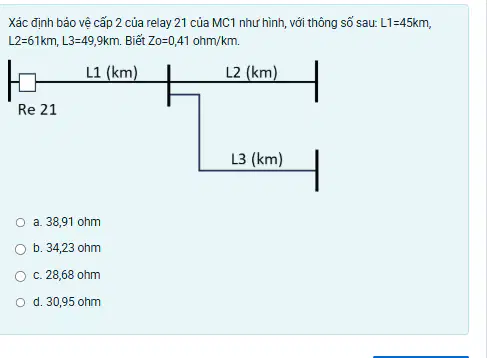
Nhập đáp án a b c hoặc d
(a)
When comparing Relay 67 and Relay 21, which of the following statements is true? Khi so sánh relay 67 và relay 21, nhận định nào sau đây là đúng?
Relay 21 is an extended version of Relay 67, considering the phase angles U and I (Relay 21 là một trường hợp mở rộng của relay 67 khi quan tâm thêm góc pha U và I)
Relay 67 and Relay 21 are not related to each other (Relay 67 và relay 21 không liên quan gì với nhau)
Relay 21 is an extended version of Relay 67, considering the magnitudes U and I (Relay 21 là một trường hợp mở rộng của relay 67 khi quan tâm thêm biên độ U và I)
Relay 21 is different from Relay 67 because it only uses current signals without using voltage signals for protection (Relay 21 khác với relay 67 vì chỉ dùng tín hiệu dòng điện mà không sử dụng tín hiệu điện áp của đối tượng cần bảo vệ)
How are the settings for Level 1, Level 2, and Level 3 relays determined? Cách xác định thông số đặt cho relay cấp 1, cấp 2 và cấp 3 như thế nào?
Level 1 is determined by short-circuit parameters. Level 2 and Level 3 are determined by maximum load. (Cấp 1 dùng thông số ngắn mạch để xác định. Cấp 2 và cấp 3 dùng tải cực đại)
.Level 1, Level 2, and Level 3 are all determined by short-circuit parameters (Cấp 1, cấp 2 và cấp 3 đều dùng thông số ngắn mạch để xác định)
Level 1 is determined by maximum load. Level 2 and Level 3 are determined by short-circuit parameters (Cấp 1 dùng tải cực đại để xác định. Cấp 2 và cấp 3 dùng thông số ngắn mạch)
Level 1 and Level 2 are determined by short-circuit parameters. Level 3 is determined by maximum load. (Cấp 1 và cấp 2 dùng thông số ngắn mạch để xác định. Cấp 3 dùng tải cực đại.)
What is the main characteristic of Zone 2 in a distance relay? Đặc điểm chính của vùng 2 trong relay khoảng cách là gì?
.It protects the entire length of the line plus 50% of the second shortest line (Bảo vệ toàn bộ chiều dài đường dây cộng với 50% đường dây thứ hai ngắn nhất)
It protects the entire length of the line plus part of adjacent lines (Bảo vệ toàn bộ chiều dài đường dây cộng với một phần của các đường dây liền kề)
It only detects phase faults (Chỉ phát hiện sự cố pha)
It has an instantaneous operation with no delay. (Có tác động ngay lập tức mà không có thời gian trễ
How does a distance protection relay accurately determine the fault location? Làm thế nào relay bảo vệ khoảng cách xác định chính xác vị trí sự cố?
By measuring ground fault current (Bằng cách đo dòng điện chạm đất)
By measuring the phase angle between voltage and current (Bằng cách đo góc pha giữa điện áp và dòng điện)
By measuring the load power (Bằng cách đo công suất của tải)
By measuring impedance between the relay and the fault point (Bằng cách đo tổng trở giữa relay và điểm sự cố)
Why does a distance protection relay operate reliably under complex fault conditions? Tại sao relay bảo vệ khoảng cách hoạt động ổn định trong các điều kiện sự cố phức tạp?
Because the relay measures both current and voltage (Vì relay có khả năng đo cả dòng điện và điện áp)
Because the relay is not affected by load fluctuations (Vì relay không bị ảnh hưởng bởi sự dao động của dòng tải)
Because the relay only protects during system-wide faults (Vì relay chỉ bảo vệ khi có sự cố trên toàn hệ thống)
.Because it is specifically designed for short circuit faults (Vì nó được thiết kế đặc biệt cho sự cố ngắn mạch)
Why does a distance protection relay have high sensitivity in detecting short circuits? Tại sao relay bảo vệ khoảng cách có độ nhạy cao trong việc phát hiện ngắn mạch?
Because the relay works independently of load conditions (Vì relay hoạt động độc lập với tải)
Because the relay measures the impedance of the line (Vì relay đo lường tổng trở của đường dây)
Because the relay only detects high currents (Vì relay chỉ phát hiện được dòng điện cao)
Because the relay only works for ground faults (Vì relay chỉ hoạt động khi có sự cố chạm đất)
What percentage of the transmission line does Zone 1 of a distance relay typically protect? Vùng 1 của relay khoảng cách thường bảo vệ bao nhiêu phần trăm chiều dài đường dây?
80% - 85%
100%
100 - 120%
50% - 60%
Why can a distance protection relay coordinate with other protection systems? Relay bảo vệ khoảng cách có thể phối hợp với các hệ thống bảo vệ khác để làm gì?
To detect short circuits slower (Để phát hiện ngắn mạch chậm hơn)
.To enhance multi-layer protection for the system (Để tăng cường bảo vệ nhiều lớp cho hệ thống)
To measure load voltage (Để đo điện áp tải)
To detect phase loss (Để phát hiện mất pha)
When a fault occurs, both Relay 21 and Relay 51 operate. Where is the fault located? Khi có sự cố, Relay 21 và Relay 51 cùng tác động. Sự cố xảy ra ở đâu?
.Short circuit at about 20-50% of the transmission line (Ngắn mạch khoảng 20-50% đường dây)
Short circuit in Zone 2 of Relay 21 (Ngắn mạch tại vùng 2 của Relay 21)
Short circuit in Zone 1 of Relay 21 (Ngắn mạch tại vùng 1 của Relay 21)
All three are incorrect (Cả 3 đều sai)
The transmission line is equipped with Relay 21 and Relay 50. When a fault occurs and both relays operate, where is the fault located? Đường dây được trang bị loại Relay 21 và 50, khi sự cố xảy ra và cả hai relay cùng tác động, sự cố nằm ở đâu?
All are incorrect (Tất cả đều sai)
Short circuit at about 70% of the transmission line (Ngắn mạch tại khoảng 70% của đường dây)
Short circuit in Zone 2 of Relay 21 (Ngắn mạch tại vùng 2 của relay 21)
Short circuit at around 40%-50% of the transmission line (Ngắn mạch khoảng 40%-50% đường dây)

