
 Worksheets
Unit 1 Review
Total questions: 80
Worksheet time: 4hrs 42mins
Which type of spectra produces, or emits, light of specific frequencies and has bright lines on a dark background?
Absorption spectra
Emission spectra
Continuous spectra
Which type of spectra measures the light that a gas absorbs and produces dark lines?
Absorption spectra
Emission spectra
Continuous spectra
Which three features can appear together in a single spectrum?
Emission lines
Absorption lines
Continuum
Temperature
Look at figure 15 on page 242 of your reading. Compare the spectra of the 3 given elements in order to identify the unknown element.
What is the identity of the unknown element?
Helium
Carbon
Hydrogen
True or false: different elements have different energy levels.
true
false
True or false: A continuous spectrum with no lines indicates the path of light is free from absorbing gases.
true
false
Which type of information can scientists often infer from analyzing star spectra?
location
distance
size

An astronomer looks at the spectrum of light from a distant star. Between Earth and the star is a large cloud of dust and gas. The star emits continuous-spectrum white light, but some of the light is absorbed by the cloud. The figure shows the spectrum of light that the astronomer observes as well as the absorption spectra of several pure elements. Which of the five elements shown does the interstellar cloud contain?
hydrogen and helium
hydrogen and oxygen
hydrogen, helium, and nitrogen
oxygen and nitrogen

Which elements are present in the mixture?
D and E
D and G
E and G
only D
only G

The image shows the absorption spectrum of sodium. Of the labeled lines, which corresponds to the lowest amount of energy?
Line A
Line B
Line C


What does a spectroscope do?
Create light
Absorb light
Separate light
Spectate light
Nuclear Fusion occurs inside stars and during a ________.
What elements make up the sun?
Sodium
Hydrogen
Helium
Lithium
Earth is a habitable planet. This is partly because
It has two Suns.
It has no bad weather.
It is a good distance from the Sun.
It is the closest planet to the Sun.
In fusion, atoms
combine
split apart
remain unchanged
disguise themselves
Nuclear fusion produces what? (Check all that apply)
Light
heat
matter
energy
Electromagnetic Radiation
Where does nuclear fusion happen?
In the core of stars
In the core of the Earth
In nuclear power plants
In the core of the moon

During the main sequence stage, stars primarily fuse ______ into ______.
Hydrogen → Helium
Helium → Carbon
Carbon → Iron
Hydrogen → Oxygen
What happens when hydrogen in a star’s core runs low?
The star becomes cooler and expands
The star explodes
The star turns into a black hole
Fusion stops forever
Low- and medium-mass stars end their lives as:
Neutron stars
White dwarfs
Black holes
Supernovae
Elements heavier than iron are formed in:
Planet formation
Black hole collisions
Supernova explosions
The Big Bang
What happens to protons and neutrons in nuclear fusion?
They are destroyed
They are converted to light
They combine into new nuclei, conserving total count
They disappear
Which evidence tells scientists what elements are in a star?
Star size
Light spectrum
Temperature
Magnetic field
The material from supernovae becomes:
New galaxies
Dust and gas for new stars and planets
Nothing—it disappears
Only radiation
What type of energy does fusion release?
Electromagnetic
Kinetic
Sound
Elastic
What stage in the life cycle does this describe?

What is the main factor that determines what a star will become?
mass
brightness
temperature
color

Which of the following elements is/are represented in the spectrum below?
Hydrogen only
Helium Only
Hydrogen & Helium
Calcium Only
The process of fusion requires
High heat and high pressure
Cool temperatures and no gravity
A snack
High heat and low pressure
The process of fusion happens in a star's
Corona
Convection Zone
Radiative Zone
Core
A star is producing Fe atoms in its core. What do you know about where the star is in its life cycle?
Nothing, stars can produce Fe atoms throughout their life cycle.
It is near the beginning of its life.
It near the middle of its life.
It is near the end of its life.

The diagram below represents the Earth’s orbital path around the sun. The Earth takes the same amount of time to move from A to B as from C to D.
The shaded sections of the diagram are equal in area.
The distance from the sun to the Earth is the same at point A and at point D.
The orbital velocity of the Earth at point A equals its orbital velocity at point C.
The gravitational force between the Earth and the sun at point B is the same as the gravitational force at point D.
What is Kepler's 2nd Law about?
the shape of the orbits
the speed or area an orbiting object travels
the size of the orbit an object has
the amount of time it will take for an object to orbit
Kepler's first law is about:
the shape of the orbit
the time it takes for a planet to orbit
the distance or speed a planet orbits
how fast a planet spins
What discovery did Kepler make about the planet's orbits?
He discovered the planets orbit in a circular motion
He discovered the planets orbit in an elliptical motion
He discovered the planets orbit in a rectangular motion.
He discovered the planets orbit in a triangular motion
Kepler's first law is about:
the shape of the orbit
the time it takes for a planet to orbit
the distance or speed a planet orbits
how fast a planet spins

Kepler's 2nd Law state that, if you draw a imaginary line from the Sun to a planet:
it will sweep out an equal amount of space (area) in an equal amount of time.
the length of the line will equal the eccentricity.
the line will always be the same length.
it will point to Never Never Land.
Which of the following pieces of information can be determined from looking at a transit graph?
semi-major axis
eccentricity
habitability
orbital period
One astronomical unit (1 AU) is the
average distance from the sun to Earth
average distance from the sun to Earth's moon
average distance from the sun to Mars
A random number made up by astronomers
If we are able to obtain orbital period from transit data, we can calculate _____ using Kepler's 3rd Law.
Orbital eccentricity
Average distance between the planet and its host star
Percentage of water vapor in the planet's atmosphere
The probability for advanced life
The closest star to the Earth is the Sun?
True
False
What is the order of the planets in the solar system?
(a)
A _____is a sphere of hot gases that releases energy as light.
Galaxy
Star
Comet
Gravity
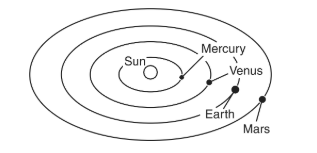
Which planet will take the least amount of time to revolve around the Sun?
Mercury
Venus
Earth
Mars
Which of the following has water in liquid form?
Earth
Comet Borrelly
Pluto
Neptune
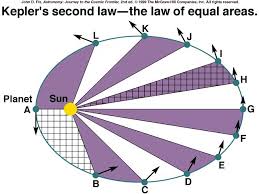
Kepler's 2nd Law deals with
the shape of the planets' orbits
the area the planet travels
the length of time/period it takes the planet to orbit the sun
What does Kepler's 1st Law state?
all planets move in elliptical shaped orbits around the sun
all ellipses have one foci
the area that a planet revolves around the sun is equal
the speed that a planet revolves around the sun changes

What is the formula for eccentricity?
e = d / L
e = L * d
e = L / d
e*d=L
The eccentricity formula is:
change in value/distance
mass/volume
distance between foci/length of major axis
change in value/time
What is the area swept out by a planet in its orbit?
It is proportional to the time taken, as stated in Kepler's Second Law.
It is constant regardless of the planet's speed.
It varies inversely with the distance from the sun.
It is determined by the planet's mass.

