
 Worksheets
L2 science oc1
Total questions: 23
Worksheet time: 17mins
Which statement best describes density as introduced in the material?
The total weight of an object regardless of its size
How much ‘stuff’ a material has in a given volume at a given temperature
The temperature of a material compared to its mass
The shape of a material and its dimensions
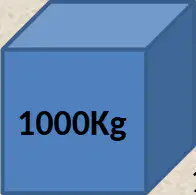
A cube has side lengths of 1 m and a mass of 1000 kg, as shown. Using the formula density = mass ÷ volume, what is the cube’s density in kg/m³?
1000 kg/m³
1 kg/m³
500 kg/m³
2000 kg/m³
Which factor most directly explains why solids, liquids, and gases have different densities?
Their color and texture
The number of molecules present within a particular volume
The shape of their containers
Whether they conduct electricity
Which statement best explains why water becomes less dense when heated?
Heating causes water molecules to slow down and pack closer together.
Heating adds energy that excites water molecules, forcing them to move further apart.
Heating removes impurities, increasing the mass per unit volume.
Heating increases pressure, compressing the liquid.
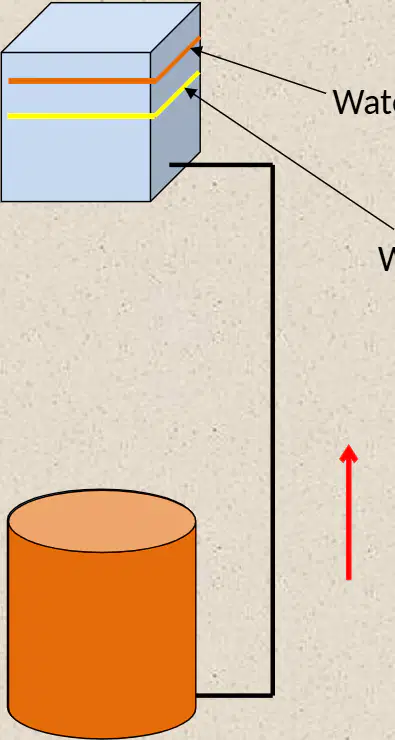
In a vented hot water storage system, what happens as the water in the cylinder heats up and expands?
It compresses within the cylinder, increasing density.
It exits through the hot outlet only.
It passes back up the cold feed pipe into the cistern because there is no room to expand in the cylinder.
It evaporates and leaves through the vent pipe.
At approximately which temperature does fresh water reach its maximum density?
0 °C
4 °C
65 °C
82 °C
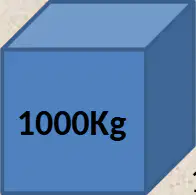
Compare the mass of 1 m³ of water at 4 °C with that at 82 °C. Which option correctly states their masses?
4 °C: 1,000 kg; 82 °C: 967 kg
4 °C: 967 kg; 82 °C: 1,000 kg
Both are 1,000 kg regardless of temperature
4 °C: 1,200 kg; 82 °C: 900 kg
Which statement best defines relative density (specific gravity) as presented?
The absolute mass of a substance per unit volume.
A ratio comparing the weight per volume of a substance to an equal volume of water.
The temperature-dependent expansion of a material.
The force required to submerge an object in water.
Given 1 m³ of water has a mass of 1,000 kg and 1 m³ of mild steel has a mass of 7,700 kg, what is the relative density of mild steel compared to water?
0.77
1.0
7.7
770
Water has a specific gravity of 1.0. Based on this, which statement is correct?
Materials with relative density less than 1 sink in water.
Materials with relative density greater than 1 float in water.
Materials with relative density equal to 1 always float.
Materials with relative density greater than 1 will sink, and those lighter than 1 will float.
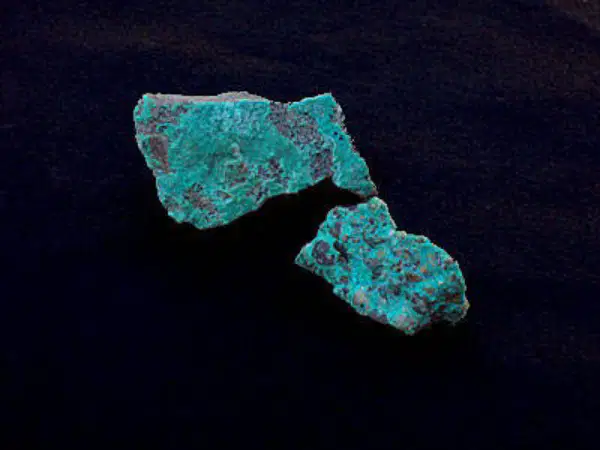
Which statement best describes how metals are obtained from their natural state?
Metals are found as pure elements ready for use
Metals usually appear as ores that are compounds with impurities and must be smelted
Metals are made synthetically from non-metallic elements
Metals are harvested from plants that absorb them
A plumber needs fittings that resist corrosion and are stronger than pure copper. Which material is most appropriate based on alloy properties?
Bronze
Brass
Solder
Gunmetal
Which alloy is correctly matched with both its primary components and a typical use in practice?
Bronze: copper and zinc; used for underground corrosion-resistant fittings
Solder: lead and tin (or tin and copper); used for electrical connections and as a jointing material
Duralumin: copper and tin; used for decorative purposes
Gunmetal: aluminium and magnesium; used in aircraft production
According to the instructional material, why did lead stop being used as a plumbing pipework material in 1986?
It became too expensive to manufacture
Concerns over lead poisoning
It was banned due to corrosion issues
It was replaced by plastic for better flow

Which application shown in the visuals demonstrates lead being used on a building exterior to channel rainwater?
Lead sheet roofing
Lead pipework connected to copper with a brass fitting
Lead guttering
Lead waste system
Which statement best describes the historical role of lead in plumbing prior to 1986?
Lead was rarely used due to limited availability
Lead was the original plumbing material and the principal material for water mains, services, waste systems, and rainwater guttering
Lead was only used for decorative roofing
Lead was primarily used for electrical wiring
Identify the building component made from lead that covers large flat areas as shown in the visual.
Lead guttering
Lead sheet roof
Lead service pipe
Lead cladding panels
Which property of copper most directly explains why it has been used in plumbing pipework for over 100 years?
High electrical resistivity
Malleability and ductility
Low melting point
Magnetic behavior
A plumbing designer needs tubing that can be bent in a machine without fracturing. Which copper tube standard is most appropriate?
R290 Hard
R220 Soft Coil
R250 Half Hard
None of the above
Which statement best compares R290 Hard with R250 Half Hard copper tube?
R290 has a thicker wall and is less likely to fracture when bent.
R290 is more rigid due to increased temper and has a thinner wall than R250, so it will fracture if bent.
R250 is harder and has a thinner wall, making it more likely to fracture than R290.
Both have the same temper and can be bent without risk of fracture.
Which application aligns with the typical use of R220 Soft Coil copper tubing?
High-rigidity sections in exposed piping
Micro-bore central heating systems or underground water service pipework
Electrical wiring conduits
Roof flashing on steep slopes
Considering copper’s malleability and ductility, which reasoning best supports the use of copper sheets in roofing across some European countries?
These properties allow copper to be formed and shaped to complex roof profiles without cracking.
Copper’s magnetism prevents storm damage.
Copper’s brittleness makes installation faster.
Copper cannot corrode, so coatings are unnecessary.
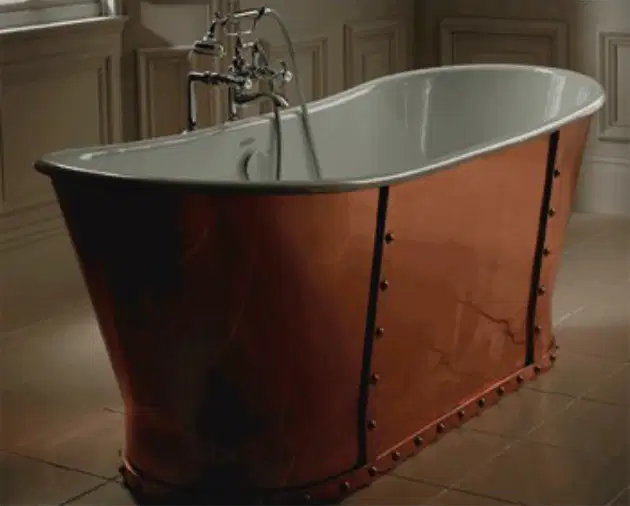
The image shows a free-standing copper bath priced at £15,850.04 in 2009. Which inference is most reasonable about copper as a material for such fixtures?
Copper is rarely used because it cannot be formed into curved shapes.
Copper’s malleability allows complex forms, but the material and craftsmanship can make products premium-priced.
Copper is inexpensive, explaining the high price.
Copper cannot be used in wet environments.

