
 Worksheets
Quarter 1 Review Honors Chemistry 2025
Total questions: 48
Worksheet time: 55mins
Horseplay or practical jokes in the laboratory are
always against the rules.
okay.
not dangerous.
okay if you are working alone.
When you finish working with chemicals, always
treat your hands with skin lotion.
wash your hands thoroughly with soap and water.
wipe your hands on a towel.
wipe your hands on your clothes.
Approved eye protection devices (goggles) are worn in the laboratory
to avoid eye strain.
to improve your vision.
only if you don't have corrective glasses.
any time chemicals, heat, or glassware are used.
You are heating a piece of glass and now want to pick it up. You should
use a rag or paper towels.
pick up the end that looks cooler.
use tongs.
pour cold water on it.
After completing an experiment, all wastes should be
taken home
tossed in the trash can
disposed of according to your teacher's directions
left out for someone else to clean
Rusting metal is an example of a ____ change.
chemical
state
physical
A change in which one or more substances are converted into different substances
physica change
chemical change
A substance that cannot be broken down into any other substance by ordinary chemical means is called —
A substance made up of two or more chemically combined elements is —
an element
a mixture
a compound
a solution

This picture represents which of the following?
A single element
a mixture
a compound

An atom has 10 protons, 15 neutrons and 10 electrons. What is its mass number?
This particle determines what element you have - the element's identity.
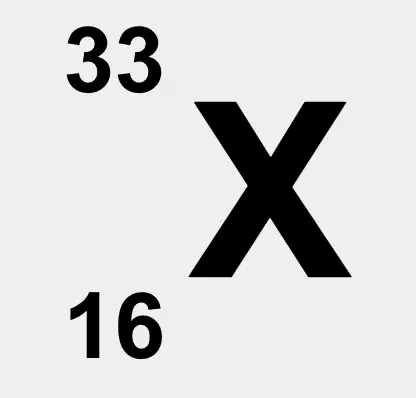
What is the element shown?
Oxygen
Chlorine
Sulfur
Copper
None of these
An atom has 38 neutrons and a mass number of 65. What element is this?
cobalt
copper
carbon
chromium
Which of the following correctly represents a sodium atom with 13 neutrons?


Radio
Visible Light
Gamma Rays
1s22s22p63s2
Each row on the periodic table represents:
an energy level
a sublevel
an electron
an orbital

This Lewis Dot Diagram could represent...
Mg
Cl
C
O

This Lewis Dot Diagram could represent
Ne
Si
Al
Be

Each element on the periodic table can be identified by its
classification as a solid, liquid or gas.
location on the table.
unique spectral "fingerprint."
Whenever an excited electron falls back from an excited state to its ground state, it __________.
absorbs energy
emits energy
absorbs specific frequencies of light
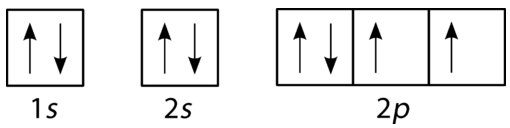
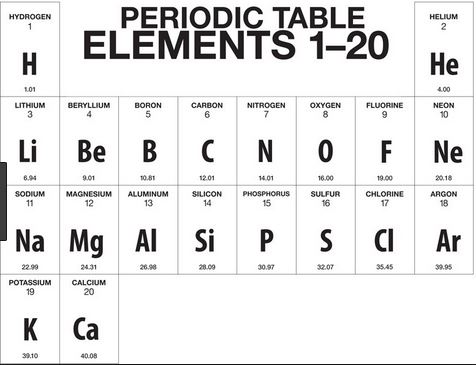
How many valence electrons does Phosphorus Have?
2 Valence electron
4 Valence electron
5 Valence electron
Which of the following elements has properties most like those of calcium?
Which element is found in Period 3, Group 2?
What is the rule that elements will gain, lose, or share electrons in order to have 8 valence electrons?
Octet rule
Octopus rule
Ion rule

Which element is this?
Nickel
Neon
Sodium
Nitrogen
A substance that can be hammered into different shapes would be classified as a
metal
nonmetal
metalloid
A substance that is dull, brittle, and a nonconductor would be classified as a
metal
nonnmetal
metalloid

Everything to the right of the zigzag line on the periodic table (blue on this pic)
metal
metalloid
non-metal

Everything on the zigzag line on the periodic table (yellow on this table)
metal
metalloid
non-metal
What does electronegativity mean?
ability to increase energy levels
ability to react with elements
ability to attract electrons

In the alkali metals, which element has a larger atomic radius?
lithium, Li
potassium, K
cesium, Cs

In the halogen family, which element is the most electronegative?
iodine, I
fluorine, F
chlorine, Cl

Which of the following elements is the most electronegative?
Hydrogen, H
Aluminum, Al
Oxygen, O
Cesium, Cs

