
 Worksheets
Unit 4 Earth Properties
Total questions: 84
Worksheet time: 51mins

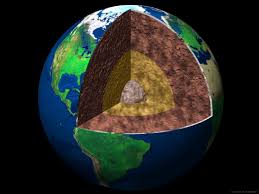
Which layer of Earth is located below the outer core?
crust
inner core
mantle
lithosphere


What is the thinnest layer?
Crust
Mantle
Inner Core
Outer Core
Which layer has the least pressure?
Crust
Mantle
Outer Core
Inner Core
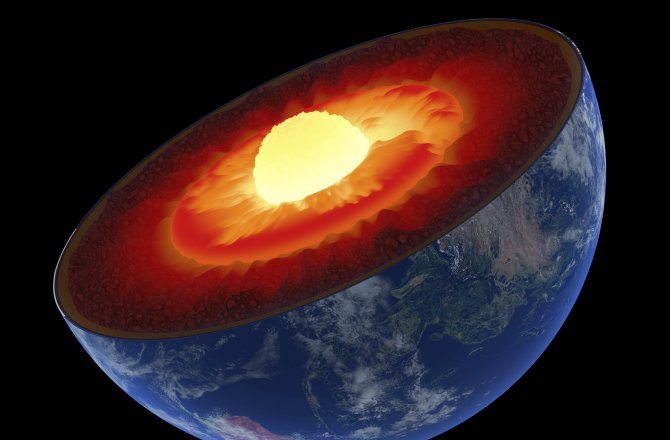
Which layer is made of liquid metal (Fe and Ni)?
crust
mantle
outer core
inner core
Which layer is the thinnest?
crust
mantle
outer core
inner core
Which layer is responsible for creating Earth's magnetic field?
crust
mantle
outer core
inner core


How do temperature and pressure change as the depth of the geosphere increases?
Temperature and pressure decreases.
Temperature and pressure Increases.
Temperature decreases, and pressure increases.
Temperature increases, and pressure decreases.
Ricky is working on a class assignment of building a model of the Earth. While building the model, which layer should he make the thinnest layer?
inner core
outer core
mantle
crust

What is part D?
Mantle
inner core
outer core
crust
What is part B?
Mantle
inner core
outer core
crust
layers of gasses around a planet
Polar
Element
Atmosphere
Tides
matter that cannot be broken down into a simpler substance
Moon
Element
Polar
Tide
in earth science, having to do with the areas on Earth closest to the geographic North or South poles (cold areas b/c of less sun light)
Polar
Gravity
Tides
Axis
an imaginary line that an object spins or rotates around
Equator
Gravity
Axis
Oxygen
is the force that keeps the planets in motion around the sun. it acts everywhere in the universe
Element
Polar
Gravity
Magnetic Field
Which of the following factors is NOT the reason why Earth can sustain life?
Moderate temperature
Water availability
Carbon dioxide for breathing
Oxygen for breathing
Atmosphere which traps and reflects light
Earth's atmosphere is mainly composed of
Carbon Dioxide & Argon
Nitrogen & Oxygen
Helium & Hydrogen
Potassium & Sodium
What is unique about Earth?
Orbited by a moon
Has a gravitational field
Revolves around the sub
covered mostly by water
The earth is protected from harmful UV rays from the sun's solar winds by our -
atmosphere
iron core
magnetosphere
ozone layer
The frozen water at the North and South Pole is called -
icebergs
ice caps
slush
ice cubes
If the North Pole has one charge, then the South Pole has -
the opposite charge
the same charge
no charge
more charge
We know the age of the Earth because of -
scientific guessing
scientific hypothesis
scientific method
scientific evidence
The Earth is approximately -
4.5 million years old
4 million years old
4.5 billion years old
4 billion years old
After learning about everything that had to be "just right" for Earth to have all of the unique characteristics that make life on this planet possible, which of these book characters it would be?
Goldilocks
Rumpelstiltskin
Big Bad Wolf
Cinderella

Which gas is represented by Gas #1?
Oxygen
Carbon dioxide
Argon
NItrogen
Scientist believe Earth is how old?
4.5 Billion Years Old
4.5 Million Years Old
4.5 Years Old
4.5 Trillion Years Old
Because of it's distance from the sun, Earth has moderate temperatures and makes oceans of (a) water possible.
Earth is the only planet that has _____ in all 3 states- solid, liquid, and gas.
water
carbon dioxide
oxygen
nitrogen
What unique property about Earth protects us from harmful radiation from the sun?
Greenhouse effect
ice caps
liquid water
Magnetic field

What would happen if the Earth had no atmosphere?
It would always be summer
It would be the same as now just a little harder to breathe
No life or weather
Air pressure would be higher.
Why is the magnetosphere (magnetic shield surrounding earth) so important?
It creates metal for Earth.
It helps some birds from leaving.
It shields us from solar flares that could destroy our ozone
It pulls the moon closer.
What zone is the United States in?
Temperate
Polar
Tropical
What zone is the equator in?
Temperate
Polar
Tropical
What is the name of the climate zones at the north and south of the map?
Tropical
Polar
Temperate
Which zone has the the coldest place on earth?
Tropical
Temperate
Polar

What climate zone is the white area in the picture?
Polar zone
Temperate zone
Tropical zone
Why are polar climates so much colder than tropical climates?
It is too humid in tropical climates
Polar bears prefer the cold
Sunlight is very indirect at the poles
Atmospheric circulation


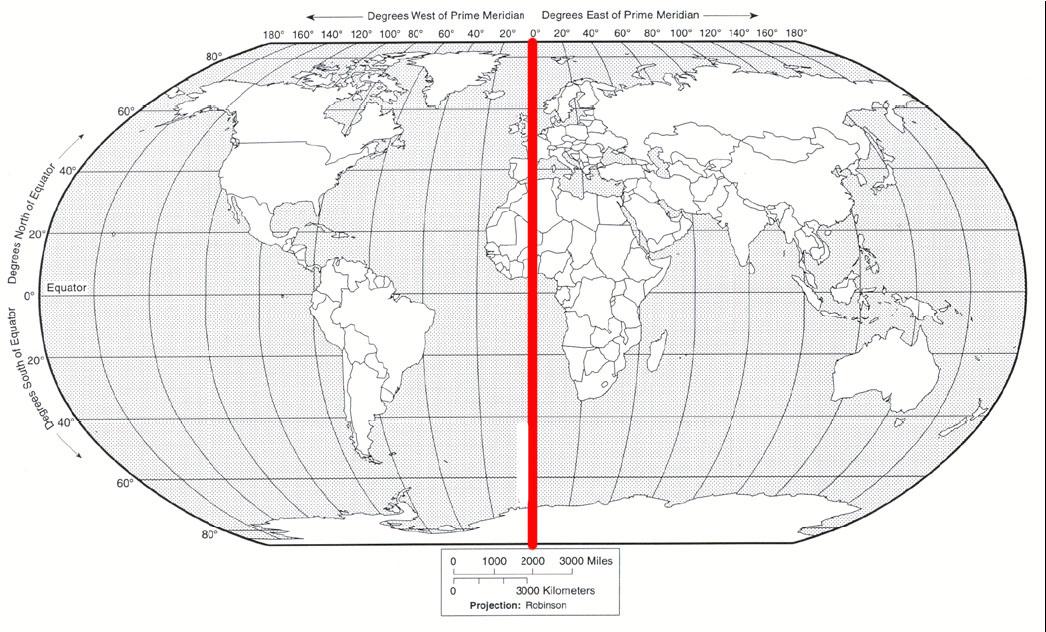
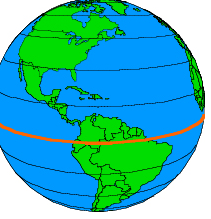
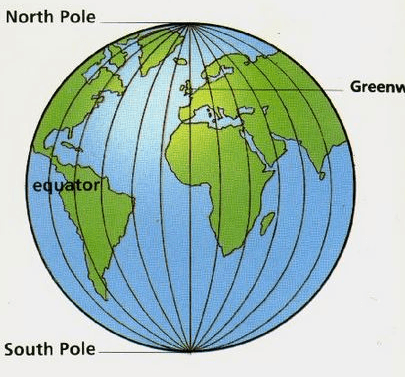
A latitude line at 0 degrees which cuts the earth into the northern and southern hemispheres is known as the
tropic of cancer
equator
prime meridian
arctic circle
Longitude lines on a globe run from
south to west
north to east
north to south
east to west
Latitude lines on a globe run from
north to south
east to west
north to east
south to west

The arrow is pointing to which line on the Earth?
Equator
Prime Meridian

The arrow is pointing to which line on the Earth?
Equator
Prime Meridian

Lines on the Earth are -
latitude
longitude

The lines on the Earth are -
latitude
longitude
Line of 0 degree LATITUDE that divides the Earth into Northern/Southern Hemispheres.
Equator
Prime Meridian
absolute location
coordinates
One half of a sphere. 4 - Northern, Southern, Eastern and Western
absolute location
hemispheres
Prime Meridian
Equator
Is Antarctica at the North Pole or South Pole?
South
North
The blocks of ice floating on the water is called ____________.
Inuit
icebergs
The area near the North Pole is called __________________.
Arctic
Antarctic

What would happen when two north poles of magnets are placed together?
The force will pull them together (attract).
The force will push them away from each other (repel).
The strength of the magnet is doubled.

What would happen when the opposite poles of magnets are placed together?
The force will pull them together (attract).
The force will push them away from each other (repel).
The strength of the magnet is doubled.
Where is the force of attraction the strongest on a magnet?
above the magnet
below the magnet
at the poles
in the middle

What do the lines around this magnet represent?
North Pole
South Pole
Magnetic Declination
Magnetic Field
What is responsible for the Magnetic Field around Earth?
The Sun
The Earth's core
The Earth's crust
The Earth's mantle
The two poles are called the _______ poles
east and west
north and east
south and west
north and south
Unlike (opposite) poles _____, like (same) poles _____
repel, attract
connect, repel
attract, repel
repel, connect

