wayground logo

Free Printable Worksheets

Font size

S
M
L
XL
Worksheets

Quarterly Review 6th Grade

Total questions: 83

Worksheet time: 1hrs 23mins

Name
Class
Date
1.

Predict what would happen to a glass of drinkable water if left outside overnight in negative degree weather. (a)  

Choose from the below words
The water would stay the same
The water would change to a solid
The water would change to a gas
2.

If a cup of hot chocolate is put in the microwave, would that add or remove thermal energy to the hot chocolate. (a)  

Choose from the below words
Thermal Energy is Added
Thermal Energy was Removed
3.

Which model is demonstrating what molecules in a solid look like.

a)
b)
c)
4.

Which model is demonstrating what molecules in a liquid look like.

a)
b)
c)
5.

If thermal energy is increasing, what is happening to the kinetic energy. (a)  

Choose from the below words
Kinetic energy would be decreasing
Kinetic energy would stay the same
Kinetic energy would be increasing
6.

The total kinetic energy of the tiny particles that make up matter. (a)  

Choose from the below words
Thermal Energy
Energy Transfer
Temperature
Heat
7.

Movement of energy from one object to another.

a)

Heat

b)

Energy Transfer

c)

Themal Energy

d)

Temperature

8.

When particles are heated they begin to ____.

a)

move faster

b)

mover slower

c)

move up

d)

jump out of the pot

9.

What tool is used to measure temperature?

a)

a stove

b)

a beaker

c)

a thermometer

d)

a glove

10.

A barefoot student steps on a hot concrete surface. Most of the heat transferred to the student’s skin by this contact is by the process of— (a)  

Choose from the below words
convection
conduction
vaporization
radiation
11.

what is convection (a)  

Choose from the below words
direct touch
movement of air or liquids
heat waves or light waves
sunbathing outside
12.
what is radiation?
a)
direct touch
b)
air or liquids
c)
heat waves/ light waves
d)
touching the cookies out of the oven
13.
What is the difference between heat and temperature?    
a)

a.  Temperature measures the motion of molecules, and heat is the motion of that energy

b)

b.  Temperature is measured by a thermometer, and heat is measured by a barometer

c)

c.  Heat is measured in calories, and temperature is measured in joules

d)

d.  Heat is caused by the sun, and temperature is caused by conditions in the atmosphere
14.
All ____________ are made up of two or more atoms bonded together.
a)
atoms
b)
molecules
c)
electrons
d)
elements
15.
Energy of motion is which type of energy?
a)
Potential
b)
Kinetic
c)
Sound
d)
Gravitational
16.
What type of energy is in this picture?
a)
Kinetic
b)
Potential
c)
Chemical
d)
Sound
17.
What kind of energy does this device use?
a)
Chemical
b)
Electrical
c)
Thermal
d)
Chemical
18.
What kind of energy is represented in the picture?
a)
Thermal
b)
Chemical
c)
Sound
d)
Nuclear
19.

What is a collision?

a)

When objects are magnetically thrown apart

b)

an instance of one moving object or person striking against another

c)

a set of things working together as parts of a mechanism or an interconnecting network.

d)

a state in which opposing forces or influences are balanced.

20.

What is Equilibrium

a)

a set of things working together as parts of a mechanism or an interconnecting network.

b)

When your math problem is equal on both sides

c)

a state in which opposing forces or influences are balanced.

d)

The conversion of one form of energy into another, or the movement of energy from one place to another.

21.

What is a system?

a)

a set of things working together as parts of a mechanism or an interconnecting network.

b)

A console you play video games on

c)

a state in which opposing forces or influences are balanced.

d)

The conversion of one form of energy into another, or the movement of energy from one place to another.

22.
Earth's current atmosphere is
a)
78% nitrogen, 21% oxygen, 0.9% argon and 0.037% carbon dioxide
b)
78% oxygen, 21%nitrogen, 0.9% argon, 0.037% carbon dioxide
c)
78% nitrogen, 21% argon, 1% oxygen
d)
78% oxygen, 21% nitrogen, 1% carbon dioxide
23.
The layers of the atmosphere in order from bottom to top are
a)
troposphere, stratosphere, mesosphere, thermosphere, exosphere
b)
troposphere, mesosphere, atmosphere, thermosphere
c)
mesosphere, thermosphere, troposphere, stratosphere, exosphere
d)
thermosphere, stratosphere, mesosphere, troposphere, exosphere
24.
The layer of the atmosphere containing the ozone layer is
a)
troposphere
b)
stratosphere
c)
thermosphere
d)
mesosphere
25.

The layer of the atmosphere containing our weather and water is

a)
thermosphere
b)
stratosphere
c)
troposphere
d)
mesosphere
26.
Air in the atmosphere is 78%
a)
Einsteinium
b)
nitrogen
c)
oxygen
d)
carbon dioxide
27.

What layer of the atmosphere is closest to outer space?

a)

mesosphere

b)

exosphere

c)

troposphere

d)

stratosphere

28.

Device used to measure the atmospheric pressure

a)

Barometer

b)

Thermometer

c)

Anemometer

d)

Altimeter

29.
The weight of the atmosphere is ...
a)
temperature
b)
humidity
c)
air pressure
d)
weather
30.

As altitude (height above ground) increases, the air pressure 
a)
decreases
b)
stays the same
c)
increases
d)
all of the above
31.
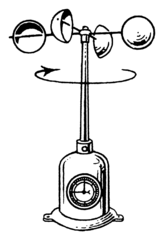
This weather instrument is an...
a)
wind vane
b)
anemometer
c)
barometer
d)
thermometer
32.

Someone who studies the weather. (a)  

Choose from the below words
rain gauge
taxonomists
meterologist
satellites
33.

What does this symbol represent? (a)  

Choose from the below words
Cold Front
Warm Front
Stationary Front
Occluded Front
34.

What does this symbol represent?

a)

Cold Front

b)

Warm Front

c)

Stationary Front

d)

Occluded Front

35.
What are tornadoes?
a)
a storm with thunder and lighting and typically also heavy rain or hail
b)
a storm that can be the same as thunderstorms, but can be even more dangerous
c)
a mobile, destructive vortex of violently rotating winds having the appearance of a funnel shaped cloud and beneath a large storm system.
d)
a huge storm with strong winds and storm surges
36.
What is storm that contains storm surges and has wind speeds of 74 mph - 200 mph?
a)
thunderstorms
b)
severe thunderstorms
c)
tornadoes
d)
hurricanes
37.
What are thunderstorms?
a)
a storm with thunder and lighting and typically also heavy rain or hail
b)
a storm that can be the same as thunderstorms, but even more dangerous
c)
a mobile, destructive vortex of violently rotating winds having the appearance of a funnel shaped cloud and advancing beneath a large storm system.
d)
a huge storm with strong winds and storm surges
38.

Which type of air mass is dry and warm?

a)

Continental polar

b)

Continental tropical

c)

Maritime polar

d)

Maritime tropical

39.

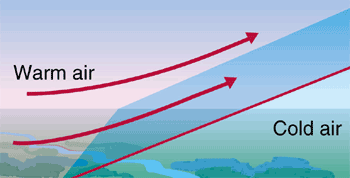
A _____________ weather front occurs when a cold air mass moves forward, pushing the warm air mass up.

a)

Cold

b)

Warm

c)

Stationary

d)

Occluded

40.

A _____________ weather front occurs when a cold air mass and a warm air mass meet, but cannot move one another so they both stay still for several days.

a)

Cold

b)

Warm

c)

Stationary

d)

Occluded

41.

Why does warm air rise above cold air?

a)

Warm air is less dense

b)

Warm air is more dense

c)

Cold air is stronger than warm air

42.

Applying what you know about air masses, which air mass would you expect to find here in Chad, Africa? (circled on the picture **hint: find the equator line**) (a)  

Choose from the below words
Continental polar
Continental tropical
Maritime polar
Maritime tropical
43.

Evaporation (a)  

Choose from the below words
A gas changes into a liquid
A solid changes into a liquid
A liquid changes into a gas
A liquid changes into a solid
44.

Condensation (a)  

Choose from the below words
A gas changes into a liquid
A liquid changes into a gas
A solid changes into a liquid
A liquid changes into a solid
45.

Heat makes evaporation take place ...

a)

faster

b)

slower

46.

Formation of clouds, dew, snow are examples of ___

a)

condensation

b)

evaporation

47.

The image shows various stages in the water cycle. During which stage does water flow back towards the sea as runoff?

a)

W

b)

X

c)

Y

d)

Z

48.

What is the energy source that drives the water cycle?

a)

The moon T

b)

The heat from our home in the winter all around the world

c)

The sun

d)

he heat generated solely from the core of the earth

49.
What is it called when plants give off water vapor as a waste product?
a)
condensation
b)
evaporation
c)
sublimation
d)
transpiration
50.
Which of the following is the smallest unit of life that can carry out all life functions?
a)
the mitochondria
b)
the vacuoles
c)
the nucleus
d)
the cell
51.
Which cell structure is found in plant and animals cells and controls what can come into or leave a cell?
a)
cell membrane
b)
cytoplasm
c)
nucleus
d)
vacuole
52.
What is the function of the cell nucleus found in both plant and animal cells?
a)
to produce energy
b)
to control cell activity
c)
to remove waste products
d)
to allow molecules to enter the cell
53.
Cell organelles that are responsible for digesting food, worn out organelles and other cellular wastes are called ___________________.
a)
Mitochondria
b)
Vacuoles
c)
Lysosomes
d)
Chlororplasts
54.
What is one basic function of the vacuoles?
a)
circulating oxygen
b)
producing food
c)
controlling cell processes
d)
storing water
55.
Chloroplasts in plant cells allow the plant to perform a function that animal cells cannot do.  What is the main function of the chloroplasts found in plant cells?
a)
to absorb light energy and manufacture food
b)
to remove waste materials by active transport
c)
to manufacture chemical energy from food
d)
to control the shape of the cell
56.

All cells need energy to function.  Which cell organelle is responsible for producing energy in the cell? (a)  

Choose from the below words
chloroplasts
mitochondria
nucleus
vacuoles
57.
What is the function of a cell wall?
a)
to protect and support the cell
b)
to perform different functions in each cell
c)
to prevent water from passing through it
d)
to prevent oxygen from entering the cell
58.

Cells with a nucleus and membrane-bound organelles are called (a)   .

59.
The basic unit of structure and function in a living things.
a)
chloroplast
b)
nucleus
c)
cell
d)
cell membrane
60.

The nucleus is like the (a)   of the cell.

Choose from the below words
foot
hand
stomach
brain
61.

The fluid that surrounds the organelles is... (hint... "Try to pull a fast one and..."

a)

chloroplast

b)

cytoplasm

c)

vacuole

d)

cell wall

62.

All plant and animal cells contain chromosomes with DNA.

a)

True

b)

False

63.
What in the cell has the instructions to tell it what type of cell it needs to be?
a)
DNA / Genes
b)
Cytoplasm
c)
Cell Membrane
d)
Mitochrondria
64.

Which organelle receives proteins and materials from the ER, packages them and distributes them

a)

Vacuoles

b)

Golgi Bodies

c)

Nucleus

d)

Chromatin

65.

what is the function of ribosomes

a)

to assemble amino acids to create proteins

b)

to pack proteins

c)

to clean proteins

66.

Cells do cell respiration in order to make (a)  

Choose from the below words
water
glucose
energy (ATP)
oxygen
67.

Which cell organelle carries out cell respiration? (a)  

Choose from the below words
chloroplasts
nucleus
mitochondria
cell membrane
68.

What is the study of genes and inheritance known as?

a)

Genetics

b)

Chemistry

c)

Physics

d)

Astronomy

69.

Where is the majority of DNA stored within a cell?

a)

Chloroplast

b)

Cell wall

c)

Cell membrane

d)

Nucleus

70.

You inherit half of your DNA from your mother and half from _______?

a)

Your father

b)

Your pet hamster

c)

Your grandmother

d)

Your sister

71.

Which of the following features is NOT inherited? (a)  

Choose from the below words
Skin color
Tatoo
Hair texture
Color blindness
72.

An organism's observable physical features are also called what? (a)  

Choose from the below words
Genotype
Phenotype
73.

Check any/all phenotypes described below

a)

Tall

b)

Green eyes

c)

Hh

d)

Spotted fur

e)

bb

74.

An organism's genetic code is also called what?

a)

Genotype

b)

Phenotype

75.

Check any/all genotypes described below

a)

Rr

b)

Striped shell

c)

Curved beak

d)

TT

e)

Curly hair

76.

A widow's peak is a dominant trait. If you inherit a RECESSIVE allele from your mother and a DOMINANT allele from your father, what type of hairline will you have?

a)

Widow's peak hair line

b)

Straight hair line

77.

Attached earlobes are a recessive trait. If you receive a DOMINANT allele from each of your parents, what kind of earlobes will you have? (a)  

Choose from the below words
Attached earlobes
Detached (free) earlobes
78.

A cleft chin is a dominant trait. If you receive a RECESSIVE allele from each of your parents, what type of chin will you have? (a)  
Choose from the below words
Cleft chin
Smooth chin
79.
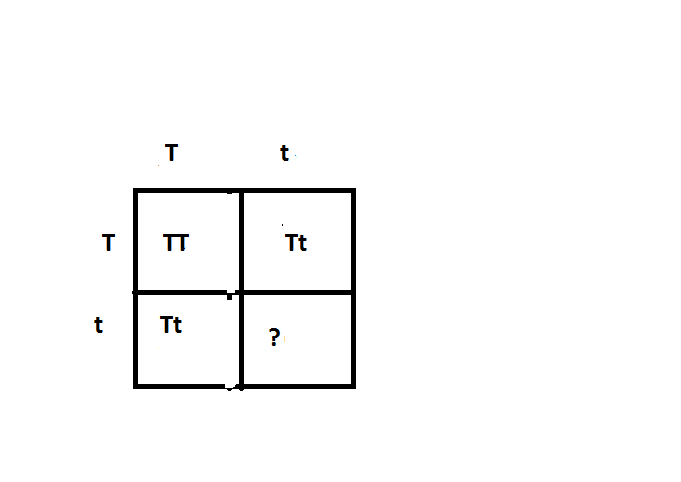
T - tall and t = short
In the punnett square below, what belongs in the missing square
a)
tt
b)
Tt
c)
Bb
d)
TT
80.

What is the probability of heterozygous offspring? (a)  

Choose from the below words
25%
50%
0%
100%
81.
What allele combination should go in the missing box?
a)
AA
b)
Aa
c)
aa
d)
none of these
82.
Each one of the boxes on the Punnett Square represents what probability of an offsprings' genotype?
a)
25%
b)
1%
c)
10%
d)
0%
83.

The passing of genetic material from parents to offspring.

a)

heredity

b)

gene

c)

allele

d)

genotype

e)

phenotype