wayground logo

Free Printable Worksheets

Font size

S
M
L
XL
Worksheets

FS Midterm_fa25

Total questions: 55

Worksheet time: 28mins

Name
Class
Date
1.
3 questions that a forensic scientists needs to ask when they run across evidence that might be blood include all of the following EXCEPT
a)
Is it human blood?
b)
How old is the blood?
c)
Is it blood?
d)
Who’s blood is it?
2.
Blood spatter pattern analysis is useful at a crime scene in determining all of the following EXCEPT
a)
the height from which the blood came from.
b)
the angle that the blood impacted a surface.
c)
the origin of the blood source (where the blood came from).
d)
whether the blood was from a human source or an animal source
3.
Which drop of blood was most likely dropped from a low angle (10-20 degrees)?
a)
Drop A
b)
Drop B
c)
Drop C
d)
Drop D
4.
Which statement best describes the difference between drop A and drop B?
a)
Both drops were dropped at around a 90 degree angle, but drop A was at a lower height than drop B
b)
Both drops were dropped at around 90 degree angle, but drop B was at a lower height than drop A
c)
Drop A was dropped at around 90 degree angle and drop B was dropped at around 40 degree angle or lower.
d)
Both drop A and B were dropped from at around 40-50 degree angle but A was dropped at a lower height than drop B
5.
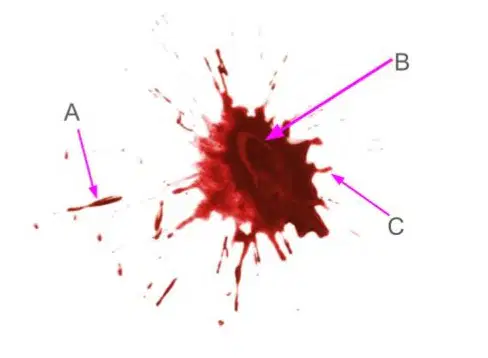
What is "C" pointing to?
a)
A spike (or spine)
b)
The parent drop
c)
A satelite
d)
a passive drop
6.
Letter "A" could be used to determine the direction the drop was traveling. Which direction was it going?
a)
Left to right (at a slight angle)
b)
Right to left (at a slight angle)
c)
Up to down
d)
Down to up
7.
To determine whether a bloodstain is of human or animal origin, the serologist will perform:
a)
a precipitin test
b)
a luminol test
c)
a Kastle-Meyer test
d)
a Takayama and Teichmann test
8.
Blood has which of the following in it?
a)
Cells (red and white blood cells)
b)
Enzymes and proteins
c)
Inorganic substances
d)
All of the above (the other 3 answers are all a part of blood).
9.
If couple with blood type A and type AB had a child, which of the following statements could NOT BE TRUE?
a)
They could have a child with blood type AB
b)
They could have a child with blood type B
c)
They could have a child with blood type A
d)
They could have a child with blood type O
10.
Which of the following images shows a blood type of O+?
a)
Sample A
b)
Sample B
c)
Sample C
d)
None of the samples are blood type O+
11.
Forensic science
a)
is defined as the application of science to those criminal and civil laws that are enforced by police agencies.
b)
includes lab workers which are called criminalists
c)
includes areas of chemistry, biology, physics, and geology
d)
is all of the above (all other answers are correct).
12.
Good observers do all the following EXCEPT:
a)
immediately jump to an interpretation about what they were observing
b)
consciously turn off the natural filters so they can observe everything
c)
make an effort to systematically examine the entire environment
d)
are aware that the brain is faulty
13.
When a criminal comes in contact with an object or person, a cross-transfer of evidence occurs. This is called
a)
Bertillion's Exchange Principle
b)
Locard's Exchange Principle
c)
Osborn's Transfer Law
d)
Hoover's Transfer Law
14.
The national crime lab that most all other crime labs are based on is ran by the
a)
FBI
b)
DOJ
c)
Smithsonian Lab
d)
DEA
15.
Data that includes measurements and numbers is considered to be
a)
Qualitative
b)
Quantitative
16.
The recent increased interest in becoming a forensic scientist and the jurors having unrealistic expectation on evidence processing during court cases is refered to as
a)
the CSI controversy
b)
the Frye standard
c)
the CSI effect
d)
the Frye effect
17.
Which statement below correctly matches the type of evidence being analyzed with the crime lab unit?
a)
The biology unit would analyze blood and body fluids
b)
The physical science unit would analyze bullets and firearms
c)
The toxicology department would analyze soil and glass
d)
The fingerprint department would analyze tool marks
18.
True or False? Rigor mortis is when muscles of the body contract (stiffen) after death.
a)
True
b)
False
19.
True or False? The MO (modus operandi) for a serial killer refers to the criminals way of working or pattern of behavior when performing the crime
a)
True
b)
False
20.
Which of the following is NOT a manner of death?
a)
Intentional
b)
Natural
c)
Homicide
d)
Suicide
e)
Unknown
21.
After death body will lose temperature at a set rate until the ambient temperature is reached. This can help determine the TOD and is called ___________ mortis
a)
rigor
b)
algor
c)
livor
d)
palor
22.
After death, gravity causes blood to pool at the lowest point on a body. This occurs at a set time frame and can help determining TOD. This is called ______ mortis
a)
algor
b)
rigor
c)
palor
d)
livor
23.
A killer who plans their crime and takes care to clean up the evidence afterwards, would be considered a(n) _____________ killer
a)
organized
b)
disorganized
24.
T or F? The bones that might be used to determine height are the femur and other long bones.
a)
True
b)
False
25.
T or F? There are 307 bones in the adult human skeleton
a)
True
b)
False
26.
Which is the most reliable bone to determine the sex of a skeleton?
a)
Femur
b)
Skull
c)
Pelvis
d)
Humerus
27.
The pubic arch (angle) that is 80-90 degrees (or more) is typically found on a _________ pelvis
a)
Male
b)
Female
28.
Someone who studies all aspects of human development and interactions is an
a)
psychologist
b)
pathologist
c)
anthroplogist
d)
entomologist
29.
Places where anthropologist and other death investigators can run experiments and learn about how bodies decay in different environments are called
a)
cemeteries
b)
funeral homes
c)
body farms
d)
death houses
30.
The younger the individual, the ______ cartilage they have
a)
more
b)
less
31.
What CANNOT be determined by examining bones?
a)
Weight
b)
Height
c)
Age
d)
Gender
e)
Facts about their life (nutrition, where they may be from, etc)
32.
A skull that is larger, rougher and has more squared angles would most likely belong to a
a)
Male
b)
Female
33.
Two ways that an anthropologist may be able use to help identify a skeleton besides analyzing the bones are (Choose 2 answers)
a)
Facial Reconstructions
b)
Genealogical Searches
c)
DNA
d)
Cartilage Analysis
34.
After more than 48 hours has passed for a dead body, what is the order of decay that occurs
a)
putrefaction, active decay, dry decay
b)
active decay, dry decay, putrefaction
c)
dry decay, putrefaction, active decay
35.
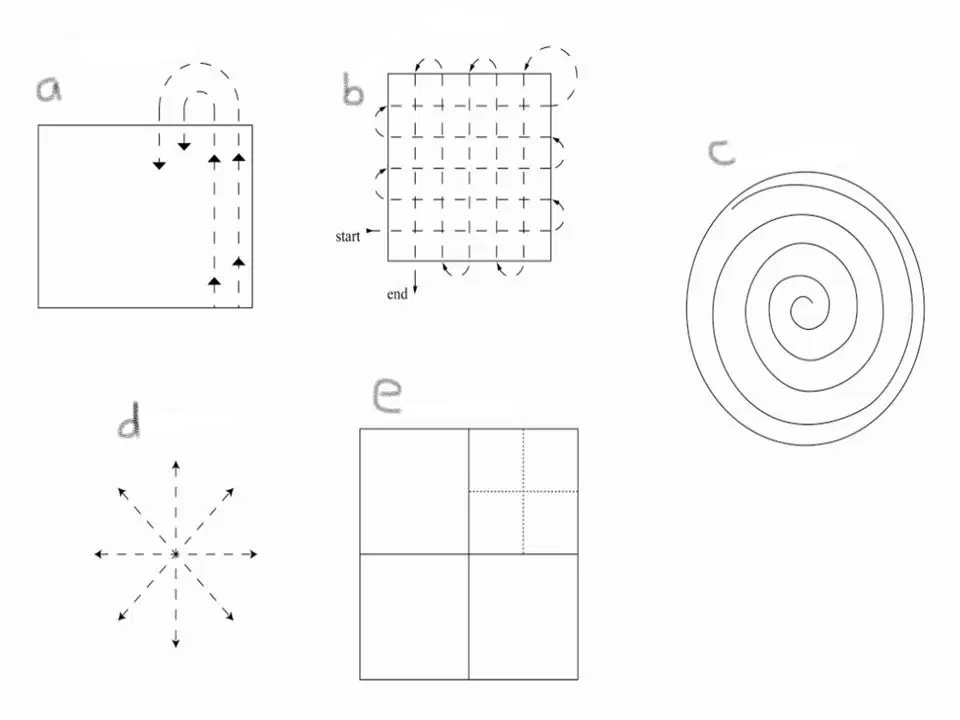
Which of the following answers correctly lists the search patterns in order from a-e
a)
grid, line, wheel, zone, spiral
b)
line, wheel, spiral, grid, zone
c)
grid, zone, spiral, wheel, line
d)
line, grid, spiral, wheel, zone
36.
Which step in the decomposition phases of a body do insects eat away the mass of the remains?
a)
active decay
b)
putrefaction
c)
dry decay
37.
The examination of physical evidence by a forensic scientists is usually undertaken for
a)
Proving a suspect’s innocence in a courtroom
b)
Identification or comparison purposes
c)
Proving a suspect’s guilt in a courtroom
d)
Assisting law enforcement in the apprehension of an offender.
38.
Both class and individual characteristics can eliminate suspects
a)
True
b)
False
39.
What is the "weakest link" in a criminal investigation?
a)
Recognition and preservation of physical evidence at the crime scene.
b)
The suspects and victim
c)
Witness testimonies
d)
None of the other answers are correct.
40.
In order for evidence to keep its authenticity and integrity in a courtroom, there needs to be a continues record of who has been in contact with the evidence. The record of who has handled the evidence when is called the
a)
expert witness
b)
chain of custody
c)
sketches
d)
notetaking
41.
Emotionally charged neighbors are not allowed on the crime scene because they may destroy evidence.
a)
True
b)
False
42.
Media should be allowed to be in the crime scene.
a)
True
b)
False
43.
Before an evidence collector picks up any evidence at a crime, all of the following must be done EXCEPT
a)
it needs to be photographed
b)
it needs to be assigned a number
c)
it needs to be video recorded
d)
the proper container type (cardboard, plastic, etc) for collection/preservation needs to be determined
44.
Higher ranking police officers are not potential destroyers of evidence.
a)
True
b)
False
45.
When securing a crime scene, all of the following should be done by the first officer (or CSO) immediately EXCEPT which of the following?
a)
Collect evidence
b)
Begin a log (write things down)
c)
Maintain security of the crime scene with ropes, baracades, etc
d)
Determine any medical needs and safety concerns
46.
A more probable match may be determined if multiple pieces of class evidence can be linked together (ex. factor's in blood, like in OJ's case)
a)
True
b)
False
47.
When trying to catch a criminal who has done multiple crimes (ex. serial killers or serial arsonists), often these people are brought in to profile the possible suspect:
a)
Forensic entomologist
b)
Forensic pathologists (or medical examiner)
c)
Forensic psychologist (or psychiatrist)
d)
Forensic anthropologist
48.
Agglutination... (chose all that apply)
a)
is the term used for blood clumping
b)
occurs when blood types that are the same are mixed (ex. Type A with Type A)
c)
occurs when a blood type mixes with an anti-body that can attach to it (ex. Type A blood mixed with Anti-A)
d)
is the term to describe the proteins found on the blood cells that give us our blood type (ex. A type=Blood Type A)
49.
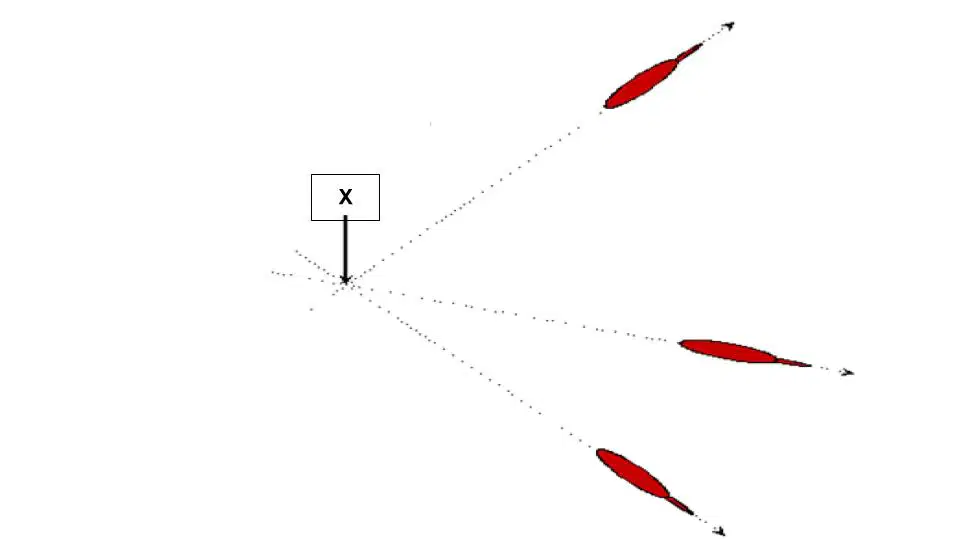
The "x" represents (choose all answers that apply)
a)
Where the blood is traveling towards
b)
Where the blood came from
c)
The area of convergence
d)
The angle of impact
50.
Which statements are true about the role of a coroner compared to forensic pathologists (medical examiners). CHOOSE ALL THAT APPLY
a)
Coroners must have a medical background
b)
Forensics pathologists must have a medical background
c)
Coroners are elected
d)
Coroners determine COD
e)
Forensic pathologist determine COD
51.
In determining TOD and COD, which two specialists may be used (CHOOSE 2 ANSWERS)
a)
Forensic entomologists
b)
Forensic pathologist (or medial examiner)
c)
Forensic psychologist
d)
Forensic engineer
52.
Which of the following types of evidence can be rightfully cited as an explanation for the rapid growth of crime labs during the last 25 years? CHOOSE 2 ANSWERS
a)
DNA anaylsis
b)
Drug analysis
c)
Fingerprint analysis
d)
Firearm analysis
e)
Glass analysis
53.
A rough sketch of a crime scene should be done at the crime scene and should include
a)
location of evidence found
b)
measurements of overall area and to each piece of evidence
c)
eyewitness accounts
d)
suspect information
e)
North
54.

Choose all the options below that would be considered or that describe individual characteristics

a)

rarely found, very specific. Observations that can distinguish between items of a group

b)

blood type

c)

shoe brand

d)

Commonly found at a crime scene, not specific. Observations bring the investigator to a group of objects/suspects.

e)

DNA

55.

Which of the following description(s) or scenario(s) would fall under the concept of comparison of physical evidence?

a)

An officer discovers a plastic bag containing a white powder substance that they suspected is a illegal drug. The crime lab runs analysis to determine what the substance is.

b)

Determining whether two or more objects have a common origin (“match”).

c)

A criminalists looks at a fingerprint left at a crime scene and one from a suspect to see if they match.