
 Worksheets
Waves 4th grade science
Total questions: 96
Worksheet time: 1hrs 5mins
The top of the wave is called the _____.
high point
trough
amplitude
crest
The bottom of a wave is called the ____.
lowest point
crest
amplitude
trough
The distance between neighboring crests or troughs is called the ______.
wavelength
amplitude
ripples
volume
The height of a wave is called its _________.
wavelength
crest
amplitude
trough
Loudness is also called ____.
annoying
volume
matter
the crest
If the amplitude of a sound produced is very large, the distance between the crest and trough is _____.
small
average
large
the wavelength
When objects are behind a transparent material we can see them completely ____________.
blurry
clearly
colorful
Waves are...
the distance between crests
the distance between troughs
regular patterns of motion that carry energy
the height of a wave
Wavelength means...
the distance between troughs or crests in a wave
the height of a wave
the energy carried by a wave
a pattern of energy
Amplitude means...
the distance between troughs in a wave
the distance between crests in a wave
the height of a wave
regular patterns of motion that carry energy
A light wave is __________ when it bounces off the surface of an object it cannot pass through.
reflected
absorbed
refracted
colorful
When light hits an object and changes direction, this is called ____________.
refraction
absorbed
reflection
colorful
Refraction of light can give the illusion that the object is...
small
bent
close up
clear
How are cell phone signals transferred?
tower to phone to tower
phone to phone
sender to tower to relay to tower to receiver
tower to receiver to sender to relay
The top of the wave is called the ______.
crest
trough
The bottom part of a wave is called the ________.
crest
trough
In a sound wave, the amplitude is also called the ____.
volume
light
Cell phones convert __________ to radio waves.
light waves
sound waves
Sounds that are soft have ______amplitudes than sounds that are loud.
smaller
larger
When signals are sent from a computer, they need to be in _____.
binary code
modem
computer
To get a signal from the internet, the message first comes to the receiver's modem before it gets to their __________.
binary code
computer
modem
Windows are _______. Light can pass through.
transparent
translucent
opaque
Tomatoes are ________. Light cannot pass through.
opaque
transparent
translucent
Opaque materials do not allow ________ waves to pass through them.
light
sound
radio
micro
When a light wave meets an opaque material, it is ______ off the material.
reflected
blurry
shadows
clearly
When light hits an opaque material, light cannot pass through. This causes a _______ to form.
shadow
translucent
blurry
reflection
When a material allows only some light to pass through, this is described as __________.
transparent
translucent
opaque
When light passes through a translucent material, it gets _______.
reflected
scattered
colorful
hot
An object behind a translucent material may appear _______.
blurry
clear
reflected
translucent
When a material allows light to completely pass through it, we call it ___________.
transparent
opaque
translucent
___________ objects reflect all wavelengths of light.
white
black
___________ objects absorb all visible light.
white
black

When sound bounces off of object and comes back it is called _________.
music
echo
sound

Sound ______ vibrations.
creates
stops
echos

When something moves back and forth it is called a...
vibration
music
echo
True or false? A sound wave travels.
True
False

How did the windshield break?
The sound vibrations came from the speakers, vibrated through the air, and then vibrated the windshield until it cracked.
People were shaking the car and then the windshield broke.
The car was in a car crash.
What is something natural that sound cannot travel through?
water
air
walls
outer space
Select ALL the different materials sound can travel through.
Air
Water
Wood
Space

2. Imagine your teacher plays the high-pitched sound of a bird singing. What would the sound wave of the bird song look like?


Imagine your teacher plays the low-pitched sound of a whale singing. What would the sound wave of the whale song look like?


What is a sound that is repeated because the sound waves are reflected back?
Pitch
Echo
Vibration
Volume
What is sound?
A type of energy made by vibrations that moves through a medium such as a gas, liquid or solid
A wave of electrical and magnetic energy moving together through space
A type of electromagnetic wave that is visible to the eye
A very low frequency electromagnetic wave that is used for the transmission of radio and television signals
Vibrations from the cup travel down the ________.
string
hands
air

The voice makes vibrations which make the _____ vibrate.
teeth
hands
cup
What does the root word -aud- mean? (as in audience or audio)
auto parts
to study
to hear
to write
Sound is created when something:
vibrates
releases energy
is touched
yells

Why are sounds not heard in space?
Space is too cold for sound waves to travel.
There is too much matter for sound to travel in space.
Space is a vacuum and there's not enough matter for sound to travel through.
There is not enough energy for sound to travel through.

How does sound energy travel?
in beams
in waves
in pulses
in strings

What is the height of a sound wave called?
length
frequency
altitude
amplitude
Sound waves can travel through...
through water
through outer space
through air
Low pitched sounds have long wave lengths.
false
true

What kind of animal would make a sound with a pitch like this?
whale
bird

What kind of animal sound would create a wavelength like this?
whale
bird

A HUGE speaker is blasting sound toward the house. What will most likely happen?
People will come out of the house and begin to dance.
There will be an echo.
The sound waves will cause the window to break.
Nobody will notice.
The wavelength of a sound tells about its __________ .
beauty
crest
pitch
amplitude
Sound is __________ .
a hot dog
a vibration
something that is easy to see.
The measurement of energy in a wave is called __________ .
amplitude
crest
trough
The lowest point of a wave is called ______.
amplitude
crest
trough
The highest point of a wave is called the _____.
amplitude
crest
trough
Waves that move in a back-and-forth or
push-and-pull pattern are called _____ waves.
circular
longitudinal
transverse
Waves that move in an up- and -down or side-to-side
pattern are called ______ waves.
circular
longitudinal
transverse
most waves travel
around in circles
in an airplane
through a medium
a vibration that moves energy from place to place
crest
medium
wave
the distance from one point on a wave to the same point on the next wave
amplitude
crest
wavelength
medium
the number of waves that pass a certain point in one second
frequency
amplitude
wavelength
medium
the measurement of energy in a wave
wavelength
amplitude
frequency
crest
which is the correct path of seeing an object?
sun to object to eyes
sun to eyes to object
sun to eyes
you cannot see color in the dark because
all of the colors are hidden
you need light to see objects
which object would reflect light best?
black paper
mirror
window glass
An animal that makes a HIGH pitch sound would be
songbird
lion
an animal that makes a LOW PITCH sound would be _____________
lion
songbird
The distance between TWO CRESTS is ____________________
amplitude
reflection
refraction
wavelength
_______________ is the amount of energy in a wave
reflection
refraction
amplitude
Water is a good _____________ of light
absorber
reflector
source
Waves with GREATER amplitude have _____ energy than waves with lower amplitude
less
more
In order to see ____________ must be present
light
refraction
colors
Light ____________ off objects and then enters the eye
directs
reflects
absorbs

A wave that transfers energy through matter and spreads outward in all directions from a vibration
sound wave
wave length

A measure that relates to the amount of energy in a sound wave.
amplitude
medium

The number of wavelengths that pass a point in a given amount of time.
frequency
wave length

The substance through which a wave travels.
frequency
medium

is the lowest point of a transverse wave
crest
trough
amplitude

Frequency is...
the number of waves that pass a given point in one second
the number of waves that pass a given point in one minute
the number of waves that pass a given point in one hour

What is crest?
is the lowest point of a transverse wave
is the midpoint point of a transverse wave
is the highest point of a transverse wave

What is amplitude?
the distance from the midpoint of a wave and the wave.
the distance between the midpoint of a wave and the crest.
the difference between the frequency of a wave and the time.
15. Which part of the drawing below shows the amplitude?
A
B
C
D
14. Which part of the drawing below is the crest?
A
B
C
D
13. Which part of the drawing below is a wavelength?
A
B
C
D
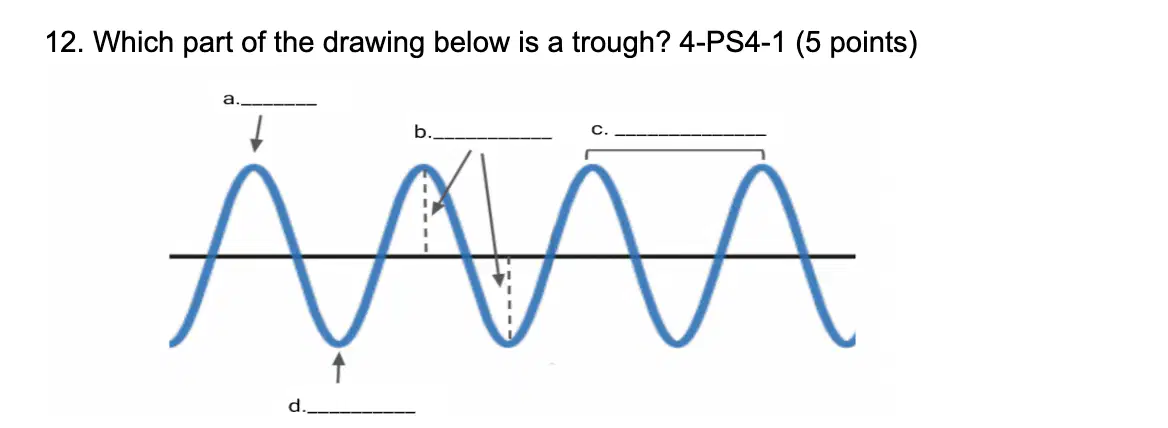
12. Which part of the drawing below is a trough?
A
B
C
D

