
 Worksheets
O/W Emulsifiers : M-1001 / S-1001P
Total questions: 98
Worksheet time: 54mins

What type of sensations can be achieved with O/W Emulsifiers?
Only light feel
Only rich feel
Both light and rich feel
No sensation

Fill in the blank: O/W Emulsifiers can achieve a variety of use sensations, from ______ to rich feel.
light
sticky
heavy
greasy
What are the features of polyglycerol fatty acid esters (PGFEs)?
They act as emulsifiers and improve texture in food products.
They are used as sweeteners in beverages.
They function as preservatives in canned foods.
They are primarily coloring agents in confectionery.
Provide an overview of M-1001 / S-1001P.
M-1001 / S-1001P are specialized devices used for industrial automation.
M-1001 / S-1001P are types of medical imaging equipment.
M-1001 / S-1001P are software applications for financial analysis.
M-1001 / S-1001P are consumer electronics for home entertainment.
Describe the characteristics of PGFEs when used as O/W emulsifier, including the formation and application of α-Gel using PGFE and formulation examples.
PGFEs act as O/W emulsifiers, can form α-Gel structures, and are used in formulations for enhanced stability and texture.
PGFEs are only used as W/O emulsifiers and do not form α-Gel structures.
PGFEs are not suitable for emulsification and have no application in gel formation.
PGFEs are primarily used as thickeners and do not contribute to emulsion stability.
Some adopted examples of PGFEs in formulations or products are:
Cyclodextrins in drug delivery systems
Sucrose in soft drinks
Silica gel in food packaging
Starch in bread making

Which of the following is NOT a feature of PGFEs in emulsification?
A) Exhibits interfacial activity from low concentrations in O/W
B) High interfacial orientation and excellent emulsification properties
C) No cloud point, excellent stability at high temperatures
D) Forms α gel in oil

Fill in the blank: PGFEs exhibit interfacial activity from low concentrations in ____ emulsions.
O/W
W/O
S/O
O/S
PGFEs have no cloud point and excellent stability at high temperatures.
True
False

Which statement about the adjustment of feel with PGFEs is correct?
Easy to form α gel in water
O/W emulsions can be adjusted from light to rich
Both A and B
None of the above
Fill in the blank: Polyglycerol acid esters are ideal for ____ emulsifiers and can control feeling.
O/W
W/O
S/O
O/S
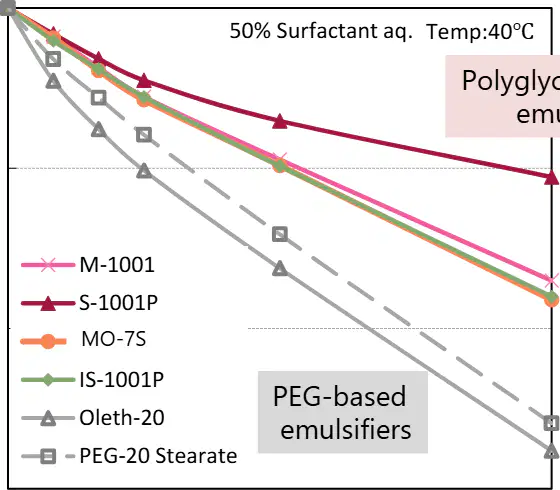
According to the graph and information provided, which type of emulsifier has higher water retaining capacity?
Polyglycerin-based emulsifiers
PEG-based emulsifiers
Both have equal capacity
None of the above
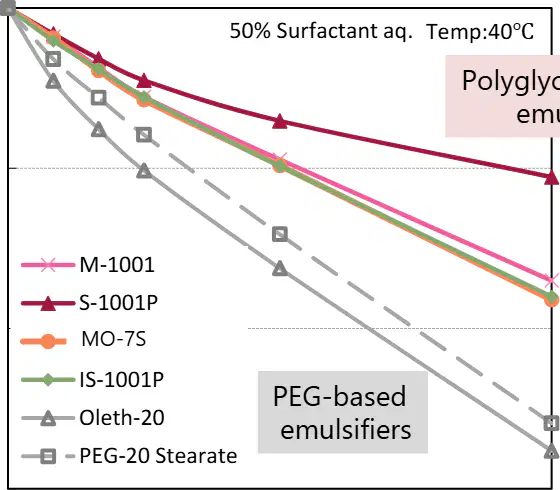
Fill in the blank: The graph shows that polyglycerin-based emulsifiers have ______ water retention compared to PEG-based emulsifiers.
higher
lower
equal
no
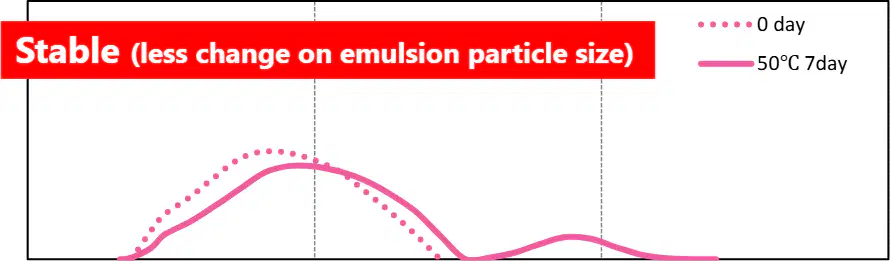
Based on the graphs, which emulsifier shows more stability in particle size under salt conditions?
M-1001 (Polyglyceryl-10 Myristate)
OLETH-20 (PEG-based emulsifier)
Fill in the blank: The formulation for O/W emulsion contains _____% TRIETHYLHEXANOIN.
15
5
25
35
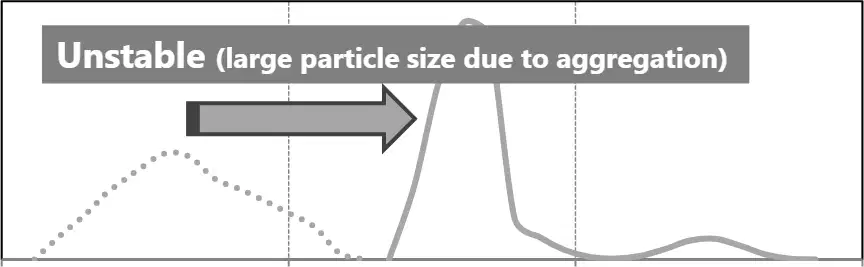
Which statement is true about the stability of O/W emulsion with OLETH-20 (PEG-based emulsifier) under salt conditions?
Stable (less change on emulsion particle size)
Unstable (large particle size due to aggregation)
Fill in the blank: The O/W emulsion formulation contains 5% ______ and 5% ______.
Emulsifier, Glycerin
Water, Oil
Preservative, Fragrance
Alcohol, Surfactant
The O/W emulsion with Polyglyceryl-10 Myristate shows excellent high temperature stability and salt resistance.
True
False
Features of polyglycerol fatty acid esters (PGFEs) include:
Emulsifying properties and stability in food systems
High protein content
Strong acidic nature
Ability to act as a sweetener
M-1001 / S-1001P is best described as:
A type of equipment or product model.
A government regulation.
A scientific theory.
A historical event.
Which of the following describes the characteristics of PGFEs when used as O/W emulsifiers, including the formation and application of α-Gel using PGFE and formulation examples?
PGFEs act as O/W emulsifiers, can form α-Gel structures, and are used in various formulations for enhanced stability and texture.
PGFEs are only used as W/O emulsifiers and do not form α-Gel structures.
PGFEs are not suitable for emulsification and have no application in formulation examples.
PGFEs are used solely for flavor enhancement and do not contribute to gel formation or emulsification.
Adopted examples of PGFE usage include:
Water treatment in industrial processes
Cooking in households
Textile dyeing in small workshops
Gardening in public parks
What is the INCI name of S Face M-1001?
POLYGLYCERYL-10 MYRISTATE
GLYCERYL STEARATE
CETEARYL ALCOHOL
PEG-100 STEARATE
What is the HLB value of S Face S-1001P?
14.1
8.5
10.2
17.3
What is the emulsification ability of both S Face M-1001 and S Face S-1001P?
High
Low
None
Moderate
Is it easy or hard to form α-gel with S Face S-1001P?
Easy
Hard
Impossible
Time-consuming
Which of the following is the INCI name of S Face S-1001P?
POLYGLYCERYL-10 MYRISTATE
POLYGLYCERYL-10 STEARATE
POLYGLYCERYL-10 LAURATE
POLYGLYCERYL-10 PALMITATE
Sustainable polyglycerol ester emulsifiers! Formulations from gels to emulsions to creams can be ________.
prepared
ignored
destroyed
postponed

For the oil Squalane, which emulsifier results in a higher percentage of particles smaller than 30 μm at 3% emulsifier amount?
M-1001
S-1001P

Based on the formulation table, what is the maximum percentage (wt%) of Oil used in the formulation?
20
10
15
25

According to the bar graphs, which oil shows the lowest percentage of particles smaller than 30 μm when using M-1001 at 1% emulsifier amount?
Squalane
Ethylhexyl Palmitate
Caprylic/Capric Triglyceride

Fill in the blank: In the formulation table, the amount of water used is ________.
To 100
50 mL
10%
1 L
Which ingredient has an HLB value of 4.0?
Glyceryl Stearate
Cetyl Alcohol
Polysorbate 20
Stearic Acid
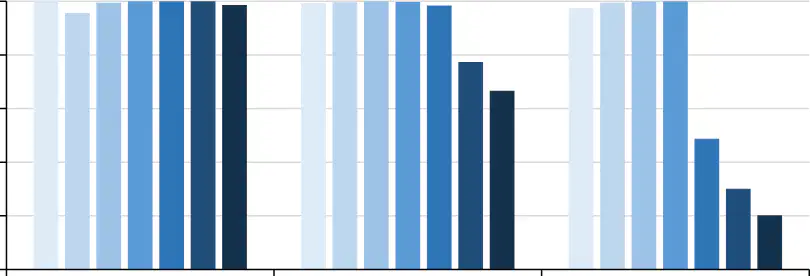
Based on the bar graphs, which oil shows the largest decrease in the percentage of particles smaller than 30 μm as HLB increases for both M-1001 and S-1001P formulations?
Squalane
Ethylhexyl Palmitate
Caprylic/Capric Triglyceride
What is the weight percentage of water in the emulsion formulation?
77
45
60
85
What does HLB stand for in the context of emulsification ability?
Hydrophilic-Lipophilic Balance
High Lipid Base
Heat-Labile Bond
Hydro-Lipidic Barrier

According to the graphs, which formulation maintains a higher percentage of particles smaller than 30 μm for Caprylic/Capric Triglyceride at HLB 12?
M-1001
S-1001P
Fill in the blank: The total weight percentage of oil in the emulsion formulation is ____%.
20
10
30
50

Based on the chart 'Comparison of particle size in emulsions', which emulsifier results in the highest percentage of particles smaller than 30 μm immediately after preparing?
S-1001P
Steareth-20
Polysorbate 60
Fill in the blank: According to the formulation table, the percentage of Water used in the emulsion formulation is ____%.
77
45
60
85
HLB stands for ______ in the context of emulsification ability.
Hydrophilic-Lipophilic Balance
High-Level Bonding
Hydrogen-Lipid Bond
Heavy-Liquid Base
According to the summary statement, what kind of emulsification is achieved over a wider HLB range?
O/W emulsification
W/O emulsification
Solid-in-liquid emulsification
Gas-in-liquid emulsification
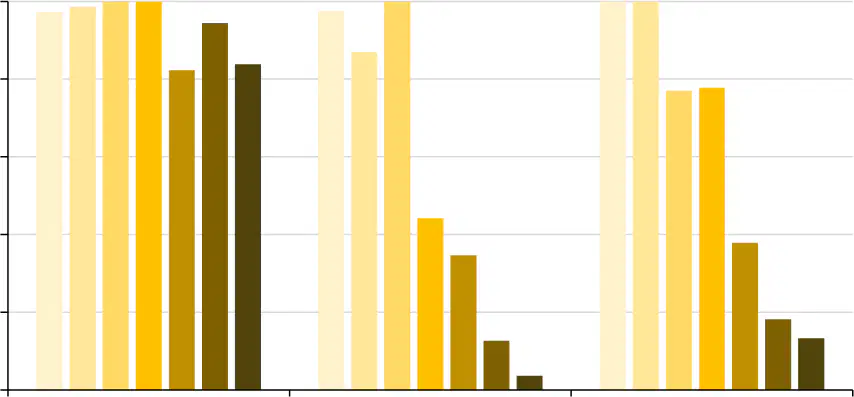
Based on the bar graph comparing particle size in emulsions, which emulsifier shows the highest percentage of particles smaller than 30 μm across the widest HLB range?
S-1001P
Steareth-20
Polysorbate 60
Fill in the blank: In the formulation table, the percentage of Water used is ____%.
77
45
62
89
Fill in the blank: In the formulation table, the percentage of Ethylhexyl Palmitate used is ____%.
20
10
30
40
Which ingredient in the formulation table has the lowest percentage by weight?
S-1001P or PEG emulsifier
Glyceryl Stearate (HLB 4.0)
Ethylhexyl Palmitate
Water
According to the worksheet, the main advantage of S-1001P in O/W emulsions regarding particle size and HLB range is:
It provides smaller particle size and a wider HLB range.
It increases viscosity and narrows the HLB range.
It reduces stability and limits the HLB range.
It offers larger particle size and a lower HLB range.
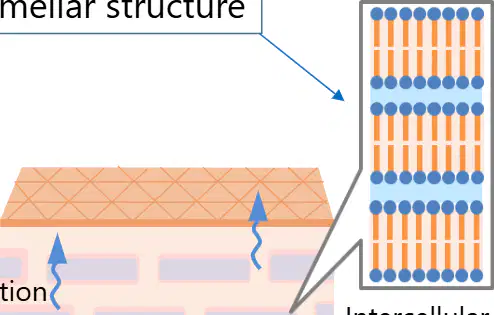
What is the main role of α-gel in regulating skin moisture?
It increases water evaporation
It has the same lamellar structure as intercellular lipids, which helps regulate skin moisture
It decreases skin temperature
It causes skin dryness
Fill in the blank: α-gel has the same ________ structure as intercellular lipids, which play an important role in regulating skin moisture.
lamellar
crystalline
amorphous
granular
Which of the following is NOT a feature of α-gel cosmetics?
Excellent water retention
Highly effective in suppressing water evaporation
Causes skin irritation
Helps regulate skin moisture
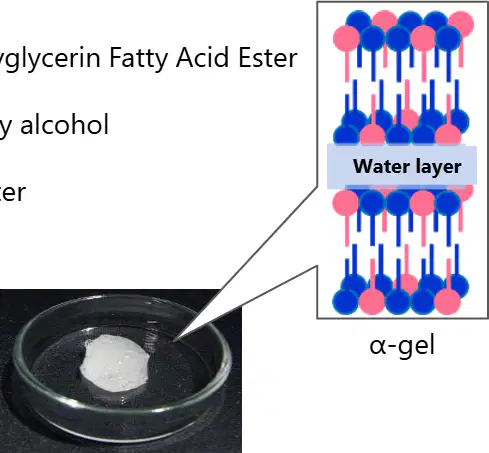
Match the following components with their symbols in the α-gel structure:
Blue pin
1-A
Pink pin
2-B
Blue rectangle
3-C
Fill in the blank: α-gel is highly effective in suppressing ________ evaporation.
water
oil
alcohol
acetone
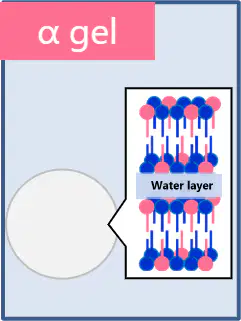
What is the main purpose of applying α gel in the preparation of highly moisturizing emulsions?
To increase oil content
To provide structural viscosity
To reduce water retention
To decrease emulsification performance
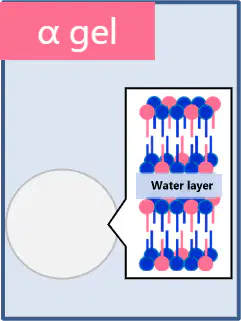
Fill in the blank: The composition of α gel includes C22OH (___%), S-1001P (12%), and Water (80%).
8
5
15
20
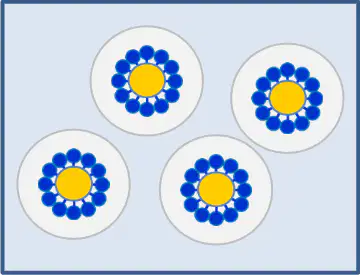
Which of the following is NOT a property of the emulsion prepared by applying α gel?
A) High water retention
B) Smooth feel in use
C) Stable emulsion
D) Low emulsification performance
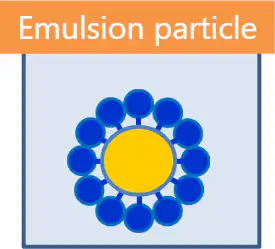
Match the following components with their roles in the formation of O/W emulsion:
High emulsification performance
C
Provides structural viscosity
A
Main ingredient in emulsion particle
B
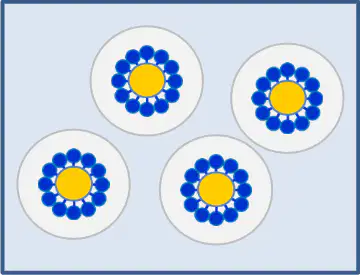
The addition of α gel to emulsion particles results in high water retention and a stable emulsion.
True
False
What is the main topic of the chart titled 'PGFE - Comparison of α gel forming regions'?
Which compound is easy to form α-gel when combined with higher fatty alcohols?
POLYGLYCERYL-10 MYRISTATE
POLYGLYCERYL-10 STEARATE
POLYGLYCERYL-10 DISTEARATE
Fill in the blank: According to the chart, S-1001P has a ______ α-gel forming region compared to other compounds.
Wide
Narrow
Small
Irregular
POLYGLYCERYL-10 MYRISTATE and POLYGLYCERYL-10 STEARATE do not form α-gel when combined with higher fatty alcohols.
True
False
What method was used for the evaluation of α-gel forming regions in the chart?
Evaluation by x-ray diffraction
Evaluation by mass spectrometry
Evaluation by UV-visible spectroscopy
Evaluation by chromatography
What does the diagram on the right side of the chart represent?
What is the appearance of α-gel as described in the worksheet?
Gel state with uniformity and no flow all over
Liquid state with flow
Solid state with cracks
Gel state with uneven texture
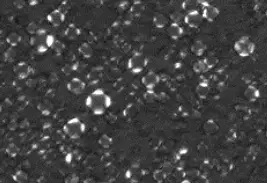
What does the polarizing micrograph confirm in the determination of α-gel?
Isotropy
Anisotropy (Maltese Cross)
Crystallinity
Amorphous structure
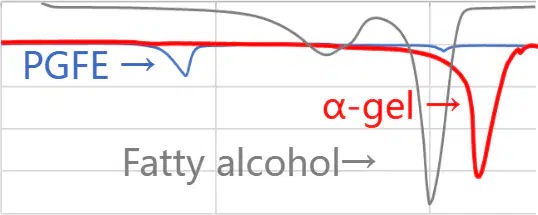
In DSC analysis, what happens to the peaks derived from the melting point of each raw material during α-gel formation?
Peaks derived from the melting point of each raw material disappear. Peaks with higher melting points appear.
Peaks become sharper and more intense.
Peaks shift to lower temperatures but remain visible.
Peaks derived from the melting point of each raw material increase in number.
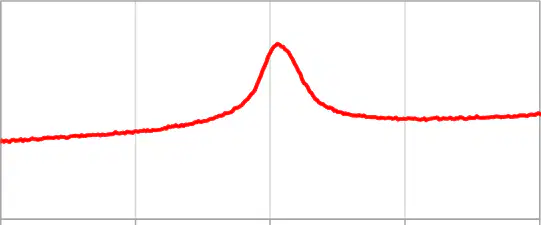
Wide-angle X-ray diffraction confirms peaks derived from which packing structure in α-gel?
Cubic
Hexagonal
Tetragonal
Orthorhombic
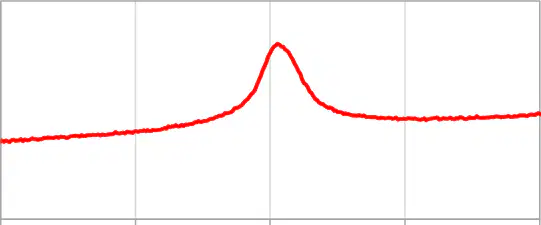
Fill in the blank: In wide-angle X-ray diffraction, the value of q for the hexagonal packing structure in α-gel is ____ nm⁻¹.
15.1
10.2
18.5
12.7
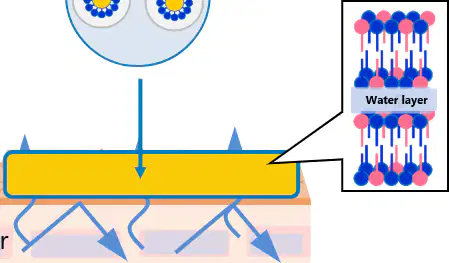
What is the result of combining emulsion particles and α-gel on the skin?
Dry skin
Moist skin
Oily skin
Rough skin
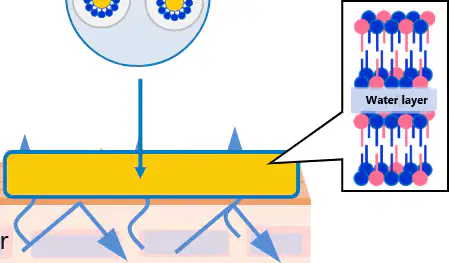
What does the water layer formed by α-gel do to the skin surface?
Removes moisture
Covers the surface of the skin with a cover
Causes irritation
Increases roughness
Fill in the blank: α-gel controls moisture evaporation on the skin surface and provides an ______ effect.
emollient
abrasive
cooling
drying
α-gel has a high moisturizing effect on the skin.
True
False
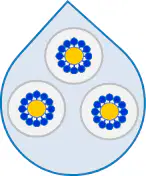
What are the two main components shown in the diagram that contribute to moist skin?
Emulsion particle and α-gel
Sebum and sweat glands
Collagen and elastin fibers
Keratin and melanin
What is the INCI name for the ingredient VL-211 used as an emollient in the Milky Lotion formulation?
Macadamia Seed Oil Polyglyceryl-6 Esters Behenate
Cetearyl Alcohol
Caprylic/Capric Triglyceride
Isopropyl Myristate
Which ingredient in the Milky Lotion formulation has the highest weight percentage?
Water (67.00%)
Glycerin (5.00%)
Cetyl Alcohol (3.00%)
Mineral Oil (10.00%)
Select the correct function for the ingredient 'Cosmetic Grade conc Glycerin' in the Milky Lotion formulation:
Emollient
Moisturizer
Emulsifier
Preservative
Match the following ingredients with their functions in the Milky Lotion formulation:
Emollient
A
Moisturizer
B
Emulsifier
C
Preservative
D
What is the weight percentage of Squalane in the Milky Lotion formulation?
9.00%
3.50%
12.00%
6.75%
Which of the following is NOT listed as a moisturizer in the Milky Lotion formulation?
Cosmetic Grade conc Glycerin
Diglycerin S
Squalane
Glycerin
Fill in the blank: The emulsifier used in the Milky Lotion formulation can be either ________ or ________.
S-1001P (Polyglyceryl-10 Stearate) or M-1001 (Polyglyceryl-10 Myristate)
Cetyl Alcohol or Stearic Acid
Polysorbate 80 or Sorbitan Oleate
Glyceryl Stearate or PEG-100 Stearate
What is the INCI name for the ingredient used as a moisturizer and listed as 'Diglycerin S'?
Diglycerin
Glycerin
Propylene Glycol
Sorbitol
Xanthan Gum is used in the Milky Lotion formulation as a moisturizer.
True
False
Which ingredient is present in the smallest amount in the Milky Lotion formulation?
Agar; Xanthan Gum
Xanthan Gum
Behenyl Alcohol
Glyceryl Stearate SE
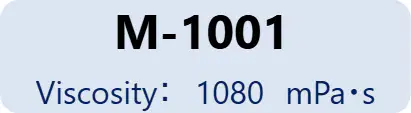
What is the viscosity of M-1001?
1080 mPa·s
7460 mPa·s
500 mPa·s
2000 mPa·s

Which emulsion has a high viscosity and rich feel of cream?
M-1001
S-1001P
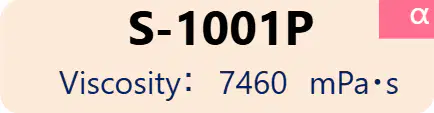
Fill in the blank: The viscosity of S-1001P is ______ mPa·s.
7460 mPa·s
5200 mPa·s
8900 mPa·s
6300 mPa·s
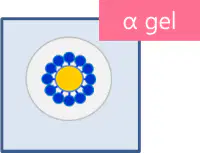
The emulsion particle in S-1001P contains α gel.
True
False
What is the first step in the preparation method for milky lotion?
Emulsification
Preparation
Cooling
Heat mixing
During the 'Heat mixing' step in the preparation of milky lotion, what temperature is used? Fill in the blank: _______°C
80°C
60°C
100°C
45°C
In the preparation of milky lotion, which phase is added during the 'Adding' step?
Water phase
Oil phase
Cream phase
Emulsification phase
What is the purpose of the 'Cooling' step in the preparation of milky lotion? Fill in the blank: Cool to room temperature with _______.
stirring
heating
shaking
boiling
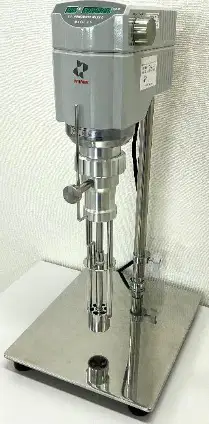
Which equipment is shown in the image and used in the preparation of milky lotion?
Homogenizing mixer
Blender
Oven
Refrigerator
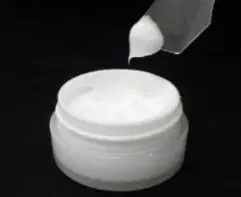
What is the final product obtained after following all the steps in the preparation method for milky lotion? Fill in the blank: _______
Cream
Ointment
Gel
Solution
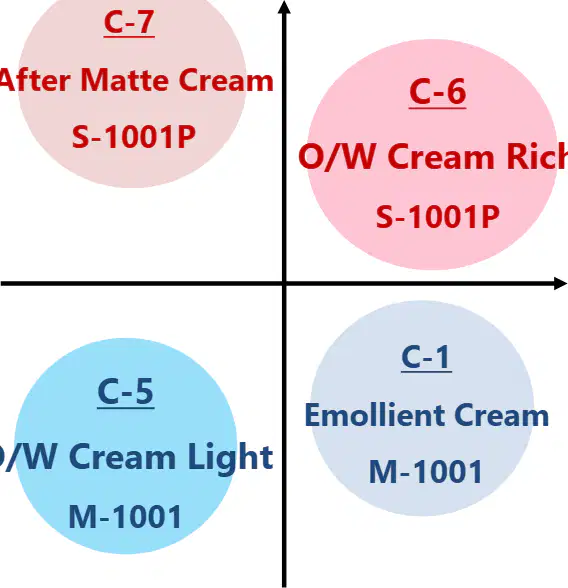
Match the cream type to its viscosity and texture:
High viscosity, thick
2
High viscosity, light
1
Low viscosity, thick
4
Low viscosity, light
3
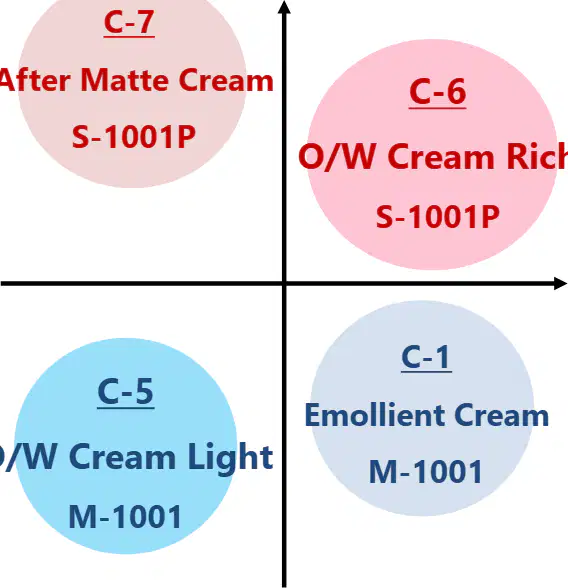
Which type of oil is associated with a light texture in creams?
Plant oils
Hydrocarbon oils
Ester oils
Silicon oils

Which cream type is described as 'O/W Cream Rich'?
C-7
C-6
C-5
C-1
Fill in the blank: PGFEs can be used to prepare creams of ______ textures.
different
same
rough
liquid

Which oils are associated with a thick texture in creams?
Ester oils
Silicon oils
Plant oils
Hydrocarbon oils

