
 Worksheets
Ch. 6, Ch.14 & Ch. 15 Exam
Total questions: 52
Worksheet time: 26mins
Stacey and Jordan are learning about tracheostomy tubes in class. Jordan asks, "Hey Stacey, do you know what makes a fenestrated tracheostomy special?" What is the correct answer?
no place in modern emergency medicine.
one or more openings in the posterior wall of the outer cannula.
an extra channel built into the tube wall for suctioning just above the cuff.
no cuff.
Angela and Stacey are learning about airway devices in class. Angela asks, "Hey Stacey, do you know which device has a Murphy’s eye located at its distal end?" Can you help them out?
oral airway (OPA).
nasal airway (NPA).
laryngeal mask airway (LMA).
endotracheal tube (ETT).
Angela and Jordan are learning about artificial airways in class. They come across a special airway device that has two proximal adaptors: one for ventilation if the tube is placed in the esophagus and another if it's placed in the trachea. Which device are they studying?
Esophageal obturator
Esophageal gastric tube airway
Combitube
Carlen's tube
Angela and Stephanie are in their respiratory therapy class, and their instructor asks: Which of the following artificial airways is specially designed for endobronchial intubation (intubation into one of the mainstem bronchi)? Can you help them pick the right answer?
Endotrol
Combitube
Carlen's tube
High lo-evac
Jordan and Kim are preparing for a medical skills challenge! Which of the following equipment should they grab if they want to perform an oral intubation?
McGill forceps
Stylette
Percutaneous tracheostomy tray
Oral airway
Jessica is helping her friend Angela confirm the placement of an ETT in a simulation lab. Which of the following devices should they use as a secondary method to confirm tracheal placement?
Colorimetric capnometer
Oximeter
Presence of tracheal sounds
Noting condensate on expiration
Xzavier and Yesenia are about to help their patient use a Passy-Muir speaking valve for the first time! Before they get started, what important step should they take?
remove the air from the cuff.
replace the inner cannula.
ensure the patient has not eaten.
change to a fenestrated tube.
During a first aid class, Angela and Jordan are learning how to help someone who might have a cervical spine injury. Which technique should they use to safely open the airway?
Head-tilt/chin-lift
Jaw thrust
Sellick maneuver
Cricoid pressure
Jordan, Yesenia, and Stacey are in a medical simulation lab, trying to confirm the tracheal placement of an ETT. Which device should they reach for as the primary tool to make sure the tube is in the right spot?
Colorimetric capnometer
Oximeter
Presence of tracheal sounds
Noting condensate on expiration
Jessica and Jordan are learning about airway devices in class. Can you help them figure out which of the following is an example of a lower airway device?
Combitube
Carlins tube
Laryngeal mask airway
Elisha Airway device
Jordan, a 16-year-old male, was rushed to the emergency department after a wild motor vehicle crash. He’s now semiconscious, breathing 18 times per minute, and you hear snoring sounds every time he tries to breathe in. As the respiratory therapist on duty, which device should you grab to help Jordan breathe easier and clear his airway?
Oral airway
Nasopharyngeal airway
Combitube
Carlen's tube
Angela and Kim are preparing for their medical exam. They come across a question: What is the recommended range for endotracheal tube cuff pressure? Can you help them choose the correct answer?
15–22 cm H2O
20–30 cm H2O
25–35 cm H2O
30–40 cm H2O
Jordan, a 20-year-old student, was rushed to the emergency department after accidentally ingesting barbiturates during a chemistry experiment gone wrong. He is now unconscious and the medical team is using bag-mask ventilation, but they notice poor chest rise that doesn't improve even after repositioning his head. As the respiratory therapist on duty, which device should you insert to help Jordan breathe better with the bag-mask ventilation?
Oral airway
Laryngeal mask airway
Combitube
Carlen's tube
Stephanie is helping out in the respiratory lab and needs to intubate a patient with a size 4 ID uncuffed ETT. What size suction catheter should she select to impress her instructor?
4 Fr
6 Fr
8 Fr
10 Fr
Jordan and Angela are learning about emergency medical equipment in class. Their teacher asks: What are the portable, handheld devices called that help deliver positive-pressure ventilation to a patient’s airway?
mechanical ventilators.
tracheostomy tubes.
PEEP valves.
manual resuscitators.
Stacey and Jordan are practicing emergency care in class. They pick up a bag-valve resuscitator and wonder what it's also called. Can you help them out?
flow-inflating.
anesthesia.
self-inflating.
demand valves.
Stacey and Xzavier are exploring different resuscitation devices in their science class. They come across one device that looks just like a collapsed balloon when it’s not hooked up to a gas source. Can you help them figure out which device it is?
Flow-inflating
Bag-valve
Demand valve
T-piece
Jessica and Jordan are helping with manual ventilation in the operating room. They connect a flow-inflating bag to an oxygen flowmeter and set the flow at 15 L/min while ventilating a patient through an ETT. What oxygen concentration are they delivering to the patient?
70%
80%
90%
100%
Kim and Jordan are helping Gea learn about different ventilation devices in class. Which device do they discover requires the clinician to constantly engage it, with its effectiveness directly linked to hands-on involvement?
Automatic resuscitator
Manual resuscitator
Mechanical ventilator
Noninvasive ventilator
Jaylese, Jordan, and Kim are setting up an automatic resuscitator for a class demonstration. To make sure it works properly, what do they need to connect it to?
a flowmeter set at 15 L/min.
a reservoir device.
a 50-psi gas source.
a blended gas source.
Manada, Kim, and Angela are helping with the resuscitation of a newborn after an emergency c-section. They know that proper flow regulation in flow-inflating manual resuscitators is crucial! Why is this so important?
To regulate FDO2.
To provide the desired CPAP level.
To prevent gastric insufflation.
To reduce the risk for oxygen toxicity.
Angela and Xzavier are helping a respiratory therapist prepare equipment for the resuscitation of a newborn at 36 weeks’ gestation. The therapist tells them they might need to deliver CPAP therapy. Which device should Angela and Xzavier pick for CPAP delivery?
Self-inflating resuscitator
Flow-inflating resuscitator
CARevent ALS handheld resuscitator
Vortran Automatic Resuscitator
Jordan, Yesenia, and Angela are helping to manually ventilate an unconscious adult patient in a simulation lab. Which of the following actions could lead to diminished cardiac output during their ventilation efforts?
Providing inadequate tidal volume delivery
Ventilating with a pressure of 15 cm H2O
Delivering a high respiratory rate
Using a PEEP of 5 cm H2O
During a lively medical simulation, Jordan and Angela are practicing bag-mask resuscitation. Suddenly, they notice the patient isn’t getting enough ventilation! What is the most common reason for this happening?
inadequate mask seal.
malfunctioning pressure-relief valve.
using an inappropriately sized resuscitator.
delivery of high mean airway pressures.
Kim, Stephanie, and Angela are discussing risks of IPV therapy in their study group. Which of the following should they be most concerned about?
Increased cardiac output
Decreased cough
Barotrauma
Atelectasis
Respiratory therapist Kim is about to give IPV therapy to her patient, Jordan, who is in the ICU. Jordan is currently on heated high-flow nasal cannula at 30% oxygen and a flow of 30 L/min. He’s alert, oriented, cooperative, and enjoying his lunch. What should Kim do next?
Administer the therapy as ordered now.
Return 1 hour after Jordan finishes his lunch to provide the treatment.
Request the therapy be discontinued.
Switch the therapy to incentive spirometry because of aspiration risk.
Manada and Kim are learning about airway clearance devices in class. Which device generates intermittent negative transrespiratory pressure pulses using a special garment that wraps around the chest and gives short, rapid squeezes to help clear the airways?
HFCWC
HFCWO
IPV
OPEP
Jordan and Angela are learning about cool respiratory devices in class! Which of the following gadgets uses a rigid external enclosure connected to a compressor that can deliver both positive and negative pressures to the chest wall, helping to move airway secretions by generating enough expiratory flow so they can be coughed out or suctioned? Help them pick the right answer!
HFCWC
HFCWO
IPV
OPEP
Angela, a patient with muscular dystrophy, is having trouble with a moist, weak, nonproductive cough. As the respiratory therapist, which device would you recommend to help Angela mobilize and clear out those stubborn secretions?
Incentive spirometry
OPEP
Cough assist
IPPB
Angela, Stacey, and Jessica are learning about the cough assist device in class. Can you help them remember: The cough assist has positive inspiratory pressures and negative expiratory pressures adjustable from:
40 to -40 cm H2O.
50 to -50 cm H2O.
60 to -60 cm H2O.
70 to -70 cm H2O.
Angela, Kim, and Jessica are learning about airway clearance devices in class. They come across the Flutter, Acapella, Quake, and RC-Cornet. Can you help them figure out which category these devices belong to?
OPEP
HFCWC
HFCWO
cough assist
Angela, a 34-year-old financial planner with bronchiectasis, is excited to be discharged home from the hospital. Her physician orders airway clearance several times a day, but Angela wants a therapy that lets her keep up with her busy work schedule. As her respiratory therapist, which of the following would you recommend to help Angela stay on top of her career and her health?
HFCWO
IPPB
Cough assist
OPEP
Angela and Kim are discussing respiratory therapies. Angela asks, "Hey Kim, do you know for which condition HFCWC is especially helpful?" Can you help them out?
diaphragmatic dysfunction.
chylothorax.
COPD.
radiation exposure.
Little Angela, a 2-year-old with cystic fibrosis, needs a fun and effective way to keep her airways clear at home. As the respiratory therapist, which therapy would you recommend to help Angela breathe easier?
Incentive spirometry
HFCWC
IPPB
Cough assist
Kim, a 25-year-old, is admitted from the emergency department after a wild game of soccer led to some unexpected blunt chest trauma. As the respiratory therapist, you spot an order for OPEP every 6 hours. Before you get started, you check on Kim and find: Heart rate: 135/minute, Respiratory rate: 35/minute, Blood pressure: 110/50, SpO2: 87% on air. Breath sounds are clear but with diminished aeration on the right, and Kim is wincing with right-sided chest discomfort. What should you do next?
Initiate therapy as ordered by the physician.
Recommend administration of an analgesic before beginning therapy.
Notify the physician to recommend a chest radiograph.
Document patient refusal of therapy in the electronic medical record.
Jessica has just returned from surgery after receiving skin grafts for burns on her chest and neck. As her respiratory therapist, you need to recommend the best airway clearance therapy device to help her breathe easier. Which device would you choose to help Jessica on her road to recovery?
IPPB
IPV
HFCWO
HFCWC
Angela, a patient with airway burns, needed surgery to repair an esophageal tear. Before surgery, she was getting IPV therapy three times a day, and the doctor re-ordered it after her operation. As the respiratory therapist, what should you do next?
Continue administering therapy as ordered.
Recommend discontinuing the therapy.
Change therapy to OPEP therapy three times daily.
Provide the therapy with a lower expiratory.
Stacey, an adventurous cyclist with cystic fibrosis, recently took a tumble during a bike race and ended up with facial and radial fractures. She usually uses OPEP therapy three times a day at home. As her respiratory therapist, what should you recommend for Stacey's airway clearance while she recovers?
Continue with home OPEP regimen.
Change to HFCWC.
Discontinue airway clearance until the injuries heal.
Decrease the frequency of OPEP therapy to once daily.
Angela and Stephanie are learning how to keep their Aerobika device clean! Which of the following is the best way for them to clean and disinfect it?
Steam autoclave
Immersion in glutaraldehyde
Place in a dishwasher
Soak in bleach and water
clearance therapy.
During a respiratory care skills lab, Kim and Stacey are discussing the advantages of self-inflating manual resuscitators. Which of the following is a key benefit of using a self-inflating bag over a flow-inflating bag?
It can deliver consistent PEEP without additional attachments.
It allows for precise control of delivered oxygen concentration.
It inflates automatically after each squeeze, even without an external gas source.
It requires a compressed gas source to function.
Jessica is learning about airway clearance therapies. Her instructor asks which device provides positive expiratory pressure and oscillations to help mobilize secretions. Which device should Jessica choose?
Cough assist
IPPB
OPEP
HFCWO
Jordan is reviewing airway adjuncts for emergency situations. Which device is specifically designed to maintain a patent airway by preventing the tongue from obstructing the oropharynx in an unconscious patient?
Laryngeal mask airway
Oral airway (OPA)
Endotracheal tube
Nasopharyngeal airway
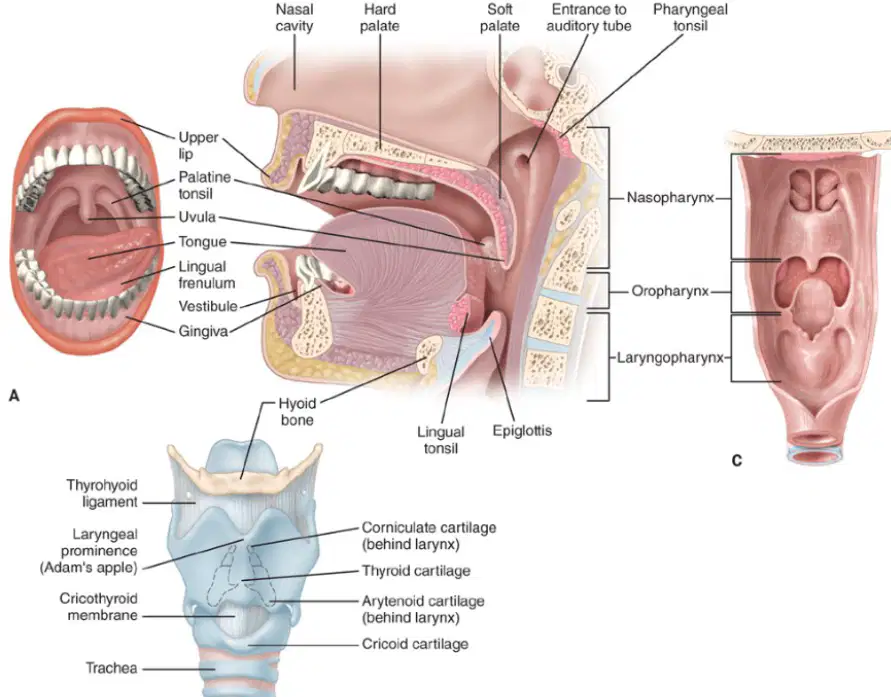
Which of the following structures is part of the upper airway?
Trachea
Nasopharynx
Cricoid cartilage
Arytenoid cartilage

What is the primary function of the alveoli in the respiratory system?
Filtering dust from inhaled air
Producing mucus
Exchanging oxygen and carbon dioxide with blood
Moving air into the trachea
What are signs that a patient needs to be suctioned? Select all that apply
Audible gurgling sounds
Oxygen saturations decreasing below 88%
Increased Respiratory Rate
Patient coughing and unable to clear all the secretions
What equipment is need to suction a patient? Select all that apply
Suction kit
Suction head, canisters, and tubing
Otoscope
PPE: protective eye wear, face mask
The nurse should plan to LIMIT the suctioning time to a MAXIMUM of which time period?
5 – 10 seconds
10 – 15 seconds
30 – 45 seconds
60 seconds
In the context of tracheostomy care, what does the term "cuffed tube" refer to?
A tube that has a balloon to secure it in place
A tube that is used only for short-term ventilation
A tube that allows for speech
A tube that is made of plastic
Your patient has a cuffed tracheostomy tube. You are applying a Passy Muir valve. Should the cuff be inflated or deflated?
Inflated
Deflated
Which of the following devices is commonly used to maintain a patent airway during anesthesia?
Nasal cannula
Tracheostomy tube
Oropharyngeal airway
Endotracheal tube
Angela and Jordan are reviewing airway clearance techniques. Which device uses high-frequency chest wall oscillations to help mobilize secretions?
Cough assist
OPEP
IPPB
HFCWO
Jessica is learning about airway management. Which maneuver is recommended to open the airway in an unconscious patient without suspected spinal injury?
Cricoid pressure
Sellick maneuver
Head-tilt/chin-lift
Jaw thrust

