
 Worksheets
NCM 116 RLE Evaluation Exam
Total questions: 30
Worksheet time: 45mins
Name
Class
Date
1.
Izuku should know that the drainage is normal 4 days after a sigmoid colostomy when the stool is:
a)
Green liquid
b)
Solid formed
c)
Loose, bloody
d)
Semiformed
2.
Nurse Dabi is caring for a client recovering from gastro-intestinal bleeding. The nurse should:
a)
Plan care so the client can receive 8 hours of uninterrupted sleep each night.
b)
Monitor vital signs every 2 hours.
c)
Make sure that the client takes food and medications at prescribed intervals.
d)
Provide milk every 2 to 3 hours.
3.
When caring for a female client who is being treated for hyperthyroidism, it is important to:
a)
Provide extra blankets and clothing to keep the client warm.
b)
Monitor the client for signs of restlessness, sweating, and excessive weight loss during thyroid replacement therapy.
c)
Balance the client’s periods of activity and rest.
d)
Encourage the client to be active to prevent constipation.
4.
During the endorsement, which of the following clients should the on-duty nurse assess first?
a)
The 58-year-old client who was admitted 2 days ago with heart failure, blood pressure of 126/76 mm Hg, and a respiratory rate of 22 breaths/minute.
b)
The 89-year-old client with end-stage right-sided heart failure, blood pressure of 78/50 mm Hg, and a “do not resuscitate” order
c)
The 62-year-old client who was admitted 1 day ago with thrombophlebitis and is receiving L.V. heparin
d)
The 75-year-old client who was admitted 1 hour ago with new-onset atrial fibrillation and is receiving L.V. dilitiazem (Cardizem)
5.
A heparin infusion at 1,500 unit/hour is ordered for a 64-year-old client with stroke in evolution. The infusion contains 25,000 units of heparin in 500 ml of saline solution. How many milliliters per hour should be given?
a)
15 ml/hour
b)
30 ml/hour
c)
45 ml/hour
d)
50 ml/hour
6.
A male client with type 1 diabetes is scheduled to receive 30 U of 70/30 insulin. There is no 70/30 insulin available. As a substitution, the nurse may give the client:
a)
9 U regular insulin and 21 U neutral protamine Hagedorn (NPH).
b)
21 U regular insulin and 9 U NPH.
c)
10 U regular insulin and 20 U NPH.
d)
20 U regular insulin and 10 U NPH
7.
All Might-san with a history of hypertension is diagnosed with primary hyperaldosteronism. This diagnosis indicates that the client’s hypertension is caused by excessive hormone secretion from which of the following glands?
a)
Adrenal cortex
b)
Pancreas
c)
Adrenal medulla
d)
Parathyroid
8.
For a diabetic male client with a foot ulcer, the doctor orders bed rest, a wet-to- dry dressing change every shift, and blood glucose monitoring before meals and bedtime. Why are wet-to-dry dressings used for this client?
a)
They contain exudate and provide a moist wound environment.
b)
They protect the wound from mechanical trauma and promote healing.
c)
They debride the wound and promote healing by secondary intention.
d)
They prevent the entrance of microorganisms and minimize wound discomfort.
9.
A female client tells nurse Katsuki that she has been working hard for the last 3 months to control her type 2 diabetes mellitus with diet and exercise. To determine the effectiveness of the client’s efforts, the nurse should check:
a)
urine glucose level.
b)
fasting blood glucose level.
c)
serum fructosamine level.
d)
glycosylated hemoglobin level.
10.
Nurse Ochaco administered neutral protamine Hagedorn (NPH) insulin to a diabetic client at 7 a.m. At what time would the nurse expect the client to be most at risk for a hypoglycemic reaction?
a)
10:00 am
b)
Noon
c)
4:00 pm
d)
10:00 pm
11.
On the third day after a partial thyroidectomy, Momo exhibits muscle twitching and hyperirritability of the nervous system. When questioned, the client reports numbness and tingling of the mouth and fingertips. Suspecting a life threatening electrolyte disturbance, the nurse notifies the surgeon immediately. Which electrolyte disturbance most commonly follows thyroid surgery?
a)
Hypocalcemia
b)
Hyponatremia
c)
Hyperkalemia
d)
Hypermagnesemia
12.
Nurse Shoto is caring for clients in the outpatient clinic. Which of the following phone calls should the nurse return first?
a)
A client with hepatitis A who states, “My arms and legs are itching.”
b)
A client with cast on the right leg who states, “I have a funny feeling in my right leg.”
c)
A client with osteomyelitis of the spine who states, “I am so nauseous that I can’t eat.”
d)
A client with rheumatoid arthritis who states, “I am having trouble sleeping.”
13.
Nurse Sarah is caring for clients on the surgical floor and has just received report from the previous shift. Which of the following clients should the nurse see first?
a)
A 35-year-old admitted three hours ago with a gunshot wound; 1.5 cm area of dark drainage noted on the dressing.
b)
A 43-year-old who had a mastectomy two days ago; 23 ml of serosanguinous fluid noted in the Jackson-Pratt drain.
c)
A 59-year-old with a collapsed lung due to an accident; no drainage noted in the previous eight hours.
d)
A 62-year-old who had an abdominal-perineal resection three days ago; client complaints of chills.
14.
Nurse Tsuyu is caring for a client who had a thyroidectomy 12 hours ago for treatment of Grave’s disease. The nurse would be most concerned if which of the following was observed?
a)
The client supports his head and neck when turning his head to the right.
b)
The client spontaneously flexes his wrist when the blood pressure is obtained.
c)
The client is drowsy and complains of sore throat.
d)
All of the above
15.
An elderly client is admitted to the nursing home setting. The client is occasionally confused and her gait is often unsteady. Which of the following actions, if by the nurse, is most appropriate?
a)
Ask the woman’s family to provide personal items such as photos or mementos.
b)
Select a room with a bed by the door so the woman can look down the hall.
c)
Suggest the woman eat her meals in the room with her roommate.
d)
Encourage the woman to ambulate in the halls twice a day.
16.
The nurse provides care for a client who is diagnosed with type 2 diabetes mellitus and hypertension. Which prescribed medication is likely the cause of the client’s bradycardia that is noted on the echocardiogram (EKG)?
a)
Atorvastatin 80 mg PO once a day.
b)
Labetalol 100 mg PO twice a day.
c)
Metformin 500 mg once daily.
d)
Albuterol 120 mcg prn.
17.
Which is the priority nursing intervention for a client who is about to leave the hospital against medical advice (AMA)?
a)
Advise the client of the diagnosis and the danger of leaving.
b)
Discontinue the client's peripheral intravenous (IV) lines and the electrocardiogram (EKG) leads.
c)
Ensure a witness is present to verify the client's wish to leave AMA.
d)
Tell the client they must sign the AMA form.
18.
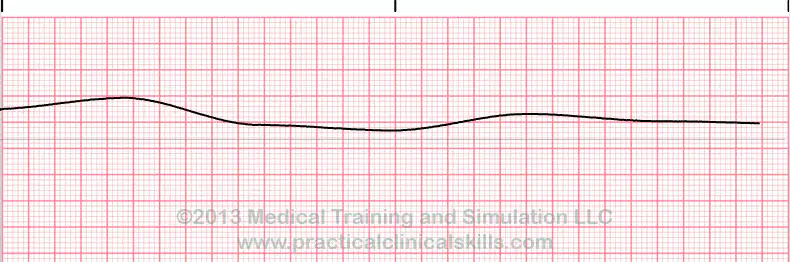
Please identify:
a)
Premature Junctional Complex
b)
Asystole
c)
Wandering Atrial Pacemaker
d)
Normal Sinus Rhythm
19.
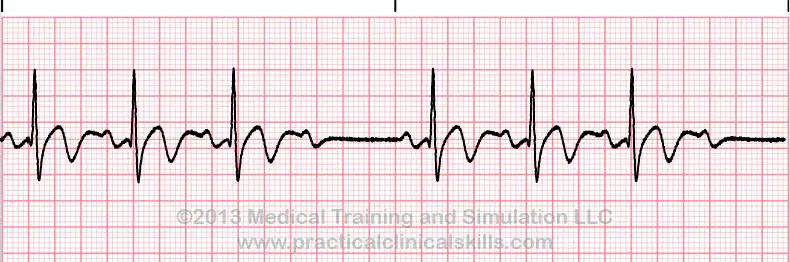
Please identify:
a)
Idioventricular Rhythm
b)
Second Degree Heart Block Type 2
c)
ST Segment Depression
d)
Normal Sinus Rhythm
20.
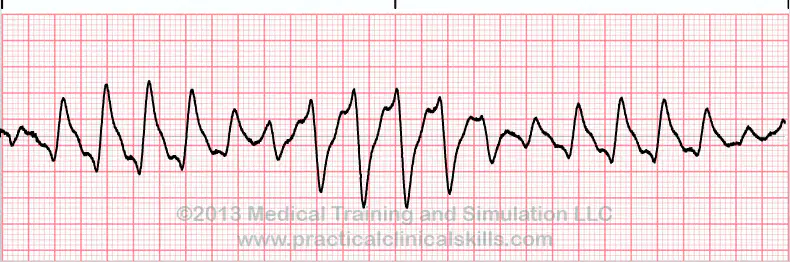
Please identify:
a)
Asystole
b)
Ventricular Tachycardia (Polymorphic)
c)
Ventricular Tachycardia (Monomorphic)
d)
Wandering Atrial Pacemaker
21.
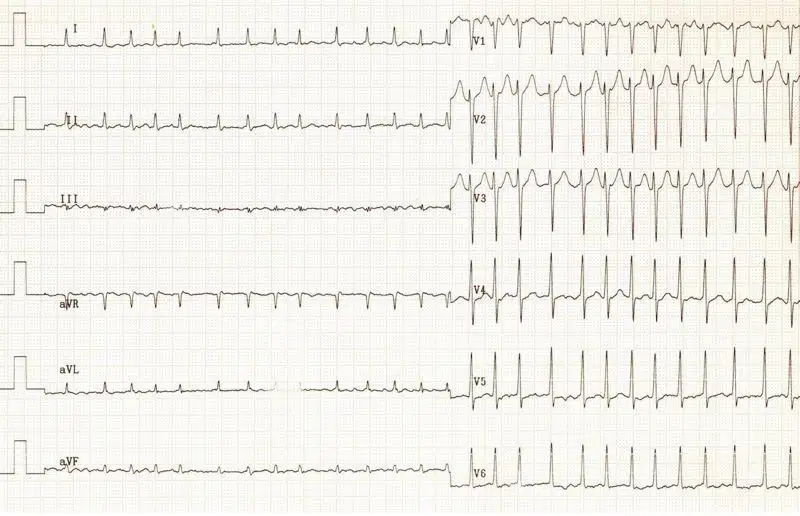
A 35 year old man presents with palpitations. He has been drinking heavily with friends over the weekend. This is his ECG. Present your findings and give a diagnosis.
a)
Atrial Fibrillation
b)
Ventricular Tachycardia (Polymorphic)
c)
Atrial Flutter
d)
Pulseless Electrical Activity
22.
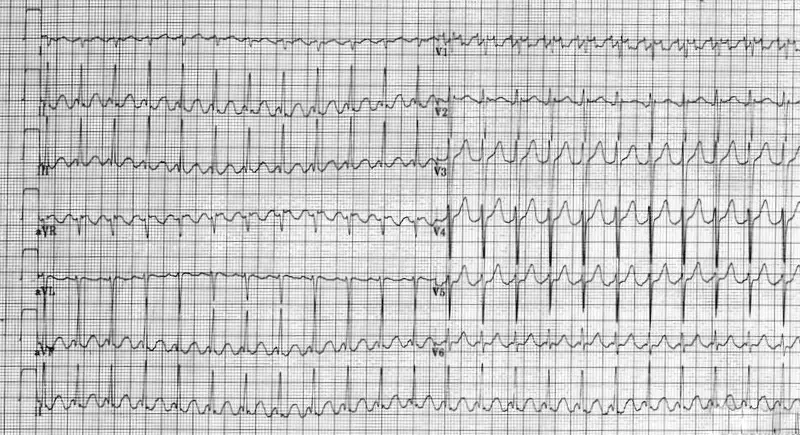
A 45 year old business man presents with a feeling that his heart is racing. He also has some shortness of breath. This is his ECG. Present your findings and give a diagnosis.
a)
Atrial Fibrillation
b)
Ventricular Tachycardia (Polymorphic)
c)
Atrial Flutter
d)
Pulseless Electrical Activity
23.
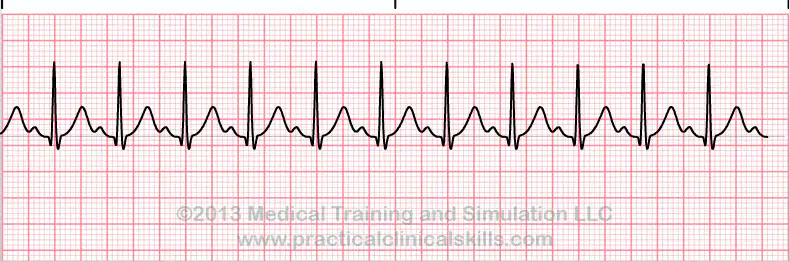
Please identify:
a)
Supraventricular Tachycardia
b)
Third Degree Heart Block
c)
Sinus Tachycardia
d)
Sinus Arrest
24.
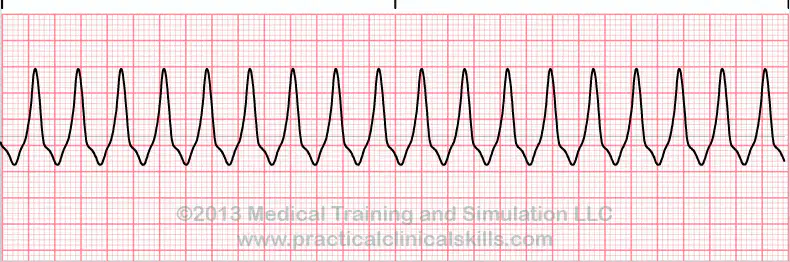
Please identify:
a)
Sinus Bradycardia
b)
Wandering Atrial Pacemaker
c)
Sinus Tachycardia
d)
Ventricular Tachycardia
25.
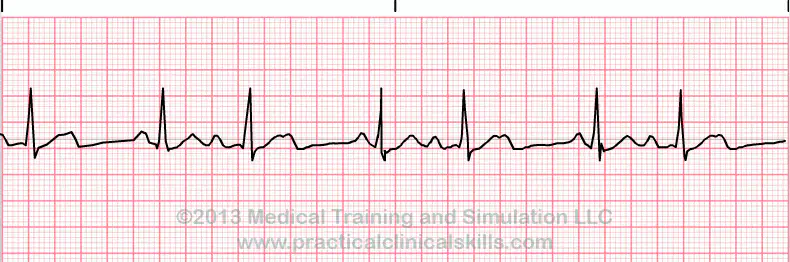
Please identify:
a)
Sinus Arrest
b)
Second Degree Heart Block Type 1
c)
Atrial Trigeminy
d)
ST segment Elevation
26.
The antiarrhythmic drug that would be utilized if the patient remained in ventricular fibrillation would be
a)
Amiodarone
b)
Adenosine
c)
Epinephrine
d)
Cardizem
27.
Once the patient is defibrillated and high quality CPR is in progress, the first drug you would expect to give would be
a)
Morphine
b)
Magnesium Sulfate
c)
Lidocaine
d)
Epinephrine
28.
You are on your way home when you are called to a wedding reception at a local hotel. The 82-year-old grandfather of the bride collapsed while standing in the reception line. He was discussing his latest project when he started sweating and then lost consciousness. A family friend started CPR. His son immediately called 911. You quickly perform the BLS primary survey. You immediately ask for a defibrillator. If the first shock is unsuccessful and the patient is still unresponsive, which drug should be administered first?
a)
Epinephrine
b)
Magnesium sulfate, epinephrine and amiodarone
c)
Epinephrine or Lidocaine
d)
Amiodarone, vasopressin and epinephrine
29.
Because this patient has an organized rhythm on the monitor but remains pulseless, we call this rhythm
a)
Sinus bradycardia
b)
Pulseless Electrical Activity (PEA)
c)
Ventricular Tachycardia
30.
The above patient has had high quality CPR for 30 minutes. He has received multiple doses of epinephrine and the monitor now shows asystole. What would be appropriate at this point?
a)
Contact a medical command physician for possible termination orders
b)
Continue CPR for an additional 10 minutes
c)
Load the patient in the ambulance with CPR in progress and transport to the nearest trauma center
d)
Ask the family what they would like you to do
100 %

