
Font size
 Worksheets
Unit 2 Review Forms of Government/ Political Economies
Total questions: 113
Worksheet time: 57mins
Which of the following best demonstrates the argument that participatory democracy has declined among Americans?
Fewer Americans are joining voluntary associations that enable interactions in a community.
Fewer Americans are pursuing college degrees following graduation from high school.
Fewer Americans are seeking jobs in vocational areas.
Fewer Americans are using traditional sources of news media, like newspapers, to gain political information.
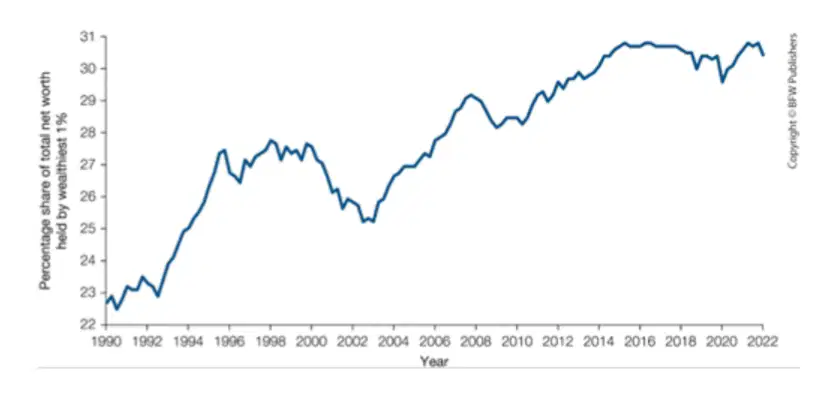
Which of the following is a trend in the data?
The percentage share of total net worth is increasing for most Americans.
The percentage share of total net worth for the wealthiest 1% is growing over the time shown.
The percentage share of total net worth of the United States is increasing over the time shown.
The percentage share of total net worth for the bottom 1% is declining.
Which of the following actions best demonstrates participatory democracy?
running for reelection to a political office you already hold
posting a message on social media
filing a lawsuit against a large corporation
joining a civil society association
Which of the following scenarios best demonstrates elite theory?
An interest group with few members but abundant wealth sways policy outcomes to their benefit.
Two interest groups with the same amount of members join together to influence policy outcomes.
Multiple interest groups compete against each other to influence policy outcomes.
An interest group with over 1 million members coordinates a protest at a state capitol building.
Which of the following is a defining feature of a republican form of government?
Free expression of publicly held political beliefs through social media posts
Removal of elected individuals through a process called impeachment
Citizens attend and participate in political protests and rallies
Elected representatives to carry out the voters' wishes
Which of the following best represents the definition of politics?
The institutions that make up the system of policymaking.
A system of government where power is held by the people.
Rights the government cannot take away.
The process of influencing the actions and policies of government.
People give up some freedoms to the government, and in exchange, the government rules over them to ensure an orderly and functioning society. This is known as
the social contract.
limited government.
popular sovereignty.
inalienable rights.
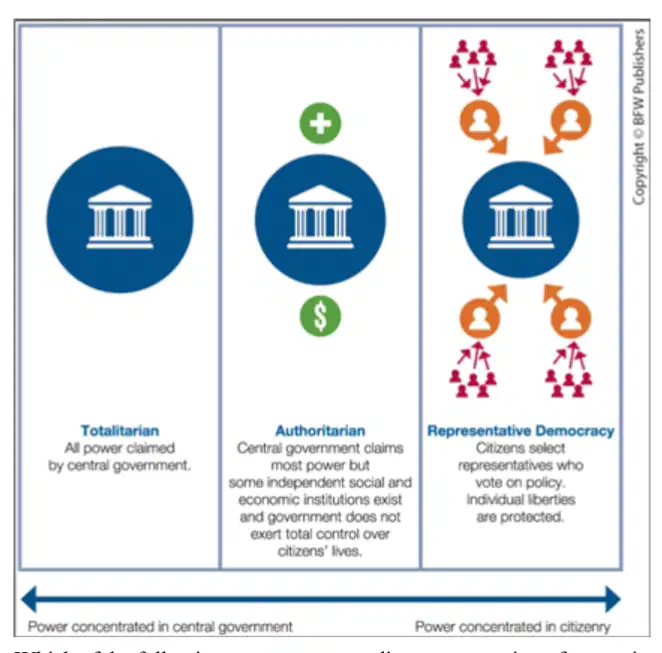
Which of the following statements regarding concentration of power is true based on the graphic?
Power is concentrated in the central government more in an authoritarian government than a totalitarian government.
Power is concentrated in the citizenry in a totalitarian government.
Power is concentrated in the citizenry more in a representative democracy than an authoritarian government.
Power is concentrated equally amongst totalitarian, authoritarian, and representative governments.
Democracy can be defined as a system of government
in which a religious leader holds the power.
where power is held by the people.
that gives all power to the central government.
where power rests in a family of high nobility.
What is popular sovereignty?
A form of government in which each citizen has a direct say in policy issues.
A system in which the government’s right to rule derives from religion.
The theory that the government should be ruled by wealthy elites.
A system of government in which the right to rules comes from the people.
The subjects of a totalitarian government have successfully overthrown their leader and are planning a new form of government that will grant them greater personal and economic freedom and prevent future tyranny. Which of the following would be most important to include in their new government if they are to achieve their stated goals?
Separation of powers
Restrictions on journalists
A list of basic rights
Unlimited terms for elected leaders
Citizens of a small American town have been dissatisfied with their elected representative in the House of Representatives and are planning to vote for a different candidate in the next election. This action represents which ideal of democracy?
Natural rights
Republican government
Limited government
Popular sovereignty
The United States has a mixed economy, in which many economic decisions are left to individuals and businesses to pursue the path that they think is best for them, with some government regulation of economic activity to ensure public safety and fair competition between companies. This system reflects a balancing of
liberty and order.
civil rights and civil liberties.
fiscal and monetary policy.
national authority and state power.
Controversies over what is taught in schools demonstrate a conflict over
the role of the government in education.
the use of tax dollars in supporting private education.
the role of the government in regulating interstate commerce.
the power of the federal government under the supremacy clause.
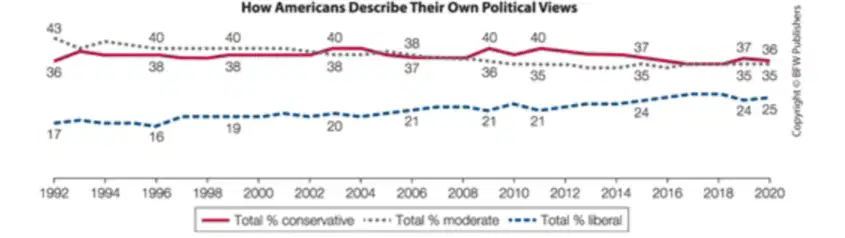
Which of the following is true of Americans according to the graph?
In 2020, 36 percent of Americans described themselves as moderate.
In 1992, 17 percent of Americans described themselves as liberal.
In 2002, 20 percent of Americans described themselves a conservative.
In 2010, a majority of Americans described themselves as moderate.
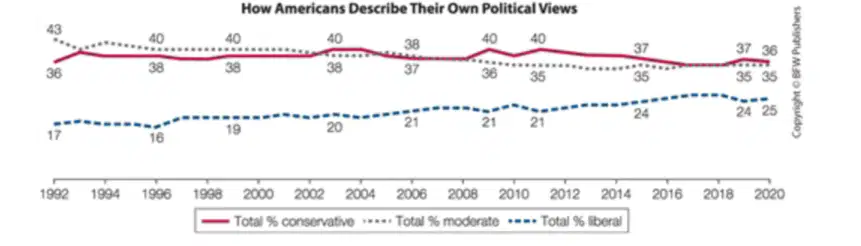
Use the graph to answer the following question. Which of the following describes a trend in the graph?
The percentage of moderates is consistently greater than the percentage of conservatives.
The percentage of conservatives decreased steadily from 1992 to 2002.
The percentage of liberals increased steadily from 1992 to 2020.
More Americans described themselves as conservatives in 2020 than in 1992.
Which of the following is an example of a collective good (common good)?
Free flight benefits for those who work for an airline
Discounts at local restaurants for members of the military
A city’s construction of flood barriers near a river
Preferential home loan terms for those who have joined a union
Users that create news content and post it to internet-based content sharing apps such as X (Twitter), Snapchat and TikTok are utilizing
traditional news sources.
investigative journalism.
microtargeting.
social media.
Investigative journalism seeks to
expose wrongdoing to hold public officials accountable.
influence the outcome of elections to benefit one political party over another.
help public officials keep unsavory details about their background hidden from the people.
extort money from public figures in exchange for not reporting on information.
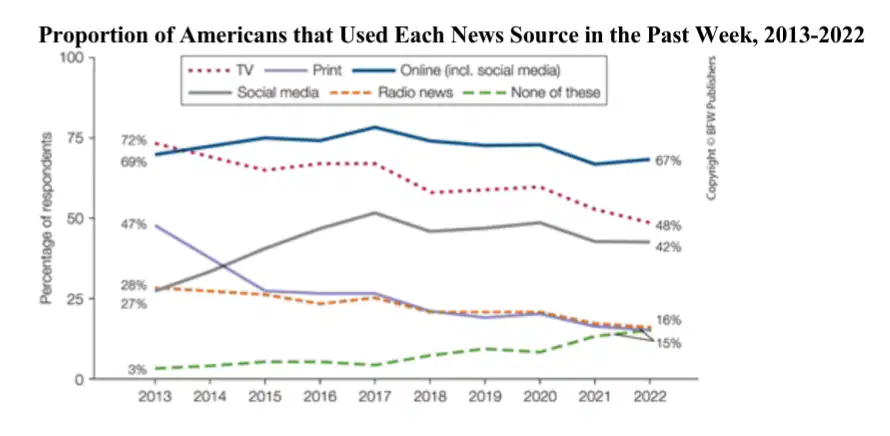
According to the graph, which of the following is true?
Radio news has seen the sharpest decline over the time shown in the graph.
Newspapers have more information than does television.
Most Americans currently get their news from online sources.
In 2013, radio was more popular than the online sources as a source of news.
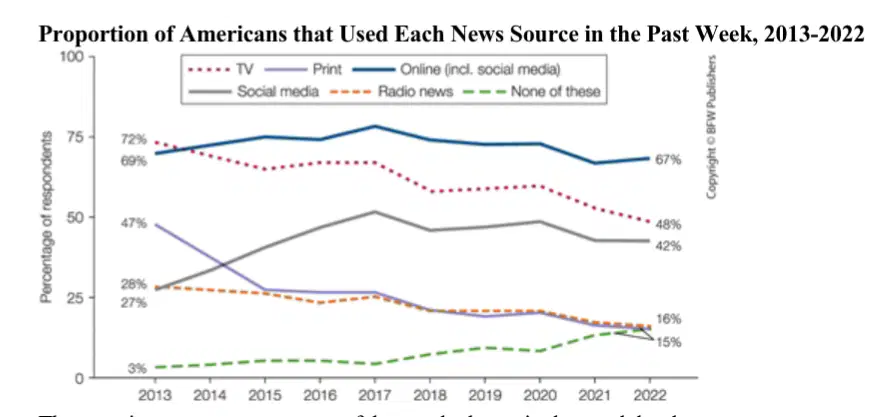
The most important consequence of the trends shown in the graph has been
an increase in the amount of partisan news.
traditional television sources gained in influence over public opinion.
voters having fewer sources of political news.
television advertising costs declining.
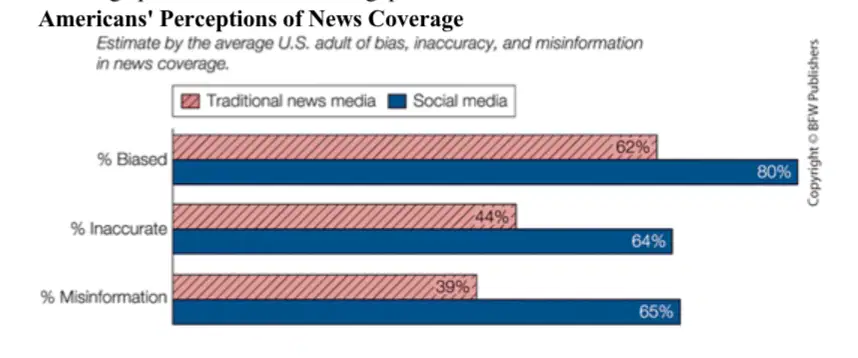
According to the line graph, which of the following statements is true?
The amount of bias in the news media has increased over time
The majority of Americans believe there is bias in the media
Most Americans believe that traditional news media is more inaccurate than social media.
The majority of Americans believe that misinformation on social media is the biggest issue facing the news media.
Which of the following describes a negative effect on news coverage because of the increased consolidation of media organizations?
Decisions about news coverage are based on financial outcomes for the corporation rather than for journalistic reasons.
Journalists have more of a say than ever, which can cause biases in the news.
The government plays a larger role in regulating these news companies.
Corporations favor television and radio news over new media sources, such as social media.
Which of the following is a potential consequence of the perception of bias in the news?
Improved knowledge about political issues
Decreasing voter turnout
Declining rates of news consumption
Increased political polarization
Which of the following statements explains why the news media often focuses on dramatic stories rather than stories covering important public policies?
Reporting on dramatic news stories generally attracts a larger audience.
News on important public policies is kept largely confidential by Congress.
Many journalists do not have the intelligence to decipher policy initiatives.
Stories covering public policy are more likely to be censored by the FCC.
Which of the following describes partisan bias in the media?
Investigating all politicians for their questionable actions
Slanting news coverage in support of a particular political party or ideology
Preferring to receive news from exclusively online sources rather than print
Covering one political candidate's campaign more than others
Which of the following best describes the media's role as a gatekeeper?
Monitoring AI-generated ads as mandated by federal law.
Highlighting key issues that are important enough to be covered and are worthy of the public’s attention.
Reporting on material in a highly biased manner to cater to the preferences of a specific audience.
Reporting on how candidates are performing in elections through polling data alone.
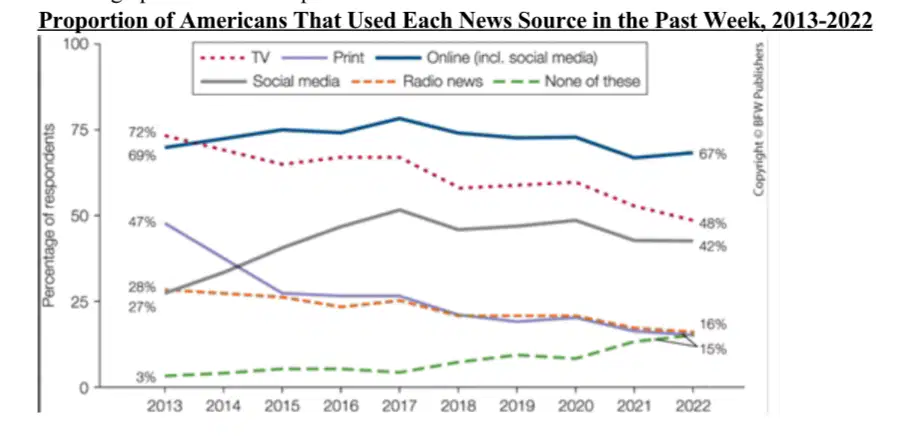
Which of the following is true based on the data?
Those aged 65 years and over used print media more than online media from 2013-2022.
67% of Americans used online news sources in 2022.
Social media was the most popular form of obtaining news from 2013-2022.
The proportion of Americans that used radio news as a source increased from 2013-2022.
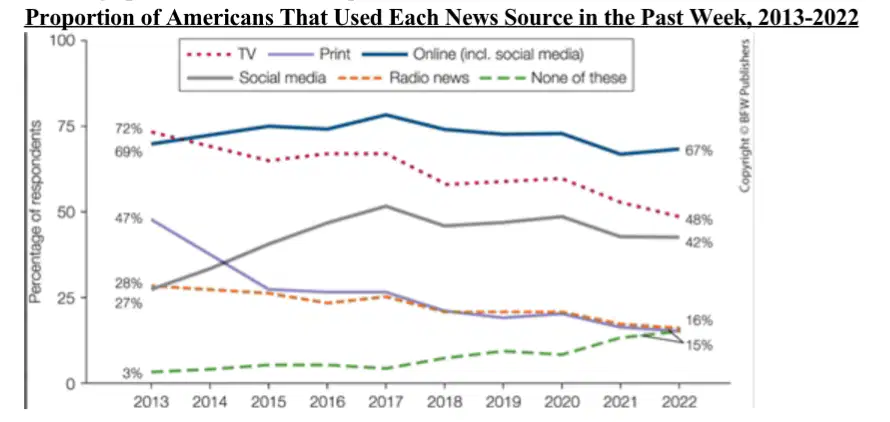
Which of the following is supported by the data presented?
New media is surpassing traditional forms over media as the main source of news for Americans from 2013-2022.
The speed at which Americans are receiving news is steadily declining from 2013-2022.
News reporting focuses less on capturing audiences and more on reporting significant statistics from 2013-2022.
Federal laws have been passed to increase regulation of new media from 2013-2022.
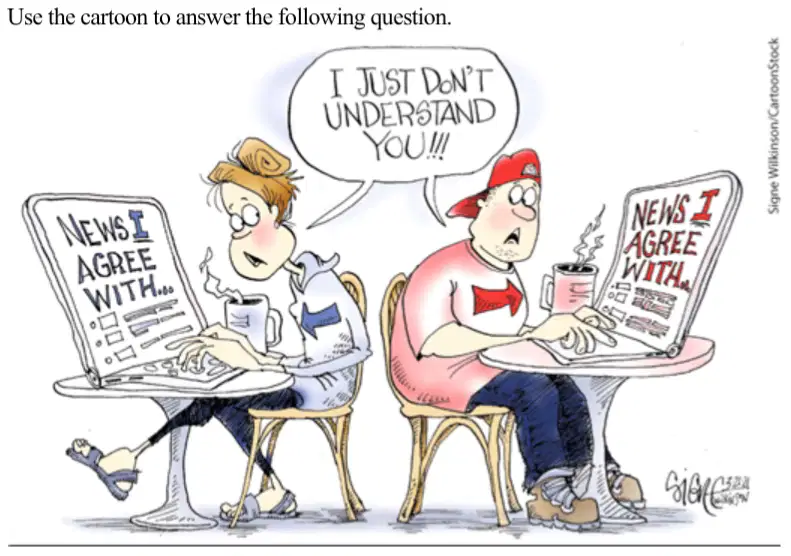
Which of the following best accounts for the situation depicted in this cartoon?
An increase in reliance on traditional print media
A decrease in knowledge in relation to current events by the public
A rise in partisan news as a major source of information for the public
A drop in regulation of the internet by the federal government
Which of the following best explains an effect of the increase in citizen journalism and entertainment news (infotainment) as main sources of news for Americans?
Americans have more concrete and factual knowledge about current events.
Americans are paying closer attention to local happenings within their community.
Americans have a harder time distinguishing factual information from opinion.
Americans are coming closer together political and culturally.
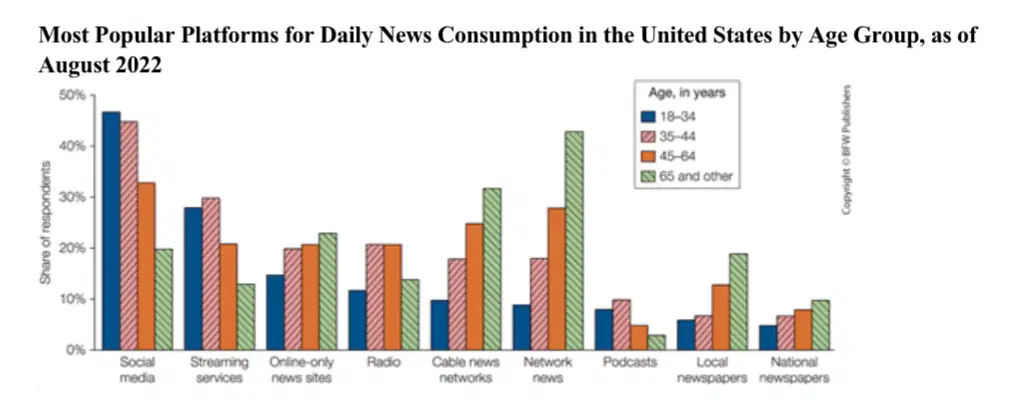
Which of the following is true based on the data presented?
The most common platform to obtain news in August 2022 was network news.
People aged 45-64 years utilized social media more than other news sources in August 2022.
Participation by citizens in posts on social media rose for every age group in August 2022.
Those aged 65 years and older largely relied on local newspapers as the main source of news in August 2022.
Scholars have noted that a possible impact of viewers relying on media programming that serves to entertain while providing news, or soft news, is
a. a reduction in confidence and support for the government and politicians.
b. increased trust in local institutions but not national ones.
c. a greater span of knowledge of international relations for viewers.
d. the desire on the part of citizens to report on the news themselves by starting podcasts.
Partisan bias in news delivery has led Americans to believe that
the federal government should do more to regulate the airwaves.
media companies should continue to buy shares in local markets.
news is not credible and should not be trusted.
only print news is trustworthy to get information.
What is a key characteristic of democracy?
Power is concentrated in one person
The people choose who will govern them
It has no elections
Citizens have no say in government
In which type of democracy do people vote for members of Parliament who then choose a Prime Minister?
Presidential democracy
Direct democracy
Parliamentary democracy
Mixed democracy
What is often a feature of healthy democracies?
Limited press freedom
An independent court system
Concentrated power
No elections
Authoritarian governments are characterized by:
Free and fair elections
Popular support for leaders
A single leader or small group in charge
Limitations on government power
What is 'democratic backsliding'?
The growth of authoritarianism
The strengthening of democracy
An increase in public participation
A type of election
What does federalism entail in a democratic government?
Centralized power
Local governments managing certain powers
No separate government levels
A single party controlling everything
In an authoritarian government, power is typically:
Determined by free and fair elections.
Concentrated in the hands of a few.
Distributed among multiple branches.
Shared equally among all citizens.
What is a defining feature of the ideal communism?
A free market economy.
Equal public control of the means of production and end of private property.
Private ownership of all businesses.
Minimal government intervention in the economy.
What is the primary goal of an authoritarian government?
To ensure political equality.
To guarantee free and fair elections.
To preserve its power.
To promote universal suffrage.
Which of the following is true about socialist systems?
They have no government welfare programs.
They exist only in theory and not in practice.
They blend public control with elements of a free market.
They promote all forms of private property.
What is a common feature of democracies?
The press is controlled by the government.
Power is concentrated in a single leader.
There are no checks and balances.
Free and fair elections are guaranteed.
Which of the following is a characteristic of a communist economy?
There is minimal government involvement in economic decisions.
Private citizens own businesses and factories.
The proletariat exerts maximum control over the economy.
Market forces set prices without government intervention.
What is a key difference between capitalism and communism?
Capitalism eliminates private property.
Communism allows for a free market economy.
Communism supports minimal government intervention.
Capitalism involves private control of production.
What is a common criticism of authoritarian governments?
They guarantee too many individual freedoms.
They are too slow to enact economic policies.
They lack political accountability.
They have too many checks and balances.
Which of the following is true about political ideologies?
They are institutions that seek to advance policy goals.
They are the same in every country.
They have remained unchanged since the French Revolution.
They describe how governments think about their role in society.
What is the main idea behind communism?
To promote individual ownership of production
To create a classless and stateless society
To enhance competition among businesses
To support capitalist economies
According to Karl Marx, who are the owners of the means of production?
Proletariat
Bourgeoisie
Socialists
Workers
What does socialism aim to eliminate?
Private property
Worker exploitation
Democratic governance
Economic classes
In socialism, who controls the means of production?
Private companies
The military
A democratic state or the proletariat directly.
Foreign investors
What is one example of a social service?
Private banking
Public healthcare
Luxury car manufacturing
High-end real estate
What is the relationship between socialism and communism?
Socialism is a later development of communism
Communism is a type of socialism
Socialism is a precursor (first requiered) for achieving communism
Socialism and communism are the same thing
Why do socialist countries struggle to reach communist ideals?
Lack of resources
Corruption among those in government positions of power
No interest in socialism
High levels of competition
Which country was referred to as the "Union of Soviet Socialist Republics"?
China
North Korea
Russia
Vietnam
Who is known as the "Father of Communism"?
Karl Marx
Joseph Stalin
Adolph Hitler
Fredrich Engels
Pierre-Joseph Proudhon argues that property owners extract value from workers through which means?
Taxation
Rent, interest, and profit
Inheritance
Charity
Henri de Saint-Simon believed that society should be organized around which principle?
Political institutions
Religious institutions
Industrial production
Military power
Engels observed that industrialization led to which of the following negative outcomes in society?
Increased agricultural production
Social instability and worker alienation
Greater religious unity
Expansion of traditional crafts
According to Karl Marx, what makes traditional patriotism obsolete in the context of capitalism?
The rise of religious authority
The creation of a global market that transcends national boundaries
The development of military power
The decline of industrial production
Pierre-Joseph Proudhon’s idea of a federation of free communes influenced which two political theories?
Anarchist and federalist
Capitalist and monarchist
Socialist and nationalist
Communist and imperialist
What does Engels argue is created when capitalism reduces workers to mere commodities?
Loss of all organizational capacity
Conditions for revolution
Complete worker satisfaction
Elimination of class society
Why did Marx believe international worker solidarity was essential?
To support religious authority
For a successful revolution against the international capitalist class
To maintain traditional patriotism
To promote military power
Engels’ analysis shows that the proletarian revolution differs from previous political changes in what way?
It aims to eliminate class society
It supports monarchy
It increases religious authority
It reduces industrial production
Strategically, how did Marx’s analysis in The Communist Manifesto challenge the concept of national identity?
By promoting military power over economic interests
By arguing that national identities serve bourgeois interests and dividing workers
By supporting traditional patriotism
By encouraging religious unity
What is the primary goal of capitalism?
Profit
Compassion
Equality
Sharing
What TWO examples of a social services that stem from the concept of the common good?
Private banking
Public healthcare
Public education
High-end real estate
What are the differences between direct democracy and a democratic republic?
Direct democracy is only used in small communities.
A democratic republic allows for no citizen input.
Direct democracy requires a monarchy to function.
Direct democracy involves direct citizen participation in decision-making, while a democratic republic relies on elected representatives to govern.
What is sortition?
A method of electing officials through public voting.
Sortition is the practice of selecting officials or representatives by random drawing.
A system where officials are appointed based on their qualifications.
A process of selecting representatives through a majority vote.
Why do socialist countries struggle to reach communist ideals?
Lack of resources
Corruption among those in government positions of power
No interest in socialism
High levels of competition
What would be evidence that the American Democratic Republic was a functioning oligarchy?
Widespread participation of all citizens in government decisions.
Equal distribution of wealth among all social classes.
Concentration of power among wealthy elites and corporations.
Frequent changes in leadership and policies by the electorate.
What is a line of rulers from the same family called?
empire
divine right
dynasty
dicatatorship
What is a common criticism of authoritarian governments?
They guarantee too many individual freedoms.
They are too slow to enact economic policies.
They lack political accountability.
They have too many checks and balances.
Which function of government is primarily responsible for creating rules of conduct to maintain order and prevent conflicts?
Enforcing Laws
Establishing Laws
Managing Resources
Building Relations
A government funds road construction, supports public schools, and operates emergency services. Which function is being demonstrated?
Providing Services
Formulating Public Policy
Providing Security
Building Relations
Which example best illustrates the function of Providing Security?
Passing new traffic regulations
Maintaining armed forces to protect the territory
Negotiating a trade agreement
Allocating budgets to various ministries
Formulating Public Policy most directly involves which of the following?
Punishing those who break regulations
Developing policies to guide actions toward goals like public health and environmental protection
Guarding borders from external threats
Constructing bridges and roads
Managing Resources refers to a government’s responsibility to:
Create new laws to resolve disputes
Allocate and budget public resources for services and initiatives
Negotiate with other governments to ease travel
Deploy police to ensure compliance with regulations
Which scenario best fits Enforcing Laws rather than Establishing Laws?
Legislators vote to introduce a new safety code for factories.
A court fines a company for violating existing pollution standards.
A ministry drafts a plan to increase economic stability.
Diplomats arrange a cultural exchange with another country.
Building Relations as a government function primarily aims to:
Protect citizens from external threats using armed forces
Deliver healthcare and emergency services domestically
Establish and maintain relationships with other governments to facilitate trade, travel, and agreements
Set criminal penalties through the judicial system
According to the section on Pillars of Society (Common Good), which term best describes the condition of being protected against potential harm and fear?
Freedom
Security
Prosperity
Common good
Which statement best aligns with the pillar of prosperity as defined in the material?
Prosperity is primarily about accumulating wealth for a few.
Prosperity is when people and society are flourishing beyond material wealth.
Prosperity is the right to act, speak, and think without restriction.
Prosperity is the government’s responsibility to enforce laws.
A city council wants to strengthen the common good by expanding after-school programs, job training, and public health clinics to ensure opportunities for all residents to thrive. Which pillar is the council most directly advancing?
Security, because it protects against external threats
Freedom, because it removes all regulations
Prosperity, because it creates conditions where people and society can flourish
Building relations, because it maintains ties with other governments
Federal Government
Government in charge of the entire United States
State Government
Government in charge of each state
Local Government
Government in charge of cities and towns
Which concept describes fascists promoting a glorified past to make people dissatisfied with the present?
Propaganda
The mythic past
Hierarchy
Law & Order
According to the material, what is a central tactic of fascist propaganda?
Providing balanced news coverage
Naming “friends” and “enemies” and spreading disinformation
Ignoring political opponents
Encouraging open debate among all groups
What do fascists attack in order to control what is considered true or false?
Religious institutions
Universities and educational systems
Small businesses
Local governments
Which term refers to deliberately creating a state where people cannot recognize truth, blurring the line between fact and fiction?
Hierarchy
Unreality
Victimhood
Sexual Anxiety
What is the primary purpose of establishing a hierarchy in fascist movements?
To encourage equality among all citizens
To promote social divisions and rank human worth by race, religion, and gender
To reduce government power
To strengthen labor unions
In the fascist framework, how is “Law & Order” primarily used?
To protect civil rights of minorities
To cast “them” as dangerous criminals and justify crackdowns on dissenting groups
To ensure the leader follows the law
To promote judicial independence
Which statement best explains fascist use of victimhood within a hierarchy?
Dominant groups accept equality as a goal
Lower groups are praised for their achievements
Moves toward equality are portrayed as attacks, fueling resentment
Victimhood is discouraged to maintain unity
What does the slogan "Arbeit macht frei" signify within fascist ideology, according to the text?
Democratic freedom through voting
Work as a path to equality for all citizens
A justification for forced labor and the devaluation of the disabled
Support for labor unions and fair wages
Which tactic exploits fears of moral decay by emphasizing an urban/rural divide, portraying cities as decadent and full of enemy “elites”?
Propaganda
Sodom and Gomorrah (Urban/Rural Divide)
Sexual Anxiety
Unreality
How do fascists typically respond to gender equity and LGBTQ+ rights, according to the material?
They promote inclusive policies
They manipulate sexual anxieties, enforce traditional norms, and demonize LGBTQ+ movements
They ignore gender issues entirely
They support progressive gender reforms

Rule by one
Dictatorship and Constitutional Monarchy
Dictatorship & Communism
Dictatorship & Absolute Monarchy
Absolute Monarchy & Republic


Example: Ancient Greece; citizens gathered to make decisions for their city-states and voted directly on issues.
Monarchy
Republic
Totalitarian
Direct Democracy

Match the following definitions & vocab. words
1 ruler who has absolute control
dictatorship
ruled by a king or queen
monarchy
religious rule; government laws are based on religious beliefs
theocracy
absence of government authority
anarchy
ruled by a small, elite group of people
oligarchy
The highest form of Socialism, where the need for government is dissolved, all resources are held in common by all people, and distribution of goods is done by common assent based on need and ability.
Socialism
Democracy
Communism
Monarchy
Form of government where the public owns all property, natural resources, major businesses, the means of production, rather than private ownership.
Monarchy
Totalitarianism
Socialism
Democracy

Ruler is a symbolic head of state with elected members of Parliament who actually govern.
An autocracy is a government with
a small group who rules
no ruler
all who rule
one ruler

